
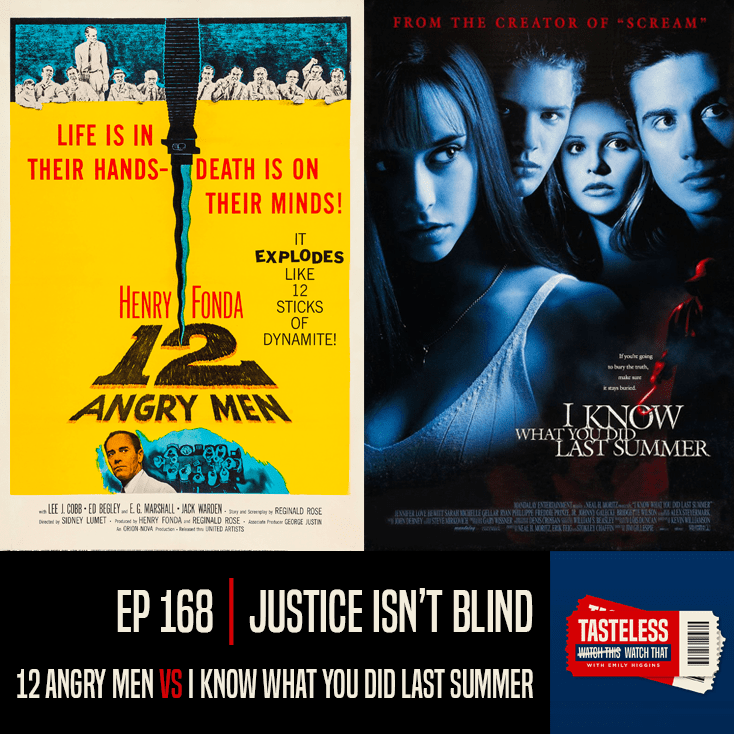
Two movies that explore the meaning of justice and how our preconceived notions affect that justice being served — it's 12 Angry Men vs I Know What You Did Last Summer.
Read The Episode
Every episode of Tasteless, I take a critically acclaimed film and compare it to one that shares the same themes but didn't get the attention it deserves — and explain why that second movie is my pick. This week: two movies that explore the meaning of justice and how our preconceived notions affect that justice being served. It's 12 Angry Men versus I Know What You Did Last Summer.
12 Angry Men
The jury in a New York City murder trial is frustrated by a single member whose skeptical caution forces them to more carefully consider the evidence before jumping to a hasty verdict.
This movie came out in 1957. It has a 100% on Rotten Tomatoes. On IMDB it is number five of the top-rated 250 movies — basically of all the movies on IMDB, this movie is number five. It was nominated for three Oscars — Best Picture, Best Director, and Best Adapted Screenplay. It lost all those nominations to The Bridge on the River Kwai.
As of 2020, this is the shortest movie in the IMDB Top 10, as well as the only one in the Top 10 to be under two hours. I love that this movie is 96 minutes. That's what I want. We need more movies that are 96 minutes. This movie is an affecting movie that has stuck with us and it doesn't need to be 30 hours long.
It feels like a play, which I enjoy. It's adapted from a teleplay, so it has that vibe of being on a stage. It's mostly taking place in one single room, and the filming was incredibly deliberate. At the beginning, the cameras are all positioned above eye level and mounted with wide-angle lenses to give the appearance of greater distance between the subjects. As the film progresses, the cameras slip down to eye level. And by the end, nearly all of it is shot below eye level, in close-up, and with telephoto lenses to increase the encroaching sense of claustrophobia. When the jurors leave the courthouse, they're filmed from a wide overhead angle, and director Sidney Lumet claimed that the final shot was filmed through the widest lens used in the movie to emphasize the sense of release.
I feel like the Rural Juror in 30 Rock having to say the word "juror" more than once.
Watching this movie — I had seen it ages ago in class and really didn't remember much. Upon a rewatch, I cannot tell these men apart. I had to take so many notes on where people were seated and what they said, cross-checking with IMDB and Googling pictures. This room is just 12 basically white guys in black and white, just sweating, wiping their brows. One guy has a cold and is blowing snot. I was like, no, this is going to be a nightmare. I was pleasantly surprised. It is a good film.
Let's go around the table clockwise. Juror #1 is the foreman — the man who gets to be like, here's the rules, we're deciding innocence or guilt. I wrote down "has a tie." Also, you can see his nipples more than you see in an episode of Friends. His shirt is so tight. No one respects him and he's mad about it. He's kind of hot in a Twilight Zone main character way.
Juror #2 looks like Bob Balaban but nerdier. Has a whiny voice. Juror #3, played by Lee J. Cobb — I say that because he looks familiar and I couldn't tell if it was because I just watched The Exorcist, which he was in, or because he looks like what I think Marlon Brando looks like if I had to draw a police sketch of Marlon Brando. So I call him Thick-Voiced Marlon Brando Guy.
This guy is our main antagonist. He's like, I used to call my father sir. Okay, cool brag. He's basically like, yeah, you should beat your kids, like I do. And I beat my kid so much and then my kid punched me and I haven't seen him in years. This guy sucks. He's really awful. But he gets his little cathartic moment at the end. He's the one who's like, let's send this kid to the electric chair because sons don't respect their fathers enough.
Juror #4 — paper reader stock guy. Has an attitude. Has glasses. He's like, I do stocks. I'm reading the paper. Juror #5 — this guy's like, I want to pass. He doesn't even want to vote. He's got a gray suit and looks really sad. Eventually when everyone's like, this kid from the slum is guilty because people from the slum suck, this guy's finally like, I'm from the slum. And later: has anyone seen a knife fight? I have.
He has the most upsetting piece of trivia. IMDB says: The death of Jack Klugman, Juror #5, on 12-24-2012 means none of the 12 jurors from the film are alive. So everyone in this movie has been dead for over a decade. Almost.
Juror #6 — I just called Squarehead Guy. He's fine. He's there. Juror #7 is Foom Baseball Tickets Hat Guy. He's like, Foom! Baseball! In the bathroom he says, I made 27 grand selling marmalade. That's not bad. IMDB trivia tells us that would be over $235,000 in 2015. So that's not bad. I don't know if this guy only sold marmalade or if he sold a bunch of different things and marmalade was especially lucrative. Wonder how this guy feels about Paddington.
I was very obsessed with the fact that Tony Danza played this role in the 1997 remake wearing a deep V. Baseball Tickets Guy is just like, I have tickets to a baseball game tonight, I don't want to be here. Let's go, I'll vote whatever. But then it starts raining and he's like, all right, I guess I'll focus on whether or not we send this kid to the electric chair since I can't go to my baseball game.
Juror #8 is our main protagonist. I said he's Window Looking Hot Guy. He's standing looking out the window at the beginning for a long time. Has a little widow's peak. This is Henry Fonda. He produced this movie. He's like, no, this kid is not guilty — slash, the prosecutor didn't meet their burden of proof. And everyone's like, ugh, now we have to stay here and talk about this.
Juror #9 is an old man who is in the bathroom at the beginning for a really long time. The secret ballot — everybody votes guilty except Henry Fonda, then later he's like, let's take a secret vote, I won't vote, and if anyone else votes not guilty we'll keep talking. They get one not-guilty vote in the most old man cursive handwriting ever. Like it is the oldest man handwriting and I immediately think, it's that old man. Later, this old man is bragging about having 20/20 vision. He's calling out the glasses stock reader guy — I have 20/20 vision myself, always have. Okay, cool.
Juror #10 is our other antagonist, a real turd played by Ed Begley. It shocked me to realize Ed Begley Jr. is Jr. for a reason. This old man is racist. He's like, anybody from the slums that's that color is definitely a criminal. And everyone's like, yeah, probably. But then as he gets more and more racist, there's this scene where he's going on this rant about we know how those people are, and one by one everyone gets up and turns around from him, stands to look out the window.
Juror #11 — I call Mustache Suspenders. Juror #12 — Rod Serling Guy. He will not stop talking about his job. He's like, I doodle. This is a doodle of Rice Pops. I sell Rice Pops. I do advertising. This guy is a wannabe standup comedian, so I hate his guts. At one point he's smoking in the background and blows little smoke rings. How? How do people do that? How are you controlling the elements?
I love when Henry Fonda pulls his own knife out in this jury room and compares it to the evidence knife. And then the other guy takes Henry Fonda's knife and stabs it into the table and I was like, that's city property, I don't think you can do that.
A really insane trivia piece: this film is commonly used in business schools and workshops to illustrate team dynamics and conflict resolution techniques. That's psychotic. Everyone in this movie is a maniac!
At the end, Henry Fonda and Marlon Brando Guy have this moment because Marlon Brando Guy is the lone holdout guilty by the end. He tears up this photo of his kid and is crying on the table. They vote and everybody walks out and our hero guy gives him his jacket in this very nice, touching gesture — helps him put his jacket on. And I was thinking how if this movie came out today there would be so many Twitter and Tumblr accounts that are like, Henry Fonda and Marlon Brando Guy should bone! Why aren't they making out? Look, I drew a picture of them making out.
Final trivia piece: there are no female characters in the film aside from extras in the courtroom prologue, although a woman's bathroom can be seen in the jury room. Cool. That's the same thing. There are no female characters, but there is a female bathroom. Great. Really great.
I Know What You Did Last Summer
Four young friends bound by a tragic accident are reunited when they find themselves being stalked by a hook-wielding maniac in their small seaside town.
Came out in 1997, has a 43% on Rotten Tomatoes. Kevin Williamson adapted the screenplay from a Lois Duncan novel and made it more deadly. He changed quite a bit from the book. I really love Lois Duncan — I loved her books growing up. I understand why she wasn't pleased with the violence added to the film. Her daughter was murdered in real life and she wrote a book about the experience. So I can see why she'd be sensitive to that. Kevin Williamson had just hit big with Scream, and I feel like this film tonally is a really perfect follow-up.
The cast of this movie is unbeatable, and probably the movie's greatest strength — the powerful 90s energy of everyone in this film.
Jennifer Love Hewitt is our hero, Julie James. I adore Jennifer Love Hewitt. She recently did an interview with Ilana Kaplan for Vulture about Heartbreakers and her career as a whole. She talks specifically about the treatment she got surrounding her body, the creepy comments made by the media. She said she wished she had known how inappropriate that was so she could have defended herself or just not answered those questions. She laughed it off a lot of the time and wishes maybe she hadn't.
Jennifer is someone who has been in the industry for ages and doesn't get the respect she deserves. She's had several successful shows — Party of Five, Ghost Whisperer, 9-1-1. She's a talented singer. She's very funny and dramatic. She was fantastic in one of the all-time best SVU episodes. She can truly do it all and her legacy should not be discounted.
In this movie she is the conscience of the group, the one we follow. Another set of iconic bangs in this film. Jennifer's in the car with three friends when they hit someone in the road. Instead of reporting it, they agree to dump the body and never speak of it again. This secret really weighs on her. When she comes back to town a year later, she receives the "I know what you did last summer" note.
There is a classic scene in this movie. She walks out in the middle of the street and spins around: what are you waiting for, huh? What are you waiting for? Great slasher moment. And the story behind it is insane — Jennifer Love Hewitt explains that this scene was directed by a kid who won a contest. That's already bananas. In the video, Jennifer's like, I don't know where that kid is now. Kid, show yourself. Message me, where are you, kid that directed this iconic scene?
Don't let kids direct your movies or win contests unless it's this kid. This is the only good contest outcome that has ever happened.
Jennifer's best friend is Helen Shivers, played by Sarah Michelle Gellar. I adore Sarah — Buffy, Cruel Intentions, Scooby-Doo, I loved Ringer. This movie has a special place in my heart because a specific question about her in one edition of the game Scene It! was my life's greatest triumph. The question was one of those scrambled pictures that slowly unscramble, and I immediately knew it was a photo of Sarah Michelle Gellar on stage at the beauty pageant in I Know What You Did Last Summer. Maybe none of it had been unscrambled. Maybe a very small portion. It was just a blob and I was like, yes, of course. I hold that victory very dear. Even though it was definitely over 15 years ago, I'm still very proud.
Sarah, like Jennifer, doesn't get credit for her range. When she's competing in the beauty pageant and answering a question: Well, Bob, at summer's end, I plan to move to New York City where I'll pursue a career as a serious actress. It's my goal to entertain the world through artistic expression. Through art, I shall serve my country. Very Denise Richards in Drop Dead Gorgeous — just dark and knowing and perfect. Then a year later, when she's the returning queen sitting on stage wearing the tiara while the new contestants share their skills and one woman is singing horribly, she just goes: Jesus. She's so good at dark comedy, at viciousness in this way that makes me laugh.
Sarah Michelle Gellar in this film in the Letterman jacket with her tiara still on after winning — before they hit someone with their car — is such a good look. I feel like I'm going to do it as my Halloween costume. Do you think someone is already selling Letterman jackets from I Know What You Did Last Summer or will I need to commission one?
Sarah's boyfriend is Barry Cox, played by Ryan Phillippe. Barry is not a Ryan Phillippe name. But okay. Ryan gets super drunk the night of the pageant. Then they all get in his car, but Freddie is driving because he's too drunk. Then they hit the guy. Ryan is the most insistent that they don't tell the police. He's the rich kid — ugh, consequences. Ryan is such a great awful guy that you're still attracted to — much like in Cruel Intentions. He's disgusting, but also he cries a little and I'm like, I could fix him.
I was really shocked every time he said the word "slicker" talking about a raincoat. He kept saying it — some guy in a slicker. Some guy in a slicker attacked me. Did you see the guy in the slicker? I don't like that. It must be a regional thing.
Also, this film has great examples of the female gaze — seeing Ryan Phillippe walk around in a towel and then also a tank top, and Freddie Prinze Jr. in a tank top. These great moments of these guys just looking so good.
Freddie Prinze Jr. is Jennifer Love Hewitt's boyfriend, Ray Bronson. In real life, Freddie and Sarah are a power couple married for ages. They met on the set of this film but didn't date until three years later. I love Freddie Prinze Jr. He has one of the most lovable faces. He's a bit of a red herring in this film — his actions are shrouded in mystery — but one thing that's clear is his love for Jennifer. She just can't look at him knowing what they did together, and that's heartbreaking. They had such love for each other, but she can't live with what they did and he's a constant reminder.
Freddie Prinze Jr. in this movie in his tank top on the docks, helping with fish, is my dream man.
Also in this film: Bridget Wilson-Sampras, who plays Sarah's older sister Elsa Shivers. Is this where they got the idea for Frozen? Elsa Shivers? We shiver in the cold? We need to find out. She calls Sarah Michelle Gellar Little Miss Kroger and that got me. While looking at her IMDB I learned there was a 2007 Mr. and Mrs. Smith TV show pilot with her and Jordana Brewster as Mrs. Smith. I am furious that show doesn't exist. I can't believe this. This is the worst thing Hollywood has ever done.
Anne Heche plays the sister of the man they believe they've killed. Johnny Galecki plays a guy in love with Jennifer Love Hewitt. This is another movie you should just watch. It's streaming on HBO Max.
Shared Themes
12 Angry Men and I Know What You Did Last Summer are about justice and how we perceive it. What equals justice to one person may not be seen as justice by another.
In 12 Angry Men, many of our prejudiced jurors think justice is the accused boy being put to death for killing his father. They're like, look, this kid did it, everyone thinks he did it, and someone needs to pay for this man's death. While our main dissenting juror, Henry Fonda, thinks justice is following the laws set out by the court — sending someone to their death only when there is no reasonable doubt.
For him, the boy actually killing his father is less important than the task before them. And it's not as important to the movie either. We never actually find out if the boy was guilty or not. But we do see that the court did not meet its burden of proof. There were too many circumstantial pieces of evidence, too many explanations for how the boy may not have done it. Some of our jurors have a really hard time with that — the idea that a man is dead and perhaps no one will pay for it. Someone being punished is more important to some of them than carrying out the instructions laid forth by the court.
It's interesting to see how seriously some jurors take their task versus others. Some just want to get this over with. But when they start to listen and realize things may not be as cut and dry — when it's pointed out that the woman who claims she saw the stabbing had little glasses marks on her nose and likely wasn't wearing her glasses when she saw whatever she thinks she saw — the juror arguing for that testimony is like, you're right, she did have little glasses marks, just like me. For some people, it needs to be relatable to them.
For Juror #3, Marlon Brando Guy — he's like, no, I don't care what evidence you have or don't have. Children are terrible, like mine who hates me, so definitely this kid should be punished. At one point he's arguing that the old man witness is infallible. Someone else is like, well, that old man also said such-and-such. And juror three goes, he's an old man. How could he be positive about anything? And you see on his face — he's saying very clearly that obviously this old man doesn't know what he's talking about, but he's also basing his belief of the crime on what the old man said. He brushes right past it. He wants his views to be correct.
In I Know What You Did Last Summer, the conceit is someone knowing the actions of our protagonists and wanting to make them pay — wanting to enact his own form of justice on these rowdy teens. The slasher of the film — spoilers — is Ben Willis, a man whose daughter Susie died in a car crash with her boyfriend David Egan. Ben Willis blames David for Susie's death and enacts his own justice by first killing David and making it look like a suicide. Then, as he's leaving that scene, that's when he's hit by our four teens on their joyride. They dump his body instead of calling for help, and when he comes to, he dedicates himself to going after them.
Our four teens hit this guy with their car and argue over what to do. Jennifer Love Hewitt wants to tell the police. Ryan Phillippe thinks the accident will get them in more trouble because he's super drunk — he spilled alcohol all over the car, it's his car, it'll look like he was driving. Freddie Prinze Jr. is a poor kid from the wrong side of the tracks — he worries about his future, thinks justice isn't served by having his life ruined when this guy ran out into the middle of the road. And to be honest, you're right — that doesn't feel like justice.
If I hit someone with my car, I would tell the police. I swear I would. But I see where these people are coming from — it looks worse than it is and all four could suffer massive consequences. They're about to head off to college. Their lives could be cut short. I get it. Of course, because of their guilt, their lives don't go the way they want anyway.
Jennifer keeps insisting it was an accident, police will understand. But you never really know how the police are going to respond to anything. A year later, when the four reunite, the argument over what is right, what is just — it continues. Jennifer considers what they did murder, because instead of getting the man help or telling anyone, they dumped the body. In her mind, that's when it went from accident to crime, to murder. So she broke up with her boyfriend and left.
When she's talking to Freddie about what they've experienced, he says he knows they couldn't stay together because she blames him for driving. She says the most heartbreaking line: I'm responsible for my own actions and I don't blame you, but I don't want to know you either.
Jennifer is disgusted by her own actions, has spent the last year sad and alone, cut off from these people who reminded her of what she did, as she punishes herself as some form of justice, thinking she doesn't deserve happiness after choosing to not tell anyone about what happened.
So much of our perception of justice comes from who we are and our own experiences. It's incredibly subjective. As much as we don't want it to be, as much as it shouldn't be, preconceived notions about the ways of the world are an important part of both of these stories, because they're something we can never really get rid of in our own lives.
Juror #3 hates the accused kid in 12 Angry Men because he has such conflicting feelings about his own kid. He hates his relationship with his son and recognizes in some way that they could have just as easily been on the stand for the same thing — that his son likely wanted to kill him at some point. The racist juror — his racism has him immediately pitted against the accused. His long rant about how people from slums act shows that he believes those different from him are guilty almost immediately. He doesn't need other evidence. And then the juror from the slums is like, whoa, I came from there and I'm not a criminal. Also, I know what a knife fight is and someone wouldn't stab from above. Let me show you how a stabbing would go. He has different information than the other guys — information that helps color his view of the case. He's coming from a different perspective.
In I Know What You Did Last Summer, Jennifer Love Hewitt has lived a relatively easy life. She has faith the police will do the right thing, clear them if they say there was an accident. Whereas Freddie, who has lived as a poor guy on the wrong side of the tracks, treated badly — he doesn't have faith that the system will work in his favor because it never has. He feels like he's on a set path for life, that he's not going to get a break. When he becomes a fisherman like his father, it's with a certain resignation.
Ryan has always gotten what he wanted, gotten away with everything because of his privilege. So he believes this instance should be no different. He doesn't need to take responsibility. He can simply sweep this under the rug and go back to his life without a care.
Sarah tells herself the guy was drunk or suicidal, that he wanted to die, that they didn't kill him. She says to Jennifer, it was an accident. Jennifer says, Helen, we killed a man and then ruined the lives of everyone he knew. Sarah says, I don't think we're that powerful, Julie. You're giving us way too much credit. She doesn't want to think about the ripple effect of their actions. She wants to contain it to that one night, that one man. Because she's also never had to face consequences — she wins the pageant, things go well for her, people like her, she's popular. She starts to not like herself. You see that in the way she gives up on her dream and moves back home.
What I Know What You Did Last Summer Did Better
12 Angry Men is the story of 12 angry men forced together to determine the fate of the accused. They had nothing to do with the crime and were brought in on random chance. In I Know What You Did Last Summer, our four characters are brought together by a pact they made, a choice to remain silent regarding the crime that took place.
In 12 Angry Men, by the end, the guys mostly understand their involvement in the justice system. They understand, at least in some small way, the weight in sending a man to die. The process of being on a jury is something any one of us could experience, but it's still theoretical — this threat of a wrongful death. There's an obligation to complete the task and move on. When they vote not guilty, they all leave the courthouse never to see one another again. The old man and the main dissenter exchange last names, but then they too go their separate ways.
Even if they had voted the man guilty, they were just fulfilling their end of the bargain of society. They were called in to serve via mail. They had no idea what sort of case they'd get. The stakes for these men aren't particularly high. They're in a room with people who don't know them. It's not like anyone will know, that guy voted guilty, that guy was a real jerk about it. They will never see these men again. It's a high-minded film of what's right and what's wrong. Like a logic problem, it's theoretical rather than real. It's the trolley problem with no actual trolley.
In I Know What You Did Last Summer, four people have their lives ripped from them because of the choices they made. We see how Jennifer Love Hewitt is affected — at college, she's dead-eyed and pallid, not enjoying life. She's cut off her old relationships, her love for Freddie not enough to overcome what they did. Her affection for Sarah also falling by the wayside in her guilt. She has no one anymore. She's not connected. She's untethered.
We see that Sarah's journey to New York didn't work out — she came back home to work in her father's store with her overbearing older sister. She's not an actress, but a shut-in, reflecting on her past glory, telling herself the man they killed wanted to die. Freddie is devastated to lose Jennifer — instead of heading off to college, he stays home and goes into the fishing life expected of him. Ryan is least affected as far as we can tell, but things aren't going great for him either.
When Jennifer comes back to town, she points out that their lives have been ruined and begs them to reconsider. She says, yeah, but this is insane now, Barry. Look at us. The secret's killing us. He says, I'm not going to the police and you're not either. She says, Barry, please, we could put an end to it and maybe salvage some small fraction of a life. He says, and how do we do that? Huh? There was no accident, Julie. It was murder. Your words, remember? Murder.
Ryan feels they're in too deep and wants to solve the problem of the person taunting them by himself. Jennifer is desperate to reclaim the life she lost. Freddie has continued thinking about what they did — we learn he visited Anne Heche in secret under an alias and had a brief relationship with her before the guilt became too much, because he believed he had killed this woman's brother. All our characters hang on to what happened in one way or another, unable to move past it, unable to live their lives, because they had a hand in it.
The brilliance of 12 Angry Men is that it exists in one space at one time. It's claustrophobic, intense, frenzied, a slice of humanity. But it's a slice that exists outside of a whole, separate from a whole. There's no before and no after. There's no telling how the hours spent in this courtroom will affect the jurors going forward.
Whether the kid committed the crime or not is left ambiguous because whether he did it doesn't affect these 12 men. There can't be consequences for jurors for what they do — otherwise no one would serve jury duty. It would take away the idea that people can weigh in honestly based on what's presented. These men debate about what's right, make their pick, go on their way. It doesn't affect them.
In I Know What You Did Last Summer, four people have to live with what they chose. They didn't report what happened. They didn't call the police with even an anonymous tip. They didn't drop the body outside a hospital. They chose to shove him into the water. They used their own hands to enact it.
Sarah tries to put that choice onto the man they hit, giving him agency to remove herself from the equation. She says, maybe he wanted to die. David Egan — his girlfriend was killed on that same road, July 4th, one year earlier. Maybe he blamed himself. Maybe he was sitting in the road waiting for us to hit him. Jennifer replies: yeah, if that'll help you sleep at night.
Jennifer knows it's a futile hope. Regardless of what anyone else chose to do, regardless of whether that man wanted to die, her choices are her own. And that is what weighs on all of them.
If you're thinking about watching something about justice — you need to show something to a class — maybe think about teaching I Know What You Did Last Summer. An equally thought-provoking film on the concepts of justice and preconceived notions. It's streaming on HBO Max.
Hit me up at @tastelesspod on social media and we can talk about how much I miss late ‘90s slashers, or how incredible it was to see these four people in one film. Perfection.