
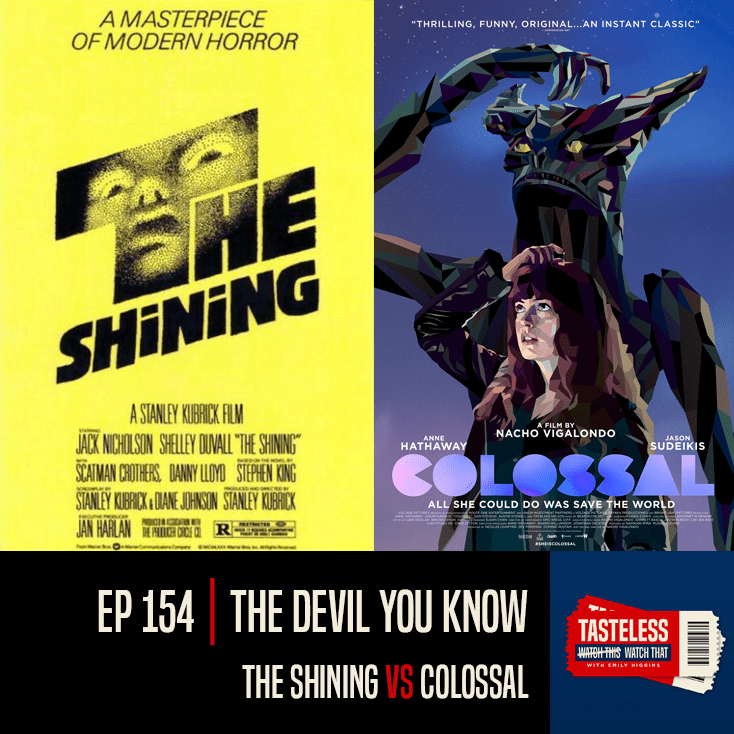
Two movies about the real dangers being closer than you might think — it's The Shining vs Colossal.
Episode Transcript & Analysis
Every episode of Tasteless, I take a critically acclaimed film and compare it to one that shares the same themes but didn't get the attention it deserves — and explain why that second movie is my pick. This week: two movies about the real danger being closer than you might think. It's The Shining versus Colossal.
The Shining
A family heads to an isolated hotel for the winter, where a sinister presence influences the father into violence. At the same time, his psychic son sees horrifying forebodings from both the past and the future.
This movie came out in 1980. It has an 84% on Rotten Tomatoes and is number 63 on the IMDB Top 250.
It is of course based on the Stephen King book. Stephen King does not like this movie. Even though it's widely regarded as the best adaptation of his work — up there with Misery — the novel itself was very personal for him, so I don't blame him for feeling negatively about changes made to the story. He said the visuals were stunning but that there was no substance. He is a writer who has battled alcoholism and substance abuse, and his book was about a writer who is battling alcoholism. He feels it's personal, and Stanley Kubrick did make some changes to his work.
Some of the most iconic moments in this movie were not in the book. The elevator full of blood, the creepy twins, the line that Jack Nicholson improvised — here's Johnny. I would be mad if I was Stephen King and the most iconic parts of the movie based on my book were not my things. I truly would. I totally get it.
Now, Stanley Kubrick is no saint. He's a sicko. He is well known for being awful to his actors, requiring way too many takes, just taking it all too seriously. The only person he was nice to was the kid, Danny Lloyd, who plays Danny — the kid who has a weird voice in his mouth, Tony, and moves his little finger and says red rum, red rum. Little creepazoid. Danny the actor was told it was a drama when they were making this movie. He didn't know it was a horror. He only saw a very cut-up version of it and didn't see the full thing for 11 years.
Jack Nicholson plays Danny's dad, Jack Torrance. Obviously Jack Nicholson has some iconic roles. He has won three Oscars and been nominated for another nine — the most nominated male actor in the Academy's history. The three he won were Best Actor in As Good As It Gets, Best Supporting Actor in Terms of Endearment, and Best Actor for One Flew Over the Cuckoo's Nest. I was shocked to realize he hasn't acted since 2010. Did we know that? I knew the moment that Cameron Diaz said she retired. I don't remember hearing that Jack Nicholson retired.
Jack Torrance is an alcoholic who claims to be five or so months sober at the time he takes the job at the Overlook Hotel, where he's going to be a caretaker over the winter. Basically, when the hotel isn't in service and there's no guests, he's there to make sure no pipes burst, to do little maintenance things so they don't come back to a totally destroyed hotel. He takes this job because he wants to be a writer. He wants to work on his writing. So you go, you stay at this isolated hotel, you check the pipes, you check the furnace, and then you get the rest of the time to yourself to write. He drags his kid and his wife Wendy to the Overlook Hotel in the middle of nowhere surrounded by snow and sets to work writing his novel, which is very frustrating to him. And the entities of the hotel begin encouraging him to do bad things.
His wife Wendy is played by Shelley Duvall. I have such an affinity for Shelley Duvall. I used to watch Shelley Duvall's Bedtime Stories, Faerie Tale Theatre. She was Olive Oyl in Popeye. She has such a soothing presence, and I think that's why her appearance in The Shining is especially striking.
Yes, she is frail in some ways. But I love that she's the one who starts fixing stuff around the hotel. She's puttering around, checking on stuff, getting involved. She's chatting on the CB radio with the police in the next town over. She keeps it together to protect her son despite the fear she feels when things start going south. Despite the fact that her husband is more physically powerful than her. Despite the fact that she has no one to turn to. She does everything she can for Danny, and there's a power to this woman who always thought she couldn't amount to much pulling it together for the person she loves most in the world.
Shelley Duvall's last acting job was in 2002, but in 2016 she had an upsetting and what many argue was exploitative appearance on Dr. Phil, where she talked about hallucinations that had plagued her. She believed Robin Williams was still alive as a shapeshifter, among other things. It was very sad, and I hope she's getting help. It was upsetting to see her be treated with such a lack of care, not allowed her dignity — to be put on TV and clearly be so unwell.
But this isn't the first time she's been mistreated. Stanley Kubrick's horrific treatment of her is well known. She suffered from nervous exhaustion throughout filming, including physical illness and hair loss. Despite Kubrick's fierce demands on everyone, Jack Nicholson admitted to having a good working relationship with him. Even Jack says he was a completely different director with Shelley Duvall. He allegedly picked on her more than anyone else, as seen in the documentaries Making The Shining and Stanley Kubrick: A Life in Pictures. He would say she was wasting the time of everyone on the set. She later reflected that he was probably pushing her to her limits to get the best out of her and that she wouldn't trade the experience for anything, but it was not something she ever wished to repeat.
I feel like you have to — I'm sure it was horrific and she has to say, well, I'm sure he just wanted the best. No. He was terrorizing her.
Jack Nicholson and Shelley Duvall have expressed open resentment against the reception of this film, feeling that critics and audiences credited Stanley Kubrick solely for the film's success without considering the efforts of the actors, crew, or the strength of Stephen King's underlying material. Nicholson and Duvall both said the film was one of the hardest of their careers, and Jack Nicholson says he considers Duvall's performance the most difficult role he's ever seen an actress take on.
Another person on set Kubrick treated horribly was Scatman Crothers, who plays Halloran, the chef at the hotel. He's the guy who gives the family a tour when they first go up there, and he has psychic abilities similar to Danny's, which he calls the Shining — that's what the ability is called, to sort of see inside people's minds, see things that haven't happened yet. You explore that more in Doctor Sleep, which is the sequel and Danny's story — it's an interesting movie, a little long.
Halloran's character is complicated because he definitely falls into the Magical Negro stereotype — he comes in with some wisdom to help the white people but is otherwise not really heard from. He's really only there to serve the story of the white characters. Watching the movie, I like his presence in the film. He cares about the family, he connects quickly with Danny, he wants to protect them. But he definitely isn't given his own story. And Stephen King is — I love some of his writing — he's also problematic in a lot of areas. In terms of race, in terms of gender. He was a man of his time and that doesn't excuse it.
Jack Nicholson is the one that suggested Scatman Crothers take on this role. Apparently Kubrick originally wanted 70 takes of the scene where Scatman gets killed by Jack Torrance. But Jack Nicholson talked Kubrick into going easy on the 69-year-old Crothers and stopping after 40 takes. At one point during the film, Crothers became so exasperated with Kubrick's notorious compulsive style of excessive retakes that he broke down and cried, asking, what do you want, Mr. Kubrick?
People are crying on the set. If someone is crying at your job — multiple people are crying at your job because of you — something is not right here.
I can't deny that this is a good movie. But is it worth what went into it? The psychological tearing down of human beings for a movie? I don't know that it is.
There are other elements of this film that contribute to its success, to the tension it builds. The sound design is not something I usually notice, but there's a scene where Danny's on his little trike, riding around the hotel, and he's going over hardwoods and then carpets and then hardwoods, and you hear it — it just really envelops you. I was surprised there weren't any Oscar nods for this movie, at least in the sound categories, the effects categories, and the music — very modernist music that Kubrick chose himself, but he left the process of matching passages to scenes to the music editor Gordon Stainforth, whose work on this film is known for the attention to fine details and remarkably precise synchronization. Every piece of this movie was chosen so carefully, like wringing blood from a stone, and it did come together.
Colossal
Gloria is an out-of-work party girl forced to leave her life in New York City and move back home. When reports surface that a giant creature is destroying Seoul, she gradually comes to the realization that she is somehow connected to this phenomenon.
This movie came out in 2016. It has an 81% on Rotten Tomatoes.
The Rotten Tomatoes review was interesting. It says Colossal's singular strangeness can be disorienting, but viewers who hang on may find the genre-defying execution and Anne Hathaway's performance well worth the ride. I would strongly agree. I think this is such a hard movie to market, such a hard movie to explain, and then you watch it and it's nothing that you thought it would be, but also perfect.
Nacho Vigalondo directed and wrote this movie, and he previously wrote and directed Timecrimes (aka Los Cronocrímenes), which is a highly thought-of film that I need to watch. He also co-wrote Paradise Hills, which came out in 2019 — an interesting story where Milla Jovovich is running a strange reform school, and it's also very female-focused and -driven. I appreciate what he's putting out. His body of work is really interesting.
Now, let me be the first to embrace Anne Hathaway's name change to Annie. She said on The Tonight Show that she goes by Annie with all her friends and just in life, and that she put Anne on her SAG card when she was 14 years old but she wants to be known as Annie now, and I'm here for it. I will always respect Annie Hathaway. She's still not getting the respect or the credit that she deserves. She was a comedic genius in Ocean's 8. The Princess Diaries is one of the best movies of all time. She can sing, she can make fun of herself. What more do you want? I will see anything she's in. She's one of those actresses where if a movie of hers is coming out, I will go see it.
Colossal is such an interesting, unexpected story, but I expected nothing less of her. I went to see it because Annie was in it as Gloria, and sometimes that's all I need to get me into a theater. By the way, I miss movie theaters so much. I went to see this movie thinking it was a quirky dramedy about a woman struggling and it turned into something much deeper and darker and something that I've been thinking of ever since I saw it.
Now, this is a movie I would love for you to watch before listening to me talk about it, because watching it unravel was just a really great movie-viewing experience for me. I went in pretty blind and was really excited about what happened and the story that was told.
Jason Sudeikis is a large part of why this movie becomes haunting. He plays Oscar, someone who still lives in Annie's old hometown. When she is forced to move back home — because she's been kicked out of her boyfriend's place for being out all night partying — she runs into Jason and he offers her his friendship and a job at the bar he inherited from his father.
You see small glimpses of his bitterness. As kids, Annie was praised for her writing and then went on to write as a career, whereas Jason, who wanted to write, didn't win any awards and feels stuck carrying on his father's dream instead of his own. We see Jason's anger when Annie grows close to a different man in the town, a friend of Jason's. Jason brings her gifts, things she talks about wanting while drunk and has no memory of in the morning. He seems helpful, solicitous, thoughtful. But there is a dark undercurrent. There are strings attached to everything that he does.
So the big thing of this movie, the piece that is woven in so interestingly, is the monster element. A monster — a big monster — destroys Seoul, South Korea. Annie feels weird about it. She hears about it and she's like, beyond the fact of, oh my God, monsters are real and it's destroying things — this monster in the news, it appears, it destroys things, it disappears. No one can tell where it goes. And she is disturbed by it.
She slowly realizes that at a certain time every morning when she is blackout drunk, she is going to a local playground, and any actions she takes in that playground reverberate through Seoul as the motions of a giant monster. Annie tells Jason and her other new friends about the strange phenomenon, showing them how it works, showing them that when she scratches her head, the monster scratches its head.
And in that moment, Jason realizes a way he can feel powerful. He's so powerless in his life, so out of control. But when he steps into that same playground at the same time, he becomes a giant robot in Seoul alongside Annie's monster. Capable of crushing buildings — and more importantly, capable of getting Annie's attention.
Their actions reverberate through Seoul. If they accidentally step on a car with people inside, those people are really dead. If they run into a building and it crumbles, those people are dead. Annie is aghast, distraught at the thought that he will hurt people, and she tells him to stop. He refuses. She falls to the ground in the park — they're fighting — and she falls and lands on people, on homes, on cars.
There is a moment where she slaps him and you can feel the darkness. You're ready for him to punch her, but he doesn't — not that time. He laughs about it. He laughs about it in a way where you can tell there is more underneath the surface.
This movie is all about what lies beneath — the elements of people that are unseen, that they try to hide.
Even Dan Stevens, the guy she was dating at the beginning of the film who comes to rescue her, to check on her, who seems like a good fit for her, who wants her to overcome her dependency on alcohol — he says to her later in the film, you owe me an explanation. She says, no, I don't. Because guess what? She doesn't. We see these men in her life trying to exert control over her.
The movie takes these massive elements — these big swings, these monsters, a robot and a monster fighting — and somehow distills them into these very small truths, truths that I rarely see on film.
It is crazy to me that this movie was hit with a lawsuit in May of 2015 claiming it had too many similarities to Godzilla. Number one, you don't own giant monsters. This monster looks nothing like Godzilla, and the monster part of it is not the important part. The monster part is a piece of something bigger. This is nothing like Godzilla. If you go into this wanting a monster movie, that is not what you're going to get. So Godzilla can suck it.
Shared Themes
The Shining and Colossal explore worlds with unbelievable horrors — elevators full of blood, gigantic monsters appearing out of thin air. But the real villains in each film are much closer to home. People who are already in our lives. The real horrors of these movies are the dangers that can be found in the everyday, from those you are close to and from yourself.
In The Shining, Jack Torrance is possessed by entities of the hotel, sure. But it is Jack who turns on his family. It is Jack's face they see, here's-Johnny-ing his way into the bathroom. It is Jack who screams at his wife to leave him alone when he's writing. Jack who drags them out to the isolated hotel in the first place. Jack controls their lives and they must tiptoe around him so as not to incur his wrath.
Wendy is never surprised by Jack's actions. Not really. She knew he had the capacity for this hatred. When she sees that their son has been strangled, she immediately believes it's Jack, because he previously broke Danny's arm. The events that lead to Jack taking on the role of the caretaker aren't important to Wendy or Danny. All that matters to them is who is attacking them and whether they can survive his attempts. If there is a ghost caretaker or not — they don't want to be harmed by their family.
Danny sees the twins, he sees the man in the bear outfit, but those beings aren't the ones he runs from. Yeah, the gross lady strangles him, but it is his father he spends much of the movie trying to escape. Jack becomes part of the horrors of the hotel, but the reason he is the most upsetting entity that could attack Wendy and Danny is because he is supposed to be someone who loves them.
He is terrified at first when he has his nightmares about killing Wendy and Danny. But eventually he gives it all up, gives them up, sells his soul for a drink — agreeing to be caretaker of the hotel forever at the cost of his family.
The writing scene is the best example to me of the mix between the possessing entity and the culpability that Jack himself has. Jack Nicholson said that the scene where Jack snaps at Wendy for interrupting his writing was the most difficult for him, as he was a writer himself and had gotten into similar arguments with his girlfriend. Being a method actor, he drew on his memories of those arguments and added the line: or if you come in here and you don't hear me typing — if I'm in here, that means I'm working. This moment could have happened even not in a demon hotel, because Jack is frustrated. He can't write. He can't do it. It's not coming out of him. He doesn't have the life he wants. He doesn't have what he thinks he deserves and it makes him angry, and he turns that anger on Wendy.
In Colossal, we see the monster that Anne becomes and the evil robot that Jason becomes and we understand they are killing people in Seoul, but we don't witness those deaths. I feel the stress and fear that Annie feels as she tries to keep from falling over and having her kaiju demolish the city. I feel her anxiety as she works to convince Jason not to enter the playground and kill thousands. But my fear is not with the people of Seoul — it is with Annie, and how she will stop him, and how she stops herself.
Annie realizes that her actions — her drinking and blacking out — lead to the monster terrorizing Seoul, and is devastated by the collateral damage she has caused. At one point, smacking a helicopter by mistake, killing those inside of it, and coming to the realization that there are consequences for what she does. She has to work to turn her life around. Her life falling apart hadn't been enough to change her behavior — getting kicked out of her apartment, moving back home, she goes right back to drinking all night every night, this time with Jason and his buddies. But when her actions begin affecting people's lives in Seoul, that makes her realize a change must be made.
Jason terrorizes Seoul on purpose as a way to mentally screw with Annie. He will set his entire life on fire to prove a point, to prove he has control. He sets off an insane firework in his bar, scaring off patrons, starting a real fire, to show Annie that no matter what he does, she cannot leave him, because he will hurt others. This is textbook abusive behavior.
The people of Seoul and the wider world wonder what is happening, why they are being plagued with fighting beasts, not knowing that it's the actions of two people struggling with their own inner demons and with one another.
The monsters in these films aren't monster monsters. They're ourselves. They're people. They are our own inner worst inclinations.
Alcoholism for our characters leads to unintended consequences, to things they never could have imagined, but they are ultimately responsible for.
For The Shining, I have to point out that Stephen King said he didn't like Kubrick's interpretation of Jack's alcoholism, that it wasn't his Jack from the book. In the book, Jack starts out as a good guy, he's possessed, he gets redemption in the end, sacrificing himself. But the Jack in the movie is not a good guy. While he tries to be good for his son and wife, he can't maintain it. He succumbs to his addiction. He is always troubled — as is Anne in Colossal. She starts the movie as a difficult person without a care for those around her or for herself, and she has to be shown the error of her ways.
In the beginning of The Shining, both Jack and Wendy say that he is sober. But then he says at the hotel, God, I'd give anything for a drink. I'd give my soul for just a glass of beer. And Lloyd, the devil stand-in of the hotel in his red coat, pops up and supplies that drink, starting Jack's true descent into possession and madness. It is that drink that sets him on his path — but he is the one that asked for it, that couldn't stop himself.
Wendy worries that he's been drinking again when she sees Danny has been strangled. She thinks Jack is possessed by his own alcoholism rather than hotel ghosts, because it's a possibility in her world, a possibility she's dealt with before — when he broke Danny's arm. There were no Overlook Hotel ghosts to blame when he did that.
In Colossal, Annie has been dealing with her own alcoholism, claiming she'll stop drinking but continuing to make poor choices, staying out all night, not looking for a new job — so she's kicked out of her boyfriend's apartment, forced to move back to her hometown. The consequences aren't just losing her boyfriend or being unable to keep a job. Now her drinking leads to death and destruction, leads to a monster rampaging through Seoul. When she trips and falls in the playground, the kaiju falls, crushing city blocks. She kills an untold number of people.
It's not that when she drinks she planned for this to happen. No one plans for this to happen. But when she realizes that's what's happening — that's what sets her apart from Jack. He realizes what's happening and asks for another drink. Annie works to stop herself.
There's a toxic masculinity rampant in both films, explained away by the alcoholism but part of a bigger issue.
Jack constantly tries to overpower his wife and child in The Shining, using his physical strength and his relative power in the situation to his advantage. He is just always frightening them, busting in on them.
Now, Stephen King said in an interview that Shelley Duvall's Wendy is one of the most misogynistic characters ever put on film — she's basically just there to scream and be stupid, and that's not the woman he wrote. I think that in itself is a problem of Stephen King's and not of the film's — that he believes Wendy should not have emotion, that no emotion is what's required to be strong. Wendy is strong and she is scared and those two things can coexist. Wendy does everything in her power to stay strong for her son.
While Jack continues to blame his own behavior on outside factors — he talks about how breaking his son's arm wasn't his fault. Everything is someone else's fault for Jack, and for Jason in Colossal. Jack thinks everyone should do what he says. He got this job, they will follow him there, they will not interrupt his writing. He is the man, he is in charge. So it's not surprising when he acts how he does. He's told by one of the ghosts, keep your woman in line, and he's like, I know, I need to, she's gotta do what I'm saying.
It's shocking in Colossal when Jason shoves Annie to the ground — even after we've seen her slap him several times, which is not okay, she should not have hit him. But you are ready for his retaliation. Jason blackmails Annie, threatening to kill people in Seoul if she doesn't do as he says — if she doesn't drink when he tells her to drink, stay out late when he tells her to stay out. He wants to own her. He shows her his power over her time and time again because he enjoys it. He enjoys being the arbiter of her world. And then to apologize, he furnishes her home, further inserting himself into her life.
Annie feels responsible for what Jason chooses to do. When he threatens to kill people, she feels it's her job to stop him. Women so often take on emotional burdens in society. This is an exaggerated example of that. Annie is ready to sacrifice her own freedom to keep Jason from punishing her with the assault of Seoul. When Jason realizes Annie has gone home with another man, he becomes extra cruel. He doesn't want other people to have her time or attention. And it's not that he even wants her love. It's not that he wants to go out with her or thinks he's a good guy. He's fine with her knowing that he's a monster — as long as she submits to him.
And we see even her ex-boyfriend Dan Stevens try to control her — he wants to save her, but only when she's behaving in a way that he approves of.
What Colossal Did Better
I think both films are really good and worth a watch. And I don't think you can deny that The Shining is a classic for a reason. But let me talk about a couple things I think Colossal does that, if you can only watch one movie, I would encourage you to choose Colossal.
The Shining is an incredible piece of filmmaking, and the characterization of its villain and his wife are very representative of a certain time. Men who are outwardly aggressive, who are told to keep their women in line — as Jack is by the entities of the hotel. None of it is shocking. We remember Jack as a drunk, evil man. We remember Wendy crying, shrinking back from him. And if you're Stephen King, you remember that as weak. I see how these broad strokes are how you would explain the movie to someone. Wendy crying, Jack screaming.
Colossal explores a more insidious form of evil. A good-looking guy who doesn't actually do anything to you. Who threatens someone else to keep you under control. Who apologizes and gives gifts when he's in his right mind, but goes right back to manipulative tactics when he's not getting his way. Jason exerts control over Annie because he finally can. He was mad that she didn't want him. Mad she achieved success while he stayed stuck in a town he felt too big for.
I felt surprised to witness this sort of man on screen — this man that I know well but that I don't see represented often enough. The villain that you see in rom-coms as the love interest. It's insidious. It's small but it's powerful.
I just watched Promising Young Woman when it came out for rental — immediately paid my $19.99. It's the only other film that made me feel the same way that Colossal did. It's one of the only other times I've seen this sort of nice guy explored — someone who seems so inoffensive, but there's an evil. I think Colossal is a uniquely modern look at how misogyny has evolved and what to look out for. It's much more upfront about the dangers of toxic masculinity. The alcoholism is a problem Annie battles within herself, while the controlling, power-hungry nature of Jason is unleashed on her. It's an outside force that many of us have had to contend with.
The Shining is incredible, with lines I could quote forever. I'll always watch it again if it's on. But Colossal is the movie that haunts me because it feels so apt for my own life. That's a personal thing, but I do think it is a more modern version. And maybe in 41 years you may watch Colossal and say, this doesn't relate to me. But right now, it is the movie for right now. For me.
Also, the resolution of The Shining wasn't as satisfying for me as the resolution of Colossal was. In The Shining, Wendy and Danny escape, Jack is frozen. There are no further consequences for him, and no further information about Wendy and Danny or any closure for those two. They run away, and only the viewers see Jack frozen in the snow, his sad little face, his Jack Nicholson grin, and the horrors of Jack Torrance die with him. You're not thinking about the future of the hotel when it reopens, if it will claim more victims — because the monster was Jack. And Jack's story is the one being told by The Shining. Not Wendy's. Not Danny's.
There are no doors opened on Wendy and Danny, on who they'll become after this, on who they thought they were. We see Wendy and Danny by themselves, overcoming what Jack does to them. But we know the most about Jack. This is Stephen King's story about himself at its core — about a writer who struggles with alcoholism and with his perception of himself, his love for his family waging war with his desire to just write, to accomplish something greater, to leave a legacy.
And Jack is not a man whose story I want told. I'm sick of seeing the abusers getting their backstories, being asked to empathize with them.
In Colossal, Jason's evil is representative of so much more. Defeating him doesn't defeat Dan Stevens thinking Annie owes him an explanation. Defeating him doesn't stop his friends from minimizing his behavior and enabling men like him and excusing them. It defeats this one man, this one demon in Annie's life, and for now, that's enough. The movie never makes excuses for Jason. Jason does. His friends do. But we see through them because of the brilliant direction and acting by all involved — because we are not meant to forgive him.
Colossal is Annie's story. She has changed who she is. She stands up for herself, but she also stands up for the people of Seoul, becoming their savior. It's not something she needs credit for. It's something she does for herself, for them, for the greater good. There's a feeling of a future. She realizes what she's been through and we get the sense that her path will continue to be a good one.
I love the humor beat it ends on. She has just faced off against a monster. No one knows, no one will ever know, and she goes into a bar to recuperate — it's just the first open door. She talks to the woman there and asks if she'd like to hear a story. The woman says, of course — because she works at a bar and wants a tip. Of course. Would you like a drink? And Annie's grin turns into a frown and she heaves a sigh. She knows she can't have a drink. She knows that's something she'll struggle with for the rest of her life. But she's going to contend with it — with humor — in her continued battle to be her best self and to do right by those around her.
I hope you will give Colossal a chance. You will give Annie Hathaway a chance — newly minted Annie. It's worth a few bucks for a rental. It really is.