

Gotta Have Faith: The Exorcist vs Enchanted
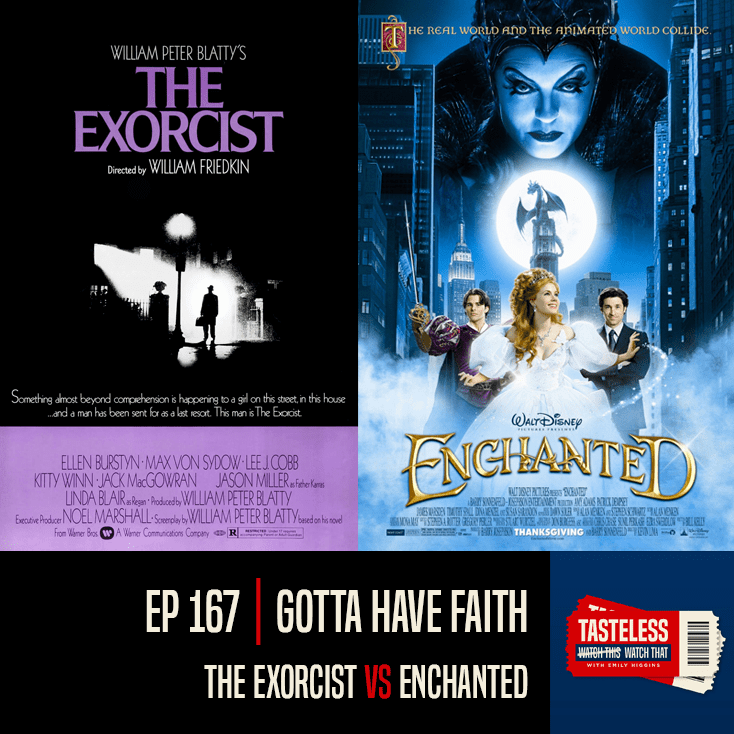
Two films that explore faith as well as representations of good and evil that endure through generations — it's The Exorcist vs Enchanted.
Read The Episode
Every episode of Tasteless, I take a critically acclaimed film and compare it to one that shares the same themes but didn't get the attention it deserves — and explain why that second movie is my pick. This week: two films that explore faith as well as the ultimate representations of good and evil. It's The Exorcist versus Enchanted.
The Exorcist
When a mysterious entity possesses a young girl, her mother seeks the help of two Catholic priests to save her life.
This movie came out in 1973 and has an 83% on Rotten Tomatoes. It won the Oscar for Best Adapted Screenplay for William Peter Blatty, who adapted the film from his own novel, and it also won for Best Sound. It was nominated for another eight Oscars — Best Picture, Best Lead Actress for Ellen Burstyn, Best Supporting Actor for Jason Miller, Best Supporting Actress for Linda Blair, Best Director for William Friedkin, Best Cinematography, Best Art Direction, Best Film Editing. That's crazy for a horror movie. A genre often maligned for supposed cheap scares and tricks — it's hard to get a horror movie the recognition it deserves.
The Exorcist was a success. It's famous for the reactions it elicited in audiences — people keeling over, passing out, barfing. Very upsetting. I'm glad I didn't see this in theaters in 1973. I knew the basics of this film, but I recently watched it for the first time. The sense of foreboding woven throughout is impressive.
It starts in this desert. This old guy, Max von Sydow — he's Father Merrin, a priest at an archaeological dig who finds a weird little statue of a demon. Maybe don't pick up dusty artifacts. We learned this in The Mummy. Don't pick stuff up out of the sand. Anything that's in the sand, it wants to be there. But then this guy is almost trampled by horses. He's just walking around looking dazed and scared. I felt like the desert was too hot for this old man. Clearly something bad is happening.
Then we meet Ellen Burstyn. Her character Chris McNeil is an actress, but we only see her being an actress for about four minutes at a fake protest scene. Is Ellen Burstyn ever not stressful? Are there movies where she just has a nice time? I haven't seen them. Poor Ellen Burstyn. Her kids are Jared Leto in Requiem for a Dream and the damn devil in this movie. And then Pieces of a Woman seems like a real bummer. And in SVU, she's Elliot Stabler's mom and bipolar and refuses to get help. Ellen Burstyn never gets to just chill.
In one scene, the lights flicker off and Ellen is just darting her eyes back and forth. Really good moment. She portrays this trembling inner fear so well she makes the viewer feel nervous, even though she has the same haircut as Danny in The Shining. Very upsetting.
Of course, this film's exorcism is centered on Ellen Burstyn's daughter Reagan, played by Linda Blair. Linda was in this great weird 80s horror movie called Hell Night. She also played an obnoxious reporter, uncredited, in Scream. I love when someone leans into their career. Linda raises money for the Linda Blair WorldHeart Foundation, an animal welfare organization, by selling autograph prints and memorabilia. She has used this thing she's so known for, for good, and I love that.
The role obviously skyrocketed her to fame. And it's upsetting how much was stacked against her. According to the Exorcist Wiki, the agency representing Linda Blair recommended 30 other clients for the part but not Linda, and Linda's mother brought her in herself. Then, due to death threats from religious zealots who believed the film glorified Satan, Warner Brothers had to hire bodyguards to protect her for six months after the film's release. People are insane.
Linda Blair received a Best Supporting Actress Oscar nomination. But William Friedkin really pushed that she was the only person who portrayed this role because he wanted realism. But Mercedes McCambridge provided the voice of the demon. When she wasn't credited, it caused controversy. They couldn't take back the nomination when that was found out, but it really killed her chances of winning.
Mercedes insisted on swallowing raw eggs and chain smoking to alter her vocalizations. She had problems with alcohol in the past and wanted to drink whiskey to mess up her voice and create the crazed state of mind. At William Friedkin's direction, McCambridge was also bound to a chair with pieces of a torn sheet at her neck, arms, wrists, legs, and feet to get a more realistic sound of the demon struggling against its restraints. Then Mercedes had to sue Warner Brothers for credit as the voice of the demon.
Basically, Linda Blair is this kid. The production of the movie has nothing to do with her. And the director is like, yeah, she did it. And she's just like, yeah, I did it. And then people are like, how dare you take credit? It just sucks.
She's possessed by a demon that claims to be the devil. The bed is shaking, she's screaming. At first I'm thinking, okay, get off the bed. But then I realized that when an earthquake happens, I just stay on the bed and assume I'm dying. I can't really judge.
Her mom takes her to doctors, to multiple doctors for different tests. One test is just blood shooting out of a throat hole. Very normal test. One of the first ones they do. They put a hole in your throat, have some blood shoot out, and go, okay, blood's coming out, that's good. Apparently it was a relatively accurate version of this test and William Friedkin claims students have used it to study the procedure, but it is a shocking scene.
Burstyn's like, okay, I guess we get a priest because I don't know what to do. The doctors are like, there's some alien intelligence, a spirit if you will. These scientists are ridiculous. Reagan is straight up purple and green and talking in this demon voice and scientists are like, uh, maybe something's weird with her brain? I don't know.
So Ellen Burstyn gets Father Karras, played by Jason Miller — a priest who has been doubting his own faith and whose mother is having a hard time and ultimately dies. He's kind of like, I don't know that exorcism is what we should be doing. And the scene where Reagan projectile vomits at Father Karras only required one take — the vomit was intended to hit Jason Miller in the chest, but the plastic tubing misfired, hitting him in the face. His reaction of shock and disgust is genuine, and he admitted he was very angered by this mistake. If a demon threw up on me, I would not be able to continue my life. It would be done.
Then we get back to Father Merrin from the beginning, Max von Sydow. He's called in because Karras is like, all right, maybe we do an exorcism. And the higher-ups are like, okay, we've got to get the big guns. This guy, Father Merrin, he'd done one before and almost died. Let's get him. And it's so sad because he's out in the woods hanging out and some other priest comes up and gives him this paper, which clearly says, hey, you've got to come do an exorcism. And he just looks at it and it's like: God, fine. I guess I'll go die doing another exorcism.
My final review: this movie has too many fluids coming out of too many holes. But it's definitely worth a watch.
Enchanted
A young maiden in a land called Andalasia, who is prepared to be wed, is sent away to New York City by an evil Queen, where she falls in love with a lawyer.
This movie came out in 2007, has a 93% on Rotten Tomatoes. Enchanted was nominated for three Oscars — three Best Song Oscars. They had a 60% chance of winning with "Happy Working Song," "So Close," and "That's How You Know." Lost to "Falling Slowly" from Once. Honestly, very unacceptable.
This movie is a mix of animation and live action. We start with the animation — animated Amy Adams running into animated James Marsden. They're both singing. They decide to get married the next day, but then she's sent by a witch, Susan Sarandon, to a place where there are no happily ever afters — aka modern-day New York. Amy is of course confused by this loud, bright new world. She lands in Times Square in her giant wedding dress. The imagery, the cinematography in this movie is so striking.
Amy Adams is incredible. To pull off this level of cartoonish bigness and not be annoying — she's so naive, so earnest. Yet I have no cynicism towards her. I'm rooting for her from moment one.
Let's talk Amy Adams roles for a second. Arrival should have gotten her an Oscar. At least a nomination. She has six Oscar nominations. Junebug was her first, one of her earlier roles. Doubt was her next — her and Philip Seymour Hoffman and Meryl Streep dealing with scandal in a church setting. The Fighter she was so good in. The Master she was so good in. American Hustle, Vice.
Other movies she should have been nominated for: this one — Enchanted. Big Eyes. Trouble with the Curve. The movie Her. The Muppets. Miss Pettigrew Lives for a Day. Sunshine Cleaning. Her episodes of The Office, her episode of Charmed, her episode of Buffy. Talladega Nights. Cruel Intentions 2. All of her scenes in Psycho Beach Party. Drop Dead Gorgeous. All things she should have been nominated for Oscars for. Am I just screaming her IMDB? Yes, I am. Amy Adams should have 200 Oscars.
Everything she does, she is a joy to watch. She's such a talented — workhorse feels like an offensive word, but whatever she is in, she is making it better. She was working for ages before hitting it big. She put just as much heart and humor and reality into the small roles as the big ones. I mean, Talladega Nights — she's the mousy assistant that winds up with Will Ferrell at the end. It's so good. She can do so broad, so specific. She gets dark humor. She gets drama. She can make you cry. And not only can she portray any role, she can sing like an angel.
"Happy Working Song." Brilliant. The pigeons and rats and roaches come and help her clean up because basically it's the classic Disney song — she calls all the forest creatures to come help her clean. But the forest creatures of New York are pigeons and rats and roaches and they help her clean and it's amazing.
When she steps out of the shower and the birds put the towel around her body, her wide-eyed grin — it could easily be insipid, but it's not. It's utterly charming. She makes a dress out of curtains. She nails every single layer of comedy and rings every funny moment out of a scene in a way that doesn't chew the scenery and that only enhances the work of her co-stars.
When Amy Adams lands in modern-day New York, she tries to find her way home and climbs up onto a billboard that looks like an enchanted castle. There, Patrick Dempsey and his young daughter find her and try to help. Patrick Dempsey is the stereotypical love interest grump. I hate fun. I have floppy hair but a rigid personality. He is perfect for this because Amy's head-in-the-clouds nature needs a little grounding to get used to New York. Who better than a single dad who helps couples get divorced and doesn't really live life for himself?
Although he does become the true villain of the movie when they're walking through the park and she's eating something — like a donut or a cinnamon bun — and she's like, this is so yummy, nibbling. And he goes, you all done? and takes it from her hand and throws it out. She wasn't done, there was still some left, Patrick Dempsey.
When they're walking in the park, we hear another of the Oscar-nominated songs, "That's How You Know." This is another fun movie moment where you're sucked in, everybody's singing and dancing. Patrick gets the classical musical moment of being like, wait, how does everyone know this song but me? I know I'm banging on him, but if I was with someone and they started singing in the park, I would be distraught. I'd be like, why do you all know this song? Why are you doing this to me?
Amy, with Patrick Dempsey, explores nuance — different emotions other than just excitement, happiness, true love. She gets to feel anger for the first time. That feeling disconnects her from her prince, James Marsden. James doesn't feel anger — he feels just dopey happiness at all times. When he and Amy are reunited, they don't click in the same way. James Marsden — perfect for this role. Handsome prince. Not fair that he can also sing. He comes to rescue her. He really does want what's best for her, but he doesn't grow or change. And she does.
She's obviously starting to fall for Patrick Dempsey. He has a girlfriend: Idina Menzel. Now, the one knock against this movie — it is a full Disney musical with Idina Menzel and Idina does not sing a note. Absolutely insane. Why? Why would you put her there and not let her sing?
Susan Sarandon comes to town — she's the witch, James Marsden's stepmother. She comes to get Amy Adams to eat a poison apple. She rises up in Times Square in a plume of green smoke from a sewer. She's so evil in the most cartoonish, amazing way. She sneaks Amy an apple. And that's another cinematography moment — Amy is looking at the apple and her face is reflected in it. She takes a bite. And of course she dies, or passes out and will die if she doesn't get revived by midnight.
James Marsden is like, I need to kiss her. True love's kiss. He kisses her. Nothing. And then he's like, hold on, Patrick Dempsey, you should kiss her. You're probably her true love. Patrick Dempsey is like, I'm kind of dating Idina Menzel. And Idina Menzel is like, just go ahead, Patrick. Just kiss her. Because even she is like, obviously you should be with Amy Adams. What a secure, wonderful woman.
Then we get the great moment of Amy saving Patrick from the evil dragon. Giselle — that's Amy's name in the movie — is like, is this a habit of yours, falling off of stuff? And Patrick says, only when you're around to catch me. I love that they turned it on its head.
Then James Marsden and Idina Menzel hop into a storm drain. I would hop into a storm drain with either of them to go live in the fairy tale land and have their own wedding. And the movie ends with a shoeless family dance, which I love just as much as I loved it in Matilda.
I haven't even talked about Nathaniel. Nathaniel is great — the henchman, played by Timothy Spall, who's a perfect henchman. IMDB's bio for him is: short, roly-poly, pudding-faced Timothy Leonard Spall was an award-winning classical character actor. Short, roly-poly, pudding-faced Timothy. That is so rude.
Shared Themes
Good versus evil is a big, broad concept — one that's at the core of most movies, of most stories. A good guy and a bad guy. The Exorcist and Enchanted are two representations rooted in a certain way of thinking: The Exorcist in religion and Enchanted in fairy tale and the world of Disney. These films tap into the types of stories we are told that are meant to shape how we perceive the world — whether that's religious lessons and doctrine or fairy tales with morals at the end. They're stories that endure in our lives across generations.
The Exorcist taps into our fears about the devil, demonic possession, an entity that is stopped only by holy water and the utterances of a priest. A pure evil, one that overtakes a child for no other reason than it can. Reagan has done nothing to deserve what happens to her. She hasn't brought it upon herself in any way. And that's an important part of the story — that she's an innocent and yet this is able to happen. The only people who can fix it, or attempt to, are those closest to God. The priests who speak from the Bible and fight off what has taken root in poor Reagan.
Ellen Burstyn is upset to find a crucifix in Reagan's room at one point, not wanting to admit that it may save her daughter — that something repelled by the presence of a crucifix could be inhabiting her child's body. People watching the film passed out, walked out, because of how intense the imagery was. Yeah, some of that was all the bodily fluids, but some of that was also tapping into this dark, primal fear we have within us.
What allows people to turn to religion in times of need is also what can be the downfall. We look back on exorcisms in olden times as barbaric and inhuman, but if we were unsure of how else to help someone we loved, I think many of us would at least give it a shot. In our bones and the stories passed down to us, we've been told that true evil can be fought by those who have been deemed worthy, blessed with the title of Father.
In modern times, religion is still a piece of who people are, still taught and learned and expressed. But we now also have the cult of media. The images we're presented every day in the art we consume, the stories we read, the bedtime stories our parents told us. Less often about demons and more often about princesses and princes, dragons and castles. These stories shape our morals and our expectations just as much as religion has. It's just a more in-touch, modern way of getting those lessons across.
Enchanted has its happy endings and its fun tropes, but it can be watched as a deconstruction of the Disney-fied idea of happily ever after that we've been fed by the media for decades.
These more modern depictions of good and evil show beautiful princesses who fall for a man who will take care of them. The princess marries him, lives as this bride. Evil are the older women jealous of the heroine's good looks, her youth. The messaging that lies under every rom-com, it's in Disney, it's in the muted fairy tales adapted from the more violent Grimm's stories — that a woman's value is in getting the attention of a man and supporting him, while a man must be the ultimate protector.
In Enchanted we explore these tropes, these extremes. We see Amy and James meet and decide to get married the next day. Then Amy meets Patrick Dempsey and realizes she has choices. But we see how she must fight that initial urge to do as she's told, do what she thinks she's been taught to do. Yeah, at the end of the day, the Evil Queen is evil. She poisons Amy. She's very rude to her little henchman guy. Susan Sarandon is awful to Nathaniel. There is still that black and white of evil and good. But in Enchanted's even more modern version of morality tales, we get to see choice — the henchman doing what is right, Amy exploring her own path, making choices for herself.
The Exorcist and Enchanted raise questions of faith — faith our characters must have in themselves and in their actions to defeat their foes.
In The Exorcist, faith is the central focus and exploration. Father Karras is a religious man but aligns much more with the scientists who repeatedly check Reagan for brain lesions, seizures, psychiatric problems. He questions his faith as he watches his mother suffer. He runs scientific tests on Reagan — flicking her with what he claims is holy water that she reacts to by screaming, and he later says it was only tap water. He also thinks to be possessed you need to speak in another language, and maybe she is, but then he finds out she's just speaking backwards and is like, she's a faker.
Father Karras's speaking backwards is kind of impressive and very scary, especially because she says the name of Merrin backwards — and it's like, how did she know he was coming? But Karras embraces what must be done with Father Merrin, and he completes the ultimate leap of faith when he demands the demon take his body instead of Reagan and then throws himself to his death.
There's something interesting to what bearing faith has on the physical. The psychiatrists Ellen Burstyn visits prior to linking up with Father Karras tell her to look into exorcism. Ellen says, you're telling me that I should take my daughter to a witch doctor? They don't think it's a demon, but they think Reagan believes that. So perhaps going through the ceremony will work through whatever inner turmoil is causing her to lash out. Basically the placebo effect.
This movie is scary if you believe in the possibility of demon possession, of exorcism. And it's scary if you don't — because someone does. On the mostly harmless side, you see people who believe in the Holy Ghost passing through them, flinging themselves around on the ground. On the scarier side, you see people who do awful things because they think some other entity is controlling them. Whether they claim a demon or Grand Theft Auto, they're ascribing their actions to something else. Their faith in that thing controlling them is what determines the outcome.
It comes down to what you believe. If you are not Catholic, you are less likely to believe you need an exorcism. People thinking they are possessed are most often Catholic or raised Catholic or associated with that faith more so than any other. There is something spiritual about this film, something that makes you question your own belief.
The film's production suffered its own events some call cursed. The set caught on fire. Ellen Burstyn had her spine injured being ripped on a wire — she said about William Friedkin that he's so dedicated to getting the shot right that some other considerations fall by the wayside. She was ripped back, landed on her coccyx, has a permanent injury. Actors Jack MacGowran and Vasiliki Maliaros both died while the film was in post-production — they also played characters that died in the film. Televangelist Billy Graham stated there is a power of evil in the film, in the fabric of the film itself.
At one show, a woman was so frightened she passed out and broke her jaw. She later sued, suggesting subliminal messages caused the accident. Warner Brothers settled. One subliminal message scholar believed such imagery to be authentic and not created by the filmmakers — therefore he deemed the film itself was possessed. But when he talked about it, the subliminal images he described were not actually in there. He imagined them. This movie sends people off the rails. It's what you are willing to let in. What you have faith in affects what's going to happen to you in a weird way.
In Enchanted, Patrick Dempsey keeps telling Amy she doesn't know what she's talking about. He tells his daughter that Amy is confused when she talks of this magical land of Andalasia. He thinks she's just a super weird non-fairy-tale human instead of a fairy tale woman plucked from her realm and unceremoniously dropped in Patrick's world.
But when Amy has been poisoned by the Evil Queen's apple, she only has until midnight to be revived. After James kisses her and nothing happens and the clock ticks forward, everyone turns to Patrick saying he can give true love's kiss and bring her back. He hesitates — no, no, I have a girlfriend. Even his girlfriend is like, just kiss her. And when he kisses her and she remains still for a moment, he is disappointed — because in that moment he believed it would work. He believed he would revive her. And then suddenly she is awake.
Whether the kiss was true love's kiss doesn't matter as much as having that faith. He needed to believe it was real because that's what gave him the magic to bring her back to life. He willed her back into existence with his love. He poured all of his love into her, hoping it would be enough.
He is so much happier when he lets these beliefs in. When Amy was just a crazy person, someone he wanted kept away from his daughter, someone who was a burden — he was like, this sucks, you're ruining my job. But when he believes she is who she says she is, it allows him to see the best parts of her. Her optimism and kindness are no longer naive but instead charming. It causes him to look at the world differently — approaching his job as a divorce lawyer not with cynicism but wanting what's best for the person in front of him.
Amy also puts her faith in true love — not in the way she thought. At first she's worried love has led her astray because when she's reunited with James Marsden, they're not having a good time. But she feels she owes him something because they're meant to be. She's bored of him, not challenged the way she is with Patrick. But she has faith things work out as they should. And when Patrick gives her true love's kiss and she reawakens, she's just as quick to put her faith in the love between herself and Patrick.
Although she's lived in a world where she's the damsel, she has faith she can protect this love. She rescues Patrick from the dragon and succeeds. She puts belief in herself as the hero in a way that changes who she is. And that's what makes her an incredible character and role model — this faith she has in herself and in the goodness of others to do the right thing.
What Enchanted Did Better
While The Exorcist played into the extremes of our beliefs, Enchanted purposefully brought its story into a world without magic to shatter those extremes, to ground them.
The Exorcist with its overabundance of fluids spraying around the screen, its subliminal imaging, its disgusting sexualized demon in the body of a young girl — it's all worst-case scenario, truly awful, meant to terrorize you. The demon takes on Father Karras's mother's voice to taunt him from beyond the grave. It flings people to their death. There's no subtlety and that's what's so frightening. The worst thing a mother could ever think of happening to her daughter is happening right in front of her. The movie's tension is ratcheted up and up and up. I understand why people keeled over — there's no respite, no time to take it in. You're hammered with aggressive imagery for over two hours.
It's effective. But I find it so intriguing on revisiting Enchanted that it takes these big ideas, these fairy tale characters, and mostly neuters them. The wisecracking chipmunk can only do little chipmunk peeps in the real world. Instead of gorgeous bluebirds, Amy is helped to clean by roaches and rats and pigeons — everyday animals. She fashions the apartment's curtains into a dress instead of wearing gorgeous fabrics made by a rabbit with some thread or whatever.
Enchanted evokes magic in the everyday, an intrigue in things closer to home. It takes the magical and makes it part of real life — instead of taking real life and making it extreme.
I think it's easier to evoke the emotion you want if you are just hammering the same note over and over, as The Exorcist does effectively. But I like the rises and falls of Enchanted.
The Exorcist leans into its stereotypes and religious mythos. Enchanted holds a mirror up to the romantic ideals, Disney-type stories that have been set forth in pop culture and turns them on their head. The Exorcist terrorizes viewers with its depiction of good and evil. It puts a real fear of God into people, fear of the devil. It came down on the side of the possession being real, giving the viewer every reason to believe Reagan's body had been taken over. The author took a real story about possession and adapted it.
Enchanted brings fairy tale archetypes we know to life, but then dismantles them, which is what makes the film so interesting. The Exorcist is about an exorcism — it's exactly what it says on the tin. Enchanted is about things not being enchanted at all, but how that's not what matters. It gives us a new lens through which we can view similar films, yet also captures the same joyful emotions that a more typical Disney film captures.
A kid can watch this movie and feel just as thrilled, have their imagination provoked in the same way as when they watch Cinderella or Sleeping Beauty. The fairy tale is the jumping-off point, but the movie fights against any expectations you set for it. It's what makes the film so charming and why it holds up now and will hold up in the future. It questions what we've been told by stories. The Exorcist enforces our deepest fears from stories. Both are valid approaches.
The Exorcist deserves a spot as one of the best all-time horror movies, as something that changed the landscape of horror. But Enchanted becomes something that can take on a life of its own across genres and can be taken at face value or looked at as something deeper. There are elements you see coming — you know she's going to end up with Patrick Dempsey. But that extra little twist of her saving him after he kisses her is what keeps me coming back.
I don't know that The Exorcist is something I need to revisit again. I think I got all I needed. So if you haven't seen either movie, I'd say watch them. Maybe don't watch them together like I did. Actually, you know what? Watch them together. Start with The Exorcist, then Enchanted, so you can go to bed less scared.
I'm going to go back to just repeatedly watching "Happy Working Song" on YouTube for the next 10 hours.
Hit me up at @tastelesspod. Tell me your favorite Amy Adams role. Or how we can get Ellen Burstyn on a nice vacation.
Pipe Dream: Call Me By Your Name vs James and the Giant Peach

Two movies about sad boys with an affinity for peaches who find self-acceptance through a dreamlike adventure — it's Call Me By Your Name vs James and the Giant Peach.
Read The Episode
Every episode of Tasteless, I take a critically acclaimed film and compare it to one that shares the same themes but didn't get the attention it deserves — and explain why that second movie is my pick. This week: two movies about sad boys with an affinity for peaches who find self-acceptance through a dreamlike adventure. It's Call Me By Your Name versus James and the Giant Peach. This is not just because of the peach, okay? I swear to God it's not. But I was watching James and the Giant Peach and had a real lightbulb moment. This episode makes sense. I swear to God. Just let's get into it.
Call Me By Your Name
In the summer of 1983, 17-year-old Elio is spending the days with his family at their villa in Lombardy, Italy. He soon meets 24-year-old Oliver, an intern working for Elio's father. They discover the heady beauty of awakening desire.
Came out in 2017, has a 94% on Rotten Tomatoes. It won the Oscar for Best Adapted Screenplay for James Ivory. It was nominated for Best Lead Actor for Timothée Chalamet, Best Motion Picture, and Best Original Song for Sufjan Stevens.
I am coming at this movie in the year 2021 as not a gay man, not a man, and it is a post-Armie-Hammer-is-a-cannibal world. So you can take this review with a grain of salt. I watched it for the first time and I think it really suffered from the non-movie-theater experience. If I had watched this in a theater in the dark with a big Coke and some buttered popcorn, I would have been more easily sucked into the fantasy than watching it at home at 8 a.m. with my neighbors making as much noise as possible.
I understand completely how this movie could mean something to someone, how you could see yourself in it. But I'm going to approach it from my angle of not liking a single person in this movie.
Timothée — actually, Timotay is how you're supposed to say it — is a teen who is with his parents at their really gorgeous house for the summer. Because this is set in the 80s, it seems totally normal to everyone that they just give Timothée's room to Armie. So Elio — let's call him Elio — gets shuffled off into this weird side room through the bathroom. He has to come out of the bathroom to leave the room. That sucks. Imagine if every single summer your parents were like, go sleep in the closet, I'm giving some other dude your room. Why don't they put him in the closet room? I mean, he is ten times the size of Elio, so maybe that's why he couldn't fit. But I would be so mad.
Immediately Elio is rubbed the wrong way by this hunky American. Every time Oliver is leaving, he's like, later. Elio is like, don't you think he's impolite when he says later? Don't you think he's arrogant? And everyone's like, Elio, who cares? He's not trying to be rude. That's just how he says goodbye. It's fine. Why are you so mad about it? You should be much more mad that your weird dad invites someone to sleep in your room every single year.
There are so many bugs in this movie. Mostly all over him. There's a scene where he's about to start touching himself and there's this fly on his crotch. When they're outside at one point, Oliver is laying in the grass and Elio is playing guitar and bugs are everywhere.
When Oliver first gets there, he's tired, he's traveled from America to Italy, he conks out. Some bell rings and Elio is like, that's the bell. The bell means it's time for dinner. Oliver doesn't wake up. So he goes in and takes a book and slams it onto the ground. The bell! It's time for dinner! Oliver's like, hey, I'm going to keep sleeping. Could you make an excuse for me, buddy? Thanks. I'm a grown man. I'll eat dinner. Leave me alone.
I was really disgusted by Elio telling his dad he almost had sex with a girl. He's like, yeah, I almost had sex with this girl the other night, Dad. All I had to do was find the courage to reach out and touch and she would have said yes. And his dad's like, ooh. And Oliver's like, then why didn't you? Why are you telling this story? I hate him. I hate Elio. I get he's a kid. I get it. Teen boys have a lot of things to deal with. I did not like him. Timothée Chalamet, perfectly talented. This is not his fault. I wanted to punch Elio in the face.
Armie Hammer as Oliver — he talks like an alien trying to be a human. All his words are very purposeful. I think that's why he was so great in The Man from U.N.C.L.E., because he was playing a Russian agent so he had to be very specific with his words. He gets to this town and he's like, hey guys, I'm here. Is there a bank in town? I'd love to start an account while I'm here. The professor's like, ooh, none of my students have ever wanted to start a bank account while here. Why would you start a new bank account in this town?
Armie straight up eats a raw egg. He keeps eating eggs that I guess are supposed to be poached or cooked or something. They just look raw. He's shoveling down raw eggs. And he drinks his juice so fast. I don't know if it's supposed to be attractive. And then they talk about apricot juice for a really long time and the professor is giving the most boring lecture and Armie goes, actually, I'm sorry, but I need to talk about the etymology of apricots because actually it's from this and not what you're saying. And then the whole family is like, ha ha, you passed the apricot test. I was like, God, I hate these people so much. This is the worst family I've ever seen.
Armie, in real life, has been accused by multiple women of lewd messages and inappropriate acts. He's been taken off every project he was involved in. And it's unfortunate because this was a mainstream movie about two men in love — and how often do we get that? Very rarely, especially to have it win the awards it did, get the consideration it did. So it sucks. It sucks that Armie Hammer was creeping around.
I was not not into it when he was doing his dance in shorts and sneakers and very long socks. He's said in interviews the most uncomfortable he felt during filming wasn't the sex scenes but the dance scenes. That's because only someone with a chiseled face like that and a head of hair like that can dance so goofy.
A trivia fact that really delighted me: during the party scene where the Psychedelic Furs' "Love My Way" begins, the opening lyrics are there's an army on the dance floor — and there is literally an Armie on the dance floor. I will never get over someone naming their kid Armie Hammer, who's an heir to the Arm & Hammer fortune. It's sick. It's like if my name was In-N-Out and my parents created In-N-Out. That's not right.
Regarding the peach scene — obviously we have to talk about the peach because it is technically what made me think about this film. Director Luca Guadagnino went to Timothée Chalamet and told him that he had tried masturbating with a peach himself and found it was indeed possible. Therefore he thought they should do the scene. Chalamet responded that he had also tried it and agreed. Very American Pie vibes.
Also, whenever he's eating a peach shirtless in his bed, he throws his peach pits just onto the ground in the corner of this room. The same gross dusty room where he brought that girl to have sex with her on the dirtiest mattress of all time, this poor girl. And then later he's in that room just flinging peach pits into the corner. This kid's an animal.
Elio's final conversation with his father shows how things have changed. His father for the first time connects with Elio as a fellow human instead of his child. He talks to him about love, about how he had something special with Oliver and how Elio must realize how rare that is. And then weirdly is like, I almost had that, but I didn't. Do you not like Mom? Apparently in the next book they get divorced. So I guess he doesn't like Mom. But maybe don't tell your kid you have never felt love before.
James And The Giant Peach
An orphan who lives with his two cruel aunts befriends anthropomorphic bugs who live inside a giant peach, and they embark on a journey to New York City.
This movie came out in 1996, has a 91% on Rotten Tomatoes. It was nominated for an Oscar for Best Music, Original Musical or Comedy Score for Randy Newman — lost to Emma by Rachel Portman. I don't remember Emma having a song that explains its plot, so I'm not sure how that happened.
This will be my third Roald Dahl book-to-movie adaptation that I'm vouching for on this podcast. I hadn't actually realized how much I loved his body of work until this. Combine it with producer Tim Burton, the darker side of Disney — the director Henry Selick also directed The Nightmare Before Christmas and Coraline. I found this movie most similar to Coraline in terms of its darkness and unique visuals. It's a really creative movie. It's a PG movie that is frightening, that has intense scenes, that has a moral. It is just stellar.
Paul Terry plays James and this is the only film he ever acted in. We first meet James with his parents — he's a little kid, they're hanging out on the beach, looking at clouds, talking about this trip they're going to take to the Empire State Building. They're in England but they're going to go to New York. Then tragedy strikes: his parents are eaten by an escaped rhinoceros from the zoo. You know how that can happen.
He is sent to live with his two aunts, Aunt Spiker and Aunt Sponge, who are super mean, basically have him working all the time, wake him up early to do chores. They are played by Joanna Lumley and Miriam Margolyes. Joanna Lumley as Aunt Spiker is an all-time scary villain. There is a scene where she has this wet mascara running that haunts me. Rewatching it brought back such strong scared emotions from childhood. This further confirms my thesis that funny people can be the absolute scariest, because this character is miles away from Ab Fab and yet has a similar edge to it.
Aunt Sponge is played by Miriam Margolyes. She also voices the Glowworm. She has been in every British thing ever.
These two aunts have him working all the time. Then a strange man, played by Pete Postlethwaite — who you know from being tall and in everything — is like, hey buddy, I got these magical crocodile tongues, here you go. James takes them and drops them all over the ground next to his aunts' old peach tree that hasn't grown anything in years. And of course a magical gigantic peach grows. His mean aunts use it to make money — as you would, you charge people to see the giant peach. If I found a real big fruit, I would get out my calculator and a little lockbox for the change.
James winds up going inside the giant peach in secret, transforms into a stop-motion boy, meets some magical human-sized bugs, and they go on an adventure. Very normal stuff.
But here is the thing. In this film, a little boy sings a song and yet I still love it. A little boy messily eats a peach, chomping away, and yet I still love it. He says "whino" instead of "rhino." The scary whino ate my parents. Yet I still love this movie. It overcomes these things. There is something so eye-catching, something so memorable — such beautiful moments, stunning visuals, haunting villains.
Rewatching it brought back so many memories. As things were happening, I had such strong déjà vu of — oh my God, I watched this a million times. I knew what was going to happen despite not seeing it for decades.
I'm pretty sure the spider in this movie is why I like spiders. There's this big bulbous black spider that James sees when he's still a flesh-and-blood person. When he goes inside the peach, he meets her and her name is Miss Spider and she is French and she is played by Susan Sarandon. Of course she's French, why not? The Times of London reported that James and the Giant Peach was once banned in a Wisconsin town because a reference to Spider licking her lips could potentially be taken in two ways, including sexual. They were like, this spider is too sexy. Which is what you get when you get a French Susan Sarandon spider. Sorry, you knew what you were doing.
Richard Dreyfuss is Mr. Centipede. He has a newsboy hat. He is the worst of the bugs. He's like, I can navigate this peach — because guess what? The peach is flying. It's flying across the world. He's like, I got this, I'll point the peach in the right direction. Then he falls asleep and they get lost in some scary ice world and have to go underwater to get a compass and rescue the centipede. Do your job, Mr. Centipede. You had enough time to put on that hat. Get it together.
Jane Leeves is the Ladybug and I love her. She of course, Daphne from Frasier, star of Hot in Cleveland. I want this ladybug to adopt me so bad. She's the nice one, the little old ladybug that's just like, let me just hold on, I'm coming along with you guys.
David Thewlis is the Earthworm — he has little sunglasses on his little face and they move because it's this incredible stop motion. You see him make little facial expressions and his little sunglasses make faces. You know, he's Remus Lupin in Harry Potter. I know him from Basic Instinct 2. Simon Callow is Mr. Grasshopper. He plays grasshopper songs.
Sometimes I can break down the plot, but sometimes you just have to see it because it's all a feeling. You have to watch it. I love the stop motion — it's something that is never not impressive. And then there's this scene with a sort of 2D paper effect that's really cool.
I'm sure it's on Disney+. It is. None of you have any excuses. All of you have access to someone's Disney Plus account. If you haven't seen it or if you haven't seen it in a while, watch James and the Giant Peach. I think you're going to be surprised by how many little elements have stuck with you.
Shared Themes
Elio and James are young. They're treated as children, treated as disposable — or if not disposable, at least pliable. Like their thoughts don't matter. Like what they want doesn't matter. Elio's room is taken from him each year for the visiting grad student. He's shuffled off into that weird side room. James is ignored by his aunts, other than getting labor out of him. But in these films, their lives are changed because each boy is treated like he matters, like what he wants has consequence.
Each year, as a new student comes and hangs out with his dad, Elio wanders his family's gorgeous compound, making eyes at one girl while another makes eyes at him. His parents force him to wear a shirt he doesn't want to, ask him to play piano for their guests like a trained monkey. Normal things, but when you're a kid, it feels so much bigger — like they're exerting control just because they can. He doesn't feel like he's in charge of his space or himself.
When he meets Oliver, he's immediately struck by him. Oliver is so self-possessed. He's not worried about what people think when he says "later" instead of goodbye. No one's going to chide him. He is a grown man. Elio is jealous of this, calling out the behavior, trying to turn his family against a person he believes to be arrogant. But his tune changes when Oliver starts to pay attention to him. He writes in his diary that he hadn't liked Oliver because he thought Oliver didn't like him, that he had the wrong impression. Oliver sees him, talks to him, asks his opinion, tells him about his paper, massages his tight shoulders. Okay, that last one is where things change a little bit.
Elio is trusted with his own choices with Oliver. Oliver basically says, hey, if this is what you want, meet me at midnight. If not, no hard feelings. And when Elio says, this is what I want, I'm an adult, I can handle this, Oliver takes him at his word. That takes away a little bit of the tragedy for me. It's of course sad at the end when he's crying over his first big love. But he was given this gift in having someone who truly saw him, and it ended on good terms.
Elio's final conversation with his father shows how things have changed. His father for the first time connects with Elio as a fellow human instead of his child. He gives weight to what Elio felt. He's not like, it was a fling, whatever. He really does treat it as serious. He validates it. We see the parents decide to let Elio have alone time on the phone with Oliver, getting off their receiver and giving each other knowing looks after Oliver shares the news he is engaged. They let Elio make his own mistakes and give him time to grieve. There's a respect there. A shift into Elio feeling like an adult.
In James and the Giant Peach, after James' parents die, he is sent to live with his hateful aunts. They see him as a nuisance. A stupid child not worthy of their time or energy. He's never spoken to about his feelings, simply told to shut up, put to work. His opinion isn't wanted, his feelings don't matter. Then he journeys away with the bugs that reside in the peach, and they treat him as a full-fledged person. They look to him for answers. He helps decide the course of their travel and solves problems like when the scary metal shark is coming after them.
He's always been shoved aside by his evil caretakers, but with the support of his new friends, he overcomes that. At the end of the film, when the aunts come to take him away, he confronts them. He stands up for himself. He says, I matter. This dream he has of going to the Empire State Building — this fantasy, this one thing he's holding onto — it happens. He gets there. He tells the aunts, I made it. I'm not nothing. You are.
The bugs told him he mattered. They asked his opinion. They trusted his judgment. When he decided to go with the spider into the icy ocean to save Mr. Centipede, they're like, do you really want to do that? It's super dangerous. But when he says, yeah, I'm not leaving anyone behind, they respect that. They want to hear from him in a way he hasn't experienced since his parents died.
Call Me By Your Name and James and the Giant Peach are both fantasies. They have a dreamy quality, and much like dreams, the events of the films allow our main characters to work through how they feel. What you believe is as important as what is real.
Call Me By Your Name has such an ambiance — a feeling of summer, of longing, a reverie of eating directly from a tree, paddling around in a river, having no obligations, and the sole attention of a hunky dude. It's in this space that Elio gets to explore himself. He doesn't have school, he just whiles away the days figuring out what he likes, who he likes, who he is. He's in this isolated capsule away from the real world so he can express things more freely and see where his complicated emotions surrounding Oliver lead.
Oliver is charming with everyone, has an easy way about himself. At first Elio isn't sure if he wants to be Oliver or be with him. Although Oliver claims he made his intentions clear with the shoulder massage, it is Elio who first admits his feelings — super vaguely, but he tells him something's going on. The whole "call me by your name" aspect — to call each other by their own names, to say their own names reverently with love and experience life as the other even for a moment — shows Elio a different side of himself, a side he loves. It shows him he matters.
Oliver leaving is heartbreaking but doesn't take away from how important this time was. Elio never really wanted to be with that girl he was sleeping with — he kept blowing her off and neither was quite sure why. When he falls into this affair with Oliver, he has sex with her to gain some sort of control. And when things end with Oliver, she's understanding because she realizes he didn't know himself well enough to know he would hurt her. This was something brewing for a long time. His inability to get close to these women — to finally have an answer to why that might be is a relief for him as much as it is for her. He had to be isolated to this special, strange space where anything could happen for him to work through how he actually feels.
James and the Giant Peach presents fantasy as reality, showing a giant peach and floating bugs in New York City surrounded by human children at the end. But whether it happened isn't what's important. James, when no one believes him, says to everyone for the world to hear: I flew the giant peach across the ocean. He believes in the adventure he has had and it empowers him. He no longer cowers at the sight of his aunts, though they have never looked scarier. He speaks up to them.
There's really such a feeling to this movie. The crackling of the paper when James lights his paper lantern. The texture of the peach chunks when they're singing their Eat the Peach song. It puts you into the mindset of anything being possible and allows you to be taken away by the magic of it all.
Whether it happened or not, not important. It only matters that James has had this meaningful, life-changing experience. He speaks his mind, he stands up for his friends, he immediately is letting all the little street kids eat off his dirty peach. I mean, maybe these kids have homes. I would not bite into that peach that has just rolled its way down a building onto the concrete. To each their own. He has lived this fantastical life and it shows him what's important — sharing, kindness.
There's also an undercurrent of darkness to both films. Something just out of reach because you know things will go wrong. Elio and Oliver can't be together forever. You worry about someone finding out. They're in a little bubble. Same for James — he's floating around up there, it's fun and there's dancing and peach eating, but he's going to have to come back to earth at some point. And that eventuality looms. But by the end, our characters realize real life isn't so bad.
What James And The Giant Peach Does Better
Both films take place in dreamlike locales where the unexpected can happen. But there is a hollowness that Call Me By Your Name possesses, while James and the Giant Peach is much more fantastical but has an emotional core that has kept me thinking about it for decades.
There's a crackle of something — of perhaps longing, if not quite chemistry — in Call Me By Your Name. Whenever Elio and Armie aren't talking but simply sharing knowing glances, you feel it. But then they talk and it's like, is this what we were waiting for? The way they talk to each other is so stilted and weird. There's this whole exchange when Elio is playing something on the guitar — I'll show it to you on the piano. Did you change it? I changed it a little bit. Why? I just played it the way Liszt would have played it if he'd altered Bach's version. Play that again. Play what again? The thing you played outside. Oh, you want me to play the thing I played outside? Please.
It's all so weird and aggressive. Just play the song, man. Why you gotta be so difficult? This Who's on First forced teasing — it's like false intimacy. They're trying to make us think there's a connection when there really isn't one. What on earth does Oliver see in Elio? I don't buy it. The parents are too chill with it. The girlfriend too calm. It all feels like things fall into place in a way that — I don't need realism, but something about this rings false.
I love the longing Elio has for their relationship, but the moments when they are actually together, there's a lack of emotion. I think Elio really could have gained many of the same lessons from experiencing that longing and intrigue without ever becoming physical with Oliver, because it's really Oliver's approval that makes such a big difference. Oliver admitting he likes to spend time with Elio, that he was looking at him when they were playing volleyball — that's what is important.
But the casualness with which Oliver has sex with his professor's underage kid and then is like, okay, well, this was fun, gonna go get married — there just isn't a real connection. I don't feel the humanity. It's very manic pixie dream girl — he flits in, is like, I like you too, bye bye.
In James and the Giant Peach, James is hanging out with talking bugs — obviously insane — but Spider, whom he saved before he knew she could talk, looks out for him in such a kind way despite her slightly hardened edges. The bugs coddle him just as much as they turn to him for his thoughts. There's a give and take, a push and pull. We see who James truly is — going out of his way to save the centipede even though the centipede screwed them all over. He's a good kid and he wants to help people, and the bugs sense that about him.
When they first meet, Spider vouches for him — look, he put his neck out there with Aunt Spiker in coming to my aid. There's a connection here that is real, that is true. They all eat their little peach lumps together, they sing a song, and I feel like I'm at home. I feel part of things as the viewer. I feel the memories James has of his parents and how the new ones he's making with these bugs help alleviate some of his sadness.
Something about this fantasy allows the viewer to fully connect, to really get into the mindset and feel what James is experiencing — having people who love him again, how important that is. Mr. Centipede is probably the closest to Oliver in this film — he's just like, whatever, I'll navigate, I got a cool little hat and 40 hands, what's up? He's a jerk, he messes up, but he has remorse. He tries to fix it. There's never that moment with Oliver. Oliver is such a hollow, false, Greek-god-of-a-man with no actual substance. There's no vulnerability.
There's a very sweet scene where the Earthworm is stressed about what just happened when they were trying to escape the metal shark. James says, when I had a problem, my mom and dad would tell me to look at it another way. Earthworm says, how? First I was bird bait, then I was shark bait. James says, I suppose. But you could say you gave us wings to fly and defeated a giant shark single-handedly. Earthworm says, no-handedly. James says, you're a hero. Earthworm says, I am? I'm a wonder worm. James replies, you are.
I get more humanity out of a centipede than I do out of Oliver. And that's too bad. Although I still would be so attracted to Oliver in real life.
Being older doesn't mean you know more. Doesn't mean you know better. Growth is possible for people at any age. And yet Oliver seems unchanged by his relationship with Elio, whereas James and his anthropomorphic bug friends learn from one another. Equally.
In Call Me By Your Name, one of the most interesting elements was Elio's father coming to him as a man. When he talks to Elio about how rare that kind of love is, there's real emotion there. But I hated that Oliver truly seems unaffected. There's just no conflict for him. He had a fling with Elio and moves on completely, still the exact same guy. That's what makes the relationship strangest and brings me back to — why? What are you getting out of this?
Elio really lets himself be free. He's totally honest with Oliver in a way he isn't with other people. He's goofy instead of trying too hard to look cool. He realizes it's okay to open yourself up, even if it doesn't end how you hope. He grows.
In James and the Giant Peach, these bugs have been living their weird bug lives for ages. They've been in a rut. Then James plops into their home and suddenly they're on an adventure. Suddenly they're honest with each other. Centipede admits fault. They share about their pasts, their goals for the future. There's learning and growing. All of them gain new knowledge from their time together, new appreciation for the ways of the world.
Every relationship doesn't have to teach you something. But it certainly feels more equitable, more meaningful, to have our hero influencing the life of someone else the way James influences these bugs. These bugs that have been hiding, have been almost stepped on — they're now front and center and proud, ready to web up the mean aunts that people have been terrorizing when they were too small to fight back.
Give James and the Giant Peach a shot. It's very fun. It's like 80 minutes. It's short, it's cool, it's beautifully done. It's on Disney+.
And if I'm missing something in Call Me By Your Name, feel free to tell me. Hit me up at @tastelesspod on social media where we can talk about which bug was your favorite, or about Joanna Lumley as Aunt Spiker being one of the scariest villains of all time.
Manic Pixie Dream Girls: Amelie vs Elizabethtown

If you want quirky women, look no further than this episode where I debate the Manic Pixie Dream Girl title given to Kirsten Dunst and her red hat in Elizabethtown. I also complain about Amelie sticking her hand in things and grinning from under her bangs. I miss Orlando Bloom.