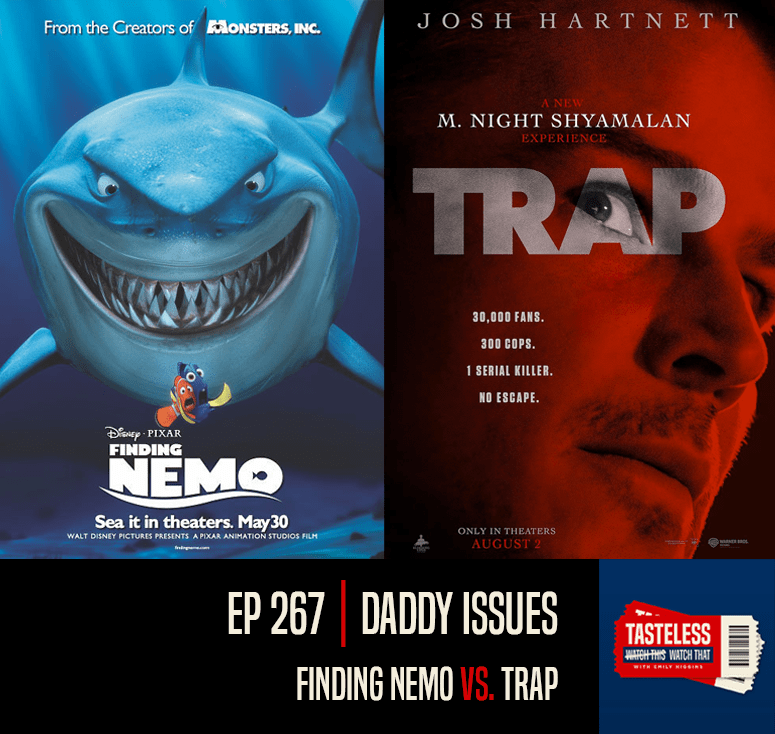
Two movies about terrible fathers trying their best for their children — it's Finding Nemo vs. Trap.
Tunnel Vision: Goodfellas vs I, Tonya

Two movies about the pursuit of a specific lifestyle and feeling powerless — it's Goodfellas vs I, Tonya.
Read The Episode
Every episode of Tasteless, I take a critically acclaimed film and compare it to one that shares the same themes but didn't get the attention it deserves — and explain why that second movie is my pick. This week: two Oscar winners about the pursuit of a specific lifestyle and feeling powerless. It's Goodfellas versus I, Tonya. And yes, I was furious to discover the I, Tonya poster literally has the pull quote "the Goodfellas of figure skating." Someone thought of this comparison before me and put it on the poster.
Goodfellas
The story of Henry Hill and his life in the mafia, covering his relationship with his wife Karen and his mob partners Jimmy Conway and Tommy DeVito.
This movie came out in 1990, has a 96% on Rotten Tomatoes, and is number 17 on the IMDB Top 250. Joe Pesci won an Oscar for Best Supporting Actor for playing Tommy DeVito. It was also nominated for Best Picture, Best Supporting Actress for Lorraine Bracco, Best Director for Martin Scorsese, Best Adapted Screenplay, and Best Film Editing.
I like this movie, mostly because I love Lorraine Bracco. We're going to talk about her. But let's talk Ray Liotta first, who plays Henry Hill. Henry Hill is a real man on whom this book was based. Ray Liotta was so attractive. I knew him better from Chantix commercials and I hope he managed to stop smoking. In Goodfellas, he always looks like he has eyeliner on in a very attractive way. I also realized while watching that I know him maybe best from voicing Tommy Vercetti in Grand Theft Auto: Vice City, a game I used to play for hours on the original Xbox.
Ray Liotta is our protagonist, our guy, the one doing the narration. He's a little more even-keeled than the other guys because he's the most normal, the most human, the easiest to empathize with. A lot of the movie is just him listing foods. He loves talking about foods. Made me very hungry. There's a whole scene where they're in prison and he's talking about the foods that are being made. There's another scene where he's voicing over all the things he has to get done — the cops are following him, there's a wire, he has to drop stuff off, call this person, get someone's lucky hat — I gotta chop the veal, I gotta chop the tomatoes, I gotta get a nice sear on the things. He was cooking some full meat as an appetizer. It was a big to-do. This movie will make you very hungry. I actually, after watching it, ordered pizza from a fancy place and it sucked. It sucked so hard and I'm mad about it.
Robert De Niro — also a hunk in this movie, but I would say he's a hunk now, and that I was attracted to him in the film called Dirty Grandpa. This role unfortunately is kind of just a worse version of his role in The Godfather Part II. He's just supporting as Jimmy Conway. And apparently on set he was very obsessed with realism and authenticity — he wanted to use real money for a scene where Jimmy hands out money because he didn't like the way fake money felt in his hands. IMDB claims the prop master gave De Niro $5,000 of his own money. At the end of each take, no one was allowed to leave the set until all the money was returned and counted.
It got me thinking — if Robert De Niro said, I need $5,000, you'll get it back, would I get it for him? I think I would. If I had $5,000, if that was all my savings, I'd be like, okay, here, I just went to the bank. Is this good enough for you, Mr. De Niro? Also, he was always asking questions like, how would the real Jimmy do something? How would he apply his ketchup? And Henry Hill is just like, oh my God, because the real Henry Hill talked about this movie — he claims Robert De Niro was calling him multiple times a day. Robert De Niro sounds a little clingy.
Joe Pesci is Tommy DeVito. He is always screaming and shooting people. Henry Hill had a rude little factoid about him — Henry Hill said Joe Pesci's portrayal of Tommy DeSimone was 90 to 99% accurate with one notable exception: the real Tommy DeSimone was massively built. Very rude. Joe Pesci is a little wise guy. He's like, hey, you think I'm funny? Funny like a clown? I'm gonna shoot you. Pop pop. I don't like that unhinged chaotic energy.
What I do like is a little character named Karen, played by the original Karen, played by Lorraine Bracco — who I know you know as Angela Rizzoli, the Rizzoli matriarch in Rizzoli & Isles. Love her from that. That's why I watched Goodfellas: to watch Angela Rizzoli.
What I love about her character is Karen is very down for whatever's going on. She says — because we get to hear from her in the narration — look, other women would not have been into this. He asked me to hide the gun and it turned me on. All right, Karen, cool. She wears a lot of great sweaters.
The lens through which I look at these films is a lot of the time: why isn't there more women? It's a big problem I have with a lot of these gangster movies. What's most frustrating is they always have one really good woman. Lorraine Bracco in Goodfellas is such an interesting character. When we see her with the other mob wives, she doesn't quite gel there. She doesn't quite fit in, because I think in another life she could have been the Henry Hill. She could have been the mobster, because she likes a little bit of danger and there's this undercurrent with her where nothing is what you think it's going to be. I would say the same about Casino — Sharon Stone is so incredible in that film and it's like, why are we even looking at anyone else?
Lorraine Bracco, in talking about this movie, said she found the shoot emotionally difficult because it was such a male-dominated cast. She realized if she didn't make her work important, it would probably end up on the cutting room floor. What's fascinating about that is yes, they could have carved her out of this movie. Absolutely. And I think it wouldn't have been the hit that it was. She adds something perhaps intangible, something important, something human — seeing Ray Liotta through her eyes, seeing the way she views this world. He is stars in his eyes, wants to be a mobster, loves these guys. Lorraine Bracco is kind of like, I mean, it's fine. I don't know why we have to spend every weekend hanging out with them.
It's crazy to think this movie is number 17 on top movies of all time, nominated for multiple Oscars, and she could have just been cut out. You wonder how many of these movies had storylines like hers just removed.
There's a lot of yelling at Karen. She flushes his drugs and he's just yelling and she's like, the cops were here. Of course I flushed the drugs. She could have done better. Honestly, you know what would have been great? If she had started hooking up with Jimmy Conway, with Robert De Niro. Yes. That would have been a movie. Let's redo it. Cast Lorraine Bracco and Ray Liotta and Robert De Niro all at their current ages. Have De Niro and Lorraine Bracco make out. Cinema.
Paul Sorvino plays Paulie. He's kind of the quiet one, the big mob guy you never quite know what he's thinking. In IMDB trivia it says when Paulie confronts Henry after Henry's release from prison, Paul Sorvino improvised the slap to Ray Liotta's face, hence Liotta's reaction. Imagine a job where you can just slap someone and be like, it's fine, I was in character.
A couple really great supporting women in this movie — Illeana Douglas of To Die For, love her. Debi Mazar of the show Younger. Two important Italian women and I was so excited when both popped up. And Martin Scorsese's mother Catherine plays Tommy's mother in the infamous dinner scene. Scorsese's father Charles played Vinny the prisoner who put too many onions in the tomato sauce. I love nepotism when it helps old people. That's the kind of nepotism I can get behind. Cast your moms in stuff. Good. But only if they're over 70; otherwise I don't care.
Joe Pesci won the Oscar. Sixth shortest acceptance speech in Academy history: It's my privilege, thank you. He later admitted he didn't say very much because he genuinely felt he didn't have a chance of winning. The record is two words — Patty Duke in 1963 said thank you. Somebody needs to get up there and just go thanks and walk away. Imagine the power that would have. I will now be getting into acting so that I can win an Oscar and give the shortest acceptance speech. I'll keep you all abreast of how that goes.
I, Tonya
Competitive ice skater Tonya Harding rises amongst the ranks at the U.S. Figure Skating Championships, but her future in the activity is thrown into doubt when her ex-husband intervenes.
This movie came out in 2017, has a 90% on Rotten Tomatoes. It won a Supporting Actress Oscar for Allison Janney as Tonya Harding's mother. It was also nominated for Best Actress for Margot Robbie and Best Film Editing.
Clearly I've been on a Margot Robbie kick lately with Bombshell and Birds of Prey already covered this year. I don't think I quite realized what an incredible filmography she has. I saw I, Tonya at a screening, was so blown away — just frantically telling everyone they needed to see it ASAP. I was gratified to see it get awards recognition. I felt like finally the Oscars knew what was up.
The prep Margot Robbie put into this movie really paid off. She learned to ice skate, she met with Tonya Harding, and I felt like she didn't pull her punches in presenting an authentic portrayal, but she also did engender sympathy for a woman who faced hardship on an international level.
Let's face it, there's a harsh reality to what happened to Tonya Harding. I want to be cautious because I don't want to make light of what Nancy Kerrigan went through. She was assaulted. And as we watch this movie and feel such sadness at the thought of Tonya not being able to skate again professionally, it's important to note that was the reality Nancy Kerrigan faced. Nancy wound up recovering, was able to compete at the Olympics. But when all you do is skate and someone bashes your knee in, things aren't looking good. But this is Tonya's story, so let's talk about her angle.
There's a through line where she addresses the way the media portrayed her, how we reacted to Tonya Harding, the jokes, the punchline she was made. She says at one point, turning to camera: you're all my attackers too. You think about how we all knew who she was, we all knew the joke. There are a few national jokes — it's like that woman who cut her husband's penis off. There's a few where we just all know it.
The story as told in the film: her ex-husband Jeff Gillooly — they have a complicated, volatile relationship. Not even complicated: in the movie he beats her, he abuses her, he treats her like garbage and she thinks that's what love is. He gets involved with his weird friend Shawn Eckhardt, who wants to basically shake up Nancy Kerrigan because Nancy is Tonya's biggest threat. Tonya thinks they're going to send a letter, a scary threatening letter. She also gets Nancy's training schedule and tells Jeff — like, yeah, this is when she's here and this is when she's there. She's not on the up and up, but I doubt she was involved in knowing a physical attack would be carried out.
She says to camera: Nancy gets hit one time, everybody goes nuts. For me, it was an everyday occurrence. When we see her confiding in her mother that her husband hits her and her mom's like, well, you know, he needs to shut you up — it's disgusting the way she was treated. She was raised in such a hateful environment. The way the movie explores her is really nuanced and interesting. And it's also funny — very darkly comedic. At one point Jeff is telling his side of the story, saying she pulled a gun on him, and it shows Tonya chasing him around the house with a shotgun. And she turns to camera, pumps the shotgun, and says, this is BS. I never did this. And goes back to chasing him.
The only really bad thing about this movie is the CGI. And I say that only because it's so shocking amidst this incredible film. Do you remember those Elf Yourself dance videos? That's what it looks like. Margot trained extensively, but as producer Tom Ackerley stated, there have been only six women since Tonya Harding who have done a triple axel. Even if there was one doing it today, she'd be training for the Olympics and couldn't risk doing it for the film. So the jump was accomplished with visual effects and a lot of these skating scenes are Margot Robbie's head glued onto someone else's body. I would have rather had a stunt double whose hair was in their face, like old-school Buffy or Charmed.
Margot Robbie — incredible. Allison Janney as Tonya's mother is intense and awful and hateful, but is also the reason Tonya was able to train. Allison Janney herself had actually trained to become a figure skater as a child, but she walked into a sliding glass door at 17 and gravely injured her right leg. She shot for about eight days on this movie and won the Oscar. She has a little bird on her shoulder. At the Q&A, the writer talked about how they had to audition different birds to figure out which one to hire — they just wanted one that wasn't always yelling. They chose the most chill bird.
Sebastian Stan plays Jeff Gillooly. He is so charming at first, has his moments, but you see the anger in him — the way he hits Tonya when he doesn't get what he wants. Their relationship is so unhealthy, but they need each other because he takes care of all the business things so Tonya can focus on skating. Her mother raised her with no life skills, so Jeff basically takes on the role of her mother. Sebastian is currently best known as Bucky in the Avengers series, but I loved him on Once Upon a Time as the Mad Hatter, as Carter in Gossip Girl, as Nicole Kidman's criminal boyfriend in Destroyer. He has range. That is a talented actor who I think we will be seeing Oscar nominations for at some point.
Paul Walter Hauser plays Shawn, the dumb friend who is the one who basically makes all this happen. Jeff is the one who pays for it and thinks he's the boss, but it's Shawn just wanting to do stuff that makes it an issue. I hate this character so much. In the interview scenes, he's just talking with his eyes almost all the way closed, leaned back, like, I know counterterrorism. I'm an expert. And they're like, what? No you aren't. We looked. And he's like, yeah, yeah. The doubling down, the lying. I hate him so much. But Paul Walter Hauser himself, the actor — I've heard such lovely things about him.
Julianne Nicholson plays Diane, Tonya's trainer. She is there for Tonya in a way not many people are. She's frank with her and with her mother that the judges expect a certain level of presentation. She gets one of the best moments in the film — when she begins working with Tonya again and they're training for the Olympics. Some of the training is a little unorthodox. Tonya is running through the woods carrying a massive bag of dog food over her shoulders, and we hear in the narration: this is how Rocky trained when he had to fight the Russian, and it worked. Then the camera pans out past Diane, who turns directly to the lens and says, matter-of-factly: she actually did this.
Touches like this bring an extra interesting layer of humanity to the film — reminding us this is a real person who is alive today, who was such a part of our cultural conversation. And Bobby Cannavale appears as a tabloid producer, commenting on needing to fill the 24-hour news cycle. The timing of Tonya's story was such a big deal partially because the media made it a big deal because they needed to fill time.
Shared Themes
Our protagonists lose control over their lives and their selves. Their humanity takes a backseat to the pursuit of a certain lifestyle. Both Ray Liotta and Tonya are so laser-focused on one arena to the detriment of the rest of their lives.
Ray wants to be a wise guy. He sees value in getting respect and thinks joining the mobsters is how you get it. But to maintain his lifestyle, to keep his bosses happy while also getting respect from those he's shaking down, he gets embroiled in more and more criminal activities and runs himself ragged. He meets a nice woman, Lorraine Bracco, who he barely spends time with because he's always off running cons. He can never fully trust those around him — a wrong move can lead to being offed. He gets into the drugs he's selling and is always worried about the next big thing, where money is coming from, whether he's being followed, whether he'll get caught. For all his bravado, he lives life in fear 100% of the time. He is never secure. He never feels secure.
Tonya Harding wants to skate. That's all she wants to do. She's been pushed into it from a young age. She doesn't have other life skills. She says at one point when a judge tells her she can never skate professionally again after the Nancy Kerrigan incident: the people who actually ordered and paid for the attack got jail time. They got 18 months — I'll do that, your honor. I don't have an education. All I know is skating. I'm no one if I can't — I'm not this monster. I'm trying to do the best with what I know how to. It's like you're giving me a life sentence. You can't do that.
Not being able to skate is worse than prison. It is a life sentence. She has been skating since she was four years old. It's where she gets her confidence, her sense of self. In a world that has beaten her down in every other arena, no one can take from her the skill she has on the ice. No one can take from her that she can land a triple axel.
Ray and Tonya become involved with shady figures — the people who hang around their lines of business. The other mobsters, and then Jeff Gillooly, who was truly just lurking at the skate rink. Because they're only ever in this one space, they never have people in their lives they can really trust. Ray's best friend in Goodfellas is probably Robert De Niro, but by the end of the film De Niro is going to kill him. He can't trust anyone, not really. He's so by himself. Even in a house full of people, even in an organization he has helped build up.
Tonya has a mother who abused her and a father who abandoned her. She looks for love in the wrong places. Her mother hit her, so when Jeff Gillooly hits her, she takes it, accepting it as a piece of a normal loving relationship. She keeps trying to escape, but she goes back because Jeff knows her business and he knows her. When she's training long hours, where else is she going to meet someone? This is the world she is in.
Ray and Tonya get caught up in things that get fully out of control, their lives spiraling, with other people's actions creating more and more panic.
There's something so tragic about the circumstances of Ray and Tonya's birth not allowing them to ever fully be accepted into the professions they've dedicated their lives to.
Ray can never be a made man because he's part Irish, not full-blooded Italian. It's a point of contention for him and Robert De Niro, who's also half Irish, because being a made man is an incredible honor — it grants you a certain level of protection as well as greater respect. It's the acknowledgment: you're one of us, officially. But he can't change the fact that he's part Irish. Being truly part of this community is outside his reach, forever.
For Tonya, her supposed redneck upbringing has her in the judges' crosshairs from day one. She can't afford fur coats to wear on the ice. She doesn't have fancy schooling or parents of means. The upper crust of the figure skating world will never truly accept her. It doesn't matter what she does, what moves she can land — she's not considered one of them. They're like, yeah, Tonya Harding's out there, got a triple axel, which barely any other humans can do. Well, but look at her skirt. It's so absurd and she just can't change that perception. It's the perception the media cashed in on, exaggerated, dragged out, and turned into a punchline.
Power is something always just out of reach for Ray and Tonya. Something they crave if for no other reason than to finally be in charge of themselves, to not have to bow to the whims of others. They attempt to garner this power in small ways throughout their films, but Ray and Tonya are doomed from the start. The hand life has dealt them never allowed them to truly empower themselves. Their fate is left to others. At their lowest, they are powerless. Not in charge of what is happening or what will happen.
Ray spends a large chunk of Goodfellas serving others, doing as people say, trying to be a team player. As a kid, when he first dabs with the mob, he gets a warm reaction from Robert De Niro because when he's caught in a crime, he doesn't rat out his friends. That loyalty sticks with him. But when he's sent to jail, he develops his own drug connections and grows increasingly frustrated by Lorraine Bracco wanting to loop in Paulie. Paulie tells Ray straight up not to do the drug nonsense. But Ray finally has his own business going and doesn't want to turn down easy money. The problem is he's already too entrenched. They hang out at each other's houses. Their wives are friends, mistresses are friends. There's no escape. His illusion of power comes crashing down when the drug business makes him a paranoid wreck and the guys he's been with for decades stop trusting him.
Tonya is constantly slighted by the figure skating judges because they don't like her presentation. Doesn't matter if she's athletically the most gifted — she loses points for looks, for homemade outfits, for skating to heavy metal songs. It wears her down until finally she confronts the judges. She asks them: how am I supposed to get a fair shot if you're not actually judging me based on my skill?
It's an important moment for Tonya. The people around her don't appreciate her brashness, her questioning of this governing body. But it's one of the bravest things she does, because she says out loud: I am worth something. I know I have these skills. And this treatment is insane. And with the way Tonya has been treated her whole life, it's powerful to see her acknowledge her skills.
She eventually does have to bow to at least some whims of the figure skating ruling bodies. But it was a critical part of her own development and independence, leading to her finally extricating herself from Jeff Gillooly. The problem is it still isn't enough. You can't change how people see you to a certain extent. She stood up for herself, but she still is a joke to them. She still is glossed over by them. She doesn't get any satisfaction from yelling at them.
I do love that Tonya Harding, the real Tonya Harding, has said — when she first saw the film she particularly liked a certain line. She told Margot Robbie she wished she had actually said that. You don't get that in real life. So while it's wish fulfillment to watch her do it, you know it's not going to change anything. She's still powerless to these people and their whims.
What I, Tonya Did Better
Loyalty is something we all interpret a little differently, despite it being a concept you'd think would be pretty objective. For all Ray Liotta's talk of loyalty in Goodfellas, of having a crew — at the end of the day, they will whack you. At the end of the day, it's you or them. Whereas in I, Tonya, the dedication of Diane, Tonya's coach, is a through line that really touched me, as well as Tonya's loyalty to herself.
Loyalty is constantly rewarded for Ray in Goodfellas — he's praised when he doesn't rat people out, given more trust. And yet the same loyalty doesn't seem afforded to him. It seems crazy to take part in this system, talk up the loyalty, be excited about being a mobster, all with the knowledge you can never actually be a made man. It doesn't surprise Ray when at the end Robert De Niro definitely wants to kill him, even before he rats everyone out to the government. Ray cheats on his wife, not affording her the same loyalty he himself wants. It's all so false and hollow.
When we think of Goodfellas, we think loyalty. We think of these guys laughing in a darkened restaurant, having each other's backs, ready to bury a body for one another. But they also would totally bury each other. And that is rude. And that is not good friendship.
In I, Tonya, we see the ways people have let Tonya down. Everyone is looking out for themselves. The only constant in Tonya's life is skating, her love for it, even when it leads to her more difficult moments. Coach Diane coming back to find her at her waitressing job, bringing her out of retirement and giving her purpose again — it's so kind, so beautiful, so important. Diane wasn't taking on new clients when Allison Janney first busted into her ice rink, but she saw the passion a young Tonya had and has worked to help her channel that into skill for decades. Even knowing the reception Tonya gets, knowing how difficult it will be — Diane is there for her and wants her to do her best. That is loyalty.
And there's the loyalty Tonya has to herself when she involves herself in skating. She always gives it her full commitment. She gives her body her full commitment. She practices, she prepares. She never ever phones it in because this is what she's passionate about. And her passion is something Ray never has in Goodfellas.
Ray loves the life he's joined, the idea of it, but he never puts himself first. It's always trying to be bigger and better, but in the way that these other men want him to be. He never has a dream for himself. Tonya truly just wants to excel at this thing she loves. She wants to physically best those around her and find new heights of what she can achieve. That's compelling to watch.
Ray is not a full-fledged person in Goodfellas. He loses all aspects of himself conforming to the Goodfellas model. He's always trying to confirm that he's one of them. Whereas Tonya, despite the blows she takes, is herself to a fault. It's what makes her such a tragic figure and also why I don't have much connection to Ray Liotta. In Goodfellas, Ray is always trying to please other people. We see him as a kid wanting to be a gangster. We see him taking orders, constantly panicking, worried over how others will see him. He revels in their successes, but it's always a group affair, everyone together, no individuality.
One of the IMDB trivia facts says the film, told from Henry Hill's perspective, portrays him as a major player in the world of organized crime. Real-life gangsters of that era have said Hill was a minor figure and more of a hanger-on. So they already are taking liberties with Henry Hill — the story's about him, so of course he's going to do the most cool stuff. But he's still, even with the liberties, not cool. He has no sense of self. So why am I watching him? Show me anyone else in this movie, follow their story, because this guy has nothing.
In I, Tonya, Tonya Harding is so true to herself even as the world around her works to break her down. She is very clear about what she will or won't do in the sport. She wants to be authentic — not for some reason of looks, but because this is what she loves and what she knows, and she knows she's good. So to watch her find out what Jeff Gillooly has done, when she realizes what has happened to Nancy Kerrigan and her part in it — it's affecting. It's sad, because she could have won the right way. She had beat Nancy. She had come in first and Nancy second. She could have beat her. Jeff and Shawn took that chance from her.
When she breaks down in the courtroom over having skating taken from her, it's devastating. When we see Ray in the courtroom in Goodfellas, it's to rat out all his former friends and get himself a lighter sentence. Even his mantra of loyalty isn't carried out in that element of the film either.
There's something about Tonya. This movie definitely romanticizes the story a little bit — it shows us a woman you want to root for, and that's what this movie has been crafted to do. But think about the real-life woman who, when she performed the triple axel at the 1991 Nationals, choreographed her routine to Danny Elfman's theme for the 1989 Batman. She knew what she liked and she did it. And I love that.
I also think I, Tonya took the element of narration and upped the ante by having Tonya speak directly to the viewer while looking at us. Listening to Ray explain the world of Goodfellas is the backbone of the film. But when Tonya turned to the camera, gun in hand, pumping the shotgun and saying I never did this before chasing Jeff Gillooly — and when she said, turning about the news surrounding the attack on Nancy Kerrigan: it was like being abused all over again, only this time it was by you. All of you. You're all my attackers too — she turns and looks directly down the barrel of the camera. It struck me. It elevated the film. It helped me think more critically about the way we gather information, what the media feeds us, what we learn.
I hope you will give I, Tonya a chance. They don't need my help that much, but I do really adore it. It is currently streaming on Hulu.
Hit me up at @tastelesspod on social media. We can talk Margot Robbie, we can talk Ray Liotta's eyeliner, or we can talk about the fact that somebody needs to win an Oscar and just say "thanks" and walk away.
All That Glitters: American Beauty vs To Die For

Two stories of people unsatisfied with their lives and the suburban neighborhoods where they reside that are not quite what they seem — it's American Beauty vs To Die For.
Listen to my episode of The Kidmanifesto for more Nicole Kidman content.
Eye of the Beholder: Little Miss Sunshine vs Drop Dead Gorgeous

"Beauty is in the eye of the beholder" could really sum up Tasteless as a whole. This episode, I practice my Minnesota accent, complain about children, and reminisce over Kirstie Alley while defending the brilliance of Drop Dead Gorgeous over the mediocrity of Little Miss Sunshine.