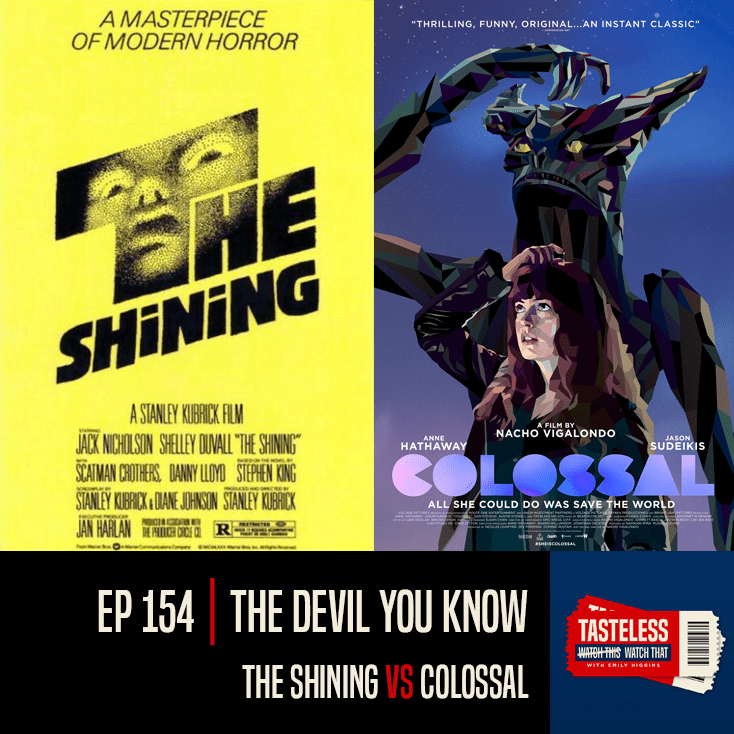
The Devil You Know: The Shining vs Colossal

The Shining vs Colossal

Two movies about the real dangers being closer than you might think — it's The Shining vs Colossal.

Episode Transcript & Analysis

Every episode of Tasteless, I take a critically acclaimed film and compare it to one that shares the same themes but didn't get the attention it deserves — and explain why that second movie is my pick. This week: two movies about the real danger being closer than you might think. It's The Shining versus Colossal.

The Shining

A family heads to an isolated hotel for the winter, where a sinister presence influences the father into violence. At the same time, his psychic son sees horrifying forebodings from both the past and the future.

This movie came out in 1980. It has an 84% on Rotten Tomatoes and is number 63 on the IMDB Top 250.

It is of course based on the Stephen King book. Stephen King does not like this movie. Even though it's widely regarded as the best adaptation of his work — up there with Misery — the novel itself was very personal for him, so I don't blame him for feeling negatively about changes made to the story. He said the visuals were stunning but that there was no substance. He is a writer who has battled alcoholism and substance abuse, and his book was about a writer who is battling alcoholism. He feels it's personal, and Stanley Kubrick did make some changes to his work.

Some of the most iconic moments in this movie were not in the book. The elevator full of blood, the creepy twins, the line that Jack Nicholson improvised — here's Johnny. I would be mad if I was Stephen King and the most iconic parts of the movie based on my book were not my things. I truly would. I totally get it.

Now, Stanley Kubrick is no saint. He's a sicko. He is well known for being awful to his actors, requiring way too many takes, just taking it all too seriously. The only person he was nice to was the kid, Danny Lloyd, who plays Danny — the kid who has a weird voice in his mouth, Tony, and moves his little finger and says red rum, red rum. Little creepazoid. Danny the actor was told it was a drama when they were making this movie. He didn't know it was a horror. He only saw a very cut-up version of it and didn't see the full thing for 11 years.

Jack Nicholson plays Danny's dad, Jack Torrance. Obviously Jack Nicholson has some iconic roles. He has won three Oscars and been nominated for another nine — the most nominated male actor in the Academy's history. The three he won were Best Actor in As Good As It Gets, Best Supporting Actor in Terms of Endearment, and Best Actor for One Flew Over the Cuckoo's Nest. I was shocked to realize he hasn't acted since 2010. Did we know that? I knew the moment that Cameron Diaz said she retired. I don't remember hearing that Jack Nicholson retired.

Jack Torrance is an alcoholic who claims to be five or so months sober at the time he takes the job at the Overlook Hotel, where he's going to be a caretaker over the winter. Basically, when the hotel isn't in service and there's no guests, he's there to make sure no pipes burst, to do little maintenance things so they don't come back to a totally destroyed hotel. He takes this job because he wants to be a writer. He wants to work on his writing. So you go, you stay at this isolated hotel, you check the pipes, you check the furnace, and then you get the rest of the time to yourself to write. He drags his kid and his wife Wendy to the Overlook Hotel in the middle of nowhere surrounded by snow and sets to work writing his novel, which is very frustrating to him. And the entities of the hotel begin encouraging him to do bad things.

His wife Wendy is played by Shelley Duvall. I have such an affinity for Shelley Duvall. I used to watch Shelley Duvall's Bedtime Stories, Faerie Tale Theatre. She was Olive Oyl in Popeye. She has such a soothing presence, and I think that's why her appearance in The Shining is especially striking.

Yes, she is frail in some ways. But I love that she's the one who starts fixing stuff around the hotel. She's puttering around, checking on stuff, getting involved. She's chatting on the CB radio with the police in the next town over. She keeps it together to protect her son despite the fear she feels when things start going south. Despite the fact that her husband is more physically powerful than her. Despite the fact that she has no one to turn to. She does everything she can for Danny, and there's a power to this woman who always thought she couldn't amount to much pulling it together for the person she loves most in the world.

Shelley Duvall's last acting job was in 2002, but in 2016 she had an upsetting and what many argue was exploitative appearance on Dr. Phil, where she talked about hallucinations that had plagued her. She believed Robin Williams was still alive as a shapeshifter, among other things. It was very sad, and I hope she's getting help. It was upsetting to see her be treated with such a lack of care, not allowed her dignity — to be put on TV and clearly be so unwell.

But this isn't the first time she's been mistreated. Stanley Kubrick's horrific treatment of her is well known. She suffered from nervous exhaustion throughout filming, including physical illness and hair loss. Despite Kubrick's fierce demands on everyone, Jack Nicholson admitted to having a good working relationship with him. Even Jack says he was a completely different director with Shelley Duvall. He allegedly picked on her more than anyone else, as seen in the documentaries Making The Shining and Stanley Kubrick: A Life in Pictures. He would say she was wasting the time of everyone on the set. She later reflected that he was probably pushing her to her limits to get the best out of her and that she wouldn't trade the experience for anything, but it was not something she ever wished to repeat.

I feel like you have to — I'm sure it was horrific and she has to say, well, I'm sure he just wanted the best. No. He was terrorizing her.

Jack Nicholson and Shelley Duvall have expressed open resentment against the reception of this film, feeling that critics and audiences credited Stanley Kubrick solely for the film's success without considering the efforts of the actors, crew, or the strength of Stephen King's underlying material. Nicholson and Duvall both said the film was one of the hardest of their careers, and Jack Nicholson says he considers Duvall's performance the most difficult role he's ever seen an actress take on.

Another person on set Kubrick treated horribly was Scatman Crothers, who plays Halloran, the chef at the hotel. He's the guy who gives the family a tour when they first go up there, and he has psychic abilities similar to Danny's, which he calls the Shining — that's what the ability is called, to sort of see inside people's minds, see things that haven't happened yet. You explore that more in Doctor Sleep, which is the sequel and Danny's story — it's an interesting movie, a little long.

Halloran's character is complicated because he definitely falls into the Magical Negro stereotype — he comes in with some wisdom to help the white people but is otherwise not really heard from. He's really only there to serve the story of the white characters. Watching the movie, I like his presence in the film. He cares about the family, he connects quickly with Danny, he wants to protect them. But he definitely isn't given his own story. And Stephen King is — I love some of his writing — he's also problematic in a lot of areas. In terms of race, in terms of gender. He was a man of his time and that doesn't excuse it.

Jack Nicholson is the one that suggested Scatman Crothers take on this role. Apparently Kubrick originally wanted 70 takes of the scene where Scatman gets killed by Jack Torrance. But Jack Nicholson talked Kubrick into going easy on the 69-year-old Crothers and stopping after 40 takes. At one point during the film, Crothers became so exasperated with Kubrick's notorious compulsive style of excessive retakes that he broke down and cried, asking, what do you want, Mr. Kubrick?

People are crying on the set. If someone is crying at your job — multiple people are crying at your job because of you — something is not right here.

I can't deny that this is a good movie. But is it worth what went into it? The psychological tearing down of human beings for a movie? I don't know that it is.

There are other elements of this film that contribute to its success, to the tension it builds. The sound design is not something I usually notice, but there's a scene where Danny's on his little trike, riding around the hotel, and he's going over hardwoods and then carpets and then hardwoods, and you hear it — it just really envelops you. I was surprised there weren't any Oscar nods for this movie, at least in the sound categories, the effects categories, and the music — very modernist music that Kubrick chose himself, but he left the process of matching passages to scenes to the music editor Gordon Stainforth, whose work on this film is known for the attention to fine details and remarkably precise synchronization. Every piece of this movie was chosen so carefully, like wringing blood from a stone, and it did come together.

Colossal

Gloria is an out-of-work party girl forced to leave her life in New York City and move back home. When reports surface that a giant creature is destroying Seoul, she gradually comes to the realization that she is somehow connected to this phenomenon.

This movie came out in 2016. It has an 81% on Rotten Tomatoes.

The Rotten Tomatoes review was interesting. It says Colossal's singular strangeness can be disorienting, but viewers who hang on may find the genre-defying execution and Anne Hathaway's performance well worth the ride. I would strongly agree. I think this is such a hard movie to market, such a hard movie to explain, and then you watch it and it's nothing that you thought it would be, but also perfect.

Nacho Vigalondo directed and wrote this movie, and he previously wrote and directed Timecrimes (aka Los Cronocrímenes), which is a highly thought-of film that I need to watch. He also co-wrote Paradise Hills, which came out in 2019 — an interesting story where Milla Jovovich is running a strange reform school, and it's also very female-focused and -driven. I appreciate what he's putting out. His body of work is really interesting.

Now, let me be the first to embrace Anne Hathaway's name change to Annie. She said on The Tonight Show that she goes by Annie with all her friends and just in life, and that she put Anne on her SAG card when she was 14 years old but she wants to be known as Annie now, and I'm here for it. I will always respect Annie Hathaway. She's still not getting the respect or the credit that she deserves. She was a comedic genius in Ocean's 8. The Princess Diaries is one of the best movies of all time. She can sing, she can make fun of herself. What more do you want? I will see anything she's in. She's one of those actresses where if a movie of hers is coming out, I will go see it.

Colossal is such an interesting, unexpected story, but I expected nothing less of her. I went to see it because Annie was in it as Gloria, and sometimes that's all I need to get me into a theater. By the way, I miss movie theaters so much. I went to see this movie thinking it was a quirky dramedy about a woman struggling and it turned into something much deeper and darker and something that I've been thinking of ever since I saw it.

Now, this is a movie I would love for you to watch before listening to me talk about it, because watching it unravel was just a really great movie-viewing experience for me. I went in pretty blind and was really excited about what happened and the story that was told.

Jason Sudeikis is a large part of why this movie becomes haunting. He plays Oscar, someone who still lives in Annie's old hometown. When she is forced to move back home — because she's been kicked out of her boyfriend's place for being out all night partying — she runs into Jason and he offers her his friendship and a job at the bar he inherited from his father.

You see small glimpses of his bitterness. As kids, Annie was praised for her writing and then went on to write as a career, whereas Jason, who wanted to write, didn't win any awards and feels stuck carrying on his father's dream instead of his own. We see Jason's anger when Annie grows close to a different man in the town, a friend of Jason's. Jason brings her gifts, things she talks about wanting while drunk and has no memory of in the morning. He seems helpful, solicitous, thoughtful. But there is a dark undercurrent. There are strings attached to everything that he does.

So the big thing of this movie, the piece that is woven in so interestingly, is the monster element. A monster — a big monster — destroys Seoul, South Korea. Annie feels weird about it. She hears about it and she's like, beyond the fact of, oh my God, monsters are real and it's destroying things — this monster in the news, it appears, it destroys things, it disappears. No one can tell where it goes. And she is disturbed by it.

She slowly realizes that at a certain time every morning when she is blackout drunk, she is going to a local playground, and any actions she takes in that playground reverberate through Seoul as the motions of a giant monster. Annie tells Jason and her other new friends about the strange phenomenon, showing them how it works, showing them that when she scratches her head, the monster scratches its head.

And in that moment, Jason realizes a way he can feel powerful. He's so powerless in his life, so out of control. But when he steps into that same playground at the same time, he becomes a giant robot in Seoul alongside Annie's monster. Capable of crushing buildings — and more importantly, capable of getting Annie's attention.

Their actions reverberate through Seoul. If they accidentally step on a car with people inside, those people are really dead. If they run into a building and it crumbles, those people are dead. Annie is aghast, distraught at the thought that he will hurt people, and she tells him to stop. He refuses. She falls to the ground in the park — they're fighting — and she falls and lands on people, on homes, on cars.

There is a moment where she slaps him and you can feel the darkness. You're ready for him to punch her, but he doesn't — not that time. He laughs about it. He laughs about it in a way where you can tell there is more underneath the surface.

This movie is all about what lies beneath — the elements of people that are unseen, that they try to hide.

Even Dan Stevens, the guy she was dating at the beginning of the film who comes to rescue her, to check on her, who seems like a good fit for her, who wants her to overcome her dependency on alcohol — he says to her later in the film, you owe me an explanation. She says, no, I don't. Because guess what? She doesn't. We see these men in her life trying to exert control over her.

The movie takes these massive elements — these big swings, these monsters, a robot and a monster fighting — and somehow distills them into these very small truths, truths that I rarely see on film.

It is crazy to me that this movie was hit with a lawsuit in May of 2015 claiming it had too many similarities to Godzilla. Number one, you don't own giant monsters. This monster looks nothing like Godzilla, and the monster part of it is not the important part. The monster part is a piece of something bigger. This is nothing like Godzilla. If you go into this wanting a monster movie, that is not what you're going to get. So Godzilla can suck it.

Shared Themes

The Shining and Colossal explore worlds with unbelievable horrors — elevators full of blood, gigantic monsters appearing out of thin air. But the real villains in each film are much closer to home. People who are already in our lives. The real horrors of these movies are the dangers that can be found in the everyday, from those you are close to and from yourself.

In The Shining, Jack Torrance is possessed by entities of the hotel, sure. But it is Jack who turns on his family. It is Jack's face they see, here's-Johnny-ing his way into the bathroom. It is Jack who screams at his wife to leave him alone when he's writing. Jack who drags them out to the isolated hotel in the first place. Jack controls their lives and they must tiptoe around him so as not to incur his wrath.

Wendy is never surprised by Jack's actions. Not really. She knew he had the capacity for this hatred. When she sees that their son has been strangled, she immediately believes it's Jack, because he previously broke Danny's arm. The events that lead to Jack taking on the role of the caretaker aren't important to Wendy or Danny. All that matters to them is who is attacking them and whether they can survive his attempts. If there is a ghost caretaker or not — they don't want to be harmed by their family.

Danny sees the twins, he sees the man in the bear outfit, but those beings aren't the ones he runs from. Yeah, the gross lady strangles him, but it is his father he spends much of the movie trying to escape. Jack becomes part of the horrors of the hotel, but the reason he is the most upsetting entity that could attack Wendy and Danny is because he is supposed to be someone who loves them.

He is terrified at first when he has his nightmares about killing Wendy and Danny. But eventually he gives it all up, gives them up, sells his soul for a drink — agreeing to be caretaker of the hotel forever at the cost of his family.

The writing scene is the best example to me of the mix between the possessing entity and the culpability that Jack himself has. Jack Nicholson said that the scene where Jack snaps at Wendy for interrupting his writing was the most difficult for him, as he was a writer himself and had gotten into similar arguments with his girlfriend. Being a method actor, he drew on his memories of those arguments and added the line: or if you come in here and you don't hear me typing — if I'm in here, that means I'm working. This moment could have happened even not in a demon hotel, because Jack is frustrated. He can't write. He can't do it. It's not coming out of him. He doesn't have the life he wants. He doesn't have what he thinks he deserves and it makes him angry, and he turns that anger on Wendy.

In Colossal, we see the monster that Anne becomes and the evil robot that Jason becomes and we understand they are killing people in Seoul, but we don't witness those deaths. I feel the stress and fear that Annie feels as she tries to keep from falling over and having her kaiju demolish the city. I feel her anxiety as she works to convince Jason not to enter the playground and kill thousands. But my fear is not with the people of Seoul — it is with Annie, and how she will stop him, and how she stops herself.

Annie realizes that her actions — her drinking and blacking out — lead to the monster terrorizing Seoul, and is devastated by the collateral damage she has caused. At one point, smacking a helicopter by mistake, killing those inside of it, and coming to the realization that there are consequences for what she does. She has to work to turn her life around. Her life falling apart hadn't been enough to change her behavior — getting kicked out of her apartment, moving back home, she goes right back to drinking all night every night, this time with Jason and his buddies. But when her actions begin affecting people's lives in Seoul, that makes her realize a change must be made.

Jason terrorizes Seoul on purpose as a way to mentally screw with Annie. He will set his entire life on fire to prove a point, to prove he has control. He sets off an insane firework in his bar, scaring off patrons, starting a real fire, to show Annie that no matter what he does, she cannot leave him, because he will hurt others. This is textbook abusive behavior.

The people of Seoul and the wider world wonder what is happening, why they are being plagued with fighting beasts, not knowing that it's the actions of two people struggling with their own inner demons and with one another.

The monsters in these films aren't monster monsters. They're ourselves. They're people. They are our own inner worst inclinations.

Alcoholism for our characters leads to unintended consequences, to things they never could have imagined, but they are ultimately responsible for.

For The Shining, I have to point out that Stephen King said he didn't like Kubrick's interpretation of Jack's alcoholism, that it wasn't his Jack from the book. In the book, Jack starts out as a good guy, he's possessed, he gets redemption in the end, sacrificing himself. But the Jack in the movie is not a good guy. While he tries to be good for his son and wife, he can't maintain it. He succumbs to his addiction. He is always troubled — as is Anne in Colossal. She starts the movie as a difficult person without a care for those around her or for herself, and she has to be shown the error of her ways.

In the beginning of The Shining, both Jack and Wendy say that he is sober. But then he says at the hotel, God, I'd give anything for a drink. I'd give my soul for just a glass of beer. And Lloyd, the devil stand-in of the hotel in his red coat, pops up and supplies that drink, starting Jack's true descent into possession and madness. It is that drink that sets him on his path — but he is the one that asked for it, that couldn't stop himself.

Wendy worries that he's been drinking again when she sees Danny has been strangled. She thinks Jack is possessed by his own alcoholism rather than hotel ghosts, because it's a possibility in her world, a possibility she's dealt with before — when he broke Danny's arm. There were no Overlook Hotel ghosts to blame when he did that.

In Colossal, Annie has been dealing with her own alcoholism, claiming she'll stop drinking but continuing to make poor choices, staying out all night, not looking for a new job — so she's kicked out of her boyfriend's apartment, forced to move back to her hometown. The consequences aren't just losing her boyfriend or being unable to keep a job. Now her drinking leads to death and destruction, leads to a monster rampaging through Seoul. When she trips and falls in the playground, the kaiju falls, crushing city blocks. She kills an untold number of people.

It's not that when she drinks she planned for this to happen. No one plans for this to happen. But when she realizes that's what's happening — that's what sets her apart from Jack. He realizes what's happening and asks for another drink. Annie works to stop herself.

There's a toxic masculinity rampant in both films, explained away by the alcoholism but part of a bigger issue.

Jack constantly tries to overpower his wife and child in The Shining, using his physical strength and his relative power in the situation to his advantage. He is just always frightening them, busting in on them.

Now, Stephen King said in an interview that Shelley Duvall's Wendy is one of the most misogynistic characters ever put on film — she's basically just there to scream and be stupid, and that's not the woman he wrote. I think that in itself is a problem of Stephen King's and not of the film's — that he believes Wendy should not have emotion, that no emotion is what's required to be strong. Wendy is strong and she is scared and those two things can coexist. Wendy does everything in her power to stay strong for her son.

While Jack continues to blame his own behavior on outside factors — he talks about how breaking his son's arm wasn't his fault. Everything is someone else's fault for Jack, and for Jason in Colossal. Jack thinks everyone should do what he says. He got this job, they will follow him there, they will not interrupt his writing. He is the man, he is in charge. So it's not surprising when he acts how he does. He's told by one of the ghosts, keep your woman in line, and he's like, I know, I need to, she's gotta do what I'm saying.

It's shocking in Colossal when Jason shoves Annie to the ground — even after we've seen her slap him several times, which is not okay, she should not have hit him. But you are ready for his retaliation. Jason blackmails Annie, threatening to kill people in Seoul if she doesn't do as he says — if she doesn't drink when he tells her to drink, stay out late when he tells her to stay out. He wants to own her. He shows her his power over her time and time again because he enjoys it. He enjoys being the arbiter of her world. And then to apologize, he furnishes her home, further inserting himself into her life.

Annie feels responsible for what Jason chooses to do. When he threatens to kill people, she feels it's her job to stop him. Women so often take on emotional burdens in society. This is an exaggerated example of that. Annie is ready to sacrifice her own freedom to keep Jason from punishing her with the assault of Seoul. When Jason realizes Annie has gone home with another man, he becomes extra cruel. He doesn't want other people to have her time or attention. And it's not that he even wants her love. It's not that he wants to go out with her or thinks he's a good guy. He's fine with her knowing that he's a monster — as long as she submits to him.

And we see even her ex-boyfriend Dan Stevens try to control her — he wants to save her, but only when she's behaving in a way that he approves of.

What Colossal Did Better

I think both films are really good and worth a watch. And I don't think you can deny that The Shining is a classic for a reason. But let me talk about a couple things I think Colossal does that, if you can only watch one movie, I would encourage you to choose Colossal.

The Shining is an incredible piece of filmmaking, and the characterization of its villain and his wife are very representative of a certain time. Men who are outwardly aggressive, who are told to keep their women in line — as Jack is by the entities of the hotel. None of it is shocking. We remember Jack as a drunk, evil man. We remember Wendy crying, shrinking back from him. And if you're Stephen King, you remember that as weak. I see how these broad strokes are how you would explain the movie to someone. Wendy crying, Jack screaming.

Colossal explores a more insidious form of evil. A good-looking guy who doesn't actually do anything to you. Who threatens someone else to keep you under control. Who apologizes and gives gifts when he's in his right mind, but goes right back to manipulative tactics when he's not getting his way. Jason exerts control over Annie because he finally can. He was mad that she didn't want him. Mad she achieved success while he stayed stuck in a town he felt too big for.

I felt surprised to witness this sort of man on screen — this man that I know well but that I don't see represented often enough. The villain that you see in rom-coms as the love interest. It's insidious. It's small but it's powerful.

I just watched Promising Young Woman when it came out for rental — immediately paid my $19.99. It's the only other film that made me feel the same way that Colossal did. It's one of the only other times I've seen this sort of nice guy explored — someone who seems so inoffensive, but there's an evil. I think Colossal is a uniquely modern look at how misogyny has evolved and what to look out for. It's much more upfront about the dangers of toxic masculinity. The alcoholism is a problem Annie battles within herself, while the controlling, power-hungry nature of Jason is unleashed on her. It's an outside force that many of us have had to contend with.

The Shining is incredible, with lines I could quote forever. I'll always watch it again if it's on. But Colossal is the movie that haunts me because it feels so apt for my own life. That's a personal thing, but I do think it is a more modern version. And maybe in 41 years you may watch Colossal and say, this doesn't relate to me. But right now, it is the movie for right now. For me.

Also, the resolution of The Shining wasn't as satisfying for me as the resolution of Colossal was. In The Shining, Wendy and Danny escape, Jack is frozen. There are no further consequences for him, and no further information about Wendy and Danny or any closure for those two. They run away, and only the viewers see Jack frozen in the snow, his sad little face, his Jack Nicholson grin, and the horrors of Jack Torrance die with him. You're not thinking about the future of the hotel when it reopens, if it will claim more victims — because the monster was Jack. And Jack's story is the one being told by The Shining. Not Wendy's. Not Danny's.

There are no doors opened on Wendy and Danny, on who they'll become after this, on who they thought they were. We see Wendy and Danny by themselves, overcoming what Jack does to them. But we know the most about Jack. This is Stephen King's story about himself at its core — about a writer who struggles with alcoholism and with his perception of himself, his love for his family waging war with his desire to just write, to accomplish something greater, to leave a legacy.

And Jack is not a man whose story I want told. I'm sick of seeing the abusers getting their backstories, being asked to empathize with them.

In Colossal, Jason's evil is representative of so much more. Defeating him doesn't defeat Dan Stevens thinking Annie owes him an explanation. Defeating him doesn't stop his friends from minimizing his behavior and enabling men like him and excusing them. It defeats this one man, this one demon in Annie's life, and for now, that's enough. The movie never makes excuses for Jason. Jason does. His friends do. But we see through them because of the brilliant direction and acting by all involved — because we are not meant to forgive him.

Colossal is Annie's story. She has changed who she is. She stands up for herself, but she also stands up for the people of Seoul, becoming their savior. It's not something she needs credit for. It's something she does for herself, for them, for the greater good. There's a feeling of a future. She realizes what she's been through and we get the sense that her path will continue to be a good one.

I love the humor beat it ends on. She has just faced off against a monster. No one knows, no one will ever know, and she goes into a bar to recuperate — it's just the first open door. She talks to the woman there and asks if she'd like to hear a story. The woman says, of course — because she works at a bar and wants a tip. Of course. Would you like a drink? And Annie's grin turns into a frown and she heaves a sigh. She knows she can't have a drink. She knows that's something she'll struggle with for the rest of her life. But she's going to contend with it — with humor — in her continued battle to be her best self and to do right by those around her.

I hope you will give Colossal a chance. You will give Annie Hathaway a chance — newly minted Annie. It's worth a few bucks for a rental. It really is.
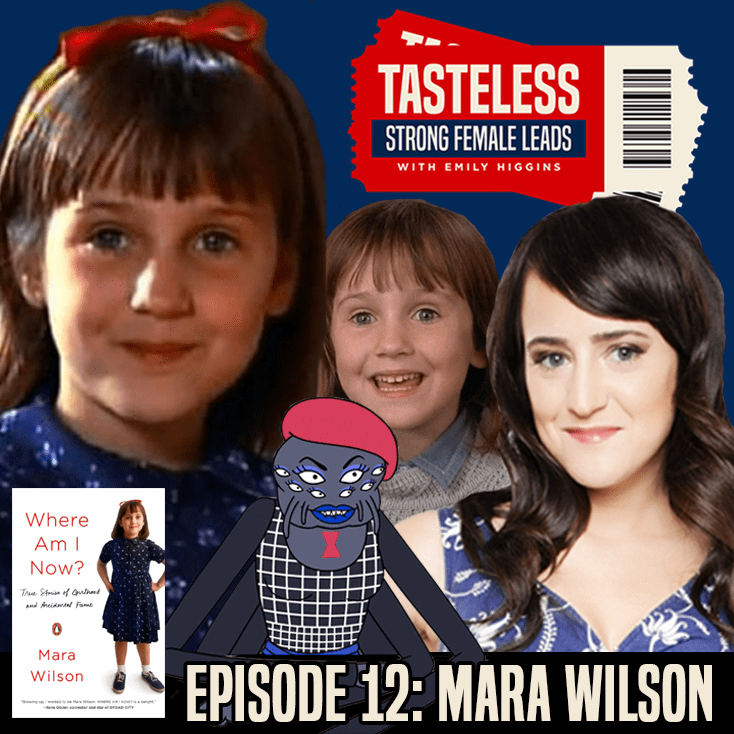
Mara Wilson | Strong Female Leads

Mara Wilson Strong Female Leads

Mara Wilson (Matilda, BoJack Horseman) truly feels like a best friend when chatting with her, and can talk about anything with ease and humor. We cover psychological studies, attractive 90s looks, and very specific movie genres in addition to discussing her acting career, her book (which I love) Where Am I Now? True Stories of Girlhood and Accidental Fame, and how she curates such a perfect Twitter feed.

Follow Mara on Twitter and Instagram | Read Mara's book, Where Am I Now? | Mara is on Cameo | Read more Mara on Shan't We Tell the Vicar | Listen to Mara narrate The Faceless Old Woman Who Secretly Lives In Your Home

Go Your Own Way: Trainspotting vs Ass Backwards

Trainspotting vs Ass Backwards

Two darkly humorous movies about living life outside the bounds of polite society and overcoming dependencies - it's Trainspotting vs Ass Backwards.

Episode Transcription & Breakdown

Every episode of Tasteless, I take a critically acclaimed film and compare it to one that shares the same themes but didn't get the attention it deserves — and explain why that second movie is my pick. This week: two darkly humorous movies about living life outside the bounds of polite society and overcoming dependencies. It's Trainspotting vs. Ass Backwards.

The tone of these movies is different, yes. But at the end of the day they explore similar emotions and should hold equally important places in the pantheon of cinema.

Trainspotting

Renton, deeply immersed in the Edinburgh drug scene, tries to clean up and get out despite the allure of drugs and the influence of friends.

This movie came out in 1996. It has a 91% on Rotten Tomatoes and it was nominated for an Oscar for Best Writing for a screenplay based on material previously produced or published, for John Hodge. It's number 164 on the IMDB top rated movies, so it's pretty entrenched in movies that people enjoy.

My first thought when watching this movie is: I don't know what I'd want to be called less — Sick Boy or Spud.

Let's talk Renton, aka Ewan McGregor. Ewan McGregor can pull off a crop top and an earring so well. It's such a good look on him — except for the skinniness. To play the skinny, heroin-addicted Renton, he lost 26 pounds. IMDB trivia claims he achieved this by grilling everything and by drinking wine and gin instead of beer. It must be nice to be a celebrity. They're like, you want to lose some weight? I'll just grill my foods. Ho ho ho. Great. Whatever.

I was very annoyed by this very actor-y thing: McGregor considered injecting heroin to better understand the character but eventually decided against it. This is the thing that makes me mad about actors. Really? You were going to try heroin for your movie job? Come on, cool it. It's a real Jared Leto move, so I'm glad he didn't wind up doing it.

Back to the crop top. Imagine if everything else in Moulin Rouge was the exact same except the entire time Ewan was wearing the crop top he wears in Trainspotting at the club scene. What a delight that would be.

Look, Ewan McGregor has been part of these massive things. He was Obi-Wan in the Star Wars prequels, he was in Tim Burton's Big Fish, he was Dan Torrance in Doctor Sleep, he was on the Fargo show, he was recently really great as the villain in Birds of Prey. He's part of these massively famous properties and universes, but he gets to go a little under the radar because we don't know him better from a scandalous personal life. We really only know him from his work. He's very talented, he always brings something new, he always chooses interesting projects. I can hate one character of his and love the next — he's not always doing the same exact thing. And when he's not acting, he's out there motorcycling around. He delivers vaccines to remote villages. What a guy.

In this movie he is a heroin addict who tries to get clean and hangs out with a bunch of other heroin-addicted friends. One of his friends is Spud, played by Ewen Bremner. Spud's a nice guy, a little dumb, but there's no malice to him the way there is with some of the other characters like Sick Boy and Begbie. The actor, Ewen Bremner — another Ewan — is a face you know from everywhere: Wonder Woman, Snowpiercer, Pearl Harbor, Perfect Sense (which also has Ewan McGregor and is so good). He also played Renton in the stage version of Trainspotting.

Johnny Lee Miller plays Sick Boy — obsessed with James Bond, probably the dad of baby Dawn who dies. Yes, this movie has a baby die. It's tough because watching it now, the fake baby is so fake that you've got to really push that aside to get on board with the emotional turmoil. But the acting is great. Sick Boy is just always babbling, and he's the one who becomes kind of a pimp and a creep. He steals from Renton. He's just a real jerk. The actor Johnny Lee Miller is probably best known for Sherlock Holmes in Elementary and for being married to Angelina Jolie for a minute. I would love to hang out in a room with everyone who has had a long-term relationship with Angelina Jolie. It is such a varied bunch. That is a gang I want to start.

Robert Carlyle plays Begbie. Begbie doesn't do heroin, but he is a maniac. He just loves to attack people. He gets his jollies from fighting. I knew him best because he plays Rumpelstiltskin in Once Upon a Time, a show that I loved on ABC. He was one of the most compelling elements of the show along with Lana Parrilla as the Evil Queen. They were two perfect villains.

Now, usually, if you know anything about me, you know I've always had a problem with J.K. Rowling. Before it was cool, okay? Before we found out she was a TERF. I was always a little annoyed that she waited until all of her books were sold and her movies optioned and then she said, by the way, Dumbledore was gay. Okay, well, why couldn't you have said that? Don't start with me, Harry Potter fans. I can't, I'm too tired.

But I thought this was interesting — maybe a little hypocritical of me. In 2009, Robert Carlyle told a BAFTA interviewer that he played Begbie as a closeted gay man whose outbursts of violence were due to his fear of being outed. Irvine Welsh, who wrote the movie's source novel, confirmed that he wrote the Begbie of the book to have an ambiguous sexuality and agreed with Carlyle's interpretation of the film's version. That's interesting to me because Begbie has a scene where he's going to go home with a woman and then finds out that she is a transsexual woman and gets very upset and fights with Ewan McGregor over it. For all of their faults — the heroin use, letting a baby die, et cetera — they are very accepting of their friends. Whatever, whoever you want to go home with, it's cool. So I think that's an interesting layer.

Also in this friend group is Tommy, played by Kevin McKidd — he was the cute one. I felt so bad for him because the actor missed the photo shoot for the promos, so he's not in any of the promotional photos, not on the DVD cover. But guess what? He's been in 288 episodes of Grey's Anatomy. He's fine.

This movie also has Kelly MacDonald, who plays a young woman that Ewan McGregor meets when he's in his crop top at a club, goes home with her, has sex with her, and finds out she is in school. She is a schoolgirl. It is illegal. So she blackmails him to keep hanging out with her. Upsettingly — not because I'm a pervert, but because I'm sick of films doing this — the sex scene between Ewan McGregor and Kelly MacDonald had to be trimmed for the American release because it appeared that Diane seemed to be enjoying it too much. You find that's often the case with what they want cut when it comes to sexuality in a movie: they want anything having to do with women cut out. But Kelly MacDonald, for being so much younger, really holds her own with this group of guys when we do see her.

This movie is known for a couple of its upsetting parts — baby Dawn dying, the worst toilet in Scotland, which is this disgusting poop scene. Every trivia thing, every video about Trainspotting, they're all like: don't worry, the poop was actually chocolate and smelled quite pleasant. Well, yeah, I didn't think it was poop. So thanks though, I guess.

This is one of those movies you need to watch because it's a slice of life of people you probably would never be exposed to. And for a movie this dark, humor can go a long way in making you empathize with the characters. The movie is funny. It has really funny moments and really dark moments and is just beautifully acted. Ewan McGregor is, I think, really an unsung hero.

Ass Backwards

Two best friends (Kate and Chloe) embark on a cross country trip back to their hometown to attempt to win a pageant that eluded them as children.

This movie came out in 2013. It has a 27% on Rotten Tomatoes.

I saw this movie at Outfest in Los Angeles when it premiered, because I'm such a big fan of its co-writers and co-stars, Casey Wilson and June Diane Raphael. After the movie screened there was a Q&A, and then I nervously approached Casey and June and June’s husband Paul Scheer after and just said how much I loved it and scurried away. It was one of my first very exciting Los Angeles experiences.

Casey Wilson and June Diane Raphael are brilliant women, friends, writers, comedians, actresses. Together they wrote Bride Wars, which I did an episode on. Love that movie. But this is a very different kind of comedy, although it does share themes of friendship.

Casey Wilson plays Chloe. Individually, Casey was on one of my all-time favorite shows, Happy Endings. I enjoy her podcast Bitch Sesh with Danielle Schneider where they talk about the Real Housewives and have great guests — whenever June shows up on that show, I'm dying laughing. Casey is currently on Black Monday, which looks up my alley but I don't have Showtime. She popped up in Gone Girl. I'll listen to any podcast she guests on.

There's a point at the end of Ass Backwards where she starts doing finger guns. She's on stage at the pageant, doing finger guns, and it's just such a great small moment. She can sing — she has an incredible voice — but will also utilize it for comedy. There's a Comedy Bang! Bang! sketch on the TV show where she sings a song about Cheez-Its. I think it's a Les Mis song but about Cheez-Its, and I think about it all of the time. She's so talented, so funny, and she has a book coming out called The Wreckage of My Presence, which is essays by her, and I'm really excited for that.

Her character Chloe is a mess. She works dancing and singing in a box — a glass box at a club — so no one can actually hear her sing. She's hung up on an ex-boyfriend from almost a decade ago. And all she has is her friend Kate.

Kate is played by June Diane Raphael, also a genius actress. She's in Grace and Frankie. I adore her podcast How Did This Get Made, which covers a lot of the same movies that I fight for here. And I love her love for Grease 2. She's so funny and brilliant. She has put her weight behind important political information and movements, writing a book along with Kate Black called Represent: The Woman's Guide to Running for Office and Changing the World. She participated in Fire Drill Fridays with her co-star Jane Fonda and founded a space called The Jane Club in Los Angeles, which started as a co-working space for women, for moms, but has morphed into an online sanctuary with classes and connection. Basically, June and Casey walk the walk. They are incredible women in addition to being the funniest.

A moment in Ass Backwards where June really got me: her and Casey go up on stage at an amateur night at this strip club because they need to make money to get to their next location — it's a road trip comedy. She gets up on stage and there are guys surrounding it, and she just starts shaking hands with the guys surrounding the stage and says, nice to meet you. Very politely. Her delivery — she's really good at a deadpan, whereas Casey is really good at an insane reaction. Then June gets very centered and quiet, and they're both equally crazy in the best way.

Also featuring in this movie as Kate and Chloe's rival — although the rival doesn't know it — is Alicia Silverstone. Clueless, The Crush, the Aerosmith music videos — but she has appeared in so many really interesting, darkly comedic roles in recent decades. Ass Backwards, Catfight with Anne Heche and Sandra Oh, The Killing of a Sacred Deer with Nicole Kidman and Colin Farrell. She's really picked some interesting projects.

There's a delivery she has — because she can do so broad, but she can also do dark, she can do somewhat oblivious, and she can be an awful person. She's talking about her charity and she says, it gives makeovers to low-income gals so they can have the opportunity to look like me, if only for one day, and says it with such conviction.

Kate and Chloe have seen this woman — she plays Laurel, who won the beauty pageant against them and now has a book and is successful. Kate and Chloe are trying to find their way in life. They go to see Laurel and Laurel has no idea who they are. She keeps calling them the wrong name. At the end, after they have a full-on meltdown at the pageant, Alicia Silverstone just very firmly says, Sherry, Faith — which is of course not their names. It's a perfect moment of comedy. It's so good.

Vincent D'Onofrio plays Casey's father — from Men in Black, Daredevil, Ratched. He has given everything to his daughter and her friend. He has not retired because he has been trying to help them. And they have to realize the way that they are hurting him.

Brian Geraghty, from The Hurt Locker, Chicago PD, Big Sky — he plays a guy who was on a show like Intervention but called Rehabilitation that Kate and Chloe love to watch. They see him, they meet him in real life, and he shows them some hard truths about themselves.

I love the darker comedic elements of the movie and I also really enjoy the just strange moments. When the two women get into a fight and are going their separate ways, there's this instrumental of "I Touch Myself" playing, and Kate runs into all these children — because there's been this overarching theme. Kate calls herself a CEO; she sells her eggs. She starts thinking about the fact that there could be all of these babies, little girls, out there from her eggs, and it starts to weigh on her. She's curious about what's happened. She meets these weird kids in the woods and is spinning around with them while Chloe tears pages out of this stalker book she has, where she keeps a lock of hair from her boyfriend who broke up with her nine years ago. It's so strange and so perfect.

This movie really captures this weird comedic feeling. I watched this with my dad and he is a tough sell on comedy — he's a dad's dad, he loves Airplane! and Young Frankenstein. And I watched this and he loved it. I was like, look, it has Penny from Happy Endings, okay? And he's like, all right, I'll give it a try. And he loved it.

I have such a fascination with the comedy of beauty pageants. They're such a specific, odd, foreign-seeming thing. This is a very strange, great movie.

Shared Themes

I know you're thinking, what? How? But let's get into it. I'm pretty proud of this one.

Our characters in Trainspotting and Ass Backwards live their lives outside the boundaries of polite society. They have chosen a different path from what is traditionally set out for us, and while it fulfills them in some ways, it does make their lives more difficult, and they have to come to terms with that.

Renton admits in Trainspotting that he knows what normal life is supposed to be like and that he is continually choosing a different path. His opening monologue is famous: Choose life. Choose a job. Choose a career. I chose not to choose life. I chose something else. And the reasons? There are no reasons. Who needs reasons when you've got heroin?

He knows he isn't part of the status quo and he doesn't care. He cares more about feeling good right now, having his little routines, getting off heroin by locking himself in a motel then getting right back on it. He doesn't want responsibility. He doesn't want commitment. He wants what feels good now.

Renton has a lot going for him — parents who are supportive, who do everything they can to try to wean him off drugs, then take a tougher tactic and make him go cold turkey. It's not that he was abandoned and that's why he shuns society. No, it can happen to anyone. I think we all have a friend who hates being bored more than anything else, who will torpedo their life to feel something. And that's Renton — always wanting to feel, wanting something to be going on, except when he does heroin and just lays there.

When Renton gets into a more socially acceptable life working in real estate, his friends come back and rope him into a drug deal where he quickly agrees to test the product for them. He thinks he's not a slave to drugs, that he decides when he does or does not partake, but that risk just shows that he will always have that desire in himself to live on the outskirts. He has to forcibly rip himself from that world by disengaging from his friends at the end of the movie. It's the only shot he has at going clean — to get out of this situation.

In Ass Backwards, Kate and Chloe are not quite so purposefully rebellious, but they also don't choose a career, a family, a big television. Instead they're trying to make ends meet while also still maintaining the closeness to one another and the freedom from the system that they think is important. Kate calls herself a CEO — she sells her eggs. Chloe is a singer in a box. The movie is Ass Backwards because that's these women's approach to life: it's backwards, it's not the norm. Instead of becoming part of the regular system, getting a boring 9-to-5, it's more important for these women to feel as though they have freedom. Yet always scrambling to keep the lights on is a strange kind of freedom — much like struggling to find your next heroin dose doesn't feel incredibly freeing.

Kate and Chloe have spent money on a waterbed but don't have money for rent. They refuse to acknowledge the obligations one has as a grown-up in a big city. When we see them walking the streets of New York discussing its beauty, we are also witness to their delusion. They talk about how friendly people are as they are screamed at. They talk about what good people they are as they give a homeless person a coupon that's valueless. They basically just live in a fully different world.

I was so struck when I was looking up the posters for these two movies. The tagline on the poster for Ass Backwards is "choose your own reality." And, you know, the Trainspotting poster has the "choose life" monologue.

They choose to live on the outskirts. They choose to not integrate. And there's something in watching people like Renton, like Kate and Chloe, that's therapeutic. There's a schadenfreude to it — getting satisfaction from witnessing another person's failures and troubles. The humor of both films comes from witnessing absolutely ridiculous situations, cringing at them, laughing, even as we know and hope we won't have to experience anything half as harrowing, half as embarrassing. It's a very specific type of humor, and I think it's what unites these movies in my mind the most. I Googled to make sure and, thank God, people call Trainspotting a dark comedy. I'm not just a monster.

Renton and his friends in Trainspotting, and Kate and Chloe in Ass Backwards — they all have a dependency that holds them back. Renton to heroin, while Kate and Chloe have a codependency on one another.

We never delve into the beginning of Renton's heroin addiction. We meet him when he's accepted it as part of his life and his days are focused on getting another fix. We see how Spud is unable to get a job — Renton encourages him not to interview too well because they don't actually want to hold a job down. They want to collect unemployment and hang around and do heroin. We see Tommy living a relatively productive life — although he isn't a great boyfriend — until he is broken up with. Then he starts heroin and can't focus on anything else.

It was important and touching that Renton would not give Tommy heroin when he wanted to try it, because Renton knows deep down it's not the right choice, despite making it for himself. He doesn't want to be the one to lead Tommy astray.

But in addition to the drugs, there's a connection among the men who do them — a camaraderie, a shared experience that makes these men close and makes that lifestyle hard to escape. It's what draws Tommy in, wanting to be part of things, something that seems to soothe his friends when they're at their lowest points. He wants that. And they all encourage each other's behavior. They keep each other down like a bucket of crabs — all crawling over each other, keeping any of them from actually reaching the rim.

That's exactly what's going on with Kate and Chloe. After a shared beauty pageant trauma that haunts them — where they lose, do a really bad job — these two women feel that they are the only two people in the world that understand each other, and they encourage one another in deeply unhelpful ways. Kate keeps telling Chloe that a guy who broke up with her nine years ago will definitely want her back. Chloe tells Kate that she's a CEO as she sets up shop in a Starbucks to try to get people to buy her eggs. These women don't understand why they aren't winners, while also not working to better themselves. They tell each other that Kate's poor question answering in the Q&A portion and Chloe's awful singing in the talent portion actually deserve to win.

You should be there for your friends, but you also need a bit of honesty. You can't live in delusion; it's not healthy.

When Kate pretends to be Chloe's therapist and asks Chloe questions about Kate, it's very dark. And that's acknowledged by Brian of Rehabilitation when they meet him, an actual drug addict. They meet him in jail and see that he's not clean despite the TV portraying him as such. They do crystal meth with him. He reaches his rock bottom when he sees how sad the two of them are — how they are still not working through the issues that have been haunting them for decades. He sees them leaning on each other, having the same fight about the pageant that they've been having this entire time, and it opens his eyes.

The addiction Kate and Chloe have to each other, to a delusion, to a different reality, is the closest I'm personally ever going to get to heroin use. That out-of-control feeling, out-of-body feeling, as you watch yourself make the worst, most embarrassing choices.

These movies make a perfect double feature — two sides of the same coin. There's an inevitability in the actions of Renton and of Kate and Chloe, a circular nature. Like that quote about insanity being doing the same thing over and over and expecting a different result. (By the way, people attribute that to Einstein. It's not him. It's not confirmed as having been said by him. But it's that inevitability.) Just trying the same thing, doing it over and over, and it's just not working, but you don't know what else to do.

To move past that, Renton, Kate, and Chloe have to acknowledge the ways they've hurt others and work to become more adult. Doing things that come naturally to most people are a struggle for them. They have to make the choice to actively be better. They don't even really fully commit to that choice, but they start taking the baby steps to get there.

Renton does choose life at the end of the film. Yes, he has to screw over his friends to do so. But they were mostly not very good friends. Who knows if he sticks to it, but for now he's choosing to extricate himself from the bad habits that have plagued him, from the people who have encouraged him to be his worst self, and to become part of polite society.

I know it's not cool. Like, I hate the man. I don't want to — there's falling completely in line with everything that you're told to do, and then there's just being part of humanity. And I think people blur those two too often and think that it's cool to just say "F it" to all of it. No — you're part of a system. If you're living in a house and not a shack in the woods, you're part of a system. Is this episode revealing that I'm very uncool? I'm like, very uncool.

Kate and Chloe get all their pent-up frustrations out when they return to the pageant. They no longer feel like they have an axe to grind, and they choose life as well. They get jobs as baristas — a big step for them. Finally, real jobs with hopefully benefits. They get an apartment in the Bronx that they can afford as opposed to the spot they were trying to live. They come to terms with the realities of the world, realities they had been ignoring for far too long. They pay back the people they had borrowed from. They acknowledge that there is a world around them, there are people around them, that they are not the only ones trying to make it in this world. And they try to right their wrongs.

What Ass Backwards Does Better

So much of both of these movies is about friendship, for better or for worse, and I love that the films explore how important friendship can be in our lives.

But Renton washing his hands of Spud did bum me out a little, whereas I appreciated that Ass Backwards ended with Kate and Chloe still learning with each other. I know Renton says a million times that he's not a good person — they let a baby die, so this isn't the worst thing they do. But so much of the film is about these integral relationships, and they sort of rush by Tommy's death.

Here's what happens at the end. Renton has been sucked in by Sick Boy into another scheme and they wind up with a bunch of money. He, Sick Boy, Begbie, and Spud are all at a hotel. Renton had just gotten his life together and this is really setting him on the wrong path. He tried drugs again. It just isn't a good fit for him. So he decides to take the money and run. Spud opens his eyes in the night when Renton gets the money, and Spud shakes his head at him, but he doesn't stop him. Renton makes a break for it and leaves two thousand pounds in a locker for Spud.

After a movie all about camaraderie, he ditches them. He does need to get away to escape these bad habits. But his whole life has been so dedicated to these friendships, to being this pack animal. And then he just fully ditches them. He bails. He leaves Spud a couple thousand in a locker, but Spud definitely still has an awful life. These friendships are such a crucial part of who he is, and yeah, you need to get rid of friends sometimes, but it was just so unceremonious. Bup, bye.

Kate and Chloe in Ass Backwards may pull each other down, but their friendship is also the strongest foundation they have. If they can overcome their demons and also maintain a healthier version of their bond with each other, that is the ultimate outcome. They have become each other's chosen family in a difficult city in pursuit of their dreams. It's nice if they can still have each other's backs.

And there's an important distinction here as well — the camaraderie over heroin versus the camaraderie over beauty pageants. You'd think in both that you're only out for yourself. In heroin, at the end of the day, if there's only one dose, you're going to take it. Renton says after baby Dawn dies that her mother asks him to mix her up a dose, but she understands she'll only get her dose after he has his. You're out for yourself when push comes to shove.

In the world of beauty pageants, yes, there can only be one winner, but there's also a camaraderie amongst those who lose. Kate and Chloe both didn't place and share the resentment built up after years of feeling that they weren't good enough. I've always had a fascination with beauty pageants. I think they're so rife for comedic interpretation. Miss Congeniality and Drop Dead Gorgeous are two of my favorite films. There's a darkness but also a togetherness of women facing the same chopping block, of all being told they're not worthy. And the exploration of that allows for the women to still have each other's backs up until a certain point, and for there to be redemption afterwards. It's such an interesting space to explore friendship in.

The drug use in Trainspotting feels almost uniquely male, and it really is the ultimate guys-being-guys. There have been papers written on the over-representation of males when it comes to heroin use. The women we see in the film are complaining about the men — the two girlfriends — or they're blackmailing them. While Kelly MacDonald is an interesting figure, these women don't have much going on for themselves.

In Ass Backwards, we cover the shades of gray of all sorts of men and women. And yes, I'm coming from my same old same old not-enough-women-in-films shtick, I get it. This doesn't take away from Trainspotting. Not every movie has to be all things to all people — that would be fully insane. Just like how we can look at older movies and books that are now absolutely not PC and we can still learn something from what they represent from a time. But this podcast is about highlighting something I love, bringing it to the forefront and convincing you of its value.

To that end: Ass Backwards explores the darkness of women and of men. Our heroes are also our villains.

Trainspotting has a horrifying moment when a baby is found dead and her mother is screaming, but we focus in on Sick Boy's reaction to the death. Renton talks about Sick Boy likely being the father. The baby's mother is an afterthought — merely the one who alerted us to this upsetting moment that changes the course of Sick Boy's life. Kelly MacDonald lies about her age to Renton, then blackmails him when he realizes she's a student, but kind of doesn't show up again. The girlfriends of Tommy and Spud are only seen in conversation with one another when it's about Tommy and Spud. Obviously a movie can only have so many main characters, but it's a little derisive.

Then Ass Backwards — a movie where our two main women are troubled, are not typical heroes. We come into contact with Chloe's overly accommodating father, a kind man who will give everything he has to these girls but is relieved when they tell him they can support themselves, even if he doesn't quite believe it. We have Brian, who bails the girls out of jail and shares his stash with them and sees in them something he hates in himself, deciding to go clean and later relapsing. We see Jon Cryer in a great role as the poor stagehand at the pageant who deals with the rage that Kate and Chloe bring. We see Paul Scheer at the amateur club night as just a very funny monster.

We get so many well-rounded figures populating this world of Kate and Chloe, which then allows them to be crazier because they're grounded by all these other people.

There's a hollowness to Trainspotting. Everything feels very surface, very bright, but it's all disintegrating if you look too long at it. And again, that's the sort of movie it is, and that's not necessarily a bad thing.

If you're looking for a movie about living life outside society's rules with dark humor that will make you think about yourself and how you relate to the world, give Ass Backwards a try. It's currently streaming on Amazon Prime, Free Peacock, Paid Peacock, Tubi, Crackle, and Epix. You have so many ways to watch Ass Backwards. Trainspotting is on CBS All Access. Fun. What a fun choice for CBS.

Hit me up at @tastelesspod on social media. We can talk about Casey Wilson and June Diane Raphael, how much I love them, the incredible work they do, the incredible podcasts they put out week after week. Or we can talk about Ewan McGregor in a crop top. Whatever you're into.

Moment of Truth: The Matrix vs Catwoman

The Matrix vs Catwoman

Two movies about becoming powerful, becoming a symbol, and fighting against the reality of our world — it's The Matrix vs Catwoman.

Read The Episode

Every episode of Tasteless, I take a critically acclaimed film and compare it to one that shares the same themes but didn't get the attention it deserves, then explain why that second movie is my pick. This week: two movies about becoming powerful, becoming a symbol, and fighting against the reality of our world. It's The Matrix versus Catwoman.

The Matrix

When a beautiful stranger leads computer hacker Neo to a forbidding underworld, he discovers the shocking truth — the life he knows is the elaborate deception of an evil cyber-intelligence.

The Matrix came out in 1999, has an 88% on Rotten Tomatoes, and it's number 16 on the IMDB Top 250. It won four Oscars — all four it was nominated for: Best Film Editing, Best Sound, Best Sound Effects Editing, Best Visual Effects. This is the largest clean sweep of nominated categories for a film that was also not nominated for Best Picture. Got all these technical recognitions, but the acting and the directing did not.

This movie was revolutionary in a lot of ways, and I think that's why it was cemented as an important film. Yes, it's also a fun movie, it has interesting philosophical aspects, but it really was the spectacular action and the groundbreaking special effects that rocketed it to the forefront of pop culture.

I had a demo version of The Matrix video game that I played a million times on my Xbox without ever seeing the movie. The demo had probably one level. I got it free from Xbox Magazine and I just kept playing that one level over and over doing bullet time stuff as Neo. That was what I knew about The Matrix. Then I finally watched it and I liked it. And when I rewatched it, I was still impressed. The technology is cool. The special effects hold up because they really created their own genre with this bullet time thing — it holds up because no one's doing it better. They invented this cool thing.

Keanu Reeves is Neo — a role he could have lost to Will Smith, who decided not to do it. But it's a perfect Keanu Reeves role and he's part of the reason it succeeded. He threw himself into this movie completely, doing all of the reading the Wachowskis told him to do. The actors in the movie were required to be able to understand and explain the Matrix. They had to read Simulacra and Simulation. Keanu also read Out of Control and Evolutionary Psychology before he even opened the script, so he was able to explain the philosophical nuances in the movie. They wanted the actors to have that understanding.

There is something I love about Keanu. Is he always the best actor? I just watched Johnny Mnemonic and I enjoyed it, but his delivery is a little wooden — I finally saw what people say about him. But I find him so charming. I think of him saving Sandra Bullock from a speeding bus, exchanging letters with Sandra Bullock through a magic mailbox. He's also just a good guy. Over the course of the Matrix trilogy, he gave crew members millions of dollars. He gave the stunt team Harley-Davidsons. He constantly acknowledges the hard work that the people do who aren't on screen. He's well known for his kindness, and that's the kind of star I want.

I like that he's found the right niche in the John Wick movies. No one can deny his action prowess and he can be intimidating. You don't need to give him a bunch of monologues to deliver. He's like Arnold Schwarzenegger — if you play to his strengths, write the role for him, you could have an incredible project that will live on forever. Because he is good.

But let's forget Keanu for a second. Let's talk about the person who kicks this movie off: Carrie-Anne Moss as Trinity. The first main character we see as she escapes bad guys and does a bullet time kick thing — that I knew best from the film Shrek when it parodied it. She is super cool. There's a scene where they're on this spaceship and you just see her in the background with a welding mask, and she pulls the welding mask off, and I was just immediately hit by that feeling of — that's a star. She has it. She's just cool.

I'm sure it's so annoying for her, but I find it a little bit funny that she's found it impossible to go out into the world while wearing sunglasses because she gets instantly recognized. If she's not wearing them, so many fewer people come up to her, but when she wears sunglasses, everyone's like, oh my God. She can play so tough that it's all the more powerful when she's vulnerable. Even though I felt Trinity and Neo were a little forced as a couple — why is she in love with him? I guess from the stalking — her admission that she's in love with him was an important moment in the film and an emotional anchor in a world where nothing feels real.

Their intrepid leader is Morpheus, played by Laurence Fishburne — a man I know and love as Cowboy Curtis in Pee-wee's Playhouse. Cowboy Curtis was a hunk. The strength in Morpheus is that he is a leader who doesn't need power. He wants to help free people. He looks over the crew on his ship, the Nebuchadnezzar, but he's seeking out Neo, the person prophesied to end things with the machines. He has no ego about that person not being him.

Agent Smith is our bad guy, played by Hugo Weaving. He's a code in the machine, a security program in the Matrix to wipe them out. He emulated a 1950s news reader and developed a neutral accent — he wanted Smith to sound neither robotic nor human. But I don't like his voice. I think his delivery is so weird. It was just the wrong side of neutral to where there was something off about it. Maybe it was supposed to be off. I think I wanted more of a Robert Patrick in Terminator 2 kind of mean machine rather than whatever this was. Obviously Agent Smith is an iconic villain. I just — when he actually talked, it took me out of it.

Cypher, played by Joe Pantoliano, betrays the crew — partially because Carrie-Anne Moss won't have sex with him. The ultimate red pill guy: he wants things given to him. And it's not this movie's fault that the red pill has become an awful thing on the internet. In the movie, taking the red pill is revealing the truth of the world. Morpheus says, you take the blue pill, the story ends, you wake up in your bed and believe whatever you want to believe. You take the red pill, you stay in Wonderland, and I show you how deep the rabbit hole goes.

Keanu takes the red pill and he swallows it all cool. It's not possible to swallow a pill cool, but he tries. On the internet, the red pill has become part of a men's rights movement where men say they've uncovered the truth of the world — that women are running things and men are being taken advantage of. It's this gross, harmful group. And it's not this movie's fault, because in its quest for truth, it doesn't set up the unhealthy examples that Fight Club did. But we do see in Cypher this guy who didn't get the woman he wants and so kills everyone.

Another supporting character who's interesting is Switch, played by Belinda McClory. When she auditioned, she was only auditioning for half the role, because the character was originally planned to be played by androgynous actors — in the real world played by a male actor, and in the Matrix represented by a female actor, hence the name Switch. Warner Brothers refined the idea and McClory ended up getting a single female role in both environments.

It's interesting because the Wachowskis have shared that they are transgender. When this movie was made and written, they were living life as men, and now they are living life as women. So it's interesting that there was this character that Warner Brothers just shuffled to the side. It's unfortunate.

Obviously this movie is layered with a lot of thinking. The Wachowskis put their hearts and souls into it with research across philosophies, practices, religion. It's a really well-crafted movie. I didn't watch it at quite the right time for it to become a pillar in my love of film. But I do appreciate it for what it brought us — all the imitators, all the references. If you haven't seen it, I mean, I don't know what you're doing. But now we're going to talk about another movie that makes you think.

Catwoman

A shy woman, endowed with the speed, reflexes, and senses of a cat, walks a thin line between criminal and hero, even as a detective doggedly pursues her, fascinated by both of her personas.

This movie came out in 2004. It has a 9% on Rotten Tomatoes. It's in the bottom-rated movies, number 42. I was shocked to realize that I haven't done any of the bottom 50, although I've done several from the top 100. This is my first bottom 50. Guess what? Critics don't know what they're talking about.

After all of the cheetah criticism from Wonder Woman 1984, I thought we should visit another CGI cat woman. And Cats, by the way, is number 25 on the worst movies. People do not like digital cats. I don't know why. I do. I like all kinds of cats.

Halle Berry plays Patience Phillips, the woman who becomes Catwoman, and she's a delight. I love her. I love The Call, Perfect Stranger, Kidnap, the live-action Flintstones. I love her as Storm in the X-Men movies. I love that she accepted her Razzie in person for this film when she won for Worst Actress.

Halle Berry became one of only six actors in history — only five at the time — to possess both an Oscar and a Razzie after her win for her infamous performance in this movie. She also became the first to accept their Razzie in person, walking out on stage proudly, holding both Oscar and Razzie aloft. First of all, I want to thank Warner Brothers. Thank you for putting me in a piece of shit, god-awful movie. Of course, Sandra Bullock later went on to also accept her Razzie for All About Steve. And both of these women hold special places in my heart.

Have I seen Monster's Ball, which Halle won her Oscar for? No. But I love her. She was in a great movie called Race the Sun where her and Jim Belushi help kids including Eliza Dushku make a solar-powered car to race around Hawaii. Great movie.

I think this Catwoman has a different energy than prior Catwomen, and that's okay. Just like we have fun Batman and dark Batman. There's a vulnerability in Halle Berry's Catwoman, in her playful nature, because it's a persona she's just trying on. She fights it. She wonders, why did I say those things to my boss? It's like I didn't have control over myself. She doesn't lean into it the way that Michelle Pfeiffer does. I love that.

She works for this beauty company, Hedare Beauty, and she overhears that one of the new products is dangerous. So bad guys want to kill her — they basically shove her down a pipe and she dies. She is brought back to life by a cat screaming in her face, breathing in her face. And the only way my cat is going to wake me up is if she screams by mistake. A cat breathing life into me is my dream. I would love for this to happen to me.

Then she is part cat, and there are nice touches — like that she sleeps better as a cat. She's finally rested. But there are tough touches, like when she rubs the catnip all on herself. Look, that's embarrassing. That's tough. She goes to a bar and orders a White Russian — no ice, hold the vodka, hold the Kahlua. The bartender's like, okay, here's a cup of cream. And she's like, mmm. She's trying to figure out what's wrong with her. She's on Google, Googling "cats, period, women, cats in history."

Forty-three cats were trained for the film. Halle Berry adopted one of them afterwards — an orange and white youngster named Plato. Apparently Halle was not a cat person when she was initially cast; she had two dogs. But she grew attached. That's what happens. That's how you get a cat. You meet one and then it's your cat.

Alex Borstein plays her friend and is the comedic relief. She's a joy. I love Alex Borstein. She wants Patience to get out and bone hot cop Benjamin Bratt. Alex is of course Lois on Family Guy, she's on The Marvelous Mrs. Maisel, she was on Mad TV. She's just very funny and this is a great comedic best friend role.

I'm going to spoil Catwoman right now to talk about my favorite part. There's a villain guy, the owner of the beauty company — this guy George — but he's not important. The true villain, the person we should have our eye on, is Sharon Stone.

Yes, from all my favorite things: Basic Instinct, Sliver, Scissors, Ratched, Law and Order: SVU, an amazing episode of Will and Grace. A true renaissance woman.

I could fully understand her deal in this. Her character Laurel is the face of her husband's beauty company. She's a model, she's gorgeous, but she's been deemed too old and shoved to the side for the new young thing. And yeah, okay, she's going to put this product out that's going to melt people's faces off, sure. But it also does — if you don't get your face melted off — make your skin really nice. That's the product Halle hears them talking about: this Beau-Line cream, beauty cream. If you stop using it, your face will disintegrate. If you keep using it — as Sharon says at one point — skin like living marble. I can't even do it. She does the best villain deliveries. It's so good.

At one point Sharon gives Catwoman a burner phone, and she sets a video so that when Sharon calls, this little gif of herself plays on this old Nokia phone. It's such a great, amazing, villainous, self-absorbed touch. I want big, larger-than-life villains. I want puns.

Sharon is such a strong villain that it does take focus from our hero a little bit, but in the same way that Heath Ledger's Joker was the standout of The Dark Knight. At one point Benjamin Bratt comes to her and he's like, I think you actually have done these killings. She stands up, walks right over to him, holds her wrists up and kind of wiggles them and snaps — it's this brilliant small moment. She says, if you have evidence, then how come I'm not in cuffs? And does this little gesture that was just so good.

When Michelle Pfeiffer played Catwoman in Batman Returns, she was iconic. She was the breakout star because she was so in touch with the role. Sharon Stone did the same for me in Catwoman. She got the tone that I wanted the movie to be and she played into it fully. And the fight between her character Laurel and Catwoman is so good because it never treads into catfight territory. It feels strong and it's calculated.

Sharon Stone's stunt double was Zoe Bell, who of course came on my show, came on Strong Female Leads, and is such a delight. She mentioned that falling onto marble in this movie was one of the more painful stunts she's done. She actually received an award for performing the 20-foot fall where Laurel Hedare falls to her death. So watching the fight scene and knowing that it's her is just an extra added level of fun because she is so beyond talented.

Benjamin Bratt plays the love interest — he was also of course Sandra Bullock's love interest in Miss Congeniality. In this movie he's a cop. Yes, okay. He is part of the infamous basketball scene. He and Halle Berry play basketball. There are about 2,000 cuts in 20 seconds. It's a lot to take in. But I get what they were going for. They were going for fun. They were going for goofiness. I get it. But okay, look, it's a lot of cuts.

Ophelia Powers is played by Frances Conroy. She owns the cat Midnight, who is the one that actually comes and breathes life back into Halle — because Midnight had been out on a ledge and Halle had tried to save him. It's possible Midnight was just testing Halle to see if she was worthy of the Catwoman powers. Halle goes to Frances Conroy and is like, something is wrong with me, I'm rubbing my face in catnip. And Frances Conroy is like: Catwomen aren't held back by the rules of society. Follow your desires. This is a blessing and a curse. You'll experience a freedom other women will never know. She tells her, you are Patience and you are also Catwoman. But you spent a lifetime caged and you need to accept all of who you are. Catwoman is this part of herself that has never come out.

Frances Conroy keeps all of these books and pieces of info on previous Catwomen, and we actually see Michelle Pfeiffer's Catwoman — indicating that we're in the same universe. But of course we have Patience Phillips and not Selina Kyle. It is a totally new myth.

A few more interesting bits. I liked that the opening had a bunch of articles about cats over the opening credits, and one of them said "CAT CULTS" in all caps. I immediately thought about how quickly I would join a cat cult. Missy Peregrym, the star of Stick It, has her first movie role in this — as the model they show the issues with the Beau-Line cream on. You see photos of her but not her in the flesh. And Halle Berry played a character named Miss Sharon Stone in the live-action Flintstones movie. I hope her and Sharon talked about that on set.

Shared Themes

Thomas Anderson, aka Neo — his internet hacker name is Neo, but his real name is Thomas Anderson. Thomas and Patience are relatively powerless in their everyday lives, but they suddenly happen onto abilities that make them more — more confident, more powerful, more everything. They come into their own. But are they even themselves anymore? They represent something to the people around them. They're no longer an individual, but a symbol. Neo and Catwoman.

Tom is a computer programmer by day with an uneventful life. Online he's Neo — that's the space where he gets to be who he wants and where he can explore the aspects of the world that confuse him. He feels like something is wrong. He keeps seeing the term "the Matrix." He just knows that there's more to life. It's like that weird deja vu feeling. He gets into some cyber crimes under his hacker alias, but generally seems pretty disengaged from the world around him. Then suddenly, instead of being Thomas, Neo is the one given full control. He becomes that which he wanted to be, that which he is fated to be — this elusive One, this person meant to bring about revolution.

When Keanu is in the Matrix at the beginning of the film as just Thomas Anderson, his costumes were deliberately shabby and ill-fitting, to suggest his feeling of not quite fitting into the world. He's looking for more, and he gets it.

Patience Phillips is a talented artist working for a boss that doesn't appreciate her. She stays under the radar. Her boisterous friend Alex Borstein tries to get her to experience life, but she stays at home while wishing for more. Then, after she dies and is brought back to life by cat breath, she loses some of her fear. She stands up to her boss. She confronts the people across from her having a loud party. Basically, she lives my dream. If I could turn into a cat lady and go knock down everything in my neighbor's apartment, I would be so pumped.

So now, instead of Tom and Patience, we have Neo and Catwoman — two figures who represent hope to those around them. They represent something. They fight for freedom, freedom of knowledge, for people to know the truth about the world that they live in, the truth about what is controlling them.

Neo finds out he's the fated One that those aware of the Matrix have hoped for — the one who was supposed to lead humans in a war against the machines and gain humanity its freedom. Everyone who has escaped the Matrix has taken on a certain amount of baggage. They understand that the world is fake, that everything is being fed to them as their bodies are used for fuel. The only thing bringing them hope is that the One is out there somewhere. That is all they have. Neo is their Jesus. One guy even calls him that when he shows up.

Catwoman is not a perfect figure by any means. She's not a true hero, but also not a villain. She does want to make sure the world knows the truth about Buhleen. And when her cat side takes over, she stands up to her boss at work — all of her coworkers cheer. She becomes this figure of hope. No one has been waiting for her the way they wait for Neo, but in small ways she works to make people's lives better. They see the news articles about the woman fighting the big corporations, and it shows that the little guy can win against the big guy. She becomes part of the tapestry of Catwoman, part of a legacy.

Both characters want to live authentically, but they're overtaken by the prophecies that have been set for them. Neo is tasked with being the savior of humanity, and Patience as Catwoman finds herself doing things she wouldn't have done before — fighting her neighbors, yelling at her boss. Her behavior becomes riskier. Neo and Catwoman must accept the expectations that come with who they are in order to embrace their powers and use them for the greater good. And so they do. Neo gives up Thomas, just as Catwoman gives up Patience, to roll up their sleeves and do the work that must be done.

Reality is shaped by those in power. Whether it's the robots in The Matrix or the slightly more realistic world of Catwoman, this is true. Reality is shaped by those in power, by an unseen network, for their own gain.

In The Matrix, we see how humans are being used as batteries, placed into a virtual world to keep them complacent. In Catwoman, we see the way corporations and beauty ideals form the world around us.

The Matrix is an entire system built on complacency. It's the world we think we're in. Your dumb job, going to McDonald's, your dog — all part of the Matrix. Your real body is in a goo pod, emaciated, having life sucked out of it. It's all illusion. The world around you has been built specifically to keep you occupied, to make you think nothing is wrong. And if you make the choice to learn the truth — to take the red pill — you will never be able to sink back into the fantasy.

Anyone who isn't ready to learn about the world won't. People can bury their heads in the sand and ignore the glitches, the deja vu. But once you commit, once you know, you can't unknow. When Cypher betrays his team, it's because he misses the freedom of ignorance. He misses not knowing the exact way that the world around him was shaped. He misses not knowing he's a puppet, a battery, a source of life for something other than himself. He wants the illusion of choice back. He wants to be controlled unknowingly, happily. Rather than see exactly what goes into his boring life, he doesn't want to know how the sausage is made.

Even when you know what the world is made up of, when you know the objective truth, what you are told about the world can shape what happens. The Oracle at one point says to Keanu, don't worry about breaking that vase. And he goes, what? What vase? And turns and breaks the vase because he turns to find out what vase he would break. And the Oracle's like, what's really going to bake your noodle — which is a phrase we should talk about more — is would you still have broken it if I hadn't said anything? The Oracle both saw and created this event.

In the same way, I don't think it really mattered whether Neo was the One — just that he tried to tap into a greater power to save his friend, that he was willing to sacrifice himself for Morpheus. What you believe is an important part of how you perceive the world.

In Catwoman, Hedare Beauty is one arm of the beauty machine. It's a company that says women need to look a certain way and they will sell them the product to do it. Now, if that's not nefarious enough, Hedare is making a product that will kill its users if they stop buying it — slash even if they keep using it, in Alex Borstein's case, but maybe she got a bad batch.

What we think is attractive changes based on the parameters the media and the world around us set. Just as how things are perceived in the Matrix are controlled by the robots that built the virtual world. Both are equally meaningless whims of those in power.

Different cultures have different beauty standards. Different decades, different centuries have different standards, because there's no objective true beauty. We're conditioned to find certain things beautiful based on what society tells us represents beauty.

When George tears down Halle — he's the owner of the company — he leads with the clothes, with the nails, with the looks, and the work is an afterthought. This is the world they're inhabiting. The world that we are all inhabiting.

When Ben and Halle are in the bowels of the building, you see discarded Sharon Stone posters because she has been replaced. And Catwoman doesn't even defeat Sharon. Sharon sees herself after Catwoman screws up her face and lets herself fall to her death. She thinks her life is no longer worth living because of what she's been told, because of the importance society has placed on beauty.

You get a better idea of the harmfulness of this industry, of the way women are treated, when Benjamin Bratt confronts Sharon Stone. He says, don't be stupid, you don't want to kill a cop. And she says, I'm a woman. I'm used to doing all kinds of things I don't want to do. And when Halle comes in to save Benjamin Bratt, Sharon says, you wanted to save him, honey — save yourself.

Ophelia Powers talks to Patience about how being a Catwoman allows her certain freedoms to work outside the bounds of society. Sharon and Halle cannot be free within the confines of this industry. They're forced to act in a certain way to be accepted. They're seen in a certain way. That's why Catwoman can't be a pure hero. She can't be a good guy like Superman. She has to have some edge. She has to do some things that are inappropriate, because she is working within the confines of a system that doesn't respect her.

What Catwoman Does Better

Here are a few things I really think Catwoman did right that I was a little disappointed with The Matrix for.

The Matrix, for all its questions about the world, felt awfully black and white in who is good and who is bad. The good guys are those trying to break down the system, the bad guys are those trying to keep the system in place. But I think there's a cruelty in exposing our characters to the horrors of this world. I would rather live in the machine, like Cypher.

In Catwoman, yeah, there's a selfishness to her actions and we see that, but we also see the good she does. She's not painted as an unflinching hero, but instead as someone who is conflicted. After doing her first crime, she leaves cupcakes. She returns the jewels. She steals jewels, she returns them, she leaves cupcakes saying sorry — because she feels bad.

In The Matrix, we have good guys and bad guys. The movie roots for those who take the red pill, those who question the world around them and want the truth. The one person who wishes he didn't know what he knows, Cypher, is the bad guy. Yeah, okay, he kills his teammates — that's horrific. But I felt the movie didn't have a lot of sympathy for him prior to that, despite the fact that in an interview when the film was first released, the Wachowskis revealed that they would both take the blue pill when given Neo's choice. That's what Cypher wishes he did. But he's relegated to bad guy, and then there's the whole wanting-to-have-sex-with-Trinity-and-being-rejected thing just to make him worse.

Cypher's basic motivation — to go back to not knowing what he knows — was what I aligned with while watching. And of course Agent Smith is wholly evil. The robots are wholly evil. But we're not given any context for the war that happened, other than the fact that humans cut off solar energy so the robots decided to use human energy instead. That's why I always say thank you to my Alexa. We're out here trying to make smarter and smarter robots but we're treating them like garbage. It's a recipe for disaster. I just don't think humans are fully innocent in this.

In Catwoman, Halle's no saint. And Sharon Stone isn't fully wrong in her motives. The only true bad guy is the CEO of the company. He's a jerk. We see the war being waged within Halle as her Catwoman side comes out and says things she would never dream, and then Patience has to contend with the fallout. She's so conflicted. Her handwriting is shown to be that of two different people — one when she's Patience, one when she's Catwoman — and she tries to bring the two sides together to stop Buhleen from releasing a face-melting serum.

Catwoman takes what she wants when she wants it, but she will also save Benjamin Bratt, the cop that wants to capture her. And she tried to save Sharon from plummeting to her death. Sharon's been shut down, mistreated, shoved aside. She has a product that works — that she herself uses. Yeah, okay, she didn't know about the side effects when she started, but she was willing to try it out. She does believe in the company in a way. It's the system that made her. As the model, as the face of it, she's become a part of it.

The Matrix is so innovative in so many areas, in ways that have rippled through film in the decades since, encouraging so many imitators — and yet when it comes to the typical movie formula, the Wachowskis were incredibly just basic in an area that Catwoman made a strong choice with. The love story.

The Matrix shoehorns in a love story, which is surprising. In a movie that questions so much, the Wachowskis went with the standard — of course the main guy and the main girl are in love. Especially when I really did not feel a spark between Neo and Trinity. Yeah, she's been watching him, keeping an eye on him, but I felt in more of a mentor-guardian way. He's trained by Morpheus. He does stuff like talk to the Oracle alone. There really wasn't much bonding time between him and Trinity.

She just chalks their love up to fate at the end, when she whispers to him as he's dying: The Oracle told me that I would fall in love, and that that man — the man that I loved — would be the One. So you see, you can't be dead. You can't be, because I love you. Why? I don't get it. The Oracle told you that. You've spent this entire time thinking you two were in love, but I've seen you guys interact only a handful of times. Maybe the next two movies explore their relationship better, but within the confines of the original Matrix, I don't see it.

In Catwoman, she knows the best thing she can do for her love is to leave him. Not to entangle him in her life of crime. Not to conflict his police officer values. Benjamin Bratt is willing to do whatever it takes to keep her safe. He has separated Catwoman and Patience in his mind — he loves Patience and is intrigued by Catwoman — but Halle knows that isn't good for him. She needs to be free to do what she needs to do to keep people safe without endangering his moral code or putting him in a difficult position.

So she leaves, and she writes him a letter, and we see him reading it and he's bummed, of course, but there's also an understanding. He respects her and her choice. More superheroes should make the hard choice to ditch their loved ones so that those loved ones can't be used as bait. Superman, Spider-Man — get it together.

I hope you'll give Catwoman another chance if you've already watched it, or if you haven't watched it yet, maybe pop it on. It is a fun movie. It has a great villain. It's a good time. And of course The Matrix is great — I'm going to have to go watch two and three because I did really enjoy the first one.

The Grass Is Always Greener: The Nightmare Before Christmas vs While You Were Sleeping

The Nightmare Before Christmas vs While You Were Sleeping

Two movies about a person taking on a new identity after growing tired of who they are but they soon realize things are never that easy — it's The Nightmare Before Christmas vs While You Were Sleeping. 

Happy holidays, see you all in 2021!

Rachel True | Strong Female Leads

Rachel True Strong Female Leads

Rachel True (The Craft, Half & Half) is a brilliant actress who imbues her roles with humor and realism, and she's also an incredible author. Her book, True Heart Intuitive Tarot, is a beautiful look at the practice of tarot as well as her own life, and she weaves the two together in a way that makes the book difficult to put down. In this dream of an episode, Rachel breaks down the practical ways you can use tarot, puts a theory about The Craft to bed, and shares some perfect film recommendations, so listen up!

For your chance to win an autographed copy of True Heart Intuitive Tarot, comment on this post and be following Rachel and Tasteless!

Follow Rachel on Instagram and on Twitter | Get your own copy of True Heart Intuitive Tarot | Leave a review on Goodreads or Amazon | Join Rachel's Patreon

When Life Gives You Lemons: Oldboy vs How The Grinch Stole Christmas

Oldboy vs How the Grinch Stole Christmas

Two movies about the course of someone's life changing due to outside influence, with a healthy dose of isolation and voyeurism thrown in — it’s Oldboy vs How the Grinch Stole Christmas.

Alexandra Holden | Strong Female Leads

Alexandra Holden Strong Female Leads

Everything Alexandra Holden is in, she elevates. A comedic delight who is responsible for some iconic characters in my favorite things (Friends, Drop Dead Gorgeous, Rizzoli & Isles), and who is now creating her own sketch comedy on Instagram as half of Out of Luck Show. I loved getting new insight into the dark humor behind her projects as well as discussing the unifying hotness of Bruce Willis.

Follow @heyalexandraholden on Instagram | Watch Out of Luck Show on Instagram and YouTube