
steven spielberg

Under the Surface: Jaws vs Bombshell

Jaws vs Bombshell

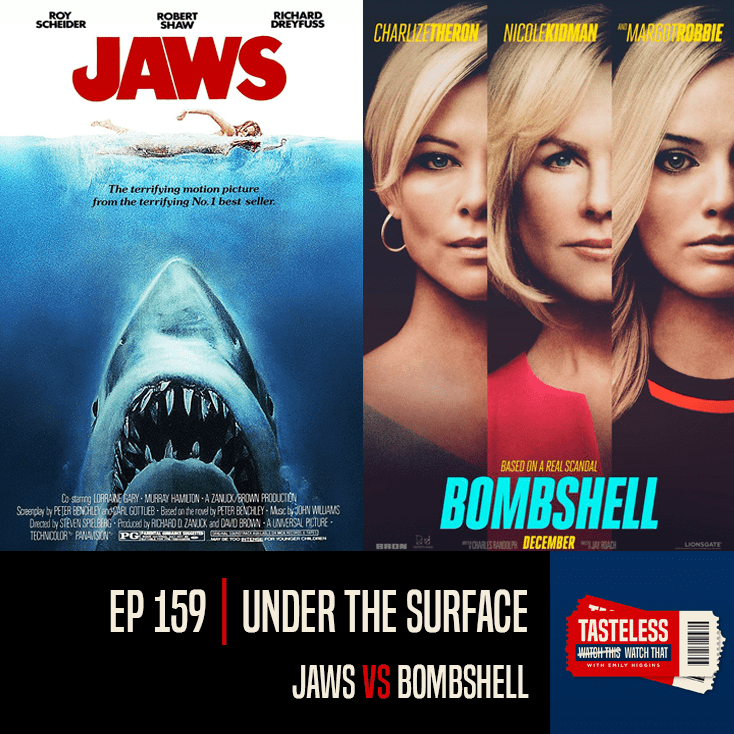
Two movies where the villain is shrouded, where decency must triumph over convenience and greed — it's Jaws vs Bombshell.

Episode Transcript & Breakdown

Every episode of Tasteless, I take a critically acclaimed film and compare it to one that shares the same themes but didn't get the attention it deserves — and explain why that second movie is my pick. This week: two movies where the villain is shrouded, where humanity and decency must triumph over convenience and greed. It's Jaws versus Bombshell.

Jaws

When a massive killer shark unleashes chaos on a beach community off Long Island, it's up to the local police chief, a marine biologist, and an old seafarer to hunt the beast down.

This movie came out in 1975, has a 98% on Rotten Tomatoes. It won three Oscars — Best Sound, Best Film Editing (by the way, a woman, Verna Fields), and Best Original Score — again our guy John Williams. Will he ever be on the right side of a Tasteless pick? Looking at his long IMDB of classics, probably not. Jaws was also nominated for Best Picture, but lost to One Flew Over the Cuckoo's Nest.

What struck me about Jaws is when the Kintner boy is killed and his mom puts out a reward for capturing the shark that did it. The reward is $3,000. People go to fight a shark for $3,000. And you're thinking, oh, that was old-timey money. Well, in today's purchasing power, that would be $14,586.36. Excuse me — would you go into the ocean to catch a shark for a little under $15,000? I don't think many people would.

We've got our classic characters here. Brody, played by Roy Scheider — he is the sheriff of this town, the law. He's a nice guy, he has a wife, he has kids, he wants to do what's right. He gets the famous line which, according to writer Carl Gottlieb, was not scripted but ad-libbed by Roy: you're gonna need a bigger boat. How many times do you think people say that to him every day? I would lose my mind.

Then we have the scientist Hooper, played by Richard Dreyfuss. I didn't remember that Hooper is rich. He comes to this town and he's like, hey, I hear shark stuff is happening. What's up? I got a boat, I got equipment. Also, I have all this stuff because I am very wealthy. My family is very wealthy and they just put me on a boat and said, go for it, man. He's out here measuring shark mouths, just having a good time.

Then we have Quint, played by Robert Shaw, wearing a sweater that looks very itchy. Quint is the seafarer from the plot description — he's the shark-hunting expert. His ship, his rules. He's like Boomhauer of the ocean.

Some insane IMDB trivia: though respected as an actor, Robert Shaw's trouble with alcohol was a frequent source of tension during filming. Roy Scheider described his co-star as a perfect gentleman whenever he was sober — all he needed was one drink and then he turned into a competitive son of a B. When it came time to shoot the infamous USS Indianapolis scene, Shaw attempted to do the monologue while intoxicated, as it called for the men to be drinking late at night. Nothing in the take could be used. A remorseful Shaw called Steven Spielberg late that night and asked if he could have another try. The next day, Shaw's electrifying performance was done in one take. Okay, I feel like he's getting an awful lot of leeway. Also, Shaw apparently bullied Richard Dreyfuss, which honestly, when you look at him in this movie, I wanted to bully him too, so I don't blame him for that.

When we talk about Brody, Hooper, and Quint, I cannot imagine three people I'd want to be stuck on a boat with less. When they're showing off their scars and it's supposed to be this great bonding scene, it's like — an eel bit me. Okay, cool, I guess. I don't know, are eels supposed to bite you? That's not a cool thing. I was arm-wrestling because I hate my ex-wives and now I can't extend my arm. Okay, great brag, Quint. What are you talking about?

I have a hard time with this movie because I am on the shark's side 100%. Just let this shark have the ocean. It's his. You lost. Your fleshy bodies keep getting eaten. Find somewhere else to hang out. Build a pool. I'm Team Bruce. Bruce, of course, is the name of the mechanical sharks they built for this set. In addition to the well-known nickname of Bruce, Steven Spielberg also called the shark "the great white turd." Notoriously, the shark broke down, didn't do what it was supposed to — they built it and were like, it works great. Then they put it in water and it didn't work because it didn't work in salt water. Nonsense.

But I am very scared, not of sharks, but of animatronics. As a child, probably 11 or 12, I went to Universal, went on the Jaws ride. In the ride, a big mechanical shark comes up to your boat and kind of splashes around and your tour guide is like, oh no, oh no, and shoots at it and flames explode. And I had nightmares for months after — not about being eaten by a shark, but about falling in and having the gears and mechanics grind me up that made the shark go. I did the Universal Studios tour in California within the last couple of years and again saw that mechanical shark and was like, no, he's gonna get me. He's hanging out in the Murder, She Wrote village.

Everyone has seen Jaws. You know the plot. There was a very fun trivia fact: several decades after the release of Jaws, Lee Fierro, who played Mrs. Kintner — the mother of the boy who gets eaten — walked into a seafood restaurant and noticed the menu had an Alex Kintner sandwich. She commented that she had played his mother so many years ago. The owner of the restaurant ran out to meet her. He was none other than Jeffrey Voorhees, who had played her son. They had not seen each other since the original movie shoot. Very cute. Very chill name for that kid, Jeffrey Voorhees.

Bombshell

A group of women take on Fox News head Roger Ailes and the toxic atmosphere he presided over at the network.

This movie came out in 2019, has a 68% on Rotten Tomatoes. It actually won the Oscar for Best Achievement in Makeup and Hairstyling for Kazu Hiro, Anne Morgan, and Vivian Baker.

My old roommate slash good friend is an incredible makeup artist, and she brought me along to a makeup guild screening of this film. It was such a great movie. I loved it. It had one of the best trailers of all time, as far as I'm concerned — where the three stars get into the elevator and that song is playing and they're looking at each other. It's so good.

At the screening, Kazu Hiro was there and mentioned that he had worked on Mighty Joe Young with Charlize. As it turns out, Charlize Theron coaxed prosthetic makeup artist Kazu Hiro out of retirement for his work on this film, and he won his second Academy Award for his efforts. He had previously won for Darkest Hour after turning Gary Oldman into Winston Churchill. When I saw the trailers, I thought her Megyn Kelly makeup was going to be distracting, but once you're watching the movie, it really works. She does a good job of recreating Megyn's look and vibe.

Charlize was nominated for Best Actress at the Oscars and Margot Robbie was nominated for Best Supporting Actress. Charlize lost to Renée Zellweger for Judy — people love a sad biopic — and Laura Dern won Supporting Actress for Marriage Story, which I am highly uninterested in. I think Margot's performance in this movie is incredible, as is Charlize's.

Let's talk Charlize. She plays Megyn Kelly, a real person, a Fox News host and anchor. She wields the word "feminist" like it's disgusting. She says at one point, I'm not a feminist, I'm a lawyer. The way they use the word feminist as an insult does remind the viewer of where we are, of what world we're in — slash just the human world. Having Charlize as Megyn narrate the story, talk to the camera — I really enjoyed it. When that works, it really works.

There's a hardness to her because there has to be to survive in this world. I am not a fan of the real Megyn Kelly — the one kind of big thing they allude to is that she said Santa is definitely white, which — okay, he's imaginary, so I don't know what you're talking about. But I'm not endorsing the actions of any Fox News employee by saying I love this movie. Regardless of party lines, this is a story that is important, a story that needs to be told. The fact that so many of these women had the same thing happen and all were worried about coming forward, about losing their livelihood — when Gretchen Carlson came forward, it broke a dam. There is bravery in that. We can't just care about crimes happening to people we agree with. That creates a bad system for everyone.

Nicole Kidman is perhaps the most sidelined in the movie as Gretchen Carlson, even though she gets the ball rolling on the charges against Roger Ailes. We see her talking to lawyers about the way she's been treated, playing back tapes of all the times on air that men said disparaging, disgusting things to her — and she bit back, but had to laugh it off, because otherwise it's going to be awkward. She had to act like she was in on the joke, like it was all in good fun. Because there's that famous saying: men are afraid that women will laugh at them. Women are afraid that men will kill them. You don't want to set someone off.

It's very affecting to watch her watch herself. Think back about how you've handled difficult situations — I don't think all of us have always been at our best. She wants to make it clear that just because she laughed along awkwardly, that's not what she wanted. She doesn't want to be treated that way. And it's important to remember that just because someone laughs along, doesn't mean you should be saying those things.

Margot Robbie plays Kayla, the composite character of the trio — not based on a real person, but instead an amalgamation of various reports about working at Fox News. She's a quilt of the bad experiences these women have faced, and we empathize with her bright-eyed optimism, her wit.

The scene of real-life character Roger Ailes asking the fictitious character of Kayla Pospisil to lift up her skirt was filmed with multiple cameras capturing all the angles at once. Jay Roach didn't want Robbie to have to perform that scene for more than one take. This is a brutal scene and she plays it so well. It's so real. It's so striking.

Basically she goes in to meet with Roger and he says, stand up and do a little spin. And she's kind of like, what? He says, you know, on-air talent, you're going to be on camera, I just want to see you. And she goes, oh, okay, and does a little spin. He goes, okay, lift your skirt up a little bit. She pauses a little longer and pulls her skirt up a little bit. He goes, higher. She pulls it a little higher. Inch by inch, it comes up so you can see her underwear and she is mortified. She is humiliated. And he's like, okay, great, well, you better prove your loyalty, and sends her on her way. And the other heartbreaking thing — she's like, could you not tell anyone about this? And he's like, of course not. She doesn't want people to know, because she'll be blamed. She did it. She agreed to do it.

A reason it's so hard to watch is because, to a lesser extent, we've all been in situations where we go along with something we're not comfortable with so as not to rock the boat. Maybe someone says something inappropriate and you just sort of laugh and brush it off and hope it goes away.

Margot to me was the character I related to the most, and her relationship with Kate McKinnon is one of the more touching aspects of the film and one of the more frustrating and heartbreaking. Kate McKinnon plays a closeted lesbian, closeted Democrat who works at Fox and takes Margot under her wing. Kate basically says, here's how you survive here. Here's what you want in stories — you want to frighten and titillate. Ask yourself what would scare your grandmother and piss off your grandfather. That's a Fox News story. She's funny, but it's also sad that she can't be herself. Her and Margot wind up going home together, sharing a bed. There's a chemistry there. But neither can be who they are, and Kate has shoved her feelings so far down.

John Lithgow plays Roger Ailes in a lot of prosthetics. He's great. I love John Lithgow. Malcolm McDowell plays Rupert Murdoch. The supporting cast in this movie — I'm going to run through it. Darcy Carden gets to yell at Margot Robbie. Lennon Parham eats some grocery store sushi. Connie Britton plays Roger's wife and says at one point, very genuinely, hoodies are creepy. Alanna Ubach plays Judge Jeanine Pirro. Holland Taylor plays the secretary to Roger. Rob Delaney plays someone who works with Megyn. We've got Brie Larson, Josh Lawson and Ben Lawson as brothers, Liv Hewson, Richard Kind, Alice Eve, Madeline Zima, Ashley Greene, Katie Aselton, Tricia Helfer, Robin Weigert, Mark Duplass, Jennifer Morrison, Allison Janney. It is quite a cast.

Jay Roach directed another great political film, Game Change — and he directed all the Austin Powers movies, and that is called range.

Bombshell is a movie that I think you need to watch. It really does a good job of putting you in someone else's shoes. Would I have thought I'd watch and love a movie about Fox News? No. Absolutely not. But this movie did a great job of stripping away my biases, getting me on board with the universe we're in. Some people think it excused the women of Fox News, and that's where we get into a gray area, and we don't need to villainize. This is a story about assault. The villains here are the people who have built a system that allows that to happen without consequence, and that can happen to anyone.

Shared Themes

Jaws and Bombshell both have a villain that is lurking under the surface — an iceberg with most of the threat going unnoticed until it is far too late. A villain that people disagree on how to face. Some think their presence should be brushed under the rug, while others want to confront this villain head-on. It's insidious.

The villains are a real mean shark and workplace assault and objectification. Two sides of the same coin. Only those who have faced these threats themselves really understand the dangers. And other people are of the opinion: out of sight, out of mind. Don't go in the water. Don't wear a short skirt. But that's not feasible and it's not fair.

Jaws has one of the most iconic antagonists of all time in the form of its great white shark — a shark that gets only four minutes of screen time. The threat of the shark is what looms over the people of Amity, but the issue is that they disagree on just how big of a threat it is. We see this so clearly when Brody's wife comes in — Brody's reading a shark book and she's like, man, let's get drunk and fool around. The kids are out on some boat and Brody's like, oh my God, kids, get off the boat. And the wife goes, don't worry about it, they're fine. Then she flips open his book and sees a picture of a shark ripping flesh and immediately starts screaming at the kids to get back on land, listen to their dad. It takes seeing that picture in the context of her kids out on the water for it to feel like a real threat to her.

The fishermen that rush into the ocean to get their reward are giddy at the thought of this excursion. Chumming the waters, captaining their dinky boats, no fear, no respect for the wildlife. When Quint gets there, he basically says, hey dummies, sharks kill people. This is a problem and I could solve it. Everyone else had been very wishy-washy about wanting to keep the beaches open. They have this town hall meeting — the beaches are going to be closed? We gotta go to the beaches. Be quiet. Go away. People will come back to your beach. Chill out.

The main antagonist of Bombshell is Roger Ailes, though we explore the system that put him in power. If he had had beady little eyes and maybe too many teeth, would he have been taken down sooner? Seen as a real threat by those in his orbit, those who aren't directly threatened by him? Most people don't see Roger on a regular basis. He's on his own floor, his own office, with Holland Taylor guarding the door and a clicker remote that opens it. Very disconnected.

People joke about the workplace culture. They talk about how Roger has a separate elevator for women to arrive in. They joke about the other men there, like Bill O'Reilly. It's all said with a laugh, with no real threat. Margot loves Fox — it's been her dream to work there. She hears the stories about the misogyny in its ranks but continues to idolize the network until she comes face-to-face with Roger's harassment. Till he makes her lift her skirt.

She tries to bring this info to Kate McKinnon and is shut down. When Gretchen Carlson tells her story, many women of Fox scramble to support Roger, not wanting to look disloyal, knowing they can be replaced. Many women say it never happened to them, and one man comments that the women it hasn't happened to are not attractive. We see older people talking about how nice Roger is while younger women get more leg out to please him. We also hear the other side of Roger — the man who pays for cancer treatments and supports his employees. Some people think that gives him the right to act as he pleases.

It takes determined people from all walks of life to take down the shark and to take down Roger.

For Jaws, it's Brody with his guilt over the Kintner boy, with Alex's mom's funeral attire stuck in his mind — he is dedicated to keeping his town safe. He's scared of the water but goes in because it feels like his duty. Hooper joins because he's an expert, the person who has determined that the other shark caught isn't the threat. He's passionate about the field. Quint is the expert on the water, here for the money. He has the experience, the grit, the boat. These three different motives come together. They attack from all angles — with knowledge, with grit, with brains — and that's how they accomplish their goals.

For Bombshell, we have Gretchen Carlson, who has finally had enough, who has been humiliated and demeaned and shuffled to the worst time slots. She decides to do something, to say something. She gets the ball rolling with her public accusations and lawsuit. This leads to Megyn Kelly's crisis of faith — should she admit what has happened to her? She starts an investigation of her own, and when she finds out how many other women have been affected, she decides her voice is necessary. Having it come from a veteran of the station adds weight, adds truth.

Each person who comes forward has to weigh their options. And okay, Roger gets an incredible severance and is living a nice life. But the fact that Gretchen gets an apology — she even notes, like, that's very rare.

Unfortunately, convenience, ease, and greed all trump humanity in Jaws and in Bombshell. The worst mayor of any town is this dude in Amity. What a freak. And right up there with him are the many employees of Fox News — people more concerned about the bottom line than lives being ruined.

The Kintner boy's mom walks up to Brody and slaps him right in his face and says, look, you knew last week a woman had died in this water and you didn't do anything. In the book, it's revealed that the mayor is being blackmailed by the mafia to keep the beaches open. In the movie, he just sucks. He keeps saying, don't scare anyone, keep the beaches open, I'm sure that shark is gone.

Brody gets that slap and I don't know that I fully blame him. It's fair for him to think the first body that turned up was a boat propeller that killed her. But I do know the town does not want it to be a shark and would rather believe anything else. The mayor fights to keep the beaches open, promises to have the problem dealt with in 24 hours. And then when everyone is out on the beach, when it's been deemed safe because some other shark has been caught, the mayor is truly walking up to people like, hey, go out in the water. Why are you sitting over here? And this old man he's haranguing is like, what? I just put my suntan lotion on. I'm letting it seep in, but okay. And he walks off into the water, and then — boom, shark.

Suntan man lives. He doesn't get bit. But others die. And Brody's kid is in full shock. Brody had been worried — he couldn't help but wonder if Hooper's analysis of the shark's mouth was correct, if they hadn't caught the right shark — but he didn't want to deal with that possibility. He didn't push it. He allowed the beaches to open again. Luckily, his guilt and his goodness do make him swing back in the other direction, demanding the mayor approve hiring a shark-catching expert. He will not let something like this happen on his watch again.

In Bombshell, the network doesn't want to admit its mistakes and be liable. The women don't want to support Gretchen and lose their jobs. Kimberly Guilfoyle makes everyone wear shirts showing their support for Roger and Fox. She's so far in the opposite direction trying to prove he's good.

Here's the deal: if my coworker, my boss, was accused of assault, I think I'd take a beat before I went gung-ho supporting them. This person isn't your best friend. How much can you even really know about your super-rich boss who has their own weird button to close their office door?

But these women don't want to be wrong. And there's a more insidious fear — that if one woman got promoted by allowing Roger's treatment, people will think all the women did. No one wants the public believing they got their job based on what they were willing to do for Roger behind closed doors. It's embarrassing.

One of the most heartbreaking moments in Bombshell is when Margot comes out of Roger's office after he's inappropriate with her and goes to her friend Kate McKinnon. Margot starts to confess what has just happened. Kate interrupts: "It's actually better if you don't involve me in this." At the end of the day, Kate values her job security over her friend.

She had said earlier that she applied to a million jobs and only Fox called back. And now no reputable place wants to hire her because she works at Fox. She feels stuck. She sees her only option is to not support those who have come forward.

People must choose hardship. They must choose the possibility of losing their job, their reputation, of being unpopular. Some must admit something they have held secret for so long. And that's not easy. It all bubbles under the surface. It's the humanity that gets Megyn to admit what has happened — because she thought, in the abstract, I'm sure it's not happening to that many people. But when she starts paying attention and listening and hearing how many women have been treated inappropriately by Roger, by other people at Fox, she can't sit idly by. She chooses humanity over job security.

Both Jaws and Bombshell explore gender in a different way, a more honest way, a way that aligns with real life.

When I was watching Jaws, I actually Googled "nice friendship Jaws" to see if other people saw what I saw. And I was glad that the internet agreed that the bond between these men shows another side of masculinity, one we don't get to see as often. Do I hate these three men? For sure. I do not like them. But I like that once they gain each other's respect, all three are all in as a team. There's no fight to be the one who takes the shark, no battle for dominance. Each man brings something to the table and each man steps aside when someone else's expertise is needed.

There's some arguing, as there is with anyone, but it really was a well-oiled machine because these men trusted one another. Brody is perhaps the most sensitive of the three — he loves his family, takes Mrs. Kintner's slap in stride thinking he deserves it. Quint is an aggressive jerk, but as soon as he realizes Hooper knows his stuff, he chills out and offers a drink. Hooper is a rich dandy, basically — someone who you'd think would not do well on a rickety boat chasing a giant beast, but he is right at home. None of these men are posturing. They're simply themselves. There were a lot of ways for these to be three macho guys off fighting a shark. But no — these are two pretty normal guys and then a weirdo who truly looks like he just got dragged up from the depths of the sea.

Bombshell's exploration of gender is a little more confronting — it's the purpose of the film. Seeing the truth of how women survive, what we do to fit in. The constant remarks to the women about their legs. The heels with band-aids for blisters. There's a truth here that is hard to stomach. Instead of just seeing the bright shiny faces that wind up on news screens, we see the dark underbelly of what goes into creating the image of the perfect conservative woman.

There are sacrifices women make so that our lives will be easier, things we put up with. If you're picking a fight every moment of the day, it's just too exhausting. When we see Gretchen Carlson's show with no makeup and she talks about Day of the Girl and how important it is, we also see the backlash she gets — the anger from viewers and the network about having to see a woman's real face. Our characters work to fit the mold, to keep their jobs, while also wondering at what point is it too much. This is the truth behind femininity — a game of inches, compromises. I'm not saying women don't want to wear makeup and look nice. But at Fox in particular, it is a very specific mold these women must fill. Honestly, in entertainment, it's a specific mold — a way you must be perceived.

What Bombshell Did Better

Jaws led to real innocent lives lost, while Bombshell opened our eyes to suffering we may not have been aware of, or at least weren't confronted with in the same way. Jaws invented a villain while Bombshell brought a real person's crimes further into the light.

The shark in Jaws may as well be Godzilla. The entity itself is a complete fabrication. But the unfortunate thing is that people viewed this movie as gospel. Much like the scene in the film where fishermen went out in droves to get their $3,000, many fishermen decided to take on sharks after seeing this movie to prove that they could. Commercial fishing at a large scale began contributing to deaths of sharks. The general populace's view of sharks as evil entities was really helped along by Jaws. Author Peter Benchley, who wrote the book the movie was based on, has said that if he had known about the actual behavior of sharks, he would have never written the book. He told the Animal Attack Files in 2000: no one appreciates how vulnerable they are to destruction. It shows the power of media. Sharks are this apex predator, but they are in so much danger because of the ways they are used — like shark-fin soup. They get caught in nets meant for other things. Having us hate them does not help.

When Bombshell came out, people seemed genuinely frustrated that it gave humanity to Fox News employees, which I think was an important and interesting lesson. We don't know everyone's story. But if someone is doing evil things, they should be punished for it. The film showed the evil lurking under the surface. I'm sure many of us had heard about Gretchen Carlson's lawsuit and that Megyn Kelly added her voice, but it was easy to ignore as someone else's problem — stuff happening between rich people, rich conservative people. Because to be frank, it tends to be the liberal side that more often gives air to these stories, that more often takes these accusations seriously. So when we were finding out about what happened to conservative women, I think there was a little bit of an attitude of, they were asking for it. But this affects everyone.

In Jaws, the biggest tragedy is the death of the Kintner boy, and the fact that it could have been avoided had people known to stay out of the water. We see the effects of the boy's death for only a few moments with his mother. Brody's family has a couple of close calls — his son is shocked by an attack but not injured. Hooper has a much more scientific stake than an emotional one. Quint dies, but he kind of deserved it. He was a little off the handle. I enjoyed the exploration of Brody's guilt, but he also has the peace of a wife that loves unconditionally, two young boys who are healthy. The stakes Brody, Quint, and Hooper have in capturing the shark are definitely diluted. None of these three have faced real tragedy in what we've seen, besides Quint's USS Indianapolis story.

In Bombshell, we follow the tales of women who have had everything taken from them — their dignity, their voice. We see Gretchen's fear and isolation when at first no one comes to her support. We see Megyn's anguish over whether coming forward would ruin the lives of her family. We see Margot break down sobbing into her phone outside a fancy restaurant, wondering what it means that this has happened to her. These are the people directly affected, and there are dozens more who we visit along the way.

All movies don't have to tell the stories of all people. But Bombshell is something that has stuck with me since my initial viewing, much in the way that the Jaws theme has stuck with us all. I'm glad stories like this are being told from all sides. If you haven't seen it, I hope you will give Bombshell a chance. And honestly, you can always rewatch Jaws.

Hit me up at @tastelesspod on social media. Let's talk about all the incredible people who are in Bombshell — Holland Taylor, Darcy Carden, Lennon Parham, Jennifer Morrison. What a dream cast. And Margot should have gotten that Oscar. The scene of her lifting her skirt is abhorrent and beautifully acted.

Shades of Grey: Saving Private Ryan vs Birds of Prey

Saving Private Ryan vs Birds of Prey

Two movies about morality outside the bounds of polite society and banding together — it's Saving Private Ryan vs Birds of Prey (and the Fantabulous Emancipation of One Harley Quinn)

Episode Transcript & Breakdown

Every episode of Tasteless, I take a critically acclaimed film and compare it to one that shares the same themes but didn't get the attention it deserves — and explain why that second movie is my pick. This week: two movies about morality outside the bounds of polite society and banding together. It's Saving Private Ryan versus Birds of Prey and the Fantabulous Emancipation of One Harley Quinn. I will say the full name only once, thank you.

Saving Private Ryan

Following the Normandy Landings, a group of U.S. soldiers go behind enemy lines to retrieve a paratrooper whose comrades have been killed in action.

This movie came out in 1998, has a 93% on Rotten Tomatoes, and is number 26 on the top-rated movies of all time. It won five Oscars — Best Director for Steven Spielberg, Best Sound, Best Cinematography, Best Film Editing, Best Sound Effects Editing. It was nominated for another six that it didn't win, including Best Picture, Best Actor for Tom Hanks, and Best Music for John Williams.

This movie kicks off with too many barfs. One of my only problems with movies: animals being hurt, barfs. Those are the things I don't like in a film. But I can't blame these guys — they are in an old-timey boat going to shore to do battle. They're barfing all over the place. Hate it.

I had seen this movie a couple of years ago and really didn't internalize a lot of it. Didn't really think about it again. But on rewatching, I was really struck. When I started it and saw it was almost three hours, I was kind of like, ugh, God, another one of these. But the first 25 minutes or so of the landing on Omaha Beach, the Normandy landing — the brutality really comes through on the screen.

A guy loses his arm — he has viscera on his sleeve hanging off, and he kind of bends over and picks up the arm and stands up and trudges off holding his arm. There's the guy that Tom Hanks is dragging and then he realizes it's only half a body — he only got his top half. He thought he was saving this guy, but he only got his top half. There's the guy who gets shot on his helmet — a bullet pings off the side, and he's like, oh my God, I just got shot but I'm okay. So he takes off his helmet to look at it, like, wow, this just saved my life. While looking at it, he gets shot in the head and dies.

Some guy is laying there with his guts hanging out and he's like, mama, mama. I mean, not like that at all. I feel like if my guts were hanging out, I would definitely be yelling for my cat. But here's the thing — the indignity of not only having your intestines outside your body, but having sand get into your intestines. Just awful.

It's just 25 minutes of relentless, unflinching war. It's not Michael Bay action-y. It's not bright red blood. It's real in this way that is striking and I was very impressed by.

The conceit of this movie is that a secretary realizes that three brothers have died in three different conflicts — three brothers, last name Ryan. And the army is basically like, God, we have to tell this mother that three of her sons are dead, but there's still one brother left alive. He paratrooped in somewhere but they lost track — something went wrong with the landing, so no one knows where he is. The army's like, okay, we have to get the other Ryan brother. Private Ryan. Save him, Private Ryan. We have to bring him home to his mother so that we don't tell her every single one of her four sons have died.

Now, I think in real life at this point, knowing our government, it would be more like — we better kill that mom so she doesn't tell anyone that the army killed all four of her children. But in this movie they are going to go rescue James Ryan.

Tom Hanks is the leader. He is in charge of the band of men that go to save Private Ryan. His name is Miller, and he's this kind of tough guy. I've talked about this before — I don't dislike Tom Hanks, I like him, he seems like a nice man, I'll watch his movies. I am never like, oh my God, what incredible acting, the way that I am when I watch Rebecca Hall or Christian Bale, who even when I don't love his movies or his zaniness, I watch him act and I'm like, wow, he's doing something.

Tom Hanks always plays these mild-mannered guys. There's this bet among the guys under his command about what his job might be, because no one's positive what he did before the war. He finally tells them: I was an English teacher and I love my wife. Which is the epitome of Tom Hanks roles. He's mild-mannered, he does the right thing.

He has seven other people on his team. Tom Sizemore is the second in command and he gets to say the title at one point — he gets to say "saving Private Ryan," so good for him. Edward Burns is the New York guy. Perfectly — that's his thing. I hadn't really realized until recently that he directs and writes movies in addition to acting. No one else is bringing us important New York stories like Edward Burns. He's very much like, hey, I'm Edward Burns. You like pizza? I may need to bump up New York on my list of hot accents. And remember how hot Edward Burns was in 27 Dresses as Katherine Heigl's boss? None of this pertains to Saving Private Ryan.

In Saving Private Ryan, Edward Burns is like, why are eight guys being risked for one guy? He's the most outspoken to Tom Hanks that he doesn't agree with this plan, but at the end of the day he will follow orders. He's like, this is stupid. What are we doing here? Hey, this is stupid. What are we doing here? You like pizza? Just like that.

Maybe most importantly — we forget, or I had forgotten, and I think the world has forgotten because they're rude — that Vin Diesel was in this movie. In fact, his role, Caparzo, was written for him after Steven Spielberg saw Diesel's independent film Strays, which was Vin's directorial, writing, producing, and lead acting debut. I need to watch that movie ASAP.

He is kind of the comedic relief along with Adam Goldberg. They're buddies, they hang out, they're chit-chatty with each other. Vin Diesel does unfortunately die in this movie because he takes a kid when he's not supposed to. He gets shot because he opens himself up to it. He's just laying there bleeding out and it's raining. Who knew we were going to have ten Fast and Furiouses after this? He looks so good in this movie. Vin Diesel has the littlest shadow of hair on his head and it looks incredible. I don't even know if it's painted on.

So Upham the translator — Jeremy Davies plays him. He's this guy who wasn't part of their crew. They were all together when they stormed the beach, but now on this mission to save Ryan, he gets added because he can speak German and French. And he's like, I want to bring my typewriter. He looks like Andrew Garfield.

But here's what's important to talk about with Jeremy Davies. He does cameos — on cameo.com — that are an hour plus each. It is bananas. You get your money's worth. On his Cameo page, he says: I'd redefine grateful if you'd read a letter I wrote to my fans, which you can find on jeremiedavies.com. I need everyone to go to jeremiedavies.com. His letter is titled "A Criminally Misfit Altruistic Inaugural Social Media Mission Statement of Sorts" and is 32 pages long. I am fascinated by this man. I cannot get over it. I'm starting a book club just for this. We're all going to read that 32-page letter and then we're going to get back together and talk about it.

Matt Damon plays Private Ryan. Steven Spielberg cast him because he wanted an unknown actor with an all-American look. But before this movie came out, Matt Damon won the Oscar for Good Will Hunting and became a massive star. So that didn't work out. He's really good in this. He has this scene where he tears up and I started crying watching it. But then he tells this very weird story about his brother making out with a girl in a barn and she runs into a wall and is knocked out, which is not a fun story. And Matt's like, well Tom, what's your story? And Tom's like, I'm going to save my story for me.

Brian Cranston pops up — also very hot with a buzz cut. Paul Giamatti. Nathan Fillion, at one point they think he's Private Ryan but he's a different Private Ryan. Ted Danson is here. Ted Danson, younger and older, looks like a Ken doll in a nice way, but he has a very long rectangular head.

Spoilers for this movie from a thousand years ago that everyone has seen. Tom Hanks dies. And as he's dying, he says to Private Ryan: earn this. That's so much pressure. Imagine someone's dying words to you being earn this. Also, when he's old and he's at the grave of Miller, he turns to his wife and says, tell me I've led a good life. Leave your wife alone. This movie has a few moments like that where it takes something real and heightens it to This Is Us levels — where you feel like they're trying to make you cry rather than trying to tell a story.

Birds Of Prey

After splitting with the Joker, Harley Quinn joins superheroines Black Canary, Huntress, and Renee Montoya to save a young girl from an evil crime lord.

This movie came out in 2020, has a 78%. No Oscars, but one of my favorites of 2020 — top three, maybe top two, maybe top one. This one and Promising Young Woman, both produced by Margot Robbie's production company Lucky Chap. Lucky Chap produced I, Tonya, Terminal, Birds of Prey, Promising Young Woman. They have a Yorgos Lanthimos movie on the slate, they have the Greta Gerwig Barbie movie. This company is making all my dreams come true.

I'm someone who's vaguely familiar with comic books. But when I saw Suicide Squad, I was — horrified is too strong a word. I saw it with a full theater of mostly men and the things they got excited about, the things they cheered for, genuinely upset me. Which sounds so stupid and lame to say, but I remember there's a scene where Harley licks a prison bar and everyone's like, yeah. And I was like, what are we doing here? I think Margot was so incredibly talented, and so I was really bummed by that.

With this movie, she took the character, she took what she knew about it, and she created this incredible super villain/superhero somewhere in between that isn't permeated by the male gaze.

She really spearheaded getting this movie made. In Suicide Squad, she's wearing short shorts, denim short shorts, ripped fishnets. In this movie, she's wearing fully insane clothes that are really fun to look at — full yellow overalls with a pink fishnet halter top. She's obviously beautiful, but nothing about the clothes she's in is sexual. She's dressed in the way she wants to be dressed. She has a specific sense of style. It's very fun.

It's such a good example of male gaze versus female gaze. The only semi-glamorized shot we see of her is her hair in a wind machine blowing back, and that's because she's watching her breakfast sandwich get made that she's so pumped about.

I remember when the movie came out and there were comments on Twitter about how this is the difference between male and female gaze — that we get this almost pornographic exploration of a breakfast sandwich being made, the eggs cracking, but then Harley is wearing overalls. It's such a different take on the genre because I think even when the women in superhero films are strong, there is that inclination to really still make sure men like them. There's none of that in Birds of Prey.

Margot Robbie in this character — I'm so glad we got this movie because she is perfect in this role. You saw that in Suicide Squad. To see her make it her own — she does this accent that's really wonderfully cartoonish, with weird emphasis on some words, like poi-fect. It really captures this surreal vibe. I knew she could act, but this really establishes her as a star. Her charisma is absolutely out of this world. As Harley, it doesn't rely on her being one of the most gorgeous women on the planet. That's not what we're looking at. She plays every element of this movie so loud, with such conviction, but also with emotion. It's never unbelievable.

The costume designer said they were talking about how Harley isn't meant to be an object of desire in this movie, which is on purpose. Erin Benach, the costume designer, said, that's what happens when you have a female producer, director, writer. Robbie added, yeah, it's definitely less male gaze-y. She had discussed how uncomfortable her outfits were for Suicide Squad, so that was altered for this movie.

There's a scene when the sprinklers are going off and she gets soaked and there is nothing sexual about it. The water makes for this really great fight scene. There's nothing wet-t-shirt-contest about it. She's wearing a white t-shirt, but that's not what's happening.

One of my favorite moments: she's hiding from all these guys, prepared to fight them — guys that got out of their jail cells. She is in basically an evidence room at a police station and she realizes she's behind a bunch of bags of cocaine and guys are shooting at it. The cocaine flies up into the air, she looks around, realizes what's happening, and she just inhales. Her eyes go wide and "Black Betty" starts playing. Such a good, fun fight scene song. The whole soundtrack for this movie is really fun. Every element came together into what I want from a superhero movie — bright and colorful and fun.

Rosie Perez plays Detective Renee Montoya. At one point Montoya is investigating a crime scene, looking at four guys that have all been shot by arrows, and it kind of pauses the scene so she can walk around it and replay what was happening. This movie is really innovative in the way it shares information. The story isn't fully linear — it unfolds these different pieces for you. Rosie Perez just gets to be grumpy and great. She's good at her job but she's also not going to play by anyone else's rules. And Renee Montoya the character is the first canonically gay character in either a Marvel or a DC movie. We see her ex-girlfriend, played by Ali Wong, which is cool. It's not a big deal — she's just mad that her ex-girlfriend is there.

Jurnee Smollett plays Dinah Lance, aka Black Canary. She's such a good singer — Jurnee does her own singing. She sings at the club that Roman owns, the Black Mask, our main villain. When he sees her fighting to help Harley get away from some drunk guys, he decides she will be his new driver. She becomes enmeshed in his world of crime but she's letting Montoya know what's going on because she wants to protect the little girl he is after. Her as Black Canary — I want her in more action movies because she is so cool.

Mary Elizabeth Winstead plays Huntress, Helena Bertinelli. What an unsung hero Mary Elizabeth Winstead is. She is so good in so many things. You watch her and you know you're going to get a good performance. She's very funny in a very understated way and she gets to really lean into that in this movie. Her entire family was killed in search of a diamond that holds their riches — all their money is in offshore bank accounts and all the numbers are stored inside a diamond. She has spent her life preparing to avenge them.

You think, wow, the Huntress kills all these people — other people call her the Crossbow Killer — but you realize she stands in a mirror and practices, do you know who I am? Do you know who I am? There's something so real about her. I love when somebody says "a bow and arrow" and she says, it's not a bow and arrow, it's a crossbow. I'm not 12. She's semi-awkward but still so cool and sure of herself in so many ways.

Ella Jay Basco plays Cassandra Cain, the kid who swallows the diamond. She's a little pickpocket. Everyone is trying to either cut it out of her or get it out another way — Harley gives her a whole lot of prune juice, that's not working. They need to protect her from Roman the Black Mask. Ella Jay Basco is a very fun kid in this movie. Everybody's trying to protect her and you're never annoyed. She can handle herself but also is a kid who needs someone to look out for her.

Our villain, the Black Mask, Roman, is played by Ewan McGregor. Before Ewan was cast, Nicolas Cage, Sharlto Copley, and Sam Rockwell were considered. Rockwell passed on the role but was considered the archetype for the casting. As much as I adore him, I'm very happy that Ewan got to flex this weird, dark, comedic, strange, Nicolas Cage energy type muscle in this movie. He is so good in it.

He has all these little idiosyncrasies. He's going to cut the faces off these people. Then he goes, actually, this girl can go. And he takes tape off her mouth. Then he sees a snot bubble in her nose. And he's like, ew, nevermind, cut her face off.

What I love is that he's this male villain who never sexualizes the heroes. There's never a threat of sexual assault. He never looks them up and down. He respects Black Canary as his driver and is devastated when he thinks he's been betrayed. Yes, he wants to own her in the way that she's his singer at his club. But there aren't those elements. He definitely is misogynistic, he definitely doesn't love women, but I liked that there weren't those elements.

Important trivia: Harley suffers a concussion at one point and has a dream of herself singing "Diamonds Are a Girl's Best Friend." Of course, Ewan McGregor is probably best known for Moulin Rouge, where Nicole Kidman sings "Diamonds Are a Girl's Best Friend." So he is in both of those, dancing to it. I love it.

Chris Messina plays his right-hand man, Mr. Zsasz — also a really strange, quirky villain I enjoyed. He's sniveling a little bit. At one point Black Canary is late and Ewan McGregor is like, it's fine. And Chris Messina is like, no, you're late. Shouldn't she come back later because she's late? She was late, shouldn't she? He really wants other people to be punished. And Ewan McGregor is like, no man, cool it, it's fine, don't worry about it.

Cathy Yan directed this movie. She is the first Asian woman to direct a superhero movie. She is the second woman to direct a DC film, after Patty Jenkins. She knocks it out of the park. Every element of this film came together for me — the little things that come up on the screen telling you why people are mad at Harley, the way it unfolds, the coloring, all of it. The writer, Christina Hodson, she wrote another movie that has appeared on Tasteless — Unforgettable with Katherine Heigl and Rosario Dawson, which I love. All the pieces in this movie came together. Watching it in a theater was breathtaking.

Shared Themes

Something that sets these two films apart is that their protagonists aren't heroes to everyone. They're people who live in moral shades of gray, who have to do things outside the realm of human decency to survive. And that doesn't make them bad people, doesn't make them good people. It's a much less black-and-white way of looking at things.

In Saving Private Ryan, we are following soldiers in the midst of war. Soldiers are forced to do horrible things to protect not only themselves but their fellow soldiers and their country. Other people's lives are in their hands. The best example of this is Vin Diesel and the little girl. A girl's parents beg the soldiers to take their two children to safety. Tom Hanks screams at his soldiers — no children, we do not take children. They have a mission, they can't take the risk. Vin Diesel defies orders, grabs the kid, and says, sorry, Captain, she reminds me of my niece. I gotta take her, I gotta help her. And he gets shot and bleeds out slowly all over the note he wrote to his dad.

Was taking the kid the moral thing to do, the "right" thing to do? Yeah, probably. But they have a mission. And when Vin takes the girl, he's focused on her, so not only is he endangering his life, he's endangering the lives of the other men he's supposed to be looking out for.

Which leads us to the crux of the movie. Eight men are sent back into battle to save a single man and they feel conflicted about it. Most of them don't think it's worthwhile. Why kill eight men to save one man? They don't think it's right. Private Ryan could already be dead, but they're here alive now and they don't want to put themselves in danger. Many of them do die on the way to rescue Private Ryan, or even when they're with him. But he represents something more — he represents that mother. And Edward Burns is like, I have a mother. We all have mothers who don't want their sons to die. Why is he more important?

Another complicated aspect: Tom Hanks at one point has a POW, a prisoner of war. He sets him free — has him dig graves, then they're like, you can't kill the guy now. He sets him free with a blindfold and a hundred-yard head start. That is the man who kills him. That is the man who later at the bridge shoots him. There was no clear morally correct option in war. There just isn't.

In Birds of Prey, we're exploring the choices of women who have been shafted by the world, who have been put in a box, mistreated, and who are trying to make things right in the only way they can. They don't have the luxury of making the right choice a lot of the time. They've been left to their own devices and need to survive the seedy underbelly of the worlds they've found themselves in.

Harley is an incredibly complicated character. She's not a hero, not even a villain — just a woman who has gotten away with her behavior for a really long time while putting up with disrespect from the Joker. That got her certain perks, people looked the other way. Now she needs to figure out how to stand on her own two feet, which leads to some poor decisions. When she decides to turn in Cassandra — when she's going to give Cassandra over to Roman — it's because she feels like she doesn't have another choice.

We don't judge Black Canary for working as a driver for Roman, or Huntress for murdering vigilante-style the people who killed her family instead of pulling a Spider-Man and tying them up outside a police station. Where the criminal justice system has failed, Huntress has stepped in to make sure these evil men are dealt with. Detective Montoya is working outside the scope of her job to make sure the real bad guy who no one else wants to go after gets what's coming to him. And in the process, she forgets the rules she promised to adhere to as an officer of the law and becomes a vigilante.

Even Cassandra must make bad choices to survive. She picks pockets from people — maybe good people, maybe bad people — to keep herself going as her foster parents fight about keeping her. She is on her own, and since she can't get a job as a kid, she does what she needs to do. Everyone here is operating at the level of survival in both movies, and when they can do the right thing, they try to. But that's not always possible.

The best element of these movies is when our wildly different characters come together and have each other's backs. The protagonists in both films must learn to put the group above the individual.

In Saving Private Ryan, Tom Hanks' team had worked together during their attack on Omaha Beach. When he's told he needs to head up the mission, he gets the same men along with Jeremy Davies the translator and they set out. We've seen these guys in battle together, covering each other. But for those first 25 minutes, we don't see a lot of communication — it's just Tom Hanks giving them orders, which is what battle is. With this new mission, a lot of the men are unhappy. They wonder why their lives aren't as important as Ryan's. They question Tom Hanks, they grumble and gripe. But when they're faced with incredible challenges and not many resources, they learn how to work together.

When they're in that town with the bridge that Ryan refuses to leave because he wants to protect it, the men finally begin sharing personal facts with each other. They set a plan — they're going to destroy the tracks on one of the tanks so it'll block the road and funnel the bad guys in one spot where they can be gunned down. Everyone is working together. They come together in a way that's really incredible. A lot of them wind up dying, but it's not for a lack of trying and being the best they can for each other and for themselves.

In Birds of Prey, our women had been working separately to get the diamond, each after it for their own reasons. But then they find themselves trapped at the theme park in a room, at which point they realize it would be best if they worked together. They each use their individual strengths. Harley does gymnastics. Montoya loves punching. Black Canary is a kicker. Huntress has a crossbow. In conjunction, in the service of one goal — saving Cassandra — they fight off wave after wave of bad guys. They each have their own focus while also looking out for the others. And in saving one another, they know they've got each other's backs. They don't worry that one of them is going to betray the other. That's never a concern. They're like, nope, we're working together. That's it. I know you've got my back. I love that.

Between our soldiers and our sirens, there are such distinct personalities, but you believe — of course they could work together. I see how this works. It wasn't unbelievable.

Saving Private Ryan and Birds of Prey both have troubled characters, but they also share an important message of hope.

The guys in Saving Private Ryan are mad that eight men's lives are being risked for one man. But Tom Hanks, in addition to just wanting to do the job so he can go home, also understands the importance of hope. Ryan represents that. A mother has three dead sons coming home to her. All she has left in this world is Matt Damon. There's something about this mother losing all four children that the head army guys cannot stomach. It's too devastating. One child gives her something, some link.

Ryan's story is one that upsets the people he runs into. Everyone has a similarly somber reaction when they find out three separate brothers have died. We learn the brothers were purposely sent to different areas with different tasks to try to keep something like this from happening. Regardless, getting James Ryan home to his mother means a great deal to morale, to the optics of the war, to this family. While the guys are mad to be sacrificed for one other man, everyone wants this mother to have someone come home to her.

In Birds of Prey, our women are mostly single-minded, working towards a set goal with no plans afterwards. But finding each other, uniting to save Cassandra — it gives them new life. It gives them hope for a better future. Through their protection of Cassandra, they realize they can be better people. They realize that others can rely on them and that they can make connections.

Harley felt bereft with the loss of the Joker. She doesn't know who she is without him. But she's able to define herself, differentiate herself over the course of this film. Instead of mourning her past, she finally becomes excited for her future — making new business cards, starting a new life for herself and Cassandra. And the other women start their own crime-fighting squad, giving themselves a new purpose and a continued bond with the people who understand them best.

What Birds Of Prey Did Better

One big difference in the two films that sets them apart is the importance of having a choice. At the end of the day, the guys in Saving Private Ryan have a duty to their country and are following orders. That carries over into the duty to their fellow soldier — not just the duties they have to those above them, but also to the men they are in this situation with. And of course they grow to care for each other. Of course there's camaraderie in this awful world they're forced to navigate. And that camaraderie isn't made any less meaningful just because it is forced. Most of life is like — you're put with people and then you like them or you don't.

But there's something I love about Birds of Prey having people come together not just because they have to, but because they want to. They want to protect the kid. The women in Birds of Prey make choices for themselves, for the moment, not because someone above them is telling them what they must do. In fact, they're finally getting to make their own choices, especially Harley.

In the world of Saving Private Ryan, at the end of the day, these men have been given orders and they're going to do them. Even when they argue with Tom Hanks — when he's just like, well, it's orders — they're like, all right. And by following these orders, they can take a lot of the blame off themselves. Even Tom Hanks, the head of this contingent, is following the orders of people above him who aren't in the field, who are sitting in their office reading an old Abraham Lincoln letter and bemoaning a mother losing her children.

Tom Hanks makes one call for himself. He agrees to have the men stay to help Ryan's men hold that bridge. And that leads to a lot of them dying. But the other men at the bridge had to stay because of orders. They didn't choose because they love their country to stay there — there's this obligation everyone has.

The women in Birds of Prey who have felt so helpless at various points in their lives, who have been treated as less than, who have been consistently underestimated — in this story, they are finally making choices for themselves.

Harley had been under the Joker's thumb, and it's a huge turning point when she admits to the world she's no longer associated with him and must stand on her own two feet, no longer under his umbrella of protection. Finally responsible for her own actions.

Montoya stops coloring inside the lines of Gotham City PD because they have passed her over for promotion and treat her with zero respect. In following her own path, she uncovers the evils of Ewan McGregor. She's on his trail.

Black Canary is someone who has not wanted to live in her mother's shadow — someone else who had the vocal powers that she does. She balks at Montoya's suggestion that she follow in the senior Dinah's footsteps. However, it is her choice near the end of the film to use the power she inherited. A choice she doesn't make lightly.

Huntress had everything taken from her and a specific mission she lived her life by that kept her going. Everything prior to this movie was in service of killing the men that killed her family. When she kills who she thinks is the last one, she's able to make the choice for how to continue forward. Montoya is integral in that, reminding her that Roman is the man at the top and Huntress can keep doing good for the world.

Cassandra Cain is shuttled around from person to person, place to place, in search of the diamond she swallowed. But she realizes these women do have her best interests at heart, and when she has the chance to start a new life with Harley as her apprentice, she makes that choice, she takes that chance.

Here's the issue. While I think Saving Private Ryan is a fascinating look at the things people go through during war, it gives all the characters an out. They don't have to be responsible for their actions. It can always be blamed on someone up the line. They don't have to come to terms with what they've done in the same way they would if they had made the choices themselves. The women of Birds of Prey — they're experiencing choice for the first time and we're seeing the consequences of that.

I know men and women are different — that's like half my podcast, probably. But despite the camaraderie among the men in Saving Private Ryan, we see how cruel they are to someone they see as an outsider — to the translator, Jeremy Davies — until really the last moments of the film. Whereas the relationships between the women in Birds of Prey develop. There's not immediate acceptance, but there are so many more shades of gray. It's not this immediate rudeness. No one compromises their snarkiness, but they are supportive of one another in the way that humans should be. Not just because they've been assigned the same team by the United States government.

Jeremy Davies the translator in Saving Private Ryan — he's annoying. And it's clear the other guys have a tight-knit thing and now they have this intruder in their midst. I'm not the most welcoming person. I hate new things. But these guys are hateful to Jeremy Davies. They mock everything he says. They ask him questions about the book he's writing so he'll start answering and then they shut him down. They tell Private Ryan he's a burden. There's very little compassion among these men, even with all they've faced.

They have moments of sadness for one another, for themselves — Adam Goldberg crying, holding the Nazi knife. Private Ryan at the end, crying when he's old. He knows he owes his life to these men. But in an abstract way, I didn't really feel the bonds of brotherhood would extend past the three hours of their lives that we watched. They're in it for now only, and then they'll all go back to their separate lives that they don't even tell these guys about. Tom Hanks — none of them knew he was a teacher. He's going to go back to that life, none of them are going to know about it. I mean, he's not, because he's dead, but you know what I mean. There was no "in" — this was always a "for now." Brotherhood is such a large part of this movie, but it doesn't feel lasting. It feels temporary, in these specific circumstances only.

In Birds of Prey, the women are fiercely independent but they always respect one another. I don't know how you can be in the army expecting someone to have your back and not have some form of respect for them. That's crazy to me.

The women in Birds of Prey — their bonds go beyond orders, beyond requirements and what's expected. They validate one another, value one another for their individual contributions. Sometimes they tease each other, sometimes they're frustrated, sometimes they say mean things. But at the end of the day, there's no competition between these women that is anything other than professional.

There are these moments. Harley will tell Huntress, you are so cool. When Black Canary beats up somebody that was about to get her, Harley's like, thanks. Such a genuine appreciation of someone else. Then she gives Black Canary that hair tie — another moment that was spoken about on Twitter a lot as proof that this movie was made by women. The fact that these women are in a fight and Harley says to Black Canary, who has very long hair, hair tie? And offers it to her. Black Canary says thanks and puts her hair up so she can keep fighting. This small moment that's really incredible.

Then later one of them says to Huntress, I love that name, Huntress. And Huntress says, and I love how you were able to kick so high in those really tight pants.

I'm not saying everything needs to be a love fest. But you can tell they're sizing each other up and they appreciate what each other brings to the table. Montoya apologizes to Harley for underestimating her, for thinking she was just the Joker's pawn.

There's such a humanity here that fleshes these characters out into more than the battle they are facing — into people that we can picture in a variety of contexts. The guys in Saving Private Ryan don't exist outside that movie and they don't exist outside that battle.

We don't know who these men are when they go back home, if they go back home.

Watch Birds of Prey. It is on HBO Max. Every one of those fight scenes was something new — it wasn't the same old same old. Exploding glitter and smells and a beanbag gun. It's so fun.

Hit me up at @tastelesspod on social media. We can talk about Margot Robbie, we can talk about her beanbag gun, which was such a fun weapon, or we can talk about how we all collectively forgot Vin Diesel was in Saving Private Ryan.