Nicole Bilderback | Strong Female Leads

Nicole Bilderback Strong Female Leads

Nicole Bilderback (Bring It On, Mercenaries, Brooklyn Nine-Nine) is part of the very fabric of good teen movie making and has continuously graced our screens with laughter and action. We talked lip-synching to the earworm that is Mickey, the similarities between dancing and fighting, and the importance of being informed about the world around you.

Follow Nikki on Instagram and Twitter | Get a Cameo | Visit her website

Watch Nikki and Clare Kramer recreate iconic scenes from Bring It On | Read MTV's Bring It On Oral History | Watch the promo for Cruel Summer

Addicted to Love: Judy vs Gia

Judy vs Gia

Two biopics about troubled women with star power and polarizing personalities — it’s Judy vs Gia.

Read The Episode

Every episode of Tasteless, I take a critically acclaimed film and compare it to one that shares the same themes but didn't get the attention it deserves — and explain why that second movie is my pick. This week: two biopics about troubled women with star power and polarizing personalities. It's Judy versus Gia.

Judy

Legendary performer Judy Garland arrives in London in the winter of 1968 to perform a series of sold-out concerts.

This movie came out in 2019 and has an 81% on Rotten Tomatoes. It won an Oscar — Renée Zellweger won for Best Actress, which is why I thought of doing this movie. I was talking about Bombshell last week — Renée Zellweger beat Charlize Theron for Best Actress, but Bombshell won Best Makeup. You win some, you lose some.

I think Renée Zellweger's performance deserves recognition and accolades if for nothing else for the fact that she captured Judy's voice, her singing voice, which is absolutely insane. IMDB trivia tells us that Renée spent a year training with the vocal coach Eric Vetro before shooting began, then rehearsed with musical director Matt Dunkley for four months to master her vocals.

Number one, it's crazy to think about how much time people spend so that they can pretend — so that they can be in a movie. And it makes me wonder: does someone have to have that in them a little bit? We know Renée can sing. She was nominated for an Oscar for Chicago. But if you have the best trainers in the world, can you be trained to do anything? Like if I had four months where I could just do whatever the vocal coach told me, could I get Judy Garland's voice? Or did they pick Renée because they already knew she could tap into it somehow? It's so fascinating to me.

Renée is super talented, comedically delightful, and she really does capture Judy here. I watched a bunch of Judy Garland interviews because one thing I was struck by that didn't quite work for me in the movie, even if it was accurate, was that I was wondering if Judy was so — yuck yuck, hey mister — in real life. In the movie, at one point they say something like, oh, the biggest living legend, and she goes, Frank Sinatra's here? Like, obviously they're talking about her and she's making a joke. I was ready for her to get a cap with a propeller and just start spinning it while shooting both her eyebrows up and down.

There's this very performative, old-school, pratfall-almost type of comedy that Judy does throughout this film. I watched some interviews and you do get that sense a little bit — that she was always on, nothing was ever serious, she had to make a joke out of everything. So it's hard to tell where she's coming from.

As talented as I think Renée is, it's hard when a biopic is being made about someone and their family doesn't necessarily want that. Liza Minnelli, Judy Garland's daughter, did not approve of this movie. Prior to the film's release, Liza stated through her Facebook account that she had never met nor spoken to Renée Zellweger and made it clear she personally did not approve of the project nor sanction it in any way. That's tough. You don't want that to keep us from exploring the lives of people that were such a part of the fabric of culture, but it also does suck. Imagine a movie coming out about your mom at her worst moments and everyone's talking about it and giving it awards. Oh, it was incredible. I cried. Okay, but I lived that. It must be awful.

To make Renée into Judy, makeup designer Jeremy Woodhead had to prosthetically extend the tip of her nose. Dark gray contact lenses were used to approximate Garland's dark brown eyes and a cropped walnut brown wig was fashioned to resemble Garland's iconic hairdo. Walnut is not a sexy color name. Oh, what nice walnut hair you have.

I think the pieces we have chosen of Judy's life to focus on are odd. This film focuses on these last few months of her life in London, and it's such a strange thing to carve out and use to define someone. In this movie, and when she died, Judy was only 47 but she looks 100 years old. I called my mom — she adores this movie, loved Judy Garland — and I was like, why did Judy look 80 years old? And my mom pointed out that not only was she drinking and drugging hard, but people just looked older. If you watch Whatever Happened to Baby Jane, Bette Davis looks about 200 years old and was 54. It's so odd to realize she was only 47. That is trash.

Jessie Buckley plays Rosalyn, kind of Judy's only friend in the present-day storyline. She's not even really Judy's friend — she's basically there to keep an eye on her and make sure she gets to the stage each night. Burt is my favorite character. He plays piano for her, played by Royce Pierreson, who was also a hunk in The Witcher. I really liked him. He just has to roll with the punches when she changes up the set list. When Judy first gets to London, she shows up to rehearsal and Burt is just so happy — he's going to get to play piano for Judy Garland. And Judy's like, ugh, I want to go rest, I'm tired. And they're like, well, the show is tomorrow. And she's like, okay, bye, I'm going to go lay down.

As we explore the current-day storyline, we see some fans of hers. She's wondering, are there people waiting at the stage door for me after my shows? Rosalyn's kind of like, I mean, not really, but do you want to go get a drink? And Judy says no. She goes to the stage door and there's this couple — these two gay guys that adore her. They've bought tickets to see her every night. They get her autograph. And then she goes, hey, do you guys want to get some dinner? Everywhere is closed, so they go back to these guys' house and they make really bad eggs.

By the way, that's my dream. Imagine running into your favorite celebrity and they're like, can I come over?

This scene of her cooking eggs is the most human you see her in the movie. Even though she is still putting on a show for these guys, it was the most connected to her, because you see her seeing someone else. She's talking to one of the men and he's kind of crying because it's been hard for them, and she looks around and notices the pictures of herself on the wall and she sees what her music has meant to these men. She gets a different perspective than the one of the jaded performer. It's in those moments that I really do appreciate what Renée Zellweger can do.

But I have a hard time with the more fantastical elements because it felt like two separate movies. When we go into the childhood, everybody is so mean to her all the time. Everything is the worst. The movie opens with this really great recreation of The Wizard of Oz set. Some bigwig — I think it's Louis B. Mayer — is basically saying, look Judy, other girls are pretty, but you've got a voice. But we will replace you if we have to.

I had never thought about what Judy went through. How many pills she was given to keep her — basically they said, take these diet pills instead of eating, take these pills to stay awake so we can shoot longer hours, take these pills to do this. She didn't have a childhood. That's what went into making The Wizard of Oz — a miserable, unhappy, abused, stunted girl. Her life was ruined. Not just by this movie, but by the same machine that made this movie, that made all of her movies.

So to rewatch The Wizard of Oz feels strange. As we assess what went into creating the art that we watch — this movie that means so much to so many, that's a part of people's childhood, was this girl's waking nightmare. I would have loved to explore that more. I felt like this movie chose very weird elements to focus on and had these little hints, glimpses, almost connections to things I'm really intrigued by and then would move away and go back to one of Judy's husbands.

Finn Wittrock plays Mickey Deans, her last husband. Finn Wittrock is gorgeous, but he does do a click-your-heels joke to Judy very quickly after meeting her and it's like — get out of here. How dare you say that to her. Leave her alone.

And we haven't even gotten into her children — Liza Minnelli, Lorna Luft, Joey Luft. Why does someone like this have children? She wants to do right by them, but she has such a focus on herself as she has been taught to have. She just can't be there for her kids. She has to make money. And then while making money, she does pills and she drinks. When she basically ends her run of shows in London, Rosalyn says to her very seriously, very earnestly, are you going to be all right? She says, yeah, I'll be fine. No, she's not. Why ask her that? You're not going to help her. You're just another person who made money off of her and now she's going to go along her way. It's very much like what's happening with Britney Spears — we're all so worried about Britney. Not enough to do anything, but somebody should go help her. What are you going to do to help her, Rosalyn?

It's on Amazon Prime and Hulu. It's interesting. I'm glad I watched it. It's not my cup of tea in terms of biopics, but to see Renée Zellweger capture that voice is really incredible.

Gia

The story of the life of Gia Carangi, a top fashion model from the late 1970s, from her meteoric rise to the forefront of the modeling industry, to her untimely death.

This came out in 1998. It has a 92% on Rotten Tomatoes — though it's not a totally fair comparison because it only has 13 critical reviews, while Judy has 333. This was an HBO made-for-TV movie. Angelina Jolie won the Golden Globe for portraying Gia and Faye Dunaway won Supporting Actress for her role as Wilhelmina Cooper, the modeling agency woman. She tied with Camryn Manheim for The Practice. I adore Camryn Manheim, by the way — she's in Romy and Michele, has the yearbook, has some great scenes with Janeane Garofalo.

All the awards should have been given to Angelina Jolie and to Elizabeth Mitchell, her co-star in this film. But we've got to start with Angelina.

Angelina Jolie has the it factor in the same way that Gia did, which adds an extra layer of intrigue to this movie. Gia was a real model who in her short life took the modeling industry by storm. Angelina got painted with such harsh brushstrokes, and as the years go on she just continues to use her influence and her access for good to help people. You have to appreciate that she walks the walk. And I think she is very, very talented.

Her portrayal of Gia is particularly interesting because — this isn't an official comparison, just something interesting — Renée, to become Judy, had to study and become her. Angelina Jolie is a good actress, a really good actress. But to find someone who has that same star quality that Gia herself had, something you can't put your finger on but you are just drawn to them — Angelina has had that forever. You watch her in a movie and you are drawn to her. She has this sense of humor that carries through her work. There's a cleverness and awareness in her roles that I enjoy, a quirked eyebrow. She draws you in.

Even when she's more naive, in Maleficent, her sense of humor shines through. She knows what she knows and she's this undeniable force. I watched By the Sea, the film she directed with her and Brad Pitt just sort of hating each other, and she is so watchable. She brings Gia's story into such vivid focus.

Gia, in one of the first scenes we see her in, meets this guy who likes her and she takes him to a tattoo parlor. They don't wind up getting the tattoos, but Gia is the kind of person you get a tattoo for. She's energy and excitement and fun. She envelopes people, brings people into her fold. So when she meets some people outdoors that ask her to come back to their place to take pictures of her, we see how that translates into the camera.

At her first big photo shoot, her makeup artist is Linda, played by Elizabeth Mitchell, who she connects with immediately when she opens Linda's can of Tab for her. Elizabeth Mitchell is perhaps best known for Lost. I know her from this movie and from a great arc on Once Upon a Time where she has an ice cream shop and she's a snow queen. She is another insanely charismatic person. To watch her and Angelina share screen time is a lot to handle because it's so good.

It would have been really easy for the other character playing opposite Angelina's Gia to become overpowered by the chaotic energy of that role. But Elizabeth provides the perfect push and pull. There's a strength to her. And through her, you can see how someone would fall so hard for Gia despite the major lows that come with all the highs.

This movie's handling of Gia's relationship with Linda was impressive. These two women loved each other. And as media in 2021 continues to struggle with portraying romances that aren't heterosexual, I really appreciated that Gia never made a big deal of the love between Gia and Linda. It was inevitable. Of course they're drawn to one another. Gia's mom is kind of like, why are you sending flowers to a girl? But this movie isn't about homophobia. It's not about struggling with a sexual identity. Gia is fully herself and she loves Linda. And the fact that the two are both women is never even an issue raised between the two of them.

Linda has a boyfriend but is enthralled by Gia and can't stay away. She's the most solid person in Gia's life, but she can't give everything in the way Gia wants. Gia is very needy. Despite her deep love for Linda, Gia can never quite commit.

This movie is told through both a narrative arc and various characters speaking to the camera as though they are doing an interview about Gia. The bits of the film that are interviews — which take place after Gia has died from AIDS-related complications from sharing needles — give us the most sympathetic but also real look at who Gia was. Linda knew her better than anyone. Knew her shortcomings and appreciated her for who she was while also acknowledging Gia needed more. Gia always needed more.

The film allows us to really gradually fall in love with Gia despite the more frustrating elements of her — despite her drug addiction, her inability to say no. You feel for her. There's a line delivery where Gia is meeting Wilhelmina Cooper for the first time at the modeling agency. When she gets there, there are just all these blonde, clean-cut women. So she says to her potential employer, if I had known you were looking for Marsha effing Brady, I would have stayed home. Which ties for me all-time Marsha Brady references with Cruel IntentionsI feel like I'm the Marsha effing Brady of the Upper East Side and sometimes I want to kill myself. So Sarah Michelle Gellar and Angelina Jolie — great work.

Faye Dunaway plays Wilhelmina Cooper. She gives Gia her first big break and they become really close, with her serving as a mother figure to Gia, who needs so much support. Her real mother is played by Mercedes Ruehl — a well-intentioned woman who doesn't understand the darkness Gia can go to when she feels untethered, who maybe is aware of it but doesn't want to acknowledge it. So when Wilhelmina dies, Gia is sent into a tailspin.

The movie is definitely a made-for-TV biopic, so it's overdramatic in a lot of ways. But there's still a heart here and a realism. There are some really funny parts. It sounds like an afterschool-special bummer of heroin use, but it isn't — there's humor because there was humor in Gia's life. That's how Gia dealt with things.

And yeah, there's a lot of naked Angelina Jolie. I feel like that's what this movie got known for — it was on the top naked scenes on Mr. Skin. If that's what you're coming to this movie for, you're going to be bummed. I mean, I guess you're going to have a great time. But the story here is really good and there's a lot of heart, and this is somebody I wouldn't have known about otherwise.

I was watching interviews with the real Gia and it's such a bummer. Bummer is not a serious enough word. It's sad to watch someone that clearly had so much passion but clearly was having such a hard time. In the interviews, she's talking a mile a minute. She has so much she wants to say that she can't get out. I think she had a hard time dealing with all the thoughts going around in her head.

I appreciated getting this look at her — who she wanted to be and how she contended with finding out she was one of the first women with AIDS the doctors were dealing with. It was new. She had to come to terms with dying young. It is currently on HBO Max. I really recommend it. It's one of Angelina's best roles.

Shared Themes

Biopics are not usually a genre I seek out because I find it's either someone I already know too much about — so then you know what's gonna happen — or it's somebody you don't know and you're like, okay, this may as well just be a movie. But I've realized over the last year that I've been unfair to them. I do appreciate seeing a more honest look at the lives of women who were always presented to us as either angels or demons. Women who we oohed and aahed over until their humanity became too much for us to bear. Until the sad reality of what led them here, led them to success, made us feel too guilty, too unclean.

In these movies, we explore the life of a woman with substance abuse problems, a woman who was chewed up and spit out by the entertainment industry. If you're going into your office job, no one is going to put up with your pill popping. You're going to lose the job. But for Judy and for Gia, their substances of choice are how they got through the day. And because other people are making so much money off of them, they look the other way instead of trying to help. It's not anyone else's responsibility to help them — they're both very young when they first become embroiled in these worlds — but we see this in the entertainment industry so often because these women become commodities.

The films Judy and Gia do a good job of exploring the women's addiction without sensationalizing it, without trivializing it. We see it as a fact of their lives, as something they both struggle with.

Judy was given all sorts of pills from day one to keep her thin, keep her focused, keep her fitting the mold the studio wanted. So when those pills became an addiction, as she took more and more to balance out her emotions, the studio didn't see it as a problem. It wasn't until it cut into their bottom line that Judy was ousted. And then she's basically given a babysitter for her London shows — a babysitter who knows to have a doctor on hand, who gets Judy dressed even as she's half out of it, whose job is to get Judy on stage no matter the condition she's in.

Judy knows it. She comments on it, jokes in interviews about the pills she was given as a child. She somehow separates herself from the trauma she endured, uses it as a punchline, and doesn't acknowledge how it shaped who she is now. She drinks as well, trying to numb her feelings because she hasn't been allowed to have any since childhood when she was simply a cog in a machine. You can't go from that life to normal life. She isn't equipped for it. So she stays in the cycle — drugs to get on stage, drugs to sleep, drugs for the nerves of performing, so she can make money, so she can be with her children.

Gia's drug use was not necessarily workplace approved in the way Judy's had been, but everyone knew of it and for a long time looked the other way. When it started affecting her performance, people whispered about her, laughed at her, complained about having to work with her. One photographer hires her anyway knowing she's having problems and treats her with kindness. But even that isn't helpful because she continues making horrible choices for her body.

It's devastating when her friend comes to visit and she asks if he has money, clearly wanting to go buy drugs. He says no. She says, well, if you want to have sex with me, give me some money and you can. Later in the film, when we think she's doing a little better, she goes into a creepy alley and is assaulted by men she tries to buy drugs from. She does heroin, something difficult to kick even in the times she goes to rehab. It's too easily accessible to her. She's so young and it makes her life go more smoothly, she thinks. She worries about getting back into modeling after a stint in rehab and does just a little bit of drugs just to take the edge off. And Linda sees and is so disappointed. But it's clear Gia can't help herself.

These women's addictions are fed, ignored, glossed over to keep them making other people money. No one wants to stick their neck out and stop the gravy train.

In Judy and in Gia, our protagonists have someone else they try to be better for, someone they want to devote their life to. But those people are never enough. And that's the heartbreak of these movies — watching these women desperately try to be there for those they love, but getting sucked back under by their addictions again and again. There's a depressing, stark realism here, showing that even love, even the potential for happiness, even knowing there's a better way — it doesn't stop addiction.

Judy was in this business since she was a child. She doesn't have life skills. She can't get a job at Taco Bell. All she can do is sing for her supper. And yet performing is what leads her to having problems, what causes her to use and abuse pills and alcohol. But she wants to be with her children so badly. Her children are who she lives for. But to be with them, she needs money to buy a house. They're sick of being shuttled around from hotel to hotel. To get money, she needs to perform. To perform, she needs drugs. And therefore she is unfit to see her children. It's a vicious cycle. Each time she seems about to escape it, she is dragged down by the inevitability of her addiction.

She's been numbed throughout life, so she can't handle true emotion, leading her from one man with false promises to another. These husbands of hers took from her, destroyed her career, lost her all her money. So she is one of the most famous people, one of the most iconic singers, struggling to get money to have somewhere to live.

With her children in their happiest moments, she is still performing, playing make-believe. Her children know this on some level. Her daughter Lorna, despite being young, seems to almost be humoring her mother when they're on the phone together, when her mother tells them about her plans for the future. You can tell she has such a love for these kids. But she didn't have a childhood, so she doesn't know what to do with them. She doesn't know how to relate to them. This play-acting she does with them is so strange, and it insulates her from any real relationship with these kids.

It makes me wonder about Liza Minnelli — about her relationship with Judy in real life, about how you feel when the rest of the world has a piece of your mother that you don't.

Gia had a reckless nature before she got into modeling, before she got into drugs, but it was clear based on her actions and the testimony of those that knew her that she had a big heart. She was desperate for love and acceptance, but she always gave it back in kind. She opened people up. She was excited to be around everyone, curious about them. She was taken with Linda immediately, intrigued by the woman who didn't judge her the way the other makeup artists and models did.

At the photo shoot where she meets Linda, the photographer is like, who wants to stay and take some naked pictures? The other models are like, ew, bye. And Gia says, I'll stay if Linda stays. And Linda stays and joins in. Gia knows Linda is special. Linda is unafraid and strong in all the ways that Gia pretends to be, in the ways that Gia is vulnerable. They are a natural pair.

Gia tries so desperately to get clean for Linda, but the pull of drugs is too much. At one point when they have reunited and she promises to be clean and they're laughing, they're hugging — Linda's laughter turns to sobs racking her body because Gia has snatched back the little baggie of drugs from Linda that Linda thought they would finally be rid of. Gia can't let it go.

No matter where she is in her life, Linda is not far from Gia's mind. She calls her, she thinks of her, she wants to make it work. Her last visit with Linda made me sob. I mean, the whole movie made me sob, but it's so brutal. I'm tearing up a little bit thinking about the scene where Gia and Linda are hugging and Gia knows that she's dying and Linda doesn't know. Oh my God.

Love, adoration — it isn't enough to overcome addiction. Both women's lives are cut short before they can become clean. Judy died of an accidental overdose and Gia's years of intravenous drug use led to AIDS. Judy was only 47 and Gia was just 26.

We look at women like this from the outside — models, singers — and we think they have it all. We wonder how they could throw it away for drugs. But these stories show us how addiction has no logic. It has no boundaries. It can take hold of anyone.

Judy and Gia are two women that are difficult, that can be unlikable. The worst thing you can be as a woman, right? Unlikable. They're unlikable right up until you adore them. Those who fall for Judy and Gia fall hard. They're polarizing figures.

Judy Garland was not someone I had personally thought much about. I liked The Wizard of Oz. As we see her life unfold, we watch the more current Judy struggle to find work, struggle to get paid, even as she still has those people that adore her. And I didn't get it. Not until we meet the fan couple outside. After Judy tells Rosalyn she doesn't want to get drinks with her, saddened by the thought that no one is waiting for her, no one is interested in her — she meets this couple. To see her through the eyes of these people that adore her showed me another side of her. The way she inspires. What her voice can bring up for people.

We see how nervous the men are to impress this iconic figure in their world and what it means to them to share a quiet night with her. She says to these guys, when one of them is talking about what he and his partner have been through: they hound people in this world, anybody who's different, they can't stand it. Well, to hell with them.

There is a kindness in her, a twinkle in her eye, and in that moment I was like — I get it. I would go to the ends of the earth for Judy Garland. You watch her interviews in real life and you see that laugh, that wry humor, how she contends with how other people see her. I think you could watch that and think, this woman's full of herself, or rude, or disconnected. But I watch it and I just see someone trying to deal with the cards they've been dealt.

Gia was a mostly unknown figure to me before I saw this movie for the first time, and I've thought about it a lot since. Angelina built a legacy for Gia, gave viewers an understanding of someone we didn't know. Someone who on first glance is overbearing, too much. But because I was able to spend two hours with her, I understood where that brashness was coming from. The vulnerability underneath, the fear she masks but doesn't ever truly hide. A fear she's willing to admit while continuing the tough girl act.

The other women at her photo shoots, upon seeing her, dislike her. She's different, she's loud. Near the beginning she has a mullet haircut. It's not great. A makeup artist upon her entrance says, oh my God, she's a beast. She scares me. And yet as he says that, he sees Gia for the first time and loves her.

I was watching interviews — I was trying to make sure I could pronounce Gia Carangi's last name. And on YouTube there's a series of talks between Cindy Lindner, who is the person Linda is based on, and model Carol Alt. They talk about Gia, about seeing her and just being entranced. There was something about this woman. The people who like her love her.

These women evoke strong responses. Men yell at Judy from her audience as women cackle behind Gia's back. And yet both have people who adore them. Nobody feels truly neutral about these women once they meet them. You either marry Judy Garland or you scream at her from her audience. And for Gia, you love her or you're scared of her.

What Gia Does Better

Judy was a big-budget, incredible, prestige-film biopic. But I think there are a few things in the honesty of Gia that are worth a look if you can only watch one of these movies.

I didn't feel a connection to Judy in the same way I did to Gia. Despite not having Gia as part of my personal cultural landscape in the way that Judy is, the way Judy's story is told — the last few months of her life and then her younger days — kept the parts of her too compartmentalized. Whereas Gia's linear story with the use of interspersed interviews provided a fuller picture of who Gia was.

The two halves of Judy felt disconnected. Young Judy and old Judy were completely different people. Yes, some of the young Judy flashbacks were in direct relation to what older Judy had going on, but older Judy acknowledged her past only with laughter. There was no reconciliation of what happened to her with what she's going through. This felt like a movie portrayal of a person rather than a real person. Renée is really fantastic, but it's an impersonation of what we already know. There are no new shades to this woman — simply a regurgitation of what has already been in the ether.

We see when she's talking to a doctor about her voice and the doctor says, do you take anything for depression? And she says, four husbands didn't work. She is never serious. I appreciate her humor being captured, but to see so few real moments from her in this exploration of her life made it hard to get on board.

From the first moment in Gia, we see who Gia is. In one of her first exchanges, she says something so expository it should have been laughable. But it wasn't, because it's just who she is, just that honesty. This guy comes up to her — she's working at a diner — and this guy TJ says he's nervous. She says, am I making you nervous? Yeah. Well good, that's the idea. Scare the shit out of people so they can't see how scared you are.

She says it with no guile. She's truly herself in everything. And we see from those who talk about her what sort of role they played in her life. Everybody wanted to be loved by Gia, and they talk about her with a reverence. She saw people for who they were and she presented herself completely honestly.

Watching these two movies got me thinking — I may prefer a movie about someone I don't know as well, because we all have a picture of who Judy is. The movie either confirms or disabuses us of our preconceived notions. Judy brought up nothing new besides me being like, what? She was only 47? But Gia was not someone I knew much about. I didn't have expectations for her story.

I would have liked if Judy had shown me who Judy was — not just how she was treated. The Judy Garland we saw was constantly behind a mask. She had her vulnerable moments, but I didn't get a feeling of connection, of humanity. The movie feels like a very glossy version of her life. Even her saddest moments felt more for dramatic effect than to show me the reality of someone.

She says in this film, I'm only Judy Garland for an hour a night. Right? Meaning the other 23 hours she's a human being. But we only see the hour where she's Judy Garland. The other 23 hours make up so little of the film.

The ending has Judy saying, I love you all. You won't forget me, will you? Promise you won't. And we haven't. We're never going to forget Judy Garland. But do we know her at all? Are we remembering a real person or an amalgamation of talent and stories? A child chewed up by the Hollywood machine, an aging star with substance problems? We see her in a variety of boxes, as pieces instead of a whole. I never get a full picture to have sympathy for.

In Gia, over the course of the story, the viewer becomes enraptured by Gia — even if you don't know the model before watching the film. It's why those who left reviews were so positive. It's why the movie lives on on Film Twitter. Because if you do see it, you will feel for this woman. Gia opens herself up to love, and so we love her.

Of course she's less jaded than Judy. We see Judy after decades in the business. But I could connect with Gia in a way I would have loved from Judy.

I hope you will give Gia a chance. It's currently on HBO Max. It's one of Angelina's best roles. And Elizabeth Mitchell — two real solid heads of hair on those two, by the way..

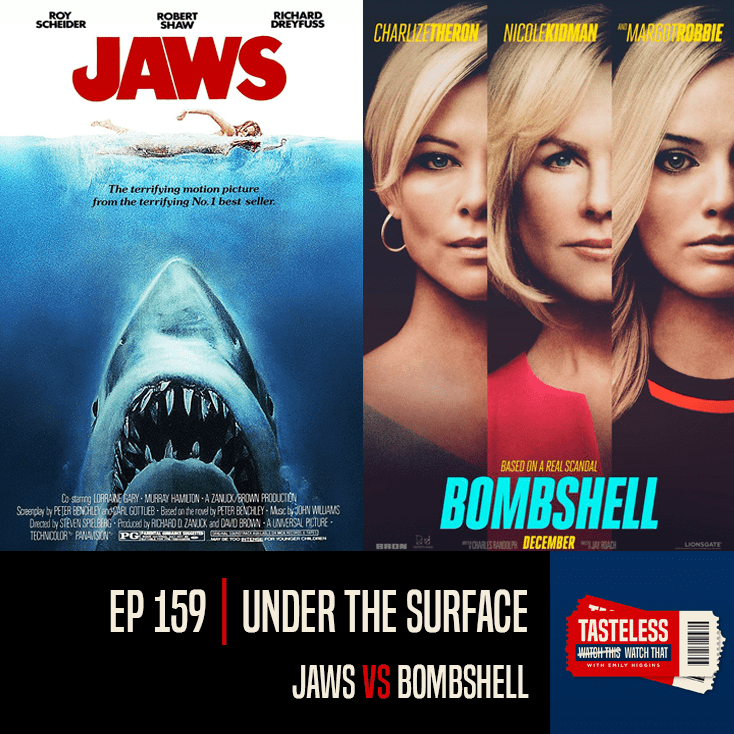
Under the Surface: Jaws vs Bombshell

Jaws vs Bombshell

Two movies where the villain is shrouded, where decency must triumph over convenience and greed — it's Jaws vs Bombshell.

Episode Transcript & Breakdown

Every episode of Tasteless, I take a critically acclaimed film and compare it to one that shares the same themes but didn't get the attention it deserves — and explain why that second movie is my pick. This week: two movies where the villain is shrouded, where humanity and decency must triumph over convenience and greed. It's Jaws versus Bombshell.

Jaws

When a massive killer shark unleashes chaos on a beach community off Long Island, it's up to the local police chief, a marine biologist, and an old seafarer to hunt the beast down.

This movie came out in 1975, has a 98% on Rotten Tomatoes. It won three Oscars — Best Sound, Best Film Editing (by the way, a woman, Verna Fields), and Best Original Score — again our guy John Williams. Will he ever be on the right side of a Tasteless pick? Looking at his long IMDB of classics, probably not. Jaws was also nominated for Best Picture, but lost to One Flew Over the Cuckoo's Nest.

What struck me about Jaws is when the Kintner boy is killed and his mom puts out a reward for capturing the shark that did it. The reward is $3,000. People go to fight a shark for $3,000. And you're thinking, oh, that was old-timey money. Well, in today's purchasing power, that would be $14,586.36. Excuse me — would you go into the ocean to catch a shark for a little under $15,000? I don't think many people would.

We've got our classic characters here. Brody, played by Roy Scheider — he is the sheriff of this town, the law. He's a nice guy, he has a wife, he has kids, he wants to do what's right. He gets the famous line which, according to writer Carl Gottlieb, was not scripted but ad-libbed by Roy: you're gonna need a bigger boat. How many times do you think people say that to him every day? I would lose my mind.

Then we have the scientist Hooper, played by Richard Dreyfuss. I didn't remember that Hooper is rich. He comes to this town and he's like, hey, I hear shark stuff is happening. What's up? I got a boat, I got equipment. Also, I have all this stuff because I am very wealthy. My family is very wealthy and they just put me on a boat and said, go for it, man. He's out here measuring shark mouths, just having a good time.

Then we have Quint, played by Robert Shaw, wearing a sweater that looks very itchy. Quint is the seafarer from the plot description — he's the shark-hunting expert. His ship, his rules. He's like Boomhauer of the ocean.

Some insane IMDB trivia: though respected as an actor, Robert Shaw's trouble with alcohol was a frequent source of tension during filming. Roy Scheider described his co-star as a perfect gentleman whenever he was sober — all he needed was one drink and then he turned into a competitive son of a B. When it came time to shoot the infamous USS Indianapolis scene, Shaw attempted to do the monologue while intoxicated, as it called for the men to be drinking late at night. Nothing in the take could be used. A remorseful Shaw called Steven Spielberg late that night and asked if he could have another try. The next day, Shaw's electrifying performance was done in one take. Okay, I feel like he's getting an awful lot of leeway. Also, Shaw apparently bullied Richard Dreyfuss, which honestly, when you look at him in this movie, I wanted to bully him too, so I don't blame him for that.

When we talk about Brody, Hooper, and Quint, I cannot imagine three people I'd want to be stuck on a boat with less. When they're showing off their scars and it's supposed to be this great bonding scene, it's like — an eel bit me. Okay, cool, I guess. I don't know, are eels supposed to bite you? That's not a cool thing. I was arm-wrestling because I hate my ex-wives and now I can't extend my arm. Okay, great brag, Quint. What are you talking about?

I have a hard time with this movie because I am on the shark's side 100%. Just let this shark have the ocean. It's his. You lost. Your fleshy bodies keep getting eaten. Find somewhere else to hang out. Build a pool. I'm Team Bruce. Bruce, of course, is the name of the mechanical sharks they built for this set. In addition to the well-known nickname of Bruce, Steven Spielberg also called the shark "the great white turd." Notoriously, the shark broke down, didn't do what it was supposed to — they built it and were like, it works great. Then they put it in water and it didn't work because it didn't work in salt water. Nonsense.

But I am very scared, not of sharks, but of animatronics. As a child, probably 11 or 12, I went to Universal, went on the Jaws ride. In the ride, a big mechanical shark comes up to your boat and kind of splashes around and your tour guide is like, oh no, oh no, and shoots at it and flames explode. And I had nightmares for months after — not about being eaten by a shark, but about falling in and having the gears and mechanics grind me up that made the shark go. I did the Universal Studios tour in California within the last couple of years and again saw that mechanical shark and was like, no, he's gonna get me. He's hanging out in the Murder, She Wrote village.

Everyone has seen Jaws. You know the plot. There was a very fun trivia fact: several decades after the release of Jaws, Lee Fierro, who played Mrs. Kintner — the mother of the boy who gets eaten — walked into a seafood restaurant and noticed the menu had an Alex Kintner sandwich. She commented that she had played his mother so many years ago. The owner of the restaurant ran out to meet her. He was none other than Jeffrey Voorhees, who had played her son. They had not seen each other since the original movie shoot. Very cute. Very chill name for that kid, Jeffrey Voorhees.

Bombshell

A group of women take on Fox News head Roger Ailes and the toxic atmosphere he presided over at the network.

This movie came out in 2019, has a 68% on Rotten Tomatoes. It actually won the Oscar for Best Achievement in Makeup and Hairstyling for Kazu Hiro, Anne Morgan, and Vivian Baker.

My old roommate slash good friend is an incredible makeup artist, and she brought me along to a makeup guild screening of this film. It was such a great movie. I loved it. It had one of the best trailers of all time, as far as I'm concerned — where the three stars get into the elevator and that song is playing and they're looking at each other. It's so good.

At the screening, Kazu Hiro was there and mentioned that he had worked on Mighty Joe Young with Charlize. As it turns out, Charlize Theron coaxed prosthetic makeup artist Kazu Hiro out of retirement for his work on this film, and he won his second Academy Award for his efforts. He had previously won for Darkest Hour after turning Gary Oldman into Winston Churchill. When I saw the trailers, I thought her Megyn Kelly makeup was going to be distracting, but once you're watching the movie, it really works. She does a good job of recreating Megyn's look and vibe.

Charlize was nominated for Best Actress at the Oscars and Margot Robbie was nominated for Best Supporting Actress. Charlize lost to Renée Zellweger for Judy — people love a sad biopic — and Laura Dern won Supporting Actress for Marriage Story, which I am highly uninterested in. I think Margot's performance in this movie is incredible, as is Charlize's.

Let's talk Charlize. She plays Megyn Kelly, a real person, a Fox News host and anchor. She wields the word "feminist" like it's disgusting. She says at one point, I'm not a feminist, I'm a lawyer. The way they use the word feminist as an insult does remind the viewer of where we are, of what world we're in — slash just the human world. Having Charlize as Megyn narrate the story, talk to the camera — I really enjoyed it. When that works, it really works.

There's a hardness to her because there has to be to survive in this world. I am not a fan of the real Megyn Kelly — the one kind of big thing they allude to is that she said Santa is definitely white, which — okay, he's imaginary, so I don't know what you're talking about. But I'm not endorsing the actions of any Fox News employee by saying I love this movie. Regardless of party lines, this is a story that is important, a story that needs to be told. The fact that so many of these women had the same thing happen and all were worried about coming forward, about losing their livelihood — when Gretchen Carlson came forward, it broke a dam. There is bravery in that. We can't just care about crimes happening to people we agree with. That creates a bad system for everyone.

Nicole Kidman is perhaps the most sidelined in the movie as Gretchen Carlson, even though she gets the ball rolling on the charges against Roger Ailes. We see her talking to lawyers about the way she's been treated, playing back tapes of all the times on air that men said disparaging, disgusting things to her — and she bit back, but had to laugh it off, because otherwise it's going to be awkward. She had to act like she was in on the joke, like it was all in good fun. Because there's that famous saying: men are afraid that women will laugh at them. Women are afraid that men will kill them. You don't want to set someone off.

It's very affecting to watch her watch herself. Think back about how you've handled difficult situations — I don't think all of us have always been at our best. She wants to make it clear that just because she laughed along awkwardly, that's not what she wanted. She doesn't want to be treated that way. And it's important to remember that just because someone laughs along, doesn't mean you should be saying those things.

Margot Robbie plays Kayla, the composite character of the trio — not based on a real person, but instead an amalgamation of various reports about working at Fox News. She's a quilt of the bad experiences these women have faced, and we empathize with her bright-eyed optimism, her wit.

The scene of real-life character Roger Ailes asking the fictitious character of Kayla Pospisil to lift up her skirt was filmed with multiple cameras capturing all the angles at once. Jay Roach didn't want Robbie to have to perform that scene for more than one take. This is a brutal scene and she plays it so well. It's so real. It's so striking.

Basically she goes in to meet with Roger and he says, stand up and do a little spin. And she's kind of like, what? He says, you know, on-air talent, you're going to be on camera, I just want to see you. And she goes, oh, okay, and does a little spin. He goes, okay, lift your skirt up a little bit. She pauses a little longer and pulls her skirt up a little bit. He goes, higher. She pulls it a little higher. Inch by inch, it comes up so you can see her underwear and she is mortified. She is humiliated. And he's like, okay, great, well, you better prove your loyalty, and sends her on her way. And the other heartbreaking thing — she's like, could you not tell anyone about this? And he's like, of course not. She doesn't want people to know, because she'll be blamed. She did it. She agreed to do it.

A reason it's so hard to watch is because, to a lesser extent, we've all been in situations where we go along with something we're not comfortable with so as not to rock the boat. Maybe someone says something inappropriate and you just sort of laugh and brush it off and hope it goes away.

Margot to me was the character I related to the most, and her relationship with Kate McKinnon is one of the more touching aspects of the film and one of the more frustrating and heartbreaking. Kate McKinnon plays a closeted lesbian, closeted Democrat who works at Fox and takes Margot under her wing. Kate basically says, here's how you survive here. Here's what you want in stories — you want to frighten and titillate. Ask yourself what would scare your grandmother and piss off your grandfather. That's a Fox News story. She's funny, but it's also sad that she can't be herself. Her and Margot wind up going home together, sharing a bed. There's a chemistry there. But neither can be who they are, and Kate has shoved her feelings so far down.

John Lithgow plays Roger Ailes in a lot of prosthetics. He's great. I love John Lithgow. Malcolm McDowell plays Rupert Murdoch. The supporting cast in this movie — I'm going to run through it. Darcy Carden gets to yell at Margot Robbie. Lennon Parham eats some grocery store sushi. Connie Britton plays Roger's wife and says at one point, very genuinely, hoodies are creepy. Alanna Ubach plays Judge Jeanine Pirro. Holland Taylor plays the secretary to Roger. Rob Delaney plays someone who works with Megyn. We've got Brie Larson, Josh Lawson and Ben Lawson as brothers, Liv Hewson, Richard Kind, Alice Eve, Madeline Zima, Ashley Greene, Katie Aselton, Tricia Helfer, Robin Weigert, Mark Duplass, Jennifer Morrison, Allison Janney. It is quite a cast.

Jay Roach directed another great political film, Game Change — and he directed all the Austin Powers movies, and that is called range.

Bombshell is a movie that I think you need to watch. It really does a good job of putting you in someone else's shoes. Would I have thought I'd watch and love a movie about Fox News? No. Absolutely not. But this movie did a great job of stripping away my biases, getting me on board with the universe we're in. Some people think it excused the women of Fox News, and that's where we get into a gray area, and we don't need to villainize. This is a story about assault. The villains here are the people who have built a system that allows that to happen without consequence, and that can happen to anyone.

Shared Themes

Jaws and Bombshell both have a villain that is lurking under the surface — an iceberg with most of the threat going unnoticed until it is far too late. A villain that people disagree on how to face. Some think their presence should be brushed under the rug, while others want to confront this villain head-on. It's insidious.

The villains are a real mean shark and workplace assault and objectification. Two sides of the same coin. Only those who have faced these threats themselves really understand the dangers. And other people are of the opinion: out of sight, out of mind. Don't go in the water. Don't wear a short skirt. But that's not feasible and it's not fair.

Jaws has one of the most iconic antagonists of all time in the form of its great white shark — a shark that gets only four minutes of screen time. The threat of the shark is what looms over the people of Amity, but the issue is that they disagree on just how big of a threat it is. We see this so clearly when Brody's wife comes in — Brody's reading a shark book and she's like, man, let's get drunk and fool around. The kids are out on some boat and Brody's like, oh my God, kids, get off the boat. And the wife goes, don't worry about it, they're fine. Then she flips open his book and sees a picture of a shark ripping flesh and immediately starts screaming at the kids to get back on land, listen to their dad. It takes seeing that picture in the context of her kids out on the water for it to feel like a real threat to her.

The fishermen that rush into the ocean to get their reward are giddy at the thought of this excursion. Chumming the waters, captaining their dinky boats, no fear, no respect for the wildlife. When Quint gets there, he basically says, hey dummies, sharks kill people. This is a problem and I could solve it. Everyone else had been very wishy-washy about wanting to keep the beaches open. They have this town hall meeting — the beaches are going to be closed? We gotta go to the beaches. Be quiet. Go away. People will come back to your beach. Chill out.

The main antagonist of Bombshell is Roger Ailes, though we explore the system that put him in power. If he had had beady little eyes and maybe too many teeth, would he have been taken down sooner? Seen as a real threat by those in his orbit, those who aren't directly threatened by him? Most people don't see Roger on a regular basis. He's on his own floor, his own office, with Holland Taylor guarding the door and a clicker remote that opens it. Very disconnected.

People joke about the workplace culture. They talk about how Roger has a separate elevator for women to arrive in. They joke about the other men there, like Bill O'Reilly. It's all said with a laugh, with no real threat. Margot loves Fox — it's been her dream to work there. She hears the stories about the misogyny in its ranks but continues to idolize the network until she comes face-to-face with Roger's harassment. Till he makes her lift her skirt.

She tries to bring this info to Kate McKinnon and is shut down. When Gretchen Carlson tells her story, many women of Fox scramble to support Roger, not wanting to look disloyal, knowing they can be replaced. Many women say it never happened to them, and one man comments that the women it hasn't happened to are not attractive. We see older people talking about how nice Roger is while younger women get more leg out to please him. We also hear the other side of Roger — the man who pays for cancer treatments and supports his employees. Some people think that gives him the right to act as he pleases.

It takes determined people from all walks of life to take down the shark and to take down Roger.

For Jaws, it's Brody with his guilt over the Kintner boy, with Alex's mom's funeral attire stuck in his mind — he is dedicated to keeping his town safe. He's scared of the water but goes in because it feels like his duty. Hooper joins because he's an expert, the person who has determined that the other shark caught isn't the threat. He's passionate about the field. Quint is the expert on the water, here for the money. He has the experience, the grit, the boat. These three different motives come together. They attack from all angles — with knowledge, with grit, with brains — and that's how they accomplish their goals.

For Bombshell, we have Gretchen Carlson, who has finally had enough, who has been humiliated and demeaned and shuffled to the worst time slots. She decides to do something, to say something. She gets the ball rolling with her public accusations and lawsuit. This leads to Megyn Kelly's crisis of faith — should she admit what has happened to her? She starts an investigation of her own, and when she finds out how many other women have been affected, she decides her voice is necessary. Having it come from a veteran of the station adds weight, adds truth.

Each person who comes forward has to weigh their options. And okay, Roger gets an incredible severance and is living a nice life. But the fact that Gretchen gets an apology — she even notes, like, that's very rare.

Unfortunately, convenience, ease, and greed all trump humanity in Jaws and in Bombshell. The worst mayor of any town is this dude in Amity. What a freak. And right up there with him are the many employees of Fox News — people more concerned about the bottom line than lives being ruined.

The Kintner boy's mom walks up to Brody and slaps him right in his face and says, look, you knew last week a woman had died in this water and you didn't do anything. In the book, it's revealed that the mayor is being blackmailed by the mafia to keep the beaches open. In the movie, he just sucks. He keeps saying, don't scare anyone, keep the beaches open, I'm sure that shark is gone.

Brody gets that slap and I don't know that I fully blame him. It's fair for him to think the first body that turned up was a boat propeller that killed her. But I do know the town does not want it to be a shark and would rather believe anything else. The mayor fights to keep the beaches open, promises to have the problem dealt with in 24 hours. And then when everyone is out on the beach, when it's been deemed safe because some other shark has been caught, the mayor is truly walking up to people like, hey, go out in the water. Why are you sitting over here? And this old man he's haranguing is like, what? I just put my suntan lotion on. I'm letting it seep in, but okay. And he walks off into the water, and then — boom, shark.

Suntan man lives. He doesn't get bit. But others die. And Brody's kid is in full shock. Brody had been worried — he couldn't help but wonder if Hooper's analysis of the shark's mouth was correct, if they hadn't caught the right shark — but he didn't want to deal with that possibility. He didn't push it. He allowed the beaches to open again. Luckily, his guilt and his goodness do make him swing back in the other direction, demanding the mayor approve hiring a shark-catching expert. He will not let something like this happen on his watch again.

In Bombshell, the network doesn't want to admit its mistakes and be liable. The women don't want to support Gretchen and lose their jobs. Kimberly Guilfoyle makes everyone wear shirts showing their support for Roger and Fox. She's so far in the opposite direction trying to prove he's good.

Here's the deal: if my coworker, my boss, was accused of assault, I think I'd take a beat before I went gung-ho supporting them. This person isn't your best friend. How much can you even really know about your super-rich boss who has their own weird button to close their office door?

But these women don't want to be wrong. And there's a more insidious fear — that if one woman got promoted by allowing Roger's treatment, people will think all the women did. No one wants the public believing they got their job based on what they were willing to do for Roger behind closed doors. It's embarrassing.

One of the most heartbreaking moments in Bombshell is when Margot comes out of Roger's office after he's inappropriate with her and goes to her friend Kate McKinnon. Margot starts to confess what has just happened. Kate interrupts: "It's actually better if you don't involve me in this." At the end of the day, Kate values her job security over her friend.

She had said earlier that she applied to a million jobs and only Fox called back. And now no reputable place wants to hire her because she works at Fox. She feels stuck. She sees her only option is to not support those who have come forward.

People must choose hardship. They must choose the possibility of losing their job, their reputation, of being unpopular. Some must admit something they have held secret for so long. And that's not easy. It all bubbles under the surface. It's the humanity that gets Megyn to admit what has happened — because she thought, in the abstract, I'm sure it's not happening to that many people. But when she starts paying attention and listening and hearing how many women have been treated inappropriately by Roger, by other people at Fox, she can't sit idly by. She chooses humanity over job security.

Both Jaws and Bombshell explore gender in a different way, a more honest way, a way that aligns with real life.

When I was watching Jaws, I actually Googled "nice friendship Jaws" to see if other people saw what I saw. And I was glad that the internet agreed that the bond between these men shows another side of masculinity, one we don't get to see as often. Do I hate these three men? For sure. I do not like them. But I like that once they gain each other's respect, all three are all in as a team. There's no fight to be the one who takes the shark, no battle for dominance. Each man brings something to the table and each man steps aside when someone else's expertise is needed.

There's some arguing, as there is with anyone, but it really was a well-oiled machine because these men trusted one another. Brody is perhaps the most sensitive of the three — he loves his family, takes Mrs. Kintner's slap in stride thinking he deserves it. Quint is an aggressive jerk, but as soon as he realizes Hooper knows his stuff, he chills out and offers a drink. Hooper is a rich dandy, basically — someone who you'd think would not do well on a rickety boat chasing a giant beast, but he is right at home. None of these men are posturing. They're simply themselves. There were a lot of ways for these to be three macho guys off fighting a shark. But no — these are two pretty normal guys and then a weirdo who truly looks like he just got dragged up from the depths of the sea.

Bombshell's exploration of gender is a little more confronting — it's the purpose of the film. Seeing the truth of how women survive, what we do to fit in. The constant remarks to the women about their legs. The heels with band-aids for blisters. There's a truth here that is hard to stomach. Instead of just seeing the bright shiny faces that wind up on news screens, we see the dark underbelly of what goes into creating the image of the perfect conservative woman.

There are sacrifices women make so that our lives will be easier, things we put up with. If you're picking a fight every moment of the day, it's just too exhausting. When we see Gretchen Carlson's show with no makeup and she talks about Day of the Girl and how important it is, we also see the backlash she gets — the anger from viewers and the network about having to see a woman's real face. Our characters work to fit the mold, to keep their jobs, while also wondering at what point is it too much. This is the truth behind femininity — a game of inches, compromises. I'm not saying women don't want to wear makeup and look nice. But at Fox in particular, it is a very specific mold these women must fill. Honestly, in entertainment, it's a specific mold — a way you must be perceived.

What Bombshell Did Better

Jaws led to real innocent lives lost, while Bombshell opened our eyes to suffering we may not have been aware of, or at least weren't confronted with in the same way. Jaws invented a villain while Bombshell brought a real person's crimes further into the light.

The shark in Jaws may as well be Godzilla. The entity itself is a complete fabrication. But the unfortunate thing is that people viewed this movie as gospel. Much like the scene in the film where fishermen went out in droves to get their $3,000, many fishermen decided to take on sharks after seeing this movie to prove that they could. Commercial fishing at a large scale began contributing to deaths of sharks. The general populace's view of sharks as evil entities was really helped along by Jaws. Author Peter Benchley, who wrote the book the movie was based on, has said that if he had known about the actual behavior of sharks, he would have never written the book. He told the Animal Attack Files in 2000: no one appreciates how vulnerable they are to destruction. It shows the power of media. Sharks are this apex predator, but they are in so much danger because of the ways they are used — like shark-fin soup. They get caught in nets meant for other things. Having us hate them does not help.

When Bombshell came out, people seemed genuinely frustrated that it gave humanity to Fox News employees, which I think was an important and interesting lesson. We don't know everyone's story. But if someone is doing evil things, they should be punished for it. The film showed the evil lurking under the surface. I'm sure many of us had heard about Gretchen Carlson's lawsuit and that Megyn Kelly added her voice, but it was easy to ignore as someone else's problem — stuff happening between rich people, rich conservative people. Because to be frank, it tends to be the liberal side that more often gives air to these stories, that more often takes these accusations seriously. So when we were finding out about what happened to conservative women, I think there was a little bit of an attitude of, they were asking for it. But this affects everyone.

In Jaws, the biggest tragedy is the death of the Kintner boy, and the fact that it could have been avoided had people known to stay out of the water. We see the effects of the boy's death for only a few moments with his mother. Brody's family has a couple of close calls — his son is shocked by an attack but not injured. Hooper has a much more scientific stake than an emotional one. Quint dies, but he kind of deserved it. He was a little off the handle. I enjoyed the exploration of Brody's guilt, but he also has the peace of a wife that loves unconditionally, two young boys who are healthy. The stakes Brody, Quint, and Hooper have in capturing the shark are definitely diluted. None of these three have faced real tragedy in what we've seen, besides Quint's USS Indianapolis story.

In Bombshell, we follow the tales of women who have had everything taken from them — their dignity, their voice. We see Gretchen's fear and isolation when at first no one comes to her support. We see Megyn's anguish over whether coming forward would ruin the lives of her family. We see Margot break down sobbing into her phone outside a fancy restaurant, wondering what it means that this has happened to her. These are the people directly affected, and there are dozens more who we visit along the way.

All movies don't have to tell the stories of all people. But Bombshell is something that has stuck with me since my initial viewing, much in the way that the Jaws theme has stuck with us all. I'm glad stories like this are being told from all sides. If you haven't seen it, I hope you will give Bombshell a chance. And honestly, you can always rewatch Jaws.

Hit me up at @tastelesspod on social media. Let's talk about all the incredible people who are in Bombshell — Holland Taylor, Darcy Carden, Lennon Parham, Jennifer Morrison. What a dream cast. And Margot should have gotten that Oscar. The scene of her lifting her skirt is abhorrent and beautifully acted.

A Hero Lies in You: Star Wars vs Spy

Star Wars Episode IV A New Hope vs Spy

Two movies where people become the sort of hero they’ve long admired, filling the shoes of those who have come before to save lives from greedy imperialists, and finding a support system along the way — it's Star Wars: Episode IV - A New Hope vs Spy.

Episode Transcript & Breakdown

Every episode of Tasteless, I take a critically acclaimed film and compare it to one that shares the same themes but didn't get the attention it deserves — and explain why that second movie is my pick. This week: two movies about people that become the sort of hero they've long admired, filling the shoes of those who have come before them to save lives from greedy imperialists. And they find a support system along the way. It's Star Wars versus Spy.

Star Wars: Episode IV - A New Hope

A farmboy joins forces with various allies to save their galaxy from the evil Empire's planet-destroying battle station, while also rescuing the princess leading the rebellion against them.

This movie came out in 1977, has a 92% on Rotten Tomatoes. It's so weird to talk about this movie so objectively, just like — this movie came out in 1977. Like, it's Star Wars.

It's number 25 on the IMDB Top 250 and it won six Oscars, which I hadn't known. Best Art Direction, Best Costume Design, Best Sound, Best Film Editing, Best Visual Effects, and Best Original Score — of course, John Williams, come on. It was nominated for another four, including Best Picture, Best Supporting Actor for Alec Guinness — who watched this and was like, you know who really pops? Alec Guinness. That's Obi-Wan Kenobi. The weird guy in the desert. All right — Best Director, and Best Screenplay. George Lucas wrote and directed this movie. This was his vision, and I just can't imagine how good it would feel to have your passion project become one of the most massive pieces of cinema in history.

I think it's hard to even comprehend how much of filmmaking since the first few Star Wars movies was influenced by it. So I'm going to do my best to look back at it as just a piece. There are a lot of better explorations of the Star Wars universe in podcast form, in book form. I'm here to talk about the first film with a semi-fresh set of eyes — I hadn't seen it in probably 20 years until I revisited it for this.

I was really surprised by the structure because it really throws you right into the world, into the battle between the Rebel Alliance and the Empire. You don't see Luke Skywalker until we're pretty far into what's going on.

I really wanted to watch the original version, but there's like a million versions. The one I watched, the crawl at the beginning says "Episode Four." But when this came out, you didn't know it was episode four — so this has been altered. This is the same as the Han-shot-first thing. Initially, Han Solo shoots Greedo. Then when George Lucas revisited the movies — because this dude is a tinkerer — he changed it so that Greedo shoots first, I guess making it so that Han isn't just a cold-blooded murderer. In this version, it was either they shot at the same time or Greedo shot first. Regardless, I just want to watch the purest version of this film. It's a Blade Runner situation except more complicated because there's a less clear-cut consensus on what version is correct.

By the way, let's talk about Greedo for a second — the green dude that Han Solo shot first. This guy was played by three different people. Actor Paul Blake played him when Han and Greedo are in the same frame. Actress Maria De Aragon wore an animatronic mask for head closeups. And linguist Larry Ward provided Greedo's voice. Why couldn't the guy who did his voice be the one in the suit? And why couldn't the one in the suit wear the animatronic head? I don't understand. It feels like George Lucas made things very complicated for himself.

But we kick off with stormtroopers versus rebels on the ship. The rebels — these freaks — their helmets are so long and so stupid. The stormtrooper outfit has stuck around with us because it is such a cool costume, like Power Rangers style, where every kid should be this costume because it is cool. And then the rebels got these roly-poly helmets going down their heads like they're sad, khaki aliens from the movie Alien. They look like straight-up dummies. I don't know how they got us to root for these guys.

When Luke Skywalker and Han Solo get on the ship and put on stormtrooper outfits — Luke Skywalker with a stormtrooper outfit with the helmet off is so attractive. I am so into Luke Skywalker and Han Solo with stormtrooper outfits on. Great outfit.

Before we even get to Luke, we see C-3PO and R2-D2. It's not often on screen you get to see a robot hunched over. Usually a robot is standing up straight. But in this movie, C-3PO — played by Anthony Daniels in a suit — has bad posture. And I felt seen. I felt like I was seeing myself on screen for the first time as C-3PO. There is so much C-3PO and R2-D2 up front as this weird buddy duo. This dude is just whining and R2-D2 is like, boop boop beep boop. And C-3PO is like, R2-D2? We gotta get off the ship!

But let's talk about Carrie Fisher. Oh my God. I watched the Star Wars movies once and that was it. I'm going to revisit them because watching this first one, I really was like, wow, this laid so much groundwork. Princess Leia is so cool. And I'm surprised to revisit it now and realize I didn't immediately glom onto her, because I know Carrie Fisher better from just being Carrie Fisher — from the books she's written, from her public persona, from just being tremendously witty and cool, from her kind interactions with people.

There is something so lasting, so important about Princess Leia. You feel it from the moment you see her in this movie — the strength, the confidence, the humor, the toughness. It's so wonderful that Carrie Fisher found this role, that this role found her. I can't imagine it being anyone else ever.

Now, it's clear George Lucas did not know Luke and Leia were going to be siblings. They flirt hardcore. They kiss. But the twist of Darth Vader being Anakin, being Luke's father, is one of the best in cinema and adds important weight to Luke's journey — which is why this is one of those movies where the more you watch it, the more it all fits together.

When we see Luke, we get to Tatooine and he is a baby. Mark Hamill is so young and he's like, Uncle Owen, I wanted to go to the Tosche Station for power converters. And Uncle Owen's like, you can see your friends when you're done with your chores, Luke. What is this? Why? I forget that he was a teen.

So he meets R2-D2 and C-3PO because they get bought to work on this farm. Very uncool. Don't like this robot slavery. R2-D2 has this little message he keeps playing — the very famous hologram of Leia being like, help me, Obi-Wan Kenobi, you're my only hope. Which is the least helpful message. Help you with what, lady? What is your problem? And Luke sees this video and he's like, who is she? She's beautiful. So clearly George Lucas did not know she was his sister.

Alec Guinness is Obi-Wan Kenobi, this old guy out in the desert, who gets called back into action. He shows Luke the lightsaber his dad left for him. The lightsaber sounds are still so satisfying. I think the lightsaber sounds are why this movie became a phenomenon. Just the sound design. Oh my God.

Luke's Uncle Owen is such a freaking liar. He's like, that guy's not Obi-Wan Kenobi, that's old Ben. He's very different. There's a lot of Kenobis, it's like Smith. But then the uncle and aunt die, and Obi-Wan and Luke are investigating what happened. They see a destroyed sand crawler and Luke's like, do we think the sand people did it? And Obi-Wan is like, no, they wanted us to think they did, but only Imperial stormtroopers are so precise. Which — Ben Kenobi is basically saying these shots are so accurate, no one is more accurate than a stormtrooper. Which is insane in a world that knows stormtroopers are the worst shots on earth. You watch them even in this movie spray laser bullets all over the place and not hit anyone even when people are right in front of them.

Luke finds out his aunt and uncle are dead and he's like, okay great, I'll go with you Kenobi, let's go. They go meet Han Solo, a smuggler with Chewbacca. Harrison Ford is so rude. He keeps calling his ship the Millennium Falcon. It's a falcon, you freak. A bird's a falcon. My ship the Millennium Falcon did the Kessel Run in point parsecs. Okay, great. You hang out with a giant dog. What's your problem? He really is the biggest turd.

In one of the later movies when Leia says I love you and he says I know — he seems like a grump too, even though he wears an earring. He is an adult man with an earring. Why is he so mad all the time? He's living the life. He says at one point in this movie, if we can avoid any more female advice, we might just be able to get out of here. Shut up, dude. Princess Leia is the only cool one.

Multiple people call Princess Leia differently, which really threw me off. There are so many accents in this movie. It reminded me of the Harry Potter books where everyone argued over how to pronounce Hermione. You can't call her Leia and Lay-a and the Millennium Falcon. What are we doing? I don't know why that's okay. Everybody else has covered every other element of Star Wars, so this is where I stake my flag. My important issues.

Everything about the world-building in this movie is so good. This was meant to be an epic series. It really was and it deserved that. If you haven't watched the first one in a while, I really suggest revisiting it. I enjoyed it a lot. I barely even talked about the plot because it's Star Wars — you know the plot. They go in their little ships, they fly around, he shoots up in that hole in the Death Star and it explodes. That's Star Wars.

Please, people who love Star Wars, don't come for me. I really do like it. I understand why people have devoted their lives to it in the way that I have devoted my life to Sandra Bullock and my cat. I get it fully.

Spy

A desk-bound CIA analyst volunteers to go undercover to infiltrate the world of a deadly arms dealer and prevent diabolical global disaster.

This movie came out in 2015 and has a 95% on Rotten Tomatoes. Now you see why I had to bring out the big guns with a Star Wars comparison.

This one is tricky because on this podcast I usually try to highlight movies that either not enough people saw or that were reviewed poorly and I disagree. This movie was reviewed very well by critics, and I find that the pockets of the internet that I interact with, people who share my same interests, all love this movie. But I found it very interesting that when I posted about it on Instagram, I got many DMs saying, this movie is so underrated. So there's this like — all of us are secretly loving this movie and thinking that no one else loves it like we do.

In this context, yes, it was reviewed fairly, but it should have had five sequels. It should be a series in the way that James Bond is a series. It should have gotten an Oscar. It's such a good movie.

Paul Feig is the George Lucas of comedy, and he wrote and directed this film. I have been in love with Paul ever since Sabrina the Teenage Witch, where he played a teacher, Mr. Pool. I love him so much. I love Freaks and Geeks. I love Spy. I love A Simple Favor. I love his dapper suits. He's so funny. There should be seven Spys. How many Star Warses are there? Ten? There should be ten Spys. There should be eleven Spys immediately. Unacceptable that there aren't.

This is Melissa McCarthy's best role. I know people love Bridesmaids, right? But no — Spy is it. The depth of this character, the different levels she gets to play it at — it's truly the culmination of Melissa McCarthy's talents. To play so funny, so crazy, so awkward, so vulnerable, and be such a real human at the same time.

She's one of the office workers, right? She has all the intel and she's speaking to an in-the-field CIA agent, keeping an eye out on him, watching through cameras, letting him know schematics, where to turn, what to do. When her charge, Jude Law — the agent in the field — is killed, she volunteers to go into action to finish the job he started.

When she decides to go undercover, they give her these horrible covers — Carol Jenkins, who she says looks like somebody's homophobic aunt. Penny Morgan, a divorced housewife from Iowa with ten cats. She's like, why? When Jude Law goes in the field, he gets to be a businessman. Why is this what I am? But that's how people see her. And this movie dives into that in such an interesting way.

The way she changes from nervous and unsure of herself to confident when Rose Byrne, the villain, thinks she's blown her cover — this is range. Because all the levels she plays it at, even when the character Melissa is playing is undercover, you understand the heart of who that main initial character was.

Jude Law, her CIA agent in the field, thinks she has cats, talks to her about it all the time. A lot of cat-lady bashing in here, Paul Feig, but I'm going to take it as satire of the type of person that people think she is. He gets her jewelry and she's so touched because she's in love with him — he's gorgeous and kind and cool. She opens it and it's this mean little cupcake necklace. He has really put her in a box of the kind of non-threatening, just shell of a person. And she lets him. Because she has to gain new confidence.

Let's get into the Rose Byrne of it all, because Paul Feig has really done right by Rose Byrne. I feel like Bridesmaids is what brought her back into the American comedic consciousness, because she has been acting incredibly in so many things for so many years. She is a highlight of anything she's in. She gives her all in every single role.

In Spy she gets to be so mean and so funny and just incredible. Every line she delivers with a scowl, with derision, is perfect. At one point she's playing Candy Crush while talking to Melissa. Melissa's like, you're being very rude. They are such a great push and pull. And when Melissa's character brings it up to eleven, Rose Byrne very quickly is like, okay, cool it. Bring it down a notch.

The chemistry slash rivalry between Rose Byrne and Melissa makes this movie. That is the driving force behind why it's so funny, why it sticks in my mind, why it's so enjoyable on a rewatch.

There's a respect between them. The way they joke with each other and make fun of each other is so human and ridiculous. There's a moment at the end where Rose has been captured and she kind of gives this little smile to Melissa because at the end of the day she does like her. They do enjoy each other. I like that they have this weird mutual respect.

What's incredible about Rose Byrne is that not only is she a shining light on the screen, but she coaxes the best possible performances out of her co-stars. Her presence always raises the bar. She is what made Neighbors work — instead of being a nagging wife, her and Seth Rogen are such equal partners and she pulls that out of people. She was the perfect maddening enemy for Kristen Wiig in Bridesmaids. I love her in the Annie remake as the person that pulls Jamie Foxx out of his shell. She's just so talented and elevates everything she's in. I adore her. And if pressed to pick a favorite role of hers, Spy might be it.

This movie also has Jason Statham, who's usually — he's fine in things. Hobbs and Shaw was cute. But he is so funny in this. He's this insane tough guy spy stereotype who just rattles off nonsense and thinks he's so tough but also never quite knows what's going on. At one point he totally screws up and Melissa McCarthy kind of shrugs to the room of bad guys and says, he means well. He does — he wants to be this tough guy spy, he really thinks he's suave, but nothing he does goes quite right.

I love how Allison Janney talks to Jason Statham, because Jason is another spy in the CIA and Allison Janney is in charge of them. She is so mean to him. She's so mean to Melissa McCarthy. In this very funny, brisk way.

We have Miranda Hart, a brilliant comedian actress, as Melissa McCarthy's confidant — another person who does the same job she does, gathering intel. She has a fling with 50 Cent and there's a line in this movie I think about all the time, it's so small, but when she goes, simmer down, 50 Cents — I think it's so funny.

We have an array of fantastic Paul Feig regulars. Michael McDonald, who comes up with the tech options for Melissa going into the field — but instead of cool stuff, like a shoe that's a gun, she's given anti-fungal spray that is actually freezing powder. Stool softener pills that are actually antidotes to poison. A watch, but it has a picture from the film Beaches on it. Then we have Jessica Chaffin, Sam Richardson, Adam Ray, Katie Dippold, Jamie Denbo, Zach Woods — all these comedic people I adore. Morena Baccarin from Firefly as a rival agent. Peter Serafinowicz as Aldo, this ridiculous man. Bobby Cannavale as a bad guy — of course, Rose Byrne's husband. He's so good as a bad guy named De Luca with slicked-back hair. I would give him the nuclear codes as well.

The only knock I have against this movie — the only bad thing I can say — is that there is a barf scene where Melissa McCarthy barfs all over. Why does every movie gotta have a barf? Why?

I also, when trying to find a bad review, found one from the World Socialist Web Site that says, does it occur to Feig or anyone involved in the making of Spy that not everyone dotes on the forces of law and order nor finds their operations as endlessly fascinating as he apparently does? Is this what I sound like when I talk about movies I don't like? I love that this person said this comedy doesn't work because I think it glorifies the CIA. This is a comedy of errors. No one is looking at this and going, I want to work for the CIA. That would be insane. It is a comedy movie, you freaks.

Shared Themes

Luke Skywalker and Melissa McCarthy are looking for adventure, for something different than the rut they have found themselves stuck in, but neither is sure what they're looking for. They've always been told that they are where they should be — Luke on the moisture farm, Melissa in what is called the basement, the part of the CIA that's not in the field. Both know that they're frustrated, unsatisfied, feeling stuck and unappreciated. They're not seen as real, formidable humans, but instead as shadows — they're looked past. But they don't know what to do about it.

They are in some dark way freed to become who they want to be, to live up to their potential, by the death of a loved one. Uncle Owen and Aunt Beru — I wrote "Aunt Unspecified" in my notes and had to Google it, and I was like, I bet she has a name. Aunt Beru. We definitely hear Uncle Owen about 18 times. We don't hear Aunt Beru. But whatever — they are killed by stormtroopers right when Luke has to make a choice. He may not have been able to bring himself to leave behind the farm and the only family he's known, but when he finds his home burned, his family dead, he realizes there is nothing left for him on Tatooine. He is freed to follow Obi-Wan Kenobi.

In Spy, Melissa has served as a consultant to Jude Law. She's watched over him. Has put her life on the sidelines to make sure he can fully live his. She fires his gardener while she tries — it doesn't work out. She picks up his dry cleaning. So when he is killed, she has to restructure. She has to figure out who she is without him. And she decides to go into the field to avenge him.

Luke and Melissa are finally given no other choice than to live out their desire for more, for action, for making something of themselves. What's up with uncles, by the way? Uncle Owen, Uncle Ben — don't kill someone's uncle if you're a bad guy. It's not a good move. It's going to lead to a lot of issues.

What I love about Luke and Melissa is their almost naive enthusiasm, their total lack of ego surrounding what they do. They want to be part of something, they want to make a difference, but neither is out for themselves. They're genuine people who feel a sense of duty to those who have come before them, those who have protected them, those who have fought for the side of good. Luke and Melissa throw themselves fully into their missions just because it's the right thing to do.

In Star Wars, Luke Skywalker wants to be an Imperial Military Academy space pilot, but he has to stay home and help on the moisture farm, collect all that moisture. The moment he learns that his father was more than he thought — that his father was a brave man who died in battle — Luke feels hope that he too can make a difference. It's not about making a name for himself, but about showing himself that he can do it, that he has it in him. Just to scratch this itch of wanting to be more.

In Spy, Melissa wants to carry through the missions of the CIA, an organization she does believe in. She's so committed to her work. She keeps helping Jude Law as bats attack her head in one of the opening scenes. Everyone else is eating fun cakes and she's just busy working because she believes in it. There's no glory in that for her, but it's what she thinks is right. She wants to follow in the footsteps of Jude Law and of the agents that came before her.

Luke Skywalker and Melissa McCarthy tap into a different piece of themselves in a way that is inspirational, in a way that shows there is something special in everyone.

The Luke Skywalker thing is hard because some of the movies make it out to be that anyone can be special, while others are like, no, there's certain really famous families and their lineage is special and everyone else can suck it. But in this movie, yes, Luke has the Force, this power he was unaware of that he's trying to learn to control. But he doesn't know that when he commits to joining Kenobi in battle. He doesn't understand the ways it will help him. He is willing to help regardless. He doesn't think he's some superhero. He thinks he's a farm boy.

If Luke hadn't come upon C-3PO and R2-D2, he would have died in his sand hut along with his aunt and uncle. But whether through chance or fate, Luke becomes an accomplice to Obi-Wan Kenobi. And in a battle that has been raging between the rebels and Darth Vader, Luke is a new factor. It is Luke who shot the Death Star right in its little death hole. One man brought down the entire Death Star. That is inspirational. Where are those posters? Like the cats that say "hang in there"? It's just, you too could shoot the one weird design flaw in a giant spaceship. Not as catchy, I guess.

In Spy, Melissa McCarthy thought she was never meant to go into the field. She left those dreams behind when Jude Law kind of suckered her into being his helper on the ground. But it is her immense knowledge of what is happening, of the politics at play, of the nuclear situation that makes her such an asset when she does get to go undercover. When all of the CIA's agents have been compromised, they don't know what to do. And Melissa steps up. Her experiences, her knowledge — that's just as valuable as the people who the CIA had deemed more worthy of the field than her.

She knows she hasn't been trained in ten years. Allison Janney is like, I would send you for training, but we gotta get going. She hasn't shot a gun in a decade, but she is willing to go out and do this. And because she does, she's in the right place at the right time to thwart Bobby Cannavale's evil nuke plans. She follows him, jumps onto his plane, pulls the nuke out, drops it in the ocean with a whole lot of diamonds. That is her. That is her doing something. Making a difference.

What I really appreciate in these films is that they emphasize the power you have as an individual, but they also show how important it is to not just be, but to feel supported. Luke and Melissa become involved with people very different from them, which helps expand their horizons and allows them to grow further confidence in themselves.

When you're around the same people all the time that all see you the same way, you can become stuck in that view of yourself. Meeting new people, expanding your horizons, can allow you to see yourself in new ways. Uncle Owen and Jude Law kept telling Luke and Melissa that they belonged where they were, that they shouldn't branch out, that they were meant only for one life — a life under the radar.

But then we meet Han Solo and Jason Statham — two men who are aggressors, very different from the mild-mannered temperaments of Luke Skywalker and Melissa McCarthy. And they complement those temperaments so well, bringing out more sides of one another and ultimately being one of the most important bonds in each film. Han and Jason show the normally controlled and rule-following Luke and Melissa that there are other ways to be, that they don't have to stay confined to what they've been taught is right — that sometimes they can go with their guts and just trust in themselves.

Chewbacca and Miranda Hart are supportive individuals who are stalwart, who can reach things on high shelves, and who will never flee, who will always be there doing their best, whatever that may be.

What Spy Does Better

Spy doesn't have a version of Leia because Melissa herself is both Luke and Leia. So let's get into that.

Star Wars — incredible movie. I cannot overstate its importance in culture. But Star Wars should be about Princess Leia. Luke is such a nothing in the context of this first film. Whereas Spy finally gave us a movie about the side character that we've wanted a movie about, expanded something that we haven't gotten to see.

When Star Wars opens and we see some robots whining and then we see the utter coolness of Princess Leia, I was like, wow, how dare they peddle this as Luke's story. Even as Han's story — Leia is the story. Luke is the most like the viewer perhaps, but he is hollow. He is half of a person and we see the beginnings of him becoming whole. But in this movie, really, he's just kind of a generic protagonist. He follows the rules, but now he's going to get cool.

Melissa in Spy lets other people walk all over her, but she's smart and she's passionate and all these things that add up to a real person — a real person who becomes a hero. She is both Luke and Leia.

She wants to impress herself. She does what needs to be done because she knows she's the person who must do it. And there's humanity and there's heart. We know her without actually having met her. We understand her.

What helps with that is the way the viewer interacts with the characters of Spy. I felt much more privy to their thoughts — between the mumbled rants from Melissa McCarthy about how other people see her every time she's given a new undercover persona, to how Rose Byrne smiles softly at Melissa as she's shoved into the back of a CIA cop car. We are given pieces of information about these people that flesh out the world and tell us who they are without them needing to spell it out.

What I wish from Star Wars that I loved in Spy is having some genuine self-reflection. With Luke, we really don't get his interior life. We mostly see him as others see him. Whereas with Melissa McCarthy, we can see her internal struggle so clearly. Star Wars has a bevy of interesting characters that we grow with over the course of 80 more movies, but Luke himself is someone we don't know much about in the first film. So much of him is hidden — to be unveiled later. Some of it known to George Lucas at the time, some of it not. We don't know his struggles. We don't know anything besides he's an insolent, bored, sullen teen. Is he 40? Is he 15? Apparently he's 18, but I don't buy it.

It's hard to view this first Star War on its own, not as a setup for greater things. And clearly on its own it did make quite an impact, winning a ton of Oscars for the world that it built. But these characters become so much more than what we see in this first film. The first Star Wars lays the building blocks beautifully — but for me doesn't stand on its own as a particularly great exploration of any of its characters besides Leia, whose tenacity and grace can be witnessed from moment one.

Perhaps these characters feel like stereotypes because they built the world — they influenced the world that we now pull our stereotypes from. But the rogue smuggler Harrison Ford is tired. I get it, he's cooler than everyone. He can't tell anyone he loves them. I get it. I don't get depth from this.

What is fantastic about Spy is that it takes a character who would be in the background in another film and explores her thoughts and feelings. We see how she reacts to how others see her — the constant positioning of her as a divorcee, a cat lover, Jude Law buying her the least sexy necklace of all time, a really mean little cupcake charm on a chain. We see her disappointment in these things so clearly. We see the way she tries to mask her hurt, the way she wants to be known for who she is instead of some sad stereotype people want to pin on her.

We see another side of our villain Rose Byrne. We know her father wanted a son and she tried her hardest to live up to his expectations and take on a more traditionally masculine role. She's a broken girl with a Bulgarian clown for a mother at the end of the day. We see vulnerability from Jason Statham — a man constantly throwing himself into things and shaking himself off when it doesn't go right. There's something about Melissa that brings out the best in him.

The approach of Luke and Melissa is also very different. Luke has questions about his past but not questions about his future. Whereas Melissa's whole world is thrown into a tailspin as she doesn't know who she can trust.

In Star Wars, Luke Skywalker is given the benefit of a clear path. He bumps into Ben Kenobi and follows him into battle. Once he's on board the Death Star, he comes into his own, gets Han motivated to help him save Leia. He doesn't worry a lot about consequence. He's just following what he believes has been set out for him.

In Spy, Melissa isn't given an easy path. No one wants her to do what she does, really. She has to convince them she can go into the field. She takes her choice to leap into action seriously — she knows the risks, but feels like she owes it to Jude Law. Once she's in the field, she realizes what an important force she is. She can't follow the rules. She has to make up her own path because everything the CIA has been trained in has been thrown out the window when they've all been compromised. There's not someone above her giving her orders. There's not a ghost voice whispering in her ear to trust the Force. She has to do what she thinks is right and see how it all plays out from there.

I hope you will give Spy a chance if you haven't seen it. I feel like everyone has just secretly seen it and isn't talking about it. It is a really good movie. As is Star Wars — look, I'm going to start revisiting all the other Star Warses now.

Hit me up at @tastelesspod if you want to talk about Rose Byrne, Spy 2, or Princess Leia. I bet someone out there has a hologram of Princess Leia. Like someone has built themselves their own R2-D2 that plays a hologram. I'm going to look into that.

Back In Business: John Wick vs Stick It

John Wick vs Stick It

Two movies about the best in their field coming out of retirement — it's John Wick vs Stick It.

Episode Transcript & Breakdown

Every episode of Tasteless, I take a critically acclaimed film and compare it to one that shares the same themes but didn't get the attention it deserves — and explain why that second movie is my pick. This week: two movies about the best in their field coming out of retirement. It's John Wick versus Stick It.

John Wick

John Wick is a former hitman grieving the loss of his true love. When his home is broken into, robbed, and his dog killed, he is forced to return to action to exact revenge.

This movie came out in 2014 and has an 86% on Rotten Tomatoes. I cannot believe it came out seven years ago. It feels like I just saw this in theaters.

Keanu Reeves plays John Wick and this is the perfect role for him. It brought him back into the spotlight as being just an all-around good guy. I only hear wonderful things about Keanu. And I shouldn't be surprised, since even Sandra Bullock had a crush on him. I spoke about his many charitable acts in The Matrix episode, but I just want to reiterate that he is always looking out for other people wherever he can, especially below-the-line crew members — the people that aren't the face, the actor, the director, the writer. The people that are making it all happen behind the scenes. The stunt people.

And that's why he is involved in this John Wick trilogy. He had such a good relationship with the stunt people on The Matrix and they wanted to utilize him for this series of movies that basically revitalized his career. So that is some good karma right there.

I saw John Wick in theaters just as something to do. I went with friends, back when that was allowed, we could have fun, I could see movies. And I was really impressed by it as an action movie that does pack a punch. It doesn't actually have that much story, but it's still affecting. A lot of that success is due to its directors who are two stunt people — perhaps the profession I'm most fascinated by. Chad Stahelski and David Leitch co-directed and co-produced it. They also directed Atomic Blonde, which I love. Chad was Keanu Reeves' stunt double in the Matrix movies. These guys believe in practical effects, real action instead of green screen, and that makes all the difference.

Keanu Reeves talks about how the stunts and fights are built out around what the actors can do, that there's so much training. Zoe Bell touched on this in the Strong Female Leads episode — something I had never thought about until she said it and haven't stopped thinking about whenever I watch an action movie: the stunt double needs to capture the physicality of the actor, the specific way that people move, how they do things. By figuring out exactly what Keanu Reeves can do and carrying that through, it makes for an excellent flow to the movie, something really natural that feels real.

Even the subtitles in this movie — there's a lot of people speaking Russian, so there are built-in subtitles — have a choreographed movement to them, the way they enter and exit the screen. Every element of this film was really thought out by two people who know what they're doing.

Bridget Moynahan plays John Wick's wife — yes, of course, Bridget of classic film Coyote Ugly. She sees the best of him. She doesn't know who he was before, his assassin life. Bridget elected not to read the whole screenplay as it might have colored her view of John Wick outside of her marriage to the character. We mostly see Bridget in a specific clip that John keeps on his cell phone — a video he took of them on the beach where he's filming her and talking about how beautiful she is and then he turns the camera around and films them kissing. She's sick, she dies, so he just watches this clip all the time.

The thought of John Wick selfie-filming him and his wife kissing is the least believable part of this movie. I believe every other element except for this man deciding to take a video of his wife while saying how beautiful she is and then turning the camera around to catch them kissing. Don't buy it.

Most important element of this film: the dog. The beagle puppy. The beagle puppy is given to John Wick by Bridget Moynahan after she dies because she knew she was dying — she arranged for the dog to be delivered to him. In her life she always wore a daisy necklace that John had given her. So the dog has a matching daisy collar and of course he calls her Daisy. He sees Daisy as a link to the woman he loved so much.

He's clearly not been an animal person before — he's always been out for himself until he met his wife. But I love the moment where he's had the dog sleep on the floor on a blanket. He's not a monster. Dog sleeps on the floor, he sleeps in the bed. He wakes up to the dog kissing him. And the next night he looks at the dog who's laying on the blanket and he's like, all right, you can sleep in the bed. And the dog gets in the bed with him.

Seeing a beagle puppy kiss Keanu Reeves is so special. Forget about rom-coms. I want a genre of movies, a series of films, where hot guys love puppies and kittens. Imagine Chris Hemsworth with a kitten just lightly licking his beard. Imagine Paul Rudd touching his forehead to the forehead of one of those really wrinkly dogs. I'm going to make these movies.

In the trivia, it says they covered his face with bacon grease. I want men covered in bacon grease on their faces getting little kisses from baby animals. Baby chicks — bring some baby chicks in there. This needs to happen. It's a billion-dollar idea.

Now we've got to talk about the sad part. Usually if an animal is killed in a movie, it will knock the movie down a few pegs for me. I can't handle it. It really often feels unnecessary or emotionally manipulative. But as awful as it is to see Daisy the beagle puppy splayed out, to watch Keanu hold her lifeless body — it's an important part of the film. Seeing Keanu wake up from being knocked out and the bad guys who have broken in have put the corpse of his beagle puppy next to him is gut-wrenching. And then for him to take Daisy's collar and put it next to his wife's daisy necklace on his bedside table. It's so upsetting.

We see the importance of what Daisy did for him. At the very end of the film, John breaks into a vet's office to basically patch himself up and he steals a dog — don't steal dogs — but he takes a dog with him because he has been opened up to that love again. This movie did something differently, and the reason the death of Daisy was earned or justified is that I felt the death was properly honored. It meant something to the viewer and to John Wick throughout the film. It wasn't just something to move us from point A to point B. It really continued to have an impact.

The person who orchestrates the killing of John Wick's dog is Alfie Allen — maybe the only person who had a very famous song about them and then later became famous. He was great on Game of Thrones and he's really good in this as a jerk. He has a very punchable face and that's why he was cast. When he first meets John Wick, he doesn't even know who John is. He just sees him in a gas station with a really cool car. He wants the car and is mad when John doesn't capitulate. So later he and his goons break into John's home, beat him senseless, kill his dog, and take his car.

It turns out Alfie is the son of a Russian mob boss played by Michael Nyqvist. His name is Viggo, he's head of everything. And he's like, oh my God, why did you kill John Wick's dog days after his wife died? You idiot. And then he punches his son so hard that his son barfs. Why do all movies have barf? I'm so sick of it. I'm just trying to live. Everybody's barfing.

So this is the plot — the actual what's happening. But then we get the action, the action of John Wick going on an all-out rampage to kill Alfie and anyone who gets in his way. Stellar fight sequences. Keanu does a lot of his own stunts. I think that's why this is a movie that should be watched at least once — even if you don't think you're a big action movie person, there's a beauty in how well choreographed the movie is and the interesting settings the fights take place in. In addition to the usual action movie fare of rainy alleys and dark warehouses, we have this insane dance club slash bathhouse sequence. Why is there a bathhouse in a club? Imagine how steamy it is.

Important to note that one of Viggo's henchmen is Dean Winters, aka Mayhem from the Allstate commercials, aka Dummy from 30 Rock, aka Brian from SVU. What a career that man has. Adrianne Palicki plays an assassin named Miss Perkins who comes after John — he gets a bounty put on his head by Viggo, who's just trying to protect his son. She has some amazing fight scenes with John. Unsurprisingly — this being the Tasteless podcast — I was a little frustrated by how many men we watch fight, but Adrianne's scenes almost make up for it. I also appreciate that the guys that made this made Atomic Blonde, so I don't think I can really come down on them too hard for that here.

Stick It

After a run-in with the law, Haley is forced to return to the world from which she fled years ago. Enrolled in an elite gymnastics program run by the legendary Burt Vickerman, Haley's rebellious attitude slowly gives way to a team spirit.

Haley is played by Missy Peregrym. Her as Haley — Missy as Haley — is one of the best performances ever. It's so good. She's so perfect. Her facial expressions, the ponytail that I'm immensely jealous of. There's a Jim Carrey delivery to her — there's voiceover and she's always a little bit snarky. At one point she's talking about how if you're in gymnastics you better like falling because you're going to fall a lot, and she says something along the lines of, good thing I didn't like falling. I loved it. Very Jim Carrey funny.

There's a lot of physical comedy from her — she's jumping around — and I don't get to see this sort of comedy from women as often as from men. I think she's allowed to exist in this space where what a movie typically wants a teen girl to be hasn't been applied to her as rigorously, in a way that makes her so much more real. She's just goofy.

Stick It is really something special. They sort of played around with gender, with expectation. Just allowed this person to be a person. Haley is annoying at first — she's an angry teenager — but you get to know her. She's a goof. She's super goofy. She is really passionate about what she's passionate about, she loves her friends. I think this is such a great character, and it's shocking to me that we didn't get sequels, a series.

By the way, Jessica Bendinger wrote and directed this movie. She also wrote Bring It On, one of my all-time favorite movies.

Stick It, the world of it, this character, this rebel — it's so fun. I put it on and thought, I wonder if this is going to hold up. Within 15 minutes I was so in. I cried at multiple points. It's a feel-good movie, it's a funny movie.

We open up with kids doing BMX. Someone has their head covered by a hood and they do some sick tricks, and then they take their hood off and it's Haley and you're like, oh my God, a girl. Here's the thing — in a movie, if the girl has a sweatband on her wrist, even though I am maybe the opposite of athletic, whatever girl in the movie has a sweatband on her wrist, I know they're going to be my new role model.

This role was written well, for sure. I like the story, the intensity, the goofiness. But it wouldn't have worked with an actor who isn't as charismatic as Missy is. Missy is the heart and soul of this movie. As the viewer grows to understand her and care for her, it makes the emotional moments later on more striking. Seeing the worst of her — the impetuousness, the attitude, the rudeness — you learn quickly that it's her armor, how she has protected herself when she was so emotionally raw. And seeing her begin to trust people again, trust the other women she's practicing with, is all the more meaningful.

I rewatched this at 10 a.m. on a Saturday. Cried multiple times. There is a scene where Haley is on a balance beam and she's flipped upside down and one tear drops onto the balance beam, and the way Jeff Bridges looks at her with such compassion.

Let's talk Jeff. Jeff Bridges — as I said a couple of weeks ago in the True Grit versus Seed of Chucky episode — this is his best role. It's the truth. In what other movie can you watch Jeff Bridges jump on a trampoline? His mentor relationship with Haley is really fascinating. At one point he calls her Miss Rebel Without Applause. Get it? I thought that was so good.

Jeff Bridges as her coach, Burt Vickerman — he runs this gymnastics academy where she has been sent instead of juvie. He tells her nobody cares what she does. That is a hard dose of reality and one of the elements of this movie I appreciated, one of the elements that felt real. Haley, like all of us, wants someone to care. Wants someone to look out for what's best for her, as her parents clearly aren't interested.

She does that thing of — okay, when I was a kid, I would tell my parents, I'm running away from home. And I'd go outside — my dad had a truck with a cap on the bed — and I would climb in, really dramatically, I'd pack up all my stuff, I'd go outside, I'd climb in and then I'd hide there and wait. I'd lay there and get more and more bored and wait because I'd think, oh my God, my parents are going to come flying out of the house so worried about me. Where could I have gone? And after what felt like hours but was probably 15 minutes, I would go back inside because I'd be so bored and no one would have even noticed. Or probably they did notice and they knew exactly where I was and they were letting me sulk out there. But there was no reaction and it did not satisfy my need to make a point.

That's Haley in this movie. She's like, guess what Jeff Bridges, I'm going to walk away. And Jeff tells her the most hurtful thing he could tell her, which is: okay, bye. What do I care? And she doesn't know what to do with that. But he grows to care for her. He appreciates her determination, the way she encourages the other girls to have confidence in themselves. He sees that and he grows fond of her. Also, Jeff Bridges is very hot in this movie.

Some of the other gymnasts at this academy: we have Joanne, who's the mean one, played by Vanessa Lengies — very by the book, teacher's pet, clashes with the freewheeling Haley. Nikki SooHoo is Wei Wei, who loves modern music and wishes she could incorporate it into her routines — she's intrigued by Haley. As is Mina, played by Maddy Curley. These two girls welcome Haley and her jokes into the fold pretty quickly and become closer with her as the film goes on. Maddy is a real gymnast herself — she wrote, produced, and stars in Chalk It Up, another gymnastics movie. Haley's rival, Trisha — a girl she left behind when she walked out of a competition — is played by Tarah Paige, who is also a world-class gymnast and stuntwoman.

John Patrick Amedori and Kellan Lutz play Haley's BMX buddies. John just so happens to have been the young romantic interest of Emma Caulfield in Timer, another of my all-time favorite movies. In this movie he and Kellan are best buds. They come to visit Haley when she's at the gymnastics school. They try to break her out, and eventually take her and some of the other gymnasts to the mall for a fun field trip. While there, the guys and the girls put on dresses and do gymnastics moves and flips throughout the mall. And it's not even played as a joke, like, ha ha, men in dresses. It's like, look at this group of people having a really good time.

John and Joanne are kind of flirting. And John says to Joanne — by the way, John's character's name is Poot, I'm not saying that — he says, you're going to have to wear a tux, because he's wearing a dress. And she kind of looks at him and he goes, we can both wear dresses. Very matter of fact. And later, when he's flirting with Joanne again and Kellan Lutz points out that she's not very nice — she's the mean girl — it hurts her feelings. And John says, who cares what he thinks about you? He's gay. And again, it's not for laughs. It's just like, look, he's not into you. I am. So who cares about him? He can go elsewhere. Also, both of these men look very good in dresses. Full-on prom dresses.

Kellan, by the way — Emmett Cullen in the Twilight series, but also one of the young actors along with Malin Akerman in The Comeback of Lisa Kudrow. What I love about these two guys is yeah, they want Haley's attention, but there's not a shoehorned romantic plot with Haley herself.

Like Birds of Prey, this movie feels like another example of the female gaze versus male gaze. And I think it's so funny — I went to the Letterboxd for this movie and I knew what I would find.

There's a scene where Haley lowers herself into an ice bath wearing a sports bra and you just see her abs, which are out of this world. If you go to Letterboxd for Stick It and look at the top reviews: Lucy says, holds the bronze medal in my movies-that-made-me-gay list. Marion says, this movie invented not only cinema but also lesbians. Indy says, shout out to Stick It for inventing abs and being gay.

There's something about this movie that struck a chord with women. It was a different view. Khaos says, I can't believe they let the lead be so sporty butch and not have a male love interest. And her guy friend whom I thought the plot was going to set her up with ended up being gay. We're so blessed. Yes — this movie really subverts expectations. It portrays Haley not as this object of desire, although obviously she's gorgeous, but as this really strong, talented human being. I appreciate that. This movie was written and directed by a woman. And so there are all these interesting elements — the way these women come together.

In gymnastics there are a lot of rules — a lot of old-school rules, a lot of stupid rules. You could do 18 flips, but if you land and your toes aren't pointed enough, you lose points. Ridiculous little things that really have nothing to do with the incredible skill on display. One of the girls from Haley's gymnastics school, when they're at this big competition, lands a trick perfectly and everyone is blown away. She gets points deducted because you could see her bra strap. And Jeff Bridges is like, what are you talking about? You can see her bra straps? She just flipped through the air.

Then Haley goes up next. She's standing at one end, getting ready to start her run and vault. Before starting her run, she reaches under her shirt, pulls out both bra straps, makes them very visible, struts down the mat — and scratches. Meaning she touches the vault. Once you touch it, you're in your trick. She touches it, removes her hand, gets all zeros.

And slowly, every other girl does the same thing.

I started crying. Because they knew that Mina should win. Mina did an incredible move. So because they all scratched, she won by default — she was the only one that scored any points. And the women get together and they say, oh my God, we've been under the thumb of these judges. We can control the outcome. We can choose who should win.

Yeah, the girls are catty. Joanne is catty. But when they come together to enact this plan, I love that they immediately know who the best girl is. They're like, yeah, this person's best at this, Wei Wei should win beam, this person should win this. Obviously they've seen them perform, they're incredible. They cheer them on. When the person winning — who is not from Jeff Bridges' gymnastics school — is performing, him and Missy are high-fiving, just proud of this girl for doing her routines so incredibly.

We get to see people do what they're good at, what they love, as a showcase instead of a competition. Wei Wei doing her moves on the beam is such a great moment of just letting go and doing what she wants to do. There's some really good editing — a moment where we see all these people doing their routines at once in this really cool kaleidoscope pattern. The soundtrack is incredible. This movie has fun opening credits. It has everything.

It's only on DVD. It's not on Blu-ray, which makes me furious. But I highly recommend renting it. Or just buying it. Just own a movie, you freaks.

Shared Themes

Our protagonist in each film has given up their career, given up what they excelled at, retired from the game. But both are forced out of retirement through surprising circumstances when someone else forces their hand.

John Wick has the misfortune of being at the gas station at the same time as Alfie Allen. John has fully escaped his past as an assassin. He lives a beautiful life in a beautiful home until his wife gets sick. But this day, with the dog his dead wife gifted to him, he comes upon Alfie, the son of John's former boss. Alfie sees John's nice car and wants it. When he tries to intimidate John, John holds his ground — he still has that element of his former life. But then Alfie breaks in, steals his car, kills his dog, setting off a journey of bloodshed.

When John has the last thing in this world he loves taken from him, he has nothing to lose. He rejoins the world he had worked so hard to escape. He calls up his old contacts, breaks the concrete in his weird shed, gets out his weapons and his gold coins, and re-emerges as the boogeyman the rest of the underworld thought they were safe from. To accomplish his goals, he must be the best, so he has to lean into this persona he thought he had shed — making you wonder if he had ever really, or could ever really, escape that part of himself.

In Stick It, Haley was a gymnast at the Olympics, one of the best in the world, known for her raw talent. Then she walked out and became a pariah to the rest of the gymnastics world. As she says, when you walk out on Worlds as part of Team USA, it's not personal — it's national. In her quest to feel in control of her own life again, after years of being obedient to the whims of her coach, she gets caught up in some BMX-versus-skateboard show-offing and has to go before a judge for the property damage she causes riding her bike through a glass door. Instead of juvie, the judge sends her to an intense gymnastics training center where she must relearn the skills she had put behind her.

Faced with the possibility of regaining what had once been such a large part of her life, Haley is torn but can't help but become invested in the outcome of her performance. She wants to be good. She wants other people to respect her.

It's not just a surprise that John Wick and Haley picked back up where they had left off — it's a big deal to others in their field, because John and Haley are the best. Fables used to warn others. People that are whispered about. Both had a good reason for leaving what they were so enmeshed with — assassinating and gymnastics — reasons that others in their field didn't understand, especially because they were at the top of their game.

John clearly wanted to be with his wife. We don't know how he got into the business of assassinations, but we know he wanted to keep his wife safe and clearly did whatever he needed to do to be allowed to leave the criminal world with no bad blood. Mob boss Viggo refers to John not just as a boogeyman, but as the person you send to kill the boogeyman. He is revered, and those who know him understand how dangerous he is. Viggo speaks with awe of the task he gave John to earn his freedom and how it was impossible, but John did it. So Viggo sets a price on John's head to protect his son. He gathers all the guards and forces he can to try to stave off John's attack. He protects Alfie — it's his kid. But when all the guards are killed, all he can do when John comes for Alfie is thank him for giving his son a quick death. He knew in his heart of hearts this would be how it ended. Others in the field fear and respect John, so their surprise when he left turns to confusion and terror when he comes back. No one wants to be up against this man.

In Stick It, right before she was about to take her turn as part of Team USA, Haley discovered that her mother was cheating on her father with Haley's coach. So Haley walked out, abandoning the competition and her teammates. No one knew this backstory besides her and her awful parents, so everyone believed she was just a failure, that she choked, that she left her team, that she didn't care about them or their success. She was so shocked by what she had discovered and she couldn't go on representing her coach, the man who destroyed her parents' marriage and her family.

When she is forced to return to gymnastics, the other girls are mean at first, but they do recognize her talent and they whisper about it. Everyone knows her name and they watch her begin to regain her abilities quickly as she is an undeniable natural. People talk about her. They don't want her fate to happen to them, but they are also jealous of her skill — she is so good and so sure of herself in a world where these women are in need of structure. She is a trailblazer.

John and Haley are topics of conversation, people you'd hope to never face off against, but whom you can't help but respect if you do. Our two characters have been seen as larger than life, but as we watch them, we gain respect for them because they stick by their convictions. John is always polite and Haley is always rebellious — and neither compromises who they are.

That's what makes a good fable — someone whose code you know.

In John Wick, John is feared by those who know him, but he's also friendly with many because they know he will not come after them without reason. He doesn't have ego about what he does. It's only the death of his love that leads him to a state bad enough to re-engage with this world. And even then he's careful about how he approaches it. He doesn't want any unnecessary bloodshed, he's trying to achieve a goal. Where appropriate, he allows people to escape.

In Stick It, Haley is known for her punk rock approach ever since she went off the rails. In the beginning of her gymnastics career, she did exactly as she was told. That aspect of the sport made her uncomfortable with the activity and with herself. So when she rejoins, she's careful to remain true to who she has become, who she has allowed herself to be, while also respecting the people around her. And they see that and there's something about it that draws them to her. Missy Peregrym's charisma is off the charts, but there is something about her where you know she's not going to talk about you behind your back. She is honest, she is clear, she is loyal. You see that about her. It's clear who she is and you can take it or leave it.

What Stick It Does Better

I love John Wick. I think it's a great action movie. But let's talk about a few things I think Stick It excelled in — reasons, if you're only going to watch one movie tonight, to watch Stick It instead of John Wick.

The world of John Wick is just as regimented as the world of gymnastics, but everyone breaks those rules besides John himself, whereas Haley's rebellious streak allows her more freedom in making the right choices.

John works within the systems of the underworld he was once part of. He doesn't stray from the rules set out for him in this first movie, even as other assassins break the rules when offered enough money. The story of John Wick is about him and his life, but it's also an interesting world-building tale of this organization of assassins, of the code that they have built, of the laws that they live by. At the Continental, the hotel where John goes to get his murder business done — a hotel for assassins — certain rules must be followed, and John is very careful. Other people like Miss Perkins are willing to go against their code to kill him, and Viggo doesn't care how it gets done and will pay more if the assassin must break the code. That puts John at a disadvantage.

I like that he has a code. But it seems odd that in this world of murder, of betrayal, when all he wants is vengeance for the last thing he loves in this world being taken from him — he is so tied to doing things the right way. It makes his approach almost clinical. It's odd that he's able to take his emotion out enough that he still needs to — I gotta give my little gold coin. I can't do business in this room. I can't. It's self-preservation, yes, and I enjoy this world being built. But in Stick It, Haley rebels against people she feels are trying to control her, against the system she believes is unfair, and she exploits that system, using it against the judges.

She had always followed the rules before, but she is broken out of that mindset and has realized people are more important than rules. She regrets being obedient to a man she didn't respect who didn't respect her. With Jeff Bridges, she finally is able to gain respect as a person and not a perfect little robot doing as she's told. And this is an important part of her journey of self-discovery and it's what allows her to look out for others and not just herself. She's so at peace with who she is. She's willing to break rules that she doesn't think are fair.

John returns to old relationships as he reverts to who he was when he worked for the Russian mob — becoming that man he had been. While Haley is figuring out who she is and making new friends based on that evolution. John is killing those he used to work for, but he's still following a certain set of rules and expectations, regressing to the John Wick before Bridget Moynahan. While Haley is something new, something stronger, as she overcomes the hurt she felt at the last competition, comes to terms with it, and moves beyond it.

Because of their different approaches, John and Haley garner different outcomes. John is avenging his dog and the memory of his wife, but he is unconcerned with anyone outside his family. At the end of the day, he gets his revenge, he gets a new puppy, and a new sense of hope in some small way. But everything else remains the same.

Haley takes her anger, takes her grit and her ability to lead and influence others, and she uses it to change what's wrong about the environment she was broken down in. She makes things better for everyone, not just herself.

John Wick is not passionate about murder — obviously, that's fine, that's good. But even though he's avenging his loved ones, he's not super concerned with other people. He didn't kill Miss Perkins — he leaves her in the care of another hotel guest, but then she kills that guy. John left this life because he wanted peace with his family, but he doesn't really care what happens to other people still engaged in this world. He plays within the rules — the gold coins, the hotel — but anything else happening is not his concern. Whether people follow the rules, whoever fills the spot that the Russian mob leader leaves when Viggo is killed, who's going to take that over? Whatever comes next is not something John cares about because he doesn't want to be part of this world.

Haley is selfish at first. She has bad parents. She went through something awful and she's a teenager. She's only looking out for herself. At one point when she first comes to the academy, Jeff Bridges makes the other girls run and says they're going to have to keep running until Haley joins them. She refuses. So they lock her out of the house. Rightly so.

But as Haley becomes re-engaged in this world, as she befriends the other gymnasts and supports them in their routines, she realizes that there is passion here, that these people aren't dumb for loving this, that they don't deserve to have their incredible skills negated by ridiculous rules from a million years ago. So instead of trying to win a gold medal for herself, she works to change the system they are a part of.

They realize they can finally have control over what's happening. The girls scratch — purposefully get themselves out after selecting who's best at what — and they allow that girl to perform her routine to the fullest, and she wins. The judges can't say this person with the worst routine wins because she moved her arm to the right side when she landed. These dumb little technicalities. Finally these girls who have been following highly regimented sets of rules — they have choice. They have freedom. And they choose to support one another. They choose to uplift one another. They choose to say, I know this other girl is talented, and we need to watch her, and we need to respect that talent.

One of the other girls, Trisha — the girl Haley had walked out on — refuses to play along and competes her hardest instead of scratching. And Haley realizes, look, we've still made our point. We have shown this crowd that we do still have control and that the judging is absurd. Haley is looking out for other people, not just herself. That's why she ends this movie in a state of peace. She has evolved. She is happy with who she is and who she's becoming. She's building a better life for herself.

And John Wick — yeah, he has the dog. I'm really happy that he got a new dog. But are you just — you went and killed all these people? What are you going to do? You're just going to go back home and sit in your nice house? What's your plan? I mean, of course there's John Wick 2 and 3. But we're talking about 1.

I hope you will give Stick It a try. I love it. I really do. I think Missy Peregrym is one of the best casting moments of all time. One of the best sets of abs of all time.

Hit me up at @tastelesspod on social media if you want to talk about Missy Peregrym being severely underrated, or how many times you cried while watching Stick It.

Shades of Grey: Saving Private Ryan vs Birds of Prey

Saving Private Ryan vs Birds of Prey

Two movies about morality outside the bounds of polite society and banding together — it's Saving Private Ryan vs Birds of Prey (and the Fantabulous Emancipation of One Harley Quinn)

Episode Transcript & Breakdown

Every episode of Tasteless, I take a critically acclaimed film and compare it to one that shares the same themes but didn't get the attention it deserves — and explain why that second movie is my pick. This week: two movies about morality outside the bounds of polite society and banding together. It's Saving Private Ryan versus Birds of Prey and the Fantabulous Emancipation of One Harley Quinn. I will say the full name only once, thank you.

Saving Private Ryan

Following the Normandy Landings, a group of U.S. soldiers go behind enemy lines to retrieve a paratrooper whose comrades have been killed in action.

This movie came out in 1998, has a 93% on Rotten Tomatoes, and is number 26 on the top-rated movies of all time. It won five Oscars — Best Director for Steven Spielberg, Best Sound, Best Cinematography, Best Film Editing, Best Sound Effects Editing. It was nominated for another six that it didn't win, including Best Picture, Best Actor for Tom Hanks, and Best Music for John Williams.

This movie kicks off with too many barfs. One of my only problems with movies: animals being hurt, barfs. Those are the things I don't like in a film. But I can't blame these guys — they are in an old-timey boat going to shore to do battle. They're barfing all over the place. Hate it.

I had seen this movie a couple of years ago and really didn't internalize a lot of it. Didn't really think about it again. But on rewatching, I was really struck. When I started it and saw it was almost three hours, I was kind of like, ugh, God, another one of these. But the first 25 minutes or so of the landing on Omaha Beach, the Normandy landing — the brutality really comes through on the screen.

A guy loses his arm — he has viscera on his sleeve hanging off, and he kind of bends over and picks up the arm and stands up and trudges off holding his arm. There's the guy that Tom Hanks is dragging and then he realizes it's only half a body — he only got his top half. He thought he was saving this guy, but he only got his top half. There's the guy who gets shot on his helmet — a bullet pings off the side, and he's like, oh my God, I just got shot but I'm okay. So he takes off his helmet to look at it, like, wow, this just saved my life. While looking at it, he gets shot in the head and dies.

Some guy is laying there with his guts hanging out and he's like, mama, mama. I mean, not like that at all. I feel like if my guts were hanging out, I would definitely be yelling for my cat. But here's the thing — the indignity of not only having your intestines outside your body, but having sand get into your intestines. Just awful.

It's just 25 minutes of relentless, unflinching war. It's not Michael Bay action-y. It's not bright red blood. It's real in this way that is striking and I was very impressed by.

The conceit of this movie is that a secretary realizes that three brothers have died in three different conflicts — three brothers, last name Ryan. And the army is basically like, God, we have to tell this mother that three of her sons are dead, but there's still one brother left alive. He paratrooped in somewhere but they lost track — something went wrong with the landing, so no one knows where he is. The army's like, okay, we have to get the other Ryan brother. Private Ryan. Save him, Private Ryan. We have to bring him home to his mother so that we don't tell her every single one of her four sons have died.

Now, I think in real life at this point, knowing our government, it would be more like — we better kill that mom so she doesn't tell anyone that the army killed all four of her children. But in this movie they are going to go rescue James Ryan.

Tom Hanks is the leader. He is in charge of the band of men that go to save Private Ryan. His name is Miller, and he's this kind of tough guy. I've talked about this before — I don't dislike Tom Hanks, I like him, he seems like a nice man, I'll watch his movies. I am never like, oh my God, what incredible acting, the way that I am when I watch Rebecca Hall or Christian Bale, who even when I don't love his movies or his zaniness, I watch him act and I'm like, wow, he's doing something.

Tom Hanks always plays these mild-mannered guys. There's this bet among the guys under his command about what his job might be, because no one's positive what he did before the war. He finally tells them: I was an English teacher and I love my wife. Which is the epitome of Tom Hanks roles. He's mild-mannered, he does the right thing.

He has seven other people on his team. Tom Sizemore is the second in command and he gets to say the title at one point — he gets to say "saving Private Ryan," so good for him. Edward Burns is the New York guy. Perfectly — that's his thing. I hadn't really realized until recently that he directs and writes movies in addition to acting. No one else is bringing us important New York stories like Edward Burns. He's very much like, hey, I'm Edward Burns. You like pizza? I may need to bump up New York on my list of hot accents. And remember how hot Edward Burns was in 27 Dresses as Katherine Heigl's boss? None of this pertains to Saving Private Ryan.

In Saving Private Ryan, Edward Burns is like, why are eight guys being risked for one guy? He's the most outspoken to Tom Hanks that he doesn't agree with this plan, but at the end of the day he will follow orders. He's like, this is stupid. What are we doing here? Hey, this is stupid. What are we doing here? You like pizza? Just like that.

Maybe most importantly — we forget, or I had forgotten, and I think the world has forgotten because they're rude — that Vin Diesel was in this movie. In fact, his role, Caparzo, was written for him after Steven Spielberg saw Diesel's independent film Strays, which was Vin's directorial, writing, producing, and lead acting debut. I need to watch that movie ASAP.

He is kind of the comedic relief along with Adam Goldberg. They're buddies, they hang out, they're chit-chatty with each other. Vin Diesel does unfortunately die in this movie because he takes a kid when he's not supposed to. He gets shot because he opens himself up to it. He's just laying there bleeding out and it's raining. Who knew we were going to have ten Fast and Furiouses after this? He looks so good in this movie. Vin Diesel has the littlest shadow of hair on his head and it looks incredible. I don't even know if it's painted on.

So Upham the translator — Jeremy Davies plays him. He's this guy who wasn't part of their crew. They were all together when they stormed the beach, but now on this mission to save Ryan, he gets added because he can speak German and French. And he's like, I want to bring my typewriter. He looks like Andrew Garfield.

But here's what's important to talk about with Jeremy Davies. He does cameos — on cameo.com — that are an hour plus each. It is bananas. You get your money's worth. On his Cameo page, he says: I'd redefine grateful if you'd read a letter I wrote to my fans, which you can find on jeremiedavies.com. I need everyone to go to jeremiedavies.com. His letter is titled "A Criminally Misfit Altruistic Inaugural Social Media Mission Statement of Sorts" and is 32 pages long. I am fascinated by this man. I cannot get over it. I'm starting a book club just for this. We're all going to read that 32-page letter and then we're going to get back together and talk about it.

Matt Damon plays Private Ryan. Steven Spielberg cast him because he wanted an unknown actor with an all-American look. But before this movie came out, Matt Damon won the Oscar for Good Will Hunting and became a massive star. So that didn't work out. He's really good in this. He has this scene where he tears up and I started crying watching it. But then he tells this very weird story about his brother making out with a girl in a barn and she runs into a wall and is knocked out, which is not a fun story. And Matt's like, well Tom, what's your story? And Tom's like, I'm going to save my story for me.

Brian Cranston pops up — also very hot with a buzz cut. Paul Giamatti. Nathan Fillion, at one point they think he's Private Ryan but he's a different Private Ryan. Ted Danson is here. Ted Danson, younger and older, looks like a Ken doll in a nice way, but he has a very long rectangular head.

Spoilers for this movie from a thousand years ago that everyone has seen. Tom Hanks dies. And as he's dying, he says to Private Ryan: earn this. That's so much pressure. Imagine someone's dying words to you being earn this. Also, when he's old and he's at the grave of Miller, he turns to his wife and says, tell me I've led a good life. Leave your wife alone. This movie has a few moments like that where it takes something real and heightens it to This Is Us levels — where you feel like they're trying to make you cry rather than trying to tell a story.

Birds Of Prey

After splitting with the Joker, Harley Quinn joins superheroines Black Canary, Huntress, and Renee Montoya to save a young girl from an evil crime lord.

This movie came out in 2020, has a 78%. No Oscars, but one of my favorites of 2020 — top three, maybe top two, maybe top one. This one and Promising Young Woman, both produced by Margot Robbie's production company Lucky Chap. Lucky Chap produced I, Tonya, Terminal, Birds of Prey, Promising Young Woman. They have a Yorgos Lanthimos movie on the slate, they have the Greta Gerwig Barbie movie. This company is making all my dreams come true.

I'm someone who's vaguely familiar with comic books. But when I saw Suicide Squad, I was — horrified is too strong a word. I saw it with a full theater of mostly men and the things they got excited about, the things they cheered for, genuinely upset me. Which sounds so stupid and lame to say, but I remember there's a scene where Harley licks a prison bar and everyone's like, yeah. And I was like, what are we doing here? I think Margot was so incredibly talented, and so I was really bummed by that.

With this movie, she took the character, she took what she knew about it, and she created this incredible super villain/superhero somewhere in between that isn't permeated by the male gaze.

She really spearheaded getting this movie made. In Suicide Squad, she's wearing short shorts, denim short shorts, ripped fishnets. In this movie, she's wearing fully insane clothes that are really fun to look at — full yellow overalls with a pink fishnet halter top. She's obviously beautiful, but nothing about the clothes she's in is sexual. She's dressed in the way she wants to be dressed. She has a specific sense of style. It's very fun.

It's such a good example of male gaze versus female gaze. The only semi-glamorized shot we see of her is her hair in a wind machine blowing back, and that's because she's watching her breakfast sandwich get made that she's so pumped about.

I remember when the movie came out and there were comments on Twitter about how this is the difference between male and female gaze — that we get this almost pornographic exploration of a breakfast sandwich being made, the eggs cracking, but then Harley is wearing overalls. It's such a different take on the genre because I think even when the women in superhero films are strong, there is that inclination to really still make sure men like them. There's none of that in Birds of Prey.

Margot Robbie in this character — I'm so glad we got this movie because she is perfect in this role. You saw that in Suicide Squad. To see her make it her own — she does this accent that's really wonderfully cartoonish, with weird emphasis on some words, like poi-fect. It really captures this surreal vibe. I knew she could act, but this really establishes her as a star. Her charisma is absolutely out of this world. As Harley, it doesn't rely on her being one of the most gorgeous women on the planet. That's not what we're looking at. She plays every element of this movie so loud, with such conviction, but also with emotion. It's never unbelievable.

The costume designer said they were talking about how Harley isn't meant to be an object of desire in this movie, which is on purpose. Erin Benach, the costume designer, said, that's what happens when you have a female producer, director, writer. Robbie added, yeah, it's definitely less male gaze-y. She had discussed how uncomfortable her outfits were for Suicide Squad, so that was altered for this movie.

There's a scene when the sprinklers are going off and she gets soaked and there is nothing sexual about it. The water makes for this really great fight scene. There's nothing wet-t-shirt-contest about it. She's wearing a white t-shirt, but that's not what's happening.

One of my favorite moments: she's hiding from all these guys, prepared to fight them — guys that got out of their jail cells. She is in basically an evidence room at a police station and she realizes she's behind a bunch of bags of cocaine and guys are shooting at it. The cocaine flies up into the air, she looks around, realizes what's happening, and she just inhales. Her eyes go wide and "Black Betty" starts playing. Such a good, fun fight scene song. The whole soundtrack for this movie is really fun. Every element came together into what I want from a superhero movie — bright and colorful and fun.

Rosie Perez plays Detective Renee Montoya. At one point Montoya is investigating a crime scene, looking at four guys that have all been shot by arrows, and it kind of pauses the scene so she can walk around it and replay what was happening. This movie is really innovative in the way it shares information. The story isn't fully linear — it unfolds these different pieces for you. Rosie Perez just gets to be grumpy and great. She's good at her job but she's also not going to play by anyone else's rules. And Renee Montoya the character is the first canonically gay character in either a Marvel or a DC movie. We see her ex-girlfriend, played by Ali Wong, which is cool. It's not a big deal — she's just mad that her ex-girlfriend is there.

Jurnee Smollett plays Dinah Lance, aka Black Canary. She's such a good singer — Jurnee does her own singing. She sings at the club that Roman owns, the Black Mask, our main villain. When he sees her fighting to help Harley get away from some drunk guys, he decides she will be his new driver. She becomes enmeshed in his world of crime but she's letting Montoya know what's going on because she wants to protect the little girl he is after. Her as Black Canary — I want her in more action movies because she is so cool.

Mary Elizabeth Winstead plays Huntress, Helena Bertinelli. What an unsung hero Mary Elizabeth Winstead is. She is so good in so many things. You watch her and you know you're going to get a good performance. She's very funny in a very understated way and she gets to really lean into that in this movie. Her entire family was killed in search of a diamond that holds their riches — all their money is in offshore bank accounts and all the numbers are stored inside a diamond. She has spent her life preparing to avenge them.

You think, wow, the Huntress kills all these people — other people call her the Crossbow Killer — but you realize she stands in a mirror and practices, do you know who I am? Do you know who I am? There's something so real about her. I love when somebody says "a bow and arrow" and she says, it's not a bow and arrow, it's a crossbow. I'm not 12. She's semi-awkward but still so cool and sure of herself in so many ways.

Ella Jay Basco plays Cassandra Cain, the kid who swallows the diamond. She's a little pickpocket. Everyone is trying to either cut it out of her or get it out another way — Harley gives her a whole lot of prune juice, that's not working. They need to protect her from Roman the Black Mask. Ella Jay Basco is a very fun kid in this movie. Everybody's trying to protect her and you're never annoyed. She can handle herself but also is a kid who needs someone to look out for her.

Our villain, the Black Mask, Roman, is played by Ewan McGregor. Before Ewan was cast, Nicolas Cage, Sharlto Copley, and Sam Rockwell were considered. Rockwell passed on the role but was considered the archetype for the casting. As much as I adore him, I'm very happy that Ewan got to flex this weird, dark, comedic, strange, Nicolas Cage energy type muscle in this movie. He is so good in it.

He has all these little idiosyncrasies. He's going to cut the faces off these people. Then he goes, actually, this girl can go. And he takes tape off her mouth. Then he sees a snot bubble in her nose. And he's like, ew, nevermind, cut her face off.

What I love is that he's this male villain who never sexualizes the heroes. There's never a threat of sexual assault. He never looks them up and down. He respects Black Canary as his driver and is devastated when he thinks he's been betrayed. Yes, he wants to own her in the way that she's his singer at his club. But there aren't those elements. He definitely is misogynistic, he definitely doesn't love women, but I liked that there weren't those elements.

Important trivia: Harley suffers a concussion at one point and has a dream of herself singing "Diamonds Are a Girl's Best Friend." Of course, Ewan McGregor is probably best known for Moulin Rouge, where Nicole Kidman sings "Diamonds Are a Girl's Best Friend." So he is in both of those, dancing to it. I love it.

Chris Messina plays his right-hand man, Mr. Zsasz — also a really strange, quirky villain I enjoyed. He's sniveling a little bit. At one point Black Canary is late and Ewan McGregor is like, it's fine. And Chris Messina is like, no, you're late. Shouldn't she come back later because she's late? She was late, shouldn't she? He really wants other people to be punished. And Ewan McGregor is like, no man, cool it, it's fine, don't worry about it.

Cathy Yan directed this movie. She is the first Asian woman to direct a superhero movie. She is the second woman to direct a DC film, after Patty Jenkins. She knocks it out of the park. Every element of this film came together for me — the little things that come up on the screen telling you why people are mad at Harley, the way it unfolds, the coloring, all of it. The writer, Christina Hodson, she wrote another movie that has appeared on Tasteless — Unforgettable with Katherine Heigl and Rosario Dawson, which I love. All the pieces in this movie came together. Watching it in a theater was breathtaking.

Shared Themes

Something that sets these two films apart is that their protagonists aren't heroes to everyone. They're people who live in moral shades of gray, who have to do things outside the realm of human decency to survive. And that doesn't make them bad people, doesn't make them good people. It's a much less black-and-white way of looking at things.

In Saving Private Ryan, we are following soldiers in the midst of war. Soldiers are forced to do horrible things to protect not only themselves but their fellow soldiers and their country. Other people's lives are in their hands. The best example of this is Vin Diesel and the little girl. A girl's parents beg the soldiers to take their two children to safety. Tom Hanks screams at his soldiers — no children, we do not take children. They have a mission, they can't take the risk. Vin Diesel defies orders, grabs the kid, and says, sorry, Captain, she reminds me of my niece. I gotta take her, I gotta help her. And he gets shot and bleeds out slowly all over the note he wrote to his dad.

Was taking the kid the moral thing to do, the "right" thing to do? Yeah, probably. But they have a mission. And when Vin takes the girl, he's focused on her, so not only is he endangering his life, he's endangering the lives of the other men he's supposed to be looking out for.

Which leads us to the crux of the movie. Eight men are sent back into battle to save a single man and they feel conflicted about it. Most of them don't think it's worthwhile. Why kill eight men to save one man? They don't think it's right. Private Ryan could already be dead, but they're here alive now and they don't want to put themselves in danger. Many of them do die on the way to rescue Private Ryan, or even when they're with him. But he represents something more — he represents that mother. And Edward Burns is like, I have a mother. We all have mothers who don't want their sons to die. Why is he more important?

Another complicated aspect: Tom Hanks at one point has a POW, a prisoner of war. He sets him free — has him dig graves, then they're like, you can't kill the guy now. He sets him free with a blindfold and a hundred-yard head start. That is the man who kills him. That is the man who later at the bridge shoots him. There was no clear morally correct option in war. There just isn't.

In Birds of Prey, we're exploring the choices of women who have been shafted by the world, who have been put in a box, mistreated, and who are trying to make things right in the only way they can. They don't have the luxury of making the right choice a lot of the time. They've been left to their own devices and need to survive the seedy underbelly of the worlds they've found themselves in.

Harley is an incredibly complicated character. She's not a hero, not even a villain — just a woman who has gotten away with her behavior for a really long time while putting up with disrespect from the Joker. That got her certain perks, people looked the other way. Now she needs to figure out how to stand on her own two feet, which leads to some poor decisions. When she decides to turn in Cassandra — when she's going to give Cassandra over to Roman — it's because she feels like she doesn't have another choice.

We don't judge Black Canary for working as a driver for Roman, or Huntress for murdering vigilante-style the people who killed her family instead of pulling a Spider-Man and tying them up outside a police station. Where the criminal justice system has failed, Huntress has stepped in to make sure these evil men are dealt with. Detective Montoya is working outside the scope of her job to make sure the real bad guy who no one else wants to go after gets what's coming to him. And in the process, she forgets the rules she promised to adhere to as an officer of the law and becomes a vigilante.

Even Cassandra must make bad choices to survive. She picks pockets from people — maybe good people, maybe bad people — to keep herself going as her foster parents fight about keeping her. She is on her own, and since she can't get a job as a kid, she does what she needs to do. Everyone here is operating at the level of survival in both movies, and when they can do the right thing, they try to. But that's not always possible.

The best element of these movies is when our wildly different characters come together and have each other's backs. The protagonists in both films must learn to put the group above the individual.

In Saving Private Ryan, Tom Hanks' team had worked together during their attack on Omaha Beach. When he's told he needs to head up the mission, he gets the same men along with Jeremy Davies the translator and they set out. We've seen these guys in battle together, covering each other. But for those first 25 minutes, we don't see a lot of communication — it's just Tom Hanks giving them orders, which is what battle is. With this new mission, a lot of the men are unhappy. They wonder why their lives aren't as important as Ryan's. They question Tom Hanks, they grumble and gripe. But when they're faced with incredible challenges and not many resources, they learn how to work together.

When they're in that town with the bridge that Ryan refuses to leave because he wants to protect it, the men finally begin sharing personal facts with each other. They set a plan — they're going to destroy the tracks on one of the tanks so it'll block the road and funnel the bad guys in one spot where they can be gunned down. Everyone is working together. They come together in a way that's really incredible. A lot of them wind up dying, but it's not for a lack of trying and being the best they can for each other and for themselves.

In Birds of Prey, our women had been working separately to get the diamond, each after it for their own reasons. But then they find themselves trapped at the theme park in a room, at which point they realize it would be best if they worked together. They each use their individual strengths. Harley does gymnastics. Montoya loves punching. Black Canary is a kicker. Huntress has a crossbow. In conjunction, in the service of one goal — saving Cassandra — they fight off wave after wave of bad guys. They each have their own focus while also looking out for the others. And in saving one another, they know they've got each other's backs. They don't worry that one of them is going to betray the other. That's never a concern. They're like, nope, we're working together. That's it. I know you've got my back. I love that.

Between our soldiers and our sirens, there are such distinct personalities, but you believe — of course they could work together. I see how this works. It wasn't unbelievable.

Saving Private Ryan and Birds of Prey both have troubled characters, but they also share an important message of hope.

The guys in Saving Private Ryan are mad that eight men's lives are being risked for one man. But Tom Hanks, in addition to just wanting to do the job so he can go home, also understands the importance of hope. Ryan represents that. A mother has three dead sons coming home to her. All she has left in this world is Matt Damon. There's something about this mother losing all four children that the head army guys cannot stomach. It's too devastating. One child gives her something, some link.

Ryan's story is one that upsets the people he runs into. Everyone has a similarly somber reaction when they find out three separate brothers have died. We learn the brothers were purposely sent to different areas with different tasks to try to keep something like this from happening. Regardless, getting James Ryan home to his mother means a great deal to morale, to the optics of the war, to this family. While the guys are mad to be sacrificed for one other man, everyone wants this mother to have someone come home to her.

In Birds of Prey, our women are mostly single-minded, working towards a set goal with no plans afterwards. But finding each other, uniting to save Cassandra — it gives them new life. It gives them hope for a better future. Through their protection of Cassandra, they realize they can be better people. They realize that others can rely on them and that they can make connections.

Harley felt bereft with the loss of the Joker. She doesn't know who she is without him. But she's able to define herself, differentiate herself over the course of this film. Instead of mourning her past, she finally becomes excited for her future — making new business cards, starting a new life for herself and Cassandra. And the other women start their own crime-fighting squad, giving themselves a new purpose and a continued bond with the people who understand them best.

What Birds Of Prey Did Better

One big difference in the two films that sets them apart is the importance of having a choice. At the end of the day, the guys in Saving Private Ryan have a duty to their country and are following orders. That carries over into the duty to their fellow soldier — not just the duties they have to those above them, but also to the men they are in this situation with. And of course they grow to care for each other. Of course there's camaraderie in this awful world they're forced to navigate. And that camaraderie isn't made any less meaningful just because it is forced. Most of life is like — you're put with people and then you like them or you don't.

But there's something I love about Birds of Prey having people come together not just because they have to, but because they want to. They want to protect the kid. The women in Birds of Prey make choices for themselves, for the moment, not because someone above them is telling them what they must do. In fact, they're finally getting to make their own choices, especially Harley.

In the world of Saving Private Ryan, at the end of the day, these men have been given orders and they're going to do them. Even when they argue with Tom Hanks — when he's just like, well, it's orders — they're like, all right. And by following these orders, they can take a lot of the blame off themselves. Even Tom Hanks, the head of this contingent, is following the orders of people above him who aren't in the field, who are sitting in their office reading an old Abraham Lincoln letter and bemoaning a mother losing her children.

Tom Hanks makes one call for himself. He agrees to have the men stay to help Ryan's men hold that bridge. And that leads to a lot of them dying. But the other men at the bridge had to stay because of orders. They didn't choose because they love their country to stay there — there's this obligation everyone has.

The women in Birds of Prey who have felt so helpless at various points in their lives, who have been treated as less than, who have been consistently underestimated — in this story, they are finally making choices for themselves.

Harley had been under the Joker's thumb, and it's a huge turning point when she admits to the world she's no longer associated with him and must stand on her own two feet, no longer under his umbrella of protection. Finally responsible for her own actions.

Montoya stops coloring inside the lines of Gotham City PD because they have passed her over for promotion and treat her with zero respect. In following her own path, she uncovers the evils of Ewan McGregor. She's on his trail.

Black Canary is someone who has not wanted to live in her mother's shadow — someone else who had the vocal powers that she does. She balks at Montoya's suggestion that she follow in the senior Dinah's footsteps. However, it is her choice near the end of the film to use the power she inherited. A choice she doesn't make lightly.

Huntress had everything taken from her and a specific mission she lived her life by that kept her going. Everything prior to this movie was in service of killing the men that killed her family. When she kills who she thinks is the last one, she's able to make the choice for how to continue forward. Montoya is integral in that, reminding her that Roman is the man at the top and Huntress can keep doing good for the world.

Cassandra Cain is shuttled around from person to person, place to place, in search of the diamond she swallowed. But she realizes these women do have her best interests at heart, and when she has the chance to start a new life with Harley as her apprentice, she makes that choice, she takes that chance.

Here's the issue. While I think Saving Private Ryan is a fascinating look at the things people go through during war, it gives all the characters an out. They don't have to be responsible for their actions. It can always be blamed on someone up the line. They don't have to come to terms with what they've done in the same way they would if they had made the choices themselves. The women of Birds of Prey — they're experiencing choice for the first time and we're seeing the consequences of that.

I know men and women are different — that's like half my podcast, probably. But despite the camaraderie among the men in Saving Private Ryan, we see how cruel they are to someone they see as an outsider — to the translator, Jeremy Davies — until really the last moments of the film. Whereas the relationships between the women in Birds of Prey develop. There's not immediate acceptance, but there are so many more shades of gray. It's not this immediate rudeness. No one compromises their snarkiness, but they are supportive of one another in the way that humans should be. Not just because they've been assigned the same team by the United States government.

Jeremy Davies the translator in Saving Private Ryan — he's annoying. And it's clear the other guys have a tight-knit thing and now they have this intruder in their midst. I'm not the most welcoming person. I hate new things. But these guys are hateful to Jeremy Davies. They mock everything he says. They ask him questions about the book he's writing so he'll start answering and then they shut him down. They tell Private Ryan he's a burden. There's very little compassion among these men, even with all they've faced.

They have moments of sadness for one another, for themselves — Adam Goldberg crying, holding the Nazi knife. Private Ryan at the end, crying when he's old. He knows he owes his life to these men. But in an abstract way, I didn't really feel the bonds of brotherhood would extend past the three hours of their lives that we watched. They're in it for now only, and then they'll all go back to their separate lives that they don't even tell these guys about. Tom Hanks — none of them knew he was a teacher. He's going to go back to that life, none of them are going to know about it. I mean, he's not, because he's dead, but you know what I mean. There was no "in" — this was always a "for now." Brotherhood is such a large part of this movie, but it doesn't feel lasting. It feels temporary, in these specific circumstances only.

In Birds of Prey, the women are fiercely independent but they always respect one another. I don't know how you can be in the army expecting someone to have your back and not have some form of respect for them. That's crazy to me.

The women in Birds of Prey — their bonds go beyond orders, beyond requirements and what's expected. They validate one another, value one another for their individual contributions. Sometimes they tease each other, sometimes they're frustrated, sometimes they say mean things. But at the end of the day, there's no competition between these women that is anything other than professional.

There are these moments. Harley will tell Huntress, you are so cool. When Black Canary beats up somebody that was about to get her, Harley's like, thanks. Such a genuine appreciation of someone else. Then she gives Black Canary that hair tie — another moment that was spoken about on Twitter a lot as proof that this movie was made by women. The fact that these women are in a fight and Harley says to Black Canary, who has very long hair, hair tie? And offers it to her. Black Canary says thanks and puts her hair up so she can keep fighting. This small moment that's really incredible.

Then later one of them says to Huntress, I love that name, Huntress. And Huntress says, and I love how you were able to kick so high in those really tight pants.

I'm not saying everything needs to be a love fest. But you can tell they're sizing each other up and they appreciate what each other brings to the table. Montoya apologizes to Harley for underestimating her, for thinking she was just the Joker's pawn.

There's such a humanity here that fleshes these characters out into more than the battle they are facing — into people that we can picture in a variety of contexts. The guys in Saving Private Ryan don't exist outside that movie and they don't exist outside that battle.

We don't know who these men are when they go back home, if they go back home.

Watch Birds of Prey. It is on HBO Max. Every one of those fight scenes was something new — it wasn't the same old same old. Exploding glitter and smells and a beanbag gun. It's so fun.

Hit me up at @tastelesspod on social media. We can talk about Margot Robbie, we can talk about her beanbag gun, which was such a fun weapon, or we can talk about how we all collectively forgot Vin Diesel was in Saving Private Ryan.
Age of Innocence: True Grit vs Seed of Chucky

True Grit vs Seed of Chucky

Two movies featuring complicated relationships with dysfunctional mentors and familial duty that propels our heroes forward — it's True Grit vs Seed of Chucky.

Episode Transcript & Breakdown

Every episode of Tasteless, I take a critically acclaimed film and compare it to one that shares the same themes but didn't get the attention it deserves — and explain why that second movie is my pick. This week: two movies that feature complicated relationships with dysfunctional mentors and a familial duty that propels our heroes forward. It's True Grit versus Seed of Chucky.

True Grit

A stubborn teenager enlists the help of a tough U.S. Marshal to track down her father's murderer.

This movie came out in 2010 and has a 95% on Rotten Tomatoes. It was nominated for 10 Academy Awards and didn't win any of them — one of the most nominated films to not win an Oscar. They were nominated for everything, like every category, but this was the year that The King's Speech won a bunch of the awards. There was Black Swan, The Fighter, The Social Network, Inception. Poor True Grit. This was a tough year at the Oscars.

Over the course of this podcast, I have had to rewatch some movies that I've truly despised, but I've also really enjoyed some movies on a rewatch more than the first time I saw them, and this was one of them. I really did like rewatching True Grit. I think it's a fun movie.

Hailee Steinfeld plays Mattie Ross. Look, am I mad at her for coming in on Pitch Perfect 2 and sucking up all the screen time? Yes, okay? I'm sorry. I do think she's very talented. She was great in Edge of Seventeen, and I'm starting Dickinson soon because of my deep undying love for Ella Hunt. There's a groundedness in Hailee. She's obviously gorgeous and talented, but the way she has played teenager roles has always felt more authentic to me than some other actors. There's something about her that really does sink into the role where I'm not like, it's a kid actor.

She's starring in the upcoming Hawkeye Marvel show where she takes the mantle from Jeremy Renner. I'm excited about that. Basically, she's incredibly talented. So her Oscar category was baffling and honestly insulting. Despite her character having the most screen time and being the hero, the protagonist, Hailee Steinfeld was nominated for Best Supporting Actress in many award shows, including the Academy Awards. That's insane. She was the lead actress. She carried this movie alongside Jeff Bridges and Matt Damon.

At the age of 13 when cast, playing a 14-year-old, she carried this movie. 15,000 girls applied for the role. This was her theatrical film debut and she was absolutely meant to be there. This role is hers.

I love the old-timey bathroom humor when she is looking to find Jeff Bridges and she stakes him out — he's in an outhouse, and she's like, you've been at it quite some time. And he says, there is no clock on my business! Because he's in there pooping. She does say the title of the movie to him. She says, they tell me you're a man with true grit. Which is okay, but she's never cloying. She has such determination but still seems like she could be 14 years old. She doesn't seem too old for the part and she also doesn't rely on cutesy kid stuff. She just walks the line so perfectly.

But where she really won me over is when she's getting a horse — a horse named Little Blackie — and she says to the person taking care of the horses, what does he like for a treat? That's so sweet. She's like, what kind of treats should I give him? I love that.

There is a really rude piece of IMDB trivia that says Hailee Steinfeld got raves at the time largely because she was 16, closer in age to the book character aged at 14, than Kim Darby, who was 21 when she played the part — but really, while Steinfeld's performance is fine, it's really no different from Darby's original. This is why you can't trust the IMDB trivia that much. You always have to double-check it because some angry freak submitted that. Actually the other one is good too? They're the same? That's not trivia. That's your opinion, you weirdo.

Also in this movie we have Jeff Bridges as Rooster Cogburn, the US Marshal that Hailee hires to help her track down Tom Chaney, her father's killer. That's the heart of this movie — she's trying to find her father's murderer with Jeff Bridges. The cutest thing Jeff Bridges says in this movie is, you're no bigger than a corn nubbin. A corn nubbin! Did you guys ever see that movie The Vanishing, where Jeff Bridges is a serial killer and Kiefer Sutherland is trying to hunt him down and Sandra Bullock is killed by him? Great movie.

I like Jeff Bridges. I find him calming. His best role is obviously as the coach in Stick It. But this is pretty good too. I need someone like Rooster Cogburn in my life because while Hailee and I are spitting mad about everything, he's just like, ugh, look, it'll be fine. Of course I can shoot with only one eye. Let's just be chill. Although he also never stops talking, which I thought was a really funny beat — when they are traveling and he just keeps talking. It's like in a Real Housewives show when they keep putting a little clock down in the bottom corner and fast-forwarding to show that someone has not stopped talking for 40 minutes. I found it funny in this movie. Would hate it in real life, so maybe I actually couldn't travel with Rooster Cogburn.

Matt Damon plays LaBoeuf, a Texas Ranger. Matt Damon does well as kind of cheeky characters — a little saucy, like in The Martian, a little attitude. His first interaction with Hailee is both very funny and very upsetting. He just shows up in her bedroom, and when she wakes up and he's just there, she's like, what are you doing? And he's like, I could have had my way with you while you were sleeping. And she's like, oh no you gross. And he's like, you're very young and sick and unattractive to boot. What is happening here?

LaBoeuf is a little more straight-laced. He wants to bring Tom Chaney back to Texas to be hanged for killing a Texas senator. And Hailee is like, no way, he's going to hang here, for killing my dad. I want him to know that's why he's dying, not because of some dumb senator. Matt and Jeff strike up an unlikely friendship and both care for Hailee's well-being and do what they can to keep her safe.

Josh Brolin plays Tom Chaney. He is such a non-entity here. The name of Tom Chaney and what he represents is so much more important than the Tom Chaney we meet. Although Josh Brolin is a hunk and, more importantly, stepson to Barbra Streisand.

Maybe the most exciting part of this movie is when Hailee gets a letter from her family's lawyer and we hear it in voiceover and I immediately was like, oh my God, that's J.K. Simmons. And it was. He plays the voice of J. Noble Daggett, Mattie's lawyer. He has one line. Loved it for him. Love hearing that voice, those dulcet tones. J.K. Simmons is hot, by the way. When he got super buff, that weirded me out, but otherwise he's hot. He may still be super buff, actually. I haven't looked at J.K. Simmons' body in a little while.

Seed Of Chucky

Chucky and Tiffany are resurrected by their innocent gender-confused child, Glen/Glenda, and hit Hollywood, where a movie depicting the killer dolls' murder spree is underway.

Came out in 2004. Has a 34% on Rotten Tomatoes. This plot description to me is not totally accurate to what the movie actually is, but we'll get into it.

Let's talk the Chucky series. I didn't love the original — the killer doll possessed by the murderer Charles Lee Ray, serial killer. It was fine. I got it. I got why it spawned a series. But my favorite Chucky is I think Bride of Chucky, which introduces Jennifer Tilly as Tiffany, Chucky's love interest, and also has the insane Katherine Heigl subplot where they're trying to take her body. But Seed of Chucky is a close second. And I love that the later Chuckys had Fiona Dourif, who is Brad Dourif's daughter.

Brad Dourif is of course Chucky himself. He was also Wormtongue in Lord of the Rings. He was in Deadwood. He was in One Flew Over the Cuckoo's Nest with Jack Nicholson. And as Chucky in this movie, he has a very "here's Johnny" moment with actually what I thought was a clever play on it. He axes his way through a door, peeks his little doll face through, pauses, gives the full Jack Nicholson Shining, pauses — and says, I can't think of a thing to say.

Chucky's snarky sense of humor, his glee in violence — it all works because of Brad Dourif. Look, Chucky is a possessed doll, possessed by a serial killer who's into voodoo, and that's how he winds up in a doll. It's all such a weird jumping-off point that I love when the movies get crazier and crazier, much like the Fast and Furious series. Each movie is crazier than the last one, and that's why they can make nine of them, ten of them. It works.

Charles Lee Ray had been dating Tiffany, played by Jennifer Tilly, and through various events Tiffany's soul is also transferred into a gross little doll in the fourth Chucky movie, Bride of Chucky. Which brings us to the fifth movie, Seed of Chucky, where Jennifer Tilly is playing Jennifer Tilly the actress, in films about the Chucky and Tiffany dolls killing people as depicted in the last film. Very meta, which I love when a movie pulls off a meta, it's like Ocean's Thirteen, where Julia Roberts plays George Clooney's ex as well as playing Julia Roberts and everyone's like, you look just like Julia Roberts. I love that stuff.

Jennifer Tilly plays an incredibly heightened version of herself — basically known for being slutty — and she has a rivalry with Julia Roberts in this movie, which I think is so funny. She's so game to be crazy that it makes the movie fun. She jokes around about the film Bound and her friendship with Gina Gershon. She jokes about how people perceive her. She brags to Redman — rapper, DJ, producer, who also plays himself — that she could get Gina Gershon to come hang out with them. She is desperately trying to seduce Redman so that she will be cast as the Virgin Mary in his upcoming Mel Gibson-esque Jesus movie. It's amazing.

What she doesn't know is that Tiffany in doll form — voiced by Jennifer Tilly — is obsessed with the real Jennifer Tilly and wants to inhabit her body so she can be famous. Tiffany is working on a plot to take Jennifer Tilly's body and put Chucky in Redman's body. And while all this is going on, they learn that they have a kid. And the kid learns that he has parents.

I'm calling him "he," even though the plot calls him "she." Let me get into it. Billy Boyd does the voice — Billy Boyd, aka Pippin from Lord of the Rings. This character is a kid — a doll kid, not a human kid — who has been used as a ventriloquist dummy. He sees Chucky and Tiffany on TV on an entertainment talk show, talking about the movie Jennifer Tilly is in. He realizes those are his parents. So he goes to find them.

They aren't sure if he is a boy or a girl. Chucky really wants a son, Tiffany wants a daughter, and the kid feels like he's not sure. So Chucky calls him Glen and Tiffany calls him Glenda. I'm calling him "him" because his dominant personality — the nicer version — is Glen. Glen is a little sweetie, and then Glenda, the other side of him, is a maniac killer.

Glen does not have multiple personalities, but is instead fractured by the burden of expectation put on him by his parents in this heightened world of doll madness where magic is possible, talking dolls are possible. Because he is incarnated later as real children — one evil Glenda and one sweet Glen — I think that gives my belief weight that it's not two sides of one person but in fact fully different characters struggling to survive and take dominance of this vessel, which is a doll, in the same way that Tiffany and Charles Lee Ray took over a doll vessel.

The gender thing is interesting. I'm sure there are a million ways it's insensitive when you go back and watch Seed of Chucky that I'm not picking up on. But as far as in the Chucky series, I liked that Chucky and Tiffany both had their own agendas but realized they needed to set them aside for the good of their kid. At one point Chucky says he doesn't need to take over Redman's body or have Tiffany take Jennifer Tilly's — that he's fine being a doll. He says, I have everything I could want. A beautiful wife, a multi-talented kid. They learn to accept Glen/Glenda for whatever they are.

Glen/Glenda is not gender dysphoria, but I love that Chucky and Tiffany learn to love Glen for who he or she is at the time.

John Waters has a role in this movie as Pete Peters, written specifically for him because he was a fan of the Child's Play movies. And as a personal assistant myself, I had an affinity for Joan, Jennifer Tilly's assistant in the movie, played by Hannah Spearritt. Hannah is of course an original member of S Club 7.

And yes, in this movie, a puppet masturbates into a cup. God, yes, it's not the classiest movie. But it's fun. That part's not fun. That part's so upsetting. John Waters watches. It's awful.

Shared Themes

Hailee in True Grit and Glen in Seed of Chucky have complicated relationships with their mentor figures. Both feel a certain amount of obligation to their parents. Hailee is dead set on avenging her father's death while Glen has been seeking his parents to find his origins. Both characters are on these missions to gain some sense of peace in a complicated world, and both discover mentors who are not quite what they expected, but exactly what they needed. Mentors who are tough, are dysfunctional, who are strange, but who allow them to explore different parts of themselves.

Hailee is a go-getter. She's a problem solver. She doesn't wait around for anyone else, instead deciding to take matters into her own hands. But upon meeting Jeff Bridges, she has to chill a little bit. Jeff Bridges' approach is much more lackadaisical. Matt Damon's is very law-focused — on what is legally right and on the task he has been assigned, rather than the emotional ties. While Hailee's goal is vengeance and making herself feel whole. She learns from the two men, although she'd never admit it to them.

Glen in Seed of Chucky has been abused from a young age with no hope for a better future and no idea of anyone even remotely like himself being out there. He only knows what his stamp tells him — on his wrist, "Made in Japan." And then he sees on the TV that there are people that look like him, people who can tell him his origins. But meeting them isn't quite what he expected.

His mom and dad love him, but they both have their issues. His father is a serial killer who doesn't want to stop, while his mother really wants to steal Jennifer Tilly's body. Glen has time with each of them. He explores what it means to be a killer like Charles Lee Ray, and he explores being the perfect daughter that Tiffany wants to raise to assuage her guilt over not being in her child's life.

Let's face it: the adults in the lives of Hailee and Glen are not the most reliable or the most normal, so the younger protagonists are forced to take on more than most people their age would be responsible for.

In True Grit, Hailee takes over the entirety of her father's last wishes — his burial, transporting his body, and the punishment of his killer. She brushes off her mother's concerns, ignoring pleas for her to return home. She thinks if she doesn't do this, no one will, and sees herself as the only person who can mete out the just punishment Tom Chaney deserves. Everyone else was ready to wash their hands of it, but Hailee — at least partially because she's young — is very focused on what is fair, what is right.

I think when you're younger you worry a lot about fairness. You learn about it in school, in kindergarten, and you find yourself angry when you begin to realize the world doesn't align with what is just. Hailee is holding on to that somewhat childish notion, but enacting it in a very grown-up way. She's responsible for herself and her family and their legacy in a way no child should have to be. She sets out to tail a bandit as a tween in the company of gruff adult men.

She winds up spending her time with two men who live outside the regular boundaries of life and she has to keep her composure, also showing them who's boss. She needs to be tough enough to gain the respect of these grown men — men who shoot and fight and spit and lose body parts, an eye and a tongue. Hailee doesn't get to play with other kids and she bristles at the notion that she would be treated as a child. She wants to be treated as Jeff Bridges' employer — not just as an equal, but as the boss of what's going on.

In Seed of Chucky, Glen is roped into the murderous schemes of his father and the stalkerish schemes of his mother. He never had the chance to be a child. He was forced into being a weird little ventriloquist dummy for much of his life. And then when he finally finds the two people he thinks will take care of him, they use him to work out their own issues.

Tiffany wants to stop murdering. She never loved it like Chucky does and doesn't like the guilt and stress that comes with it. While Chucky feels like who he is will be compromised, taken from him, if he doesn't continue his path of carnage and terror. So Glen must try to keep up with each of them, wanting to earn their love, and he becomes two different people — fractured in his quest to meet their expectations.

With his father, Glen explores masculinity. But instead of aping his father's cruelty, he becomes much gentler, only killing with Chucky when it's by mistake. With his mother, he explores a feminine side, but this becomes where he unleashes his mania, where he gives in to the murderous tendencies his father encourages. Glen doesn't fit into a neat little box, and he can't quite match the expectations set for him by either parent. He has to come to terms with who he is and who he can be without their influence.

What Seed Of Chucky Does Better

Because this is Tasteless, while I did really enjoy True Grit on a rewatch, we're going to talk about a few things that I think Seed of Chucky did better.

In True Grit, Hailee hides herself for the entirety of the film. She stays resolutely the same, closed off, with the same facade. While Glen changes because of what happens to him and explores other ways to live. I think Hailee is an incredible actress and I enjoy her character in True Grit, but we never — not for a moment — see her as a child, as a tween. That's totally True Grit's prerogative, not to show us that side of her. But because she has her walls up for the entirety of the film, from when she first is negotiating about her father's dead body to when she is an adult who learns Jeff Bridges has died just days before she arrived to visit with him — we don't see her. We don't see her crack. We don't see any sort of break in her armor.

I got more growth from Jeff Bridges, who starts off as a bit of an unreliable drunk but when the film crescendos he is hell-bent on saving Hailee at all costs. He has loyalty. He has true grit. We see Matt Damon go from wanting to be solo to appreciating the companionship of Jeff and Hailee and respecting them for their tenacity, despite having very different methods. I didn't get a moment like that from Hailee. I didn't need her crying over a doll or something, but the toughness makes it hard to empathize when we never see a crack in the armor.

In Seed of Chucky, Glen has been forced into speaking the words his owner chooses, used as a prop for someone else's act, for someone else's life. He doesn't know where he came from or who he is. He only knows a life of servitude. He's meek and sad and unsure of himself. He flees to find his parents when he sees them on TV, unsure of what he'll discover when he reaches them.

When he does, he's horrified at some of their choices, at their brutal slaying of the props guy. He lets it be known he questions them while also quivering in fear — he wets himself, the doll. Again, this isn't the classiest movie. As the film goes on, we see him continue to use his voice and to get stronger with it. He wears his heart on his sleeve and tries to be fully himself with his parents while also being open to trying new things.

Glenda is the ultimate id — the instinctual, consequence-free, primitive part of personality, exploring everything Glen himself thinks he's against.

We see these two figures war with one another as Glen tries to combine the parts of himself into a stronger whole. Eventually the two pieces are transferred to two real kids. Instead of one side winning out, each side is allowed to be explored fully on its own and to stand alone.

There is a revenge element in both films. People who have been wronged are looking to make themselves whole in whatever way they can. But the revenge of True Grit is just not as satisfying as the revenge that Glen must enact in Seed of Chucky.

We learn over the course of True Grit that Tom Chaney's death is less important than Hailee coming to terms with her father's fate. She wants to feel like there is justice in the world. When she finally does meet Tom Chaney — Josh Brolin — it's so anticlimactic. She is captured and he isn't even in charge of the capture; he's just there. There is something to be said for her finally meeting the man she has made in her mind to be this huge figure, this evil, and he's just a sad random dude. But man, it does not make for the most thrilling revenge tale.

Glen's revenge in Seed of Chucky is much more heat of the moment, but is an important step for him to take as he becomes his own person. Chucky tries to kill Tiffany, and Glen is devastated, so he kills Chucky himself out of anger and to protect Tiffany in her last moments. Chucky thinks at first that it is the bloodthirsty Glenda that kills him, but Glen reveals that it was him — that the mild-mannered Glen that Chucky didn't have a lot of respect for had the fortitude to kill his own father.

Chucky and Tiffany have a complicated and volatile relationship, and she supports him time and time again, but Glen won't allow Chucky to get away with killing her. Tiffany has been so supportive of Glen being who he is. She doesn't need him to do what she likes. She just wants him to be healthy and happy. Killing Chucky won't bring back Tiffany and in fact leaves Glen with no parents — so we think at first. But he acts on instinct, trying to keep Tiffany safe in her last moment. There's satisfaction in that.

They're as dumb as these movies are — they're fun. And there's an arc, and there is growth. Look, if you haven't watched the Chucky movies, I get it. I do. But they are fun. I don't think the first three are fun. I like four onward.

True Grit is on HBO Max. Seed of Chucky is on Free Peacock as well as Showtime. If you want to talk about these movies, hit me up at @tastelesspod on social media. We can talk about Jennifer Tilly being such a fun delight. We can talk about how gross these dolls look — truly. But the visual effects in these movies are stellar. These dolls are so gross.

The Devil You Know: The Shining vs Colossal

The Shining vs Colossal

Two movies about the real dangers being closer than you might think — it's The Shining vs Colossal.

Episode Transcript & Analysis

Every episode of Tasteless, I take a critically acclaimed film and compare it to one that shares the same themes but didn't get the attention it deserves — and explain why that second movie is my pick. This week: two movies about the real danger being closer than you might think. It's The Shining versus Colossal.

The Shining

A family heads to an isolated hotel for the winter, where a sinister presence influences the father into violence. At the same time, his psychic son sees horrifying forebodings from both the past and the future.

This movie came out in 1980. It has an 84% on Rotten Tomatoes and is number 63 on the IMDB Top 250.

It is of course based on the Stephen King book. Stephen King does not like this movie. Even though it's widely regarded as the best adaptation of his work — up there with Misery — the novel itself was very personal for him, so I don't blame him for feeling negatively about changes made to the story. He said the visuals were stunning but that there was no substance. He is a writer who has battled alcoholism and substance abuse, and his book was about a writer who is battling alcoholism. He feels it's personal, and Stanley Kubrick did make some changes to his work.

Some of the most iconic moments in this movie were not in the book. The elevator full of blood, the creepy twins, the line that Jack Nicholson improvised — here's Johnny. I would be mad if I was Stephen King and the most iconic parts of the movie based on my book were not my things. I truly would. I totally get it.

Now, Stanley Kubrick is no saint. He's a sicko. He is well known for being awful to his actors, requiring way too many takes, just taking it all too seriously. The only person he was nice to was the kid, Danny Lloyd, who plays Danny — the kid who has a weird voice in his mouth, Tony, and moves his little finger and says red rum, red rum. Little creepazoid. Danny the actor was told it was a drama when they were making this movie. He didn't know it was a horror. He only saw a very cut-up version of it and didn't see the full thing for 11 years.

Jack Nicholson plays Danny's dad, Jack Torrance. Obviously Jack Nicholson has some iconic roles. He has won three Oscars and been nominated for another nine — the most nominated male actor in the Academy's history. The three he won were Best Actor in As Good As It Gets, Best Supporting Actor in Terms of Endearment, and Best Actor for One Flew Over the Cuckoo's Nest. I was shocked to realize he hasn't acted since 2010. Did we know that? I knew the moment that Cameron Diaz said she retired. I don't remember hearing that Jack Nicholson retired.

Jack Torrance is an alcoholic who claims to be five or so months sober at the time he takes the job at the Overlook Hotel, where he's going to be a caretaker over the winter. Basically, when the hotel isn't in service and there's no guests, he's there to make sure no pipes burst, to do little maintenance things so they don't come back to a totally destroyed hotel. He takes this job because he wants to be a writer. He wants to work on his writing. So you go, you stay at this isolated hotel, you check the pipes, you check the furnace, and then you get the rest of the time to yourself to write. He drags his kid and his wife Wendy to the Overlook Hotel in the middle of nowhere surrounded by snow and sets to work writing his novel, which is very frustrating to him. And the entities of the hotel begin encouraging him to do bad things.

His wife Wendy is played by Shelley Duvall. I have such an affinity for Shelley Duvall. I used to watch Shelley Duvall's Bedtime Stories, Faerie Tale Theatre. She was Olive Oyl in Popeye. She has such a soothing presence, and I think that's why her appearance in The Shining is especially striking.

Yes, she is frail in some ways. But I love that she's the one who starts fixing stuff around the hotel. She's puttering around, checking on stuff, getting involved. She's chatting on the CB radio with the police in the next town over. She keeps it together to protect her son despite the fear she feels when things start going south. Despite the fact that her husband is more physically powerful than her. Despite the fact that she has no one to turn to. She does everything she can for Danny, and there's a power to this woman who always thought she couldn't amount to much pulling it together for the person she loves most in the world.

Shelley Duvall's last acting job was in 2002, but in 2016 she had an upsetting and what many argue was exploitative appearance on Dr. Phil, where she talked about hallucinations that had plagued her. She believed Robin Williams was still alive as a shapeshifter, among other things. It was very sad, and I hope she's getting help. It was upsetting to see her be treated with such a lack of care, not allowed her dignity — to be put on TV and clearly be so unwell.

But this isn't the first time she's been mistreated. Stanley Kubrick's horrific treatment of her is well known. She suffered from nervous exhaustion throughout filming, including physical illness and hair loss. Despite Kubrick's fierce demands on everyone, Jack Nicholson admitted to having a good working relationship with him. Even Jack says he was a completely different director with Shelley Duvall. He allegedly picked on her more than anyone else, as seen in the documentaries Making The Shining and Stanley Kubrick: A Life in Pictures. He would say she was wasting the time of everyone on the set. She later reflected that he was probably pushing her to her limits to get the best out of her and that she wouldn't trade the experience for anything, but it was not something she ever wished to repeat.

I feel like you have to — I'm sure it was horrific and she has to say, well, I'm sure he just wanted the best. No. He was terrorizing her.

Jack Nicholson and Shelley Duvall have expressed open resentment against the reception of this film, feeling that critics and audiences credited Stanley Kubrick solely for the film's success without considering the efforts of the actors, crew, or the strength of Stephen King's underlying material. Nicholson and Duvall both said the film was one of the hardest of their careers, and Jack Nicholson says he considers Duvall's performance the most difficult role he's ever seen an actress take on.

Another person on set Kubrick treated horribly was Scatman Crothers, who plays Halloran, the chef at the hotel. He's the guy who gives the family a tour when they first go up there, and he has psychic abilities similar to Danny's, which he calls the Shining — that's what the ability is called, to sort of see inside people's minds, see things that haven't happened yet. You explore that more in Doctor Sleep, which is the sequel and Danny's story — it's an interesting movie, a little long.

Halloran's character is complicated because he definitely falls into the Magical Negro stereotype — he comes in with some wisdom to help the white people but is otherwise not really heard from. He's really only there to serve the story of the white characters. Watching the movie, I like his presence in the film. He cares about the family, he connects quickly with Danny, he wants to protect them. But he definitely isn't given his own story. And Stephen King is — I love some of his writing — he's also problematic in a lot of areas. In terms of race, in terms of gender. He was a man of his time and that doesn't excuse it.

Jack Nicholson is the one that suggested Scatman Crothers take on this role. Apparently Kubrick originally wanted 70 takes of the scene where Scatman gets killed by Jack Torrance. But Jack Nicholson talked Kubrick into going easy on the 69-year-old Crothers and stopping after 40 takes. At one point during the film, Crothers became so exasperated with Kubrick's notorious compulsive style of excessive retakes that he broke down and cried, asking, what do you want, Mr. Kubrick?

People are crying on the set. If someone is crying at your job — multiple people are crying at your job because of you — something is not right here.

I can't deny that this is a good movie. But is it worth what went into it? The psychological tearing down of human beings for a movie? I don't know that it is.

There are other elements of this film that contribute to its success, to the tension it builds. The sound design is not something I usually notice, but there's a scene where Danny's on his little trike, riding around the hotel, and he's going over hardwoods and then carpets and then hardwoods, and you hear it — it just really envelops you. I was surprised there weren't any Oscar nods for this movie, at least in the sound categories, the effects categories, and the music — very modernist music that Kubrick chose himself, but he left the process of matching passages to scenes to the music editor Gordon Stainforth, whose work on this film is known for the attention to fine details and remarkably precise synchronization. Every piece of this movie was chosen so carefully, like wringing blood from a stone, and it did come together.

Colossal

Gloria is an out-of-work party girl forced to leave her life in New York City and move back home. When reports surface that a giant creature is destroying Seoul, she gradually comes to the realization that she is somehow connected to this phenomenon.

This movie came out in 2016. It has an 81% on Rotten Tomatoes.

The Rotten Tomatoes review was interesting. It says Colossal's singular strangeness can be disorienting, but viewers who hang on may find the genre-defying execution and Anne Hathaway's performance well worth the ride. I would strongly agree. I think this is such a hard movie to market, such a hard movie to explain, and then you watch it and it's nothing that you thought it would be, but also perfect.

Nacho Vigalondo directed and wrote this movie, and he previously wrote and directed Timecrimes (aka Los Cronocrímenes), which is a highly thought-of film that I need to watch. He also co-wrote Paradise Hills, which came out in 2019 — an interesting story where Milla Jovovich is running a strange reform school, and it's also very female-focused and -driven. I appreciate what he's putting out. His body of work is really interesting.

Now, let me be the first to embrace Anne Hathaway's name change to Annie. She said on The Tonight Show that she goes by Annie with all her friends and just in life, and that she put Anne on her SAG card when she was 14 years old but she wants to be known as Annie now, and I'm here for it. I will always respect Annie Hathaway. She's still not getting the respect or the credit that she deserves. She was a comedic genius in Ocean's 8. The Princess Diaries is one of the best movies of all time. She can sing, she can make fun of herself. What more do you want? I will see anything she's in. She's one of those actresses where if a movie of hers is coming out, I will go see it.

Colossal is such an interesting, unexpected story, but I expected nothing less of her. I went to see it because Annie was in it as Gloria, and sometimes that's all I need to get me into a theater. By the way, I miss movie theaters so much. I went to see this movie thinking it was a quirky dramedy about a woman struggling and it turned into something much deeper and darker and something that I've been thinking of ever since I saw it.

Now, this is a movie I would love for you to watch before listening to me talk about it, because watching it unravel was just a really great movie-viewing experience for me. I went in pretty blind and was really excited about what happened and the story that was told.

Jason Sudeikis is a large part of why this movie becomes haunting. He plays Oscar, someone who still lives in Annie's old hometown. When she is forced to move back home — because she's been kicked out of her boyfriend's place for being out all night partying — she runs into Jason and he offers her his friendship and a job at the bar he inherited from his father.

You see small glimpses of his bitterness. As kids, Annie was praised for her writing and then went on to write as a career, whereas Jason, who wanted to write, didn't win any awards and feels stuck carrying on his father's dream instead of his own. We see Jason's anger when Annie grows close to a different man in the town, a friend of Jason's. Jason brings her gifts, things she talks about wanting while drunk and has no memory of in the morning. He seems helpful, solicitous, thoughtful. But there is a dark undercurrent. There are strings attached to everything that he does.

So the big thing of this movie, the piece that is woven in so interestingly, is the monster element. A monster — a big monster — destroys Seoul, South Korea. Annie feels weird about it. She hears about it and she's like, beyond the fact of, oh my God, monsters are real and it's destroying things — this monster in the news, it appears, it destroys things, it disappears. No one can tell where it goes. And she is disturbed by it.

She slowly realizes that at a certain time every morning when she is blackout drunk, she is going to a local playground, and any actions she takes in that playground reverberate through Seoul as the motions of a giant monster. Annie tells Jason and her other new friends about the strange phenomenon, showing them how it works, showing them that when she scratches her head, the monster scratches its head.

And in that moment, Jason realizes a way he can feel powerful. He's so powerless in his life, so out of control. But when he steps into that same playground at the same time, he becomes a giant robot in Seoul alongside Annie's monster. Capable of crushing buildings — and more importantly, capable of getting Annie's attention.

Their actions reverberate through Seoul. If they accidentally step on a car with people inside, those people are really dead. If they run into a building and it crumbles, those people are dead. Annie is aghast, distraught at the thought that he will hurt people, and she tells him to stop. He refuses. She falls to the ground in the park — they're fighting — and she falls and lands on people, on homes, on cars.

There is a moment where she slaps him and you can feel the darkness. You're ready for him to punch her, but he doesn't — not that time. He laughs about it. He laughs about it in a way where you can tell there is more underneath the surface.

This movie is all about what lies beneath — the elements of people that are unseen, that they try to hide.

Even Dan Stevens, the guy she was dating at the beginning of the film who comes to rescue her, to check on her, who seems like a good fit for her, who wants her to overcome her dependency on alcohol — he says to her later in the film, you owe me an explanation. She says, no, I don't. Because guess what? She doesn't. We see these men in her life trying to exert control over her.

The movie takes these massive elements — these big swings, these monsters, a robot and a monster fighting — and somehow distills them into these very small truths, truths that I rarely see on film.

It is crazy to me that this movie was hit with a lawsuit in May of 2015 claiming it had too many similarities to Godzilla. Number one, you don't own giant monsters. This monster looks nothing like Godzilla, and the monster part of it is not the important part. The monster part is a piece of something bigger. This is nothing like Godzilla. If you go into this wanting a monster movie, that is not what you're going to get. So Godzilla can suck it.

Shared Themes

The Shining and Colossal explore worlds with unbelievable horrors — elevators full of blood, gigantic monsters appearing out of thin air. But the real villains in each film are much closer to home. People who are already in our lives. The real horrors of these movies are the dangers that can be found in the everyday, from those you are close to and from yourself.

In The Shining, Jack Torrance is possessed by entities of the hotel, sure. But it is Jack who turns on his family. It is Jack's face they see, here's-Johnny-ing his way into the bathroom. It is Jack who screams at his wife to leave him alone when he's writing. Jack who drags them out to the isolated hotel in the first place. Jack controls their lives and they must tiptoe around him so as not to incur his wrath.

Wendy is never surprised by Jack's actions. Not really. She knew he had the capacity for this hatred. When she sees that their son has been strangled, she immediately believes it's Jack, because he previously broke Danny's arm. The events that lead to Jack taking on the role of the caretaker aren't important to Wendy or Danny. All that matters to them is who is attacking them and whether they can survive his attempts. If there is a ghost caretaker or not — they don't want to be harmed by their family.

Danny sees the twins, he sees the man in the bear outfit, but those beings aren't the ones he runs from. Yeah, the gross lady strangles him, but it is his father he spends much of the movie trying to escape. Jack becomes part of the horrors of the hotel, but the reason he is the most upsetting entity that could attack Wendy and Danny is because he is supposed to be someone who loves them.

He is terrified at first when he has his nightmares about killing Wendy and Danny. But eventually he gives it all up, gives them up, sells his soul for a drink — agreeing to be caretaker of the hotel forever at the cost of his family.

The writing scene is the best example to me of the mix between the possessing entity and the culpability that Jack himself has. Jack Nicholson said that the scene where Jack snaps at Wendy for interrupting his writing was the most difficult for him, as he was a writer himself and had gotten into similar arguments with his girlfriend. Being a method actor, he drew on his memories of those arguments and added the line: or if you come in here and you don't hear me typing — if I'm in here, that means I'm working. This moment could have happened even not in a demon hotel, because Jack is frustrated. He can't write. He can't do it. It's not coming out of him. He doesn't have the life he wants. He doesn't have what he thinks he deserves and it makes him angry, and he turns that anger on Wendy.

In Colossal, we see the monster that Anne becomes and the evil robot that Jason becomes and we understand they are killing people in Seoul, but we don't witness those deaths. I feel the stress and fear that Annie feels as she tries to keep from falling over and having her kaiju demolish the city. I feel her anxiety as she works to convince Jason not to enter the playground and kill thousands. But my fear is not with the people of Seoul — it is with Annie, and how she will stop him, and how she stops herself.

Annie realizes that her actions — her drinking and blacking out — lead to the monster terrorizing Seoul, and is devastated by the collateral damage she has caused. At one point, smacking a helicopter by mistake, killing those inside of it, and coming to the realization that there are consequences for what she does. She has to work to turn her life around. Her life falling apart hadn't been enough to change her behavior — getting kicked out of her apartment, moving back home, she goes right back to drinking all night every night, this time with Jason and his buddies. But when her actions begin affecting people's lives in Seoul, that makes her realize a change must be made.

Jason terrorizes Seoul on purpose as a way to mentally screw with Annie. He will set his entire life on fire to prove a point, to prove he has control. He sets off an insane firework in his bar, scaring off patrons, starting a real fire, to show Annie that no matter what he does, she cannot leave him, because he will hurt others. This is textbook abusive behavior.

The people of Seoul and the wider world wonder what is happening, why they are being plagued with fighting beasts, not knowing that it's the actions of two people struggling with their own inner demons and with one another.

The monsters in these films aren't monster monsters. They're ourselves. They're people. They are our own inner worst inclinations.

Alcoholism for our characters leads to unintended consequences, to things they never could have imagined, but they are ultimately responsible for.

For The Shining, I have to point out that Stephen King said he didn't like Kubrick's interpretation of Jack's alcoholism, that it wasn't his Jack from the book. In the book, Jack starts out as a good guy, he's possessed, he gets redemption in the end, sacrificing himself. But the Jack in the movie is not a good guy. While he tries to be good for his son and wife, he can't maintain it. He succumbs to his addiction. He is always troubled — as is Anne in Colossal. She starts the movie as a difficult person without a care for those around her or for herself, and she has to be shown the error of her ways.

In the beginning of The Shining, both Jack and Wendy say that he is sober. But then he says at the hotel, God, I'd give anything for a drink. I'd give my soul for just a glass of beer. And Lloyd, the devil stand-in of the hotel in his red coat, pops up and supplies that drink, starting Jack's true descent into possession and madness. It is that drink that sets him on his path — but he is the one that asked for it, that couldn't stop himself.

Wendy worries that he's been drinking again when she sees Danny has been strangled. She thinks Jack is possessed by his own alcoholism rather than hotel ghosts, because it's a possibility in her world, a possibility she's dealt with before — when he broke Danny's arm. There were no Overlook Hotel ghosts to blame when he did that.

In Colossal, Annie has been dealing with her own alcoholism, claiming she'll stop drinking but continuing to make poor choices, staying out all night, not looking for a new job — so she's kicked out of her boyfriend's apartment, forced to move back to her hometown. The consequences aren't just losing her boyfriend or being unable to keep a job. Now her drinking leads to death and destruction, leads to a monster rampaging through Seoul. When she trips and falls in the playground, the kaiju falls, crushing city blocks. She kills an untold number of people.

It's not that when she drinks she planned for this to happen. No one plans for this to happen. But when she realizes that's what's happening — that's what sets her apart from Jack. He realizes what's happening and asks for another drink. Annie works to stop herself.

There's a toxic masculinity rampant in both films, explained away by the alcoholism but part of a bigger issue.

Jack constantly tries to overpower his wife and child in The Shining, using his physical strength and his relative power in the situation to his advantage. He is just always frightening them, busting in on them.

Now, Stephen King said in an interview that Shelley Duvall's Wendy is one of the most misogynistic characters ever put on film — she's basically just there to scream and be stupid, and that's not the woman he wrote. I think that in itself is a problem of Stephen King's and not of the film's — that he believes Wendy should not have emotion, that no emotion is what's required to be strong. Wendy is strong and she is scared and those two things can coexist. Wendy does everything in her power to stay strong for her son.

While Jack continues to blame his own behavior on outside factors — he talks about how breaking his son's arm wasn't his fault. Everything is someone else's fault for Jack, and for Jason in Colossal. Jack thinks everyone should do what he says. He got this job, they will follow him there, they will not interrupt his writing. He is the man, he is in charge. So it's not surprising when he acts how he does. He's told by one of the ghosts, keep your woman in line, and he's like, I know, I need to, she's gotta do what I'm saying.

It's shocking in Colossal when Jason shoves Annie to the ground — even after we've seen her slap him several times, which is not okay, she should not have hit him. But you are ready for his retaliation. Jason blackmails Annie, threatening to kill people in Seoul if she doesn't do as he says — if she doesn't drink when he tells her to drink, stay out late when he tells her to stay out. He wants to own her. He shows her his power over her time and time again because he enjoys it. He enjoys being the arbiter of her world. And then to apologize, he furnishes her home, further inserting himself into her life.

Annie feels responsible for what Jason chooses to do. When he threatens to kill people, she feels it's her job to stop him. Women so often take on emotional burdens in society. This is an exaggerated example of that. Annie is ready to sacrifice her own freedom to keep Jason from punishing her with the assault of Seoul. When Jason realizes Annie has gone home with another man, he becomes extra cruel. He doesn't want other people to have her time or attention. And it's not that he even wants her love. It's not that he wants to go out with her or thinks he's a good guy. He's fine with her knowing that he's a monster — as long as she submits to him.

And we see even her ex-boyfriend Dan Stevens try to control her — he wants to save her, but only when she's behaving in a way that he approves of.

What Colossal Did Better

I think both films are really good and worth a watch. And I don't think you can deny that The Shining is a classic for a reason. But let me talk about a couple things I think Colossal does that, if you can only watch one movie, I would encourage you to choose Colossal.

The Shining is an incredible piece of filmmaking, and the characterization of its villain and his wife are very representative of a certain time. Men who are outwardly aggressive, who are told to keep their women in line — as Jack is by the entities of the hotel. None of it is shocking. We remember Jack as a drunk, evil man. We remember Wendy crying, shrinking back from him. And if you're Stephen King, you remember that as weak. I see how these broad strokes are how you would explain the movie to someone. Wendy crying, Jack screaming.

Colossal explores a more insidious form of evil. A good-looking guy who doesn't actually do anything to you. Who threatens someone else to keep you under control. Who apologizes and gives gifts when he's in his right mind, but goes right back to manipulative tactics when he's not getting his way. Jason exerts control over Annie because he finally can. He was mad that she didn't want him. Mad she achieved success while he stayed stuck in a town he felt too big for.

I felt surprised to witness this sort of man on screen — this man that I know well but that I don't see represented often enough. The villain that you see in rom-coms as the love interest. It's insidious. It's small but it's powerful.

I just watched Promising Young Woman when it came out for rental — immediately paid my $19.99. It's the only other film that made me feel the same way that Colossal did. It's one of the only other times I've seen this sort of nice guy explored — someone who seems so inoffensive, but there's an evil. I think Colossal is a uniquely modern look at how misogyny has evolved and what to look out for. It's much more upfront about the dangers of toxic masculinity. The alcoholism is a problem Annie battles within herself, while the controlling, power-hungry nature of Jason is unleashed on her. It's an outside force that many of us have had to contend with.

The Shining is incredible, with lines I could quote forever. I'll always watch it again if it's on. But Colossal is the movie that haunts me because it feels so apt for my own life. That's a personal thing, but I do think it is a more modern version. And maybe in 41 years you may watch Colossal and say, this doesn't relate to me. But right now, it is the movie for right now. For me.

Also, the resolution of The Shining wasn't as satisfying for me as the resolution of Colossal was. In The Shining, Wendy and Danny escape, Jack is frozen. There are no further consequences for him, and no further information about Wendy and Danny or any closure for those two. They run away, and only the viewers see Jack frozen in the snow, his sad little face, his Jack Nicholson grin, and the horrors of Jack Torrance die with him. You're not thinking about the future of the hotel when it reopens, if it will claim more victims — because the monster was Jack. And Jack's story is the one being told by The Shining. Not Wendy's. Not Danny's.

There are no doors opened on Wendy and Danny, on who they'll become after this, on who they thought they were. We see Wendy and Danny by themselves, overcoming what Jack does to them. But we know the most about Jack. This is Stephen King's story about himself at its core — about a writer who struggles with alcoholism and with his perception of himself, his love for his family waging war with his desire to just write, to accomplish something greater, to leave a legacy.

And Jack is not a man whose story I want told. I'm sick of seeing the abusers getting their backstories, being asked to empathize with them.

In Colossal, Jason's evil is representative of so much more. Defeating him doesn't defeat Dan Stevens thinking Annie owes him an explanation. Defeating him doesn't stop his friends from minimizing his behavior and enabling men like him and excusing them. It defeats this one man, this one demon in Annie's life, and for now, that's enough. The movie never makes excuses for Jason. Jason does. His friends do. But we see through them because of the brilliant direction and acting by all involved — because we are not meant to forgive him.

Colossal is Annie's story. She has changed who she is. She stands up for herself, but she also stands up for the people of Seoul, becoming their savior. It's not something she needs credit for. It's something she does for herself, for them, for the greater good. There's a feeling of a future. She realizes what she's been through and we get the sense that her path will continue to be a good one.

I love the humor beat it ends on. She has just faced off against a monster. No one knows, no one will ever know, and she goes into a bar to recuperate — it's just the first open door. She talks to the woman there and asks if she'd like to hear a story. The woman says, of course — because she works at a bar and wants a tip. Of course. Would you like a drink? And Annie's grin turns into a frown and she heaves a sigh. She knows she can't have a drink. She knows that's something she'll struggle with for the rest of her life. But she's going to contend with it — with humor — in her continued battle to be her best self and to do right by those around her.

I hope you will give Colossal a chance. You will give Annie Hathaway a chance — newly minted Annie. It's worth a few bucks for a rental. It really is.

Mara Wilson | Strong Female Leads

Mara Wilson Strong Female Leads

Mara Wilson (Matilda, BoJack Horseman) truly feels like a best friend when chatting with her, and can talk about anything with ease and humor. We cover psychological studies, attractive 90s looks, and very specific movie genres in addition to discussing her acting career, her book (which I love) Where Am I Now? True Stories of Girlhood and Accidental Fame, and how she curates such a perfect Twitter feed.

Follow Mara on Twitter and Instagram | Read Mara's book, Where Am I Now? | Mara is on Cameo | Read more Mara on Shan't We Tell the Vicar | Listen to Mara narrate The Faceless Old Woman Who Secretly Lives In Your Home

Go Your Own Way: Trainspotting vs Ass Backwards

Trainspotting vs Ass Backwards

Two darkly humorous movies about living life outside the bounds of polite society and overcoming dependencies - it's Trainspotting vs Ass Backwards.

Episode Transcription & Breakdown

Every episode of Tasteless, I take a critically acclaimed film and compare it to one that shares the same themes but didn't get the attention it deserves — and explain why that second movie is my pick. This week: two darkly humorous movies about living life outside the bounds of polite society and overcoming dependencies. It's Trainspotting vs. Ass Backwards.

The tone of these movies is different, yes. But at the end of the day they explore similar emotions and should hold equally important places in the pantheon of cinema.

Trainspotting

Renton, deeply immersed in the Edinburgh drug scene, tries to clean up and get out despite the allure of drugs and the influence of friends.

This movie came out in 1996. It has a 91% on Rotten Tomatoes and it was nominated for an Oscar for Best Writing for a screenplay based on material previously produced or published, for John Hodge. It's number 164 on the IMDB top rated movies, so it's pretty entrenched in movies that people enjoy.

My first thought when watching this movie is: I don't know what I'd want to be called less — Sick Boy or Spud.

Let's talk Renton, aka Ewan McGregor. Ewan McGregor can pull off a crop top and an earring so well. It's such a good look on him — except for the skinniness. To play the skinny, heroin-addicted Renton, he lost 26 pounds. IMDB trivia claims he achieved this by grilling everything and by drinking wine and gin instead of beer. It must be nice to be a celebrity. They're like, you want to lose some weight? I'll just grill my foods. Ho ho ho. Great. Whatever.

I was very annoyed by this very actor-y thing: McGregor considered injecting heroin to better understand the character but eventually decided against it. This is the thing that makes me mad about actors. Really? You were going to try heroin for your movie job? Come on, cool it. It's a real Jared Leto move, so I'm glad he didn't wind up doing it.

Back to the crop top. Imagine if everything else in Moulin Rouge was the exact same except the entire time Ewan was wearing the crop top he wears in Trainspotting at the club scene. What a delight that would be.

Look, Ewan McGregor has been part of these massive things. He was Obi-Wan in the Star Wars prequels, he was in Tim Burton's Big Fish, he was Dan Torrance in Doctor Sleep, he was on the Fargo show, he was recently really great as the villain in Birds of Prey. He's part of these massively famous properties and universes, but he gets to go a little under the radar because we don't know him better from a scandalous personal life. We really only know him from his work. He's very talented, he always brings something new, he always chooses interesting projects. I can hate one character of his and love the next — he's not always doing the same exact thing. And when he's not acting, he's out there motorcycling around. He delivers vaccines to remote villages. What a guy.

In this movie he is a heroin addict who tries to get clean and hangs out with a bunch of other heroin-addicted friends. One of his friends is Spud, played by Ewen Bremner. Spud's a nice guy, a little dumb, but there's no malice to him the way there is with some of the other characters like Sick Boy and Begbie. The actor, Ewen Bremner — another Ewan — is a face you know from everywhere: Wonder Woman, Snowpiercer, Pearl Harbor, Perfect Sense (which also has Ewan McGregor and is so good). He also played Renton in the stage version of Trainspotting.

Johnny Lee Miller plays Sick Boy — obsessed with James Bond, probably the dad of baby Dawn who dies. Yes, this movie has a baby die. It's tough because watching it now, the fake baby is so fake that you've got to really push that aside to get on board with the emotional turmoil. But the acting is great. Sick Boy is just always babbling, and he's the one who becomes kind of a pimp and a creep. He steals from Renton. He's just a real jerk. The actor Johnny Lee Miller is probably best known for Sherlock Holmes in Elementary and for being married to Angelina Jolie for a minute. I would love to hang out in a room with everyone who has had a long-term relationship with Angelina Jolie. It is such a varied bunch. That is a gang I want to start.

Robert Carlyle plays Begbie. Begbie doesn't do heroin, but he is a maniac. He just loves to attack people. He gets his jollies from fighting. I knew him best because he plays Rumpelstiltskin in Once Upon a Time, a show that I loved on ABC. He was one of the most compelling elements of the show along with Lana Parrilla as the Evil Queen. They were two perfect villains.

Now, usually, if you know anything about me, you know I've always had a problem with J.K. Rowling. Before it was cool, okay? Before we found out she was a TERF. I was always a little annoyed that she waited until all of her books were sold and her movies optioned and then she said, by the way, Dumbledore was gay. Okay, well, why couldn't you have said that? Don't start with me, Harry Potter fans. I can't, I'm too tired.

But I thought this was interesting — maybe a little hypocritical of me. In 2009, Robert Carlyle told a BAFTA interviewer that he played Begbie as a closeted gay man whose outbursts of violence were due to his fear of being outed. Irvine Welsh, who wrote the movie's source novel, confirmed that he wrote the Begbie of the book to have an ambiguous sexuality and agreed with Carlyle's interpretation of the film's version. That's interesting to me because Begbie has a scene where he's going to go home with a woman and then finds out that she is a transsexual woman and gets very upset and fights with Ewan McGregor over it. For all of their faults — the heroin use, letting a baby die, et cetera — they are very accepting of their friends. Whatever, whoever you want to go home with, it's cool. So I think that's an interesting layer.

Also in this friend group is Tommy, played by Kevin McKidd — he was the cute one. I felt so bad for him because the actor missed the photo shoot for the promos, so he's not in any of the promotional photos, not on the DVD cover. But guess what? He's been in 288 episodes of Grey's Anatomy. He's fine.

This movie also has Kelly MacDonald, who plays a young woman that Ewan McGregor meets when he's in his crop top at a club, goes home with her, has sex with her, and finds out she is in school. She is a schoolgirl. It is illegal. So she blackmails him to keep hanging out with her. Upsettingly — not because I'm a pervert, but because I'm sick of films doing this — the sex scene between Ewan McGregor and Kelly MacDonald had to be trimmed for the American release because it appeared that Diane seemed to be enjoying it too much. You find that's often the case with what they want cut when it comes to sexuality in a movie: they want anything having to do with women cut out. But Kelly MacDonald, for being so much younger, really holds her own with this group of guys when we do see her.

This movie is known for a couple of its upsetting parts — baby Dawn dying, the worst toilet in Scotland, which is this disgusting poop scene. Every trivia thing, every video about Trainspotting, they're all like: don't worry, the poop was actually chocolate and smelled quite pleasant. Well, yeah, I didn't think it was poop. So thanks though, I guess.

This is one of those movies you need to watch because it's a slice of life of people you probably would never be exposed to. And for a movie this dark, humor can go a long way in making you empathize with the characters. The movie is funny. It has really funny moments and really dark moments and is just beautifully acted. Ewan McGregor is, I think, really an unsung hero.

Ass Backwards

Two best friends (Kate and Chloe) embark on a cross country trip back to their hometown to attempt to win a pageant that eluded them as children.

This movie came out in 2013. It has a 27% on Rotten Tomatoes.

I saw this movie at Outfest in Los Angeles when it premiered, because I'm such a big fan of its co-writers and co-stars, Casey Wilson and June Diane Raphael. After the movie screened there was a Q&A, and then I nervously approached Casey and June and June’s husband Paul Scheer after and just said how much I loved it and scurried away. It was one of my first very exciting Los Angeles experiences.

Casey Wilson and June Diane Raphael are brilliant women, friends, writers, comedians, actresses. Together they wrote Bride Wars, which I did an episode on. Love that movie. But this is a very different kind of comedy, although it does share themes of friendship.

Casey Wilson plays Chloe. Individually, Casey was on one of my all-time favorite shows, Happy Endings. I enjoy her podcast Bitch Sesh with Danielle Schneider where they talk about the Real Housewives and have great guests — whenever June shows up on that show, I'm dying laughing. Casey is currently on Black Monday, which looks up my alley but I don't have Showtime. She popped up in Gone Girl. I'll listen to any podcast she guests on.

There's a point at the end of Ass Backwards where she starts doing finger guns. She's on stage at the pageant, doing finger guns, and it's just such a great small moment. She can sing — she has an incredible voice — but will also utilize it for comedy. There's a Comedy Bang! Bang! sketch on the TV show where she sings a song about Cheez-Its. I think it's a Les Mis song but about Cheez-Its, and I think about it all of the time. She's so talented, so funny, and she has a book coming out called The Wreckage of My Presence, which is essays by her, and I'm really excited for that.

Her character Chloe is a mess. She works dancing and singing in a box — a glass box at a club — so no one can actually hear her sing. She's hung up on an ex-boyfriend from almost a decade ago. And all she has is her friend Kate.

Kate is played by June Diane Raphael, also a genius actress. She's in Grace and Frankie. I adore her podcast How Did This Get Made, which covers a lot of the same movies that I fight for here. And I love her love for Grease 2. She's so funny and brilliant. She has put her weight behind important political information and movements, writing a book along with Kate Black called Represent: The Woman's Guide to Running for Office and Changing the World. She participated in Fire Drill Fridays with her co-star Jane Fonda and founded a space called The Jane Club in Los Angeles, which started as a co-working space for women, for moms, but has morphed into an online sanctuary with classes and connection. Basically, June and Casey walk the walk. They are incredible women in addition to being the funniest.

A moment in Ass Backwards where June really got me: her and Casey go up on stage at an amateur night at this strip club because they need to make money to get to their next location — it's a road trip comedy. She gets up on stage and there are guys surrounding it, and she just starts shaking hands with the guys surrounding the stage and says, nice to meet you. Very politely. Her delivery — she's really good at a deadpan, whereas Casey is really good at an insane reaction. Then June gets very centered and quiet, and they're both equally crazy in the best way.

Also featuring in this movie as Kate and Chloe's rival — although the rival doesn't know it — is Alicia Silverstone. Clueless, The Crush, the Aerosmith music videos — but she has appeared in so many really interesting, darkly comedic roles in recent decades. Ass Backwards, Catfight with Anne Heche and Sandra Oh, The Killing of a Sacred Deer with Nicole Kidman and Colin Farrell. She's really picked some interesting projects.

There's a delivery she has — because she can do so broad, but she can also do dark, she can do somewhat oblivious, and she can be an awful person. She's talking about her charity and she says, it gives makeovers to low-income gals so they can have the opportunity to look like me, if only for one day, and says it with such conviction.

Kate and Chloe have seen this woman — she plays Laurel, who won the beauty pageant against them and now has a book and is successful. Kate and Chloe are trying to find their way in life. They go to see Laurel and Laurel has no idea who they are. She keeps calling them the wrong name. At the end, after they have a full-on meltdown at the pageant, Alicia Silverstone just very firmly says, Sherry, Faith — which is of course not their names. It's a perfect moment of comedy. It's so good.

Vincent D'Onofrio plays Casey's father — from Men in Black, Daredevil, Ratched. He has given everything to his daughter and her friend. He has not retired because he has been trying to help them. And they have to realize the way that they are hurting him.

Brian Geraghty, from The Hurt Locker, Chicago PD, Big Sky — he plays a guy who was on a show like Intervention but called Rehabilitation that Kate and Chloe love to watch. They see him, they meet him in real life, and he shows them some hard truths about themselves.

I love the darker comedic elements of the movie and I also really enjoy the just strange moments. When the two women get into a fight and are going their separate ways, there's this instrumental of "I Touch Myself" playing, and Kate runs into all these children — because there's been this overarching theme. Kate calls herself a CEO; she sells her eggs. She starts thinking about the fact that there could be all of these babies, little girls, out there from her eggs, and it starts to weigh on her. She's curious about what's happened. She meets these weird kids in the woods and is spinning around with them while Chloe tears pages out of this stalker book she has, where she keeps a lock of hair from her boyfriend who broke up with her nine years ago. It's so strange and so perfect.

This movie really captures this weird comedic feeling. I watched this with my dad and he is a tough sell on comedy — he's a dad's dad, he loves Airplane! and Young Frankenstein. And I watched this and he loved it. I was like, look, it has Penny from Happy Endings, okay? And he's like, all right, I'll give it a try. And he loved it.

I have such a fascination with the comedy of beauty pageants. They're such a specific, odd, foreign-seeming thing. This is a very strange, great movie.

Shared Themes

I know you're thinking, what? How? But let's get into it. I'm pretty proud of this one.

Our characters in Trainspotting and Ass Backwards live their lives outside the boundaries of polite society. They have chosen a different path from what is traditionally set out for us, and while it fulfills them in some ways, it does make their lives more difficult, and they have to come to terms with that.

Renton admits in Trainspotting that he knows what normal life is supposed to be like and that he is continually choosing a different path. His opening monologue is famous: Choose life. Choose a job. Choose a career. I chose not to choose life. I chose something else. And the reasons? There are no reasons. Who needs reasons when you've got heroin?

He knows he isn't part of the status quo and he doesn't care. He cares more about feeling good right now, having his little routines, getting off heroin by locking himself in a motel then getting right back on it. He doesn't want responsibility. He doesn't want commitment. He wants what feels good now.

Renton has a lot going for him — parents who are supportive, who do everything they can to try to wean him off drugs, then take a tougher tactic and make him go cold turkey. It's not that he was abandoned and that's why he shuns society. No, it can happen to anyone. I think we all have a friend who hates being bored more than anything else, who will torpedo their life to feel something. And that's Renton — always wanting to feel, wanting something to be going on, except when he does heroin and just lays there.

When Renton gets into a more socially acceptable life working in real estate, his friends come back and rope him into a drug deal where he quickly agrees to test the product for them. He thinks he's not a slave to drugs, that he decides when he does or does not partake, but that risk just shows that he will always have that desire in himself to live on the outskirts. He has to forcibly rip himself from that world by disengaging from his friends at the end of the movie. It's the only shot he has at going clean — to get out of this situation.

In Ass Backwards, Kate and Chloe are not quite so purposefully rebellious, but they also don't choose a career, a family, a big television. Instead they're trying to make ends meet while also still maintaining the closeness to one another and the freedom from the system that they think is important. Kate calls herself a CEO — she sells her eggs. Chloe is a singer in a box. The movie is Ass Backwards because that's these women's approach to life: it's backwards, it's not the norm. Instead of becoming part of the regular system, getting a boring 9-to-5, it's more important for these women to feel as though they have freedom. Yet always scrambling to keep the lights on is a strange kind of freedom — much like struggling to find your next heroin dose doesn't feel incredibly freeing.

Kate and Chloe have spent money on a waterbed but don't have money for rent. They refuse to acknowledge the obligations one has as a grown-up in a big city. When we see them walking the streets of New York discussing its beauty, we are also witness to their delusion. They talk about how friendly people are as they are screamed at. They talk about what good people they are as they give a homeless person a coupon that's valueless. They basically just live in a fully different world.

I was so struck when I was looking up the posters for these two movies. The tagline on the poster for Ass Backwards is "choose your own reality." And, you know, the Trainspotting poster has the "choose life" monologue.

They choose to live on the outskirts. They choose to not integrate. And there's something in watching people like Renton, like Kate and Chloe, that's therapeutic. There's a schadenfreude to it — getting satisfaction from witnessing another person's failures and troubles. The humor of both films comes from witnessing absolutely ridiculous situations, cringing at them, laughing, even as we know and hope we won't have to experience anything half as harrowing, half as embarrassing. It's a very specific type of humor, and I think it's what unites these movies in my mind the most. I Googled to make sure and, thank God, people call Trainspotting a dark comedy. I'm not just a monster.

Renton and his friends in Trainspotting, and Kate and Chloe in Ass Backwards — they all have a dependency that holds them back. Renton to heroin, while Kate and Chloe have a codependency on one another.

We never delve into the beginning of Renton's heroin addiction. We meet him when he's accepted it as part of his life and his days are focused on getting another fix. We see how Spud is unable to get a job — Renton encourages him not to interview too well because they don't actually want to hold a job down. They want to collect unemployment and hang around and do heroin. We see Tommy living a relatively productive life — although he isn't a great boyfriend — until he is broken up with. Then he starts heroin and can't focus on anything else.

It was important and touching that Renton would not give Tommy heroin when he wanted to try it, because Renton knows deep down it's not the right choice, despite making it for himself. He doesn't want to be the one to lead Tommy astray.

But in addition to the drugs, there's a connection among the men who do them — a camaraderie, a shared experience that makes these men close and makes that lifestyle hard to escape. It's what draws Tommy in, wanting to be part of things, something that seems to soothe his friends when they're at their lowest points. He wants that. And they all encourage each other's behavior. They keep each other down like a bucket of crabs — all crawling over each other, keeping any of them from actually reaching the rim.

That's exactly what's going on with Kate and Chloe. After a shared beauty pageant trauma that haunts them — where they lose, do a really bad job — these two women feel that they are the only two people in the world that understand each other, and they encourage one another in deeply unhelpful ways. Kate keeps telling Chloe that a guy who broke up with her nine years ago will definitely want her back. Chloe tells Kate that she's a CEO as she sets up shop in a Starbucks to try to get people to buy her eggs. These women don't understand why they aren't winners, while also not working to better themselves. They tell each other that Kate's poor question answering in the Q&A portion and Chloe's awful singing in the talent portion actually deserve to win.

You should be there for your friends, but you also need a bit of honesty. You can't live in delusion; it's not healthy.

When Kate pretends to be Chloe's therapist and asks Chloe questions about Kate, it's very dark. And that's acknowledged by Brian of Rehabilitation when they meet him, an actual drug addict. They meet him in jail and see that he's not clean despite the TV portraying him as such. They do crystal meth with him. He reaches his rock bottom when he sees how sad the two of them are — how they are still not working through the issues that have been haunting them for decades. He sees them leaning on each other, having the same fight about the pageant that they've been having this entire time, and it opens his eyes.

The addiction Kate and Chloe have to each other, to a delusion, to a different reality, is the closest I'm personally ever going to get to heroin use. That out-of-control feeling, out-of-body feeling, as you watch yourself make the worst, most embarrassing choices.

These movies make a perfect double feature — two sides of the same coin. There's an inevitability in the actions of Renton and of Kate and Chloe, a circular nature. Like that quote about insanity being doing the same thing over and over and expecting a different result. (By the way, people attribute that to Einstein. It's not him. It's not confirmed as having been said by him. But it's that inevitability.) Just trying the same thing, doing it over and over, and it's just not working, but you don't know what else to do.

To move past that, Renton, Kate, and Chloe have to acknowledge the ways they've hurt others and work to become more adult. Doing things that come naturally to most people are a struggle for them. They have to make the choice to actively be better. They don't even really fully commit to that choice, but they start taking the baby steps to get there.

Renton does choose life at the end of the film. Yes, he has to screw over his friends to do so. But they were mostly not very good friends. Who knows if he sticks to it, but for now he's choosing to extricate himself from the bad habits that have plagued him, from the people who have encouraged him to be his worst self, and to become part of polite society.

I know it's not cool. Like, I hate the man. I don't want to — there's falling completely in line with everything that you're told to do, and then there's just being part of humanity. And I think people blur those two too often and think that it's cool to just say "F it" to all of it. No — you're part of a system. If you're living in a house and not a shack in the woods, you're part of a system. Is this episode revealing that I'm very uncool? I'm like, very uncool.

Kate and Chloe get all their pent-up frustrations out when they return to the pageant. They no longer feel like they have an axe to grind, and they choose life as well. They get jobs as baristas — a big step for them. Finally, real jobs with hopefully benefits. They get an apartment in the Bronx that they can afford as opposed to the spot they were trying to live. They come to terms with the realities of the world, realities they had been ignoring for far too long. They pay back the people they had borrowed from. They acknowledge that there is a world around them, there are people around them, that they are not the only ones trying to make it in this world. And they try to right their wrongs.

What Ass Backwards Does Better

So much of both of these movies is about friendship, for better or for worse, and I love that the films explore how important friendship can be in our lives.

But Renton washing his hands of Spud did bum me out a little, whereas I appreciated that Ass Backwards ended with Kate and Chloe still learning with each other. I know Renton says a million times that he's not a good person — they let a baby die, so this isn't the worst thing they do. But so much of the film is about these integral relationships, and they sort of rush by Tommy's death.

Here's what happens at the end. Renton has been sucked in by Sick Boy into another scheme and they wind up with a bunch of money. He, Sick Boy, Begbie, and Spud are all at a hotel. Renton had just gotten his life together and this is really setting him on the wrong path. He tried drugs again. It just isn't a good fit for him. So he decides to take the money and run. Spud opens his eyes in the night when Renton gets the money, and Spud shakes his head at him, but he doesn't stop him. Renton makes a break for it and leaves two thousand pounds in a locker for Spud.

After a movie all about camaraderie, he ditches them. He does need to get away to escape these bad habits. But his whole life has been so dedicated to these friendships, to being this pack animal. And then he just fully ditches them. He bails. He leaves Spud a couple thousand in a locker, but Spud definitely still has an awful life. These friendships are such a crucial part of who he is, and yeah, you need to get rid of friends sometimes, but it was just so unceremonious. Bup, bye.

Kate and Chloe in Ass Backwards may pull each other down, but their friendship is also the strongest foundation they have. If they can overcome their demons and also maintain a healthier version of their bond with each other, that is the ultimate outcome. They have become each other's chosen family in a difficult city in pursuit of their dreams. It's nice if they can still have each other's backs.

And there's an important distinction here as well — the camaraderie over heroin versus the camaraderie over beauty pageants. You'd think in both that you're only out for yourself. In heroin, at the end of the day, if there's only one dose, you're going to take it. Renton says after baby Dawn dies that her mother asks him to mix her up a dose, but she understands she'll only get her dose after he has his. You're out for yourself when push comes to shove.

In the world of beauty pageants, yes, there can only be one winner, but there's also a camaraderie amongst those who lose. Kate and Chloe both didn't place and share the resentment built up after years of feeling that they weren't good enough. I've always had a fascination with beauty pageants. I think they're so rife for comedic interpretation. Miss Congeniality and Drop Dead Gorgeous are two of my favorite films. There's a darkness but also a togetherness of women facing the same chopping block, of all being told they're not worthy. And the exploration of that allows for the women to still have each other's backs up until a certain point, and for there to be redemption afterwards. It's such an interesting space to explore friendship in.

The drug use in Trainspotting feels almost uniquely male, and it really is the ultimate guys-being-guys. There have been papers written on the over-representation of males when it comes to heroin use. The women we see in the film are complaining about the men — the two girlfriends — or they're blackmailing them. While Kelly MacDonald is an interesting figure, these women don't have much going on for themselves.

In Ass Backwards, we cover the shades of gray of all sorts of men and women. And yes, I'm coming from my same old same old not-enough-women-in-films shtick, I get it. This doesn't take away from Trainspotting. Not every movie has to be all things to all people — that would be fully insane. Just like how we can look at older movies and books that are now absolutely not PC and we can still learn something from what they represent from a time. But this podcast is about highlighting something I love, bringing it to the forefront and convincing you of its value.

To that end: Ass Backwards explores the darkness of women and of men. Our heroes are also our villains.

Trainspotting has a horrifying moment when a baby is found dead and her mother is screaming, but we focus in on Sick Boy's reaction to the death. Renton talks about Sick Boy likely being the father. The baby's mother is an afterthought — merely the one who alerted us to this upsetting moment that changes the course of Sick Boy's life. Kelly MacDonald lies about her age to Renton, then blackmails him when he realizes she's a student, but kind of doesn't show up again. The girlfriends of Tommy and Spud are only seen in conversation with one another when it's about Tommy and Spud. Obviously a movie can only have so many main characters, but it's a little derisive.

Then Ass Backwards — a movie where our two main women are troubled, are not typical heroes. We come into contact with Chloe's overly accommodating father, a kind man who will give everything he has to these girls but is relieved when they tell him they can support themselves, even if he doesn't quite believe it. We have Brian, who bails the girls out of jail and shares his stash with them and sees in them something he hates in himself, deciding to go clean and later relapsing. We see Jon Cryer in a great role as the poor stagehand at the pageant who deals with the rage that Kate and Chloe bring. We see Paul Scheer at the amateur club night as just a very funny monster.

We get so many well-rounded figures populating this world of Kate and Chloe, which then allows them to be crazier because they're grounded by all these other people.

There's a hollowness to Trainspotting. Everything feels very surface, very bright, but it's all disintegrating if you look too long at it. And again, that's the sort of movie it is, and that's not necessarily a bad thing.

If you're looking for a movie about living life outside society's rules with dark humor that will make you think about yourself and how you relate to the world, give Ass Backwards a try. It's currently streaming on Amazon Prime, Free Peacock, Paid Peacock, Tubi, Crackle, and Epix. You have so many ways to watch Ass Backwards. Trainspotting is on CBS All Access. Fun. What a fun choice for CBS.

Hit me up at @tastelesspod on social media. We can talk about Casey Wilson and June Diane Raphael, how much I love them, the incredible work they do, the incredible podcasts they put out week after week. Or we can talk about Ewan McGregor in a crop top. Whatever you're into.