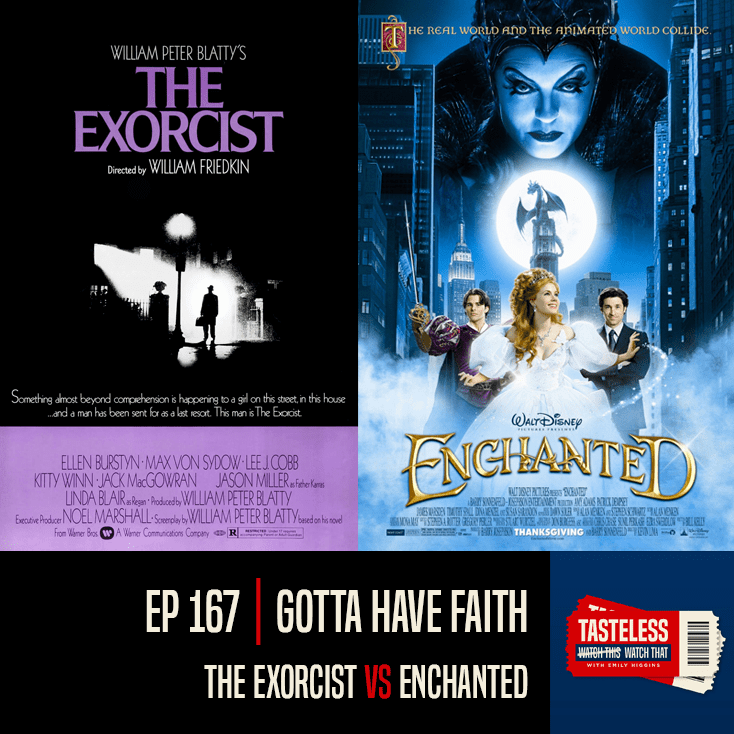
Two films that explore faith as well as representations of good and evil that endure through generations — it's The Exorcist vs Enchanted.
Shalita Grant | Strong Female Leads
Shalita Grant (Search Party, You) is truly America's sweetheart. I learned so much about not just acting, but about life and myself from Shalita, who is so insightful in her self-reflection in addition to being absurdly gifted comedically. Shalita talks about not judging the characters she plays, the importance of collaboration in comedy, and building her haircare brand Four Naturals.
I am sorry I brought up Dave & Buster's to a Tony nominee... but not really, because like with everything else Shalita speaks on, she not only made me laugh but also educated me (in this instance on getting what you want!)
Follow Shalita on Instagram | Follow on Twitter | Learn more about Four Naturals
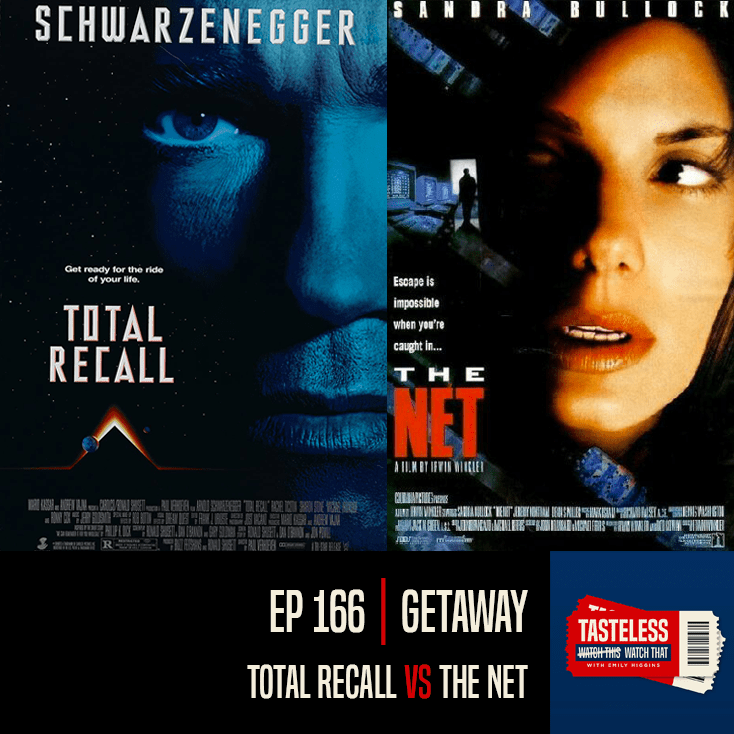
Getaway: Total Recall vs The Net
Two people decide to take a little vacation that kicks off a fight for their lives as their identities are called into question — it’s Total Recall vs The Net.
Pipe Dream: Call Me By Your Name vs James and the Giant Peach
Two movies about sad boys with an affinity for peaches who find self-acceptance through a dreamlike adventure — it's Call Me By Your Name vs James and the Giant Peach.
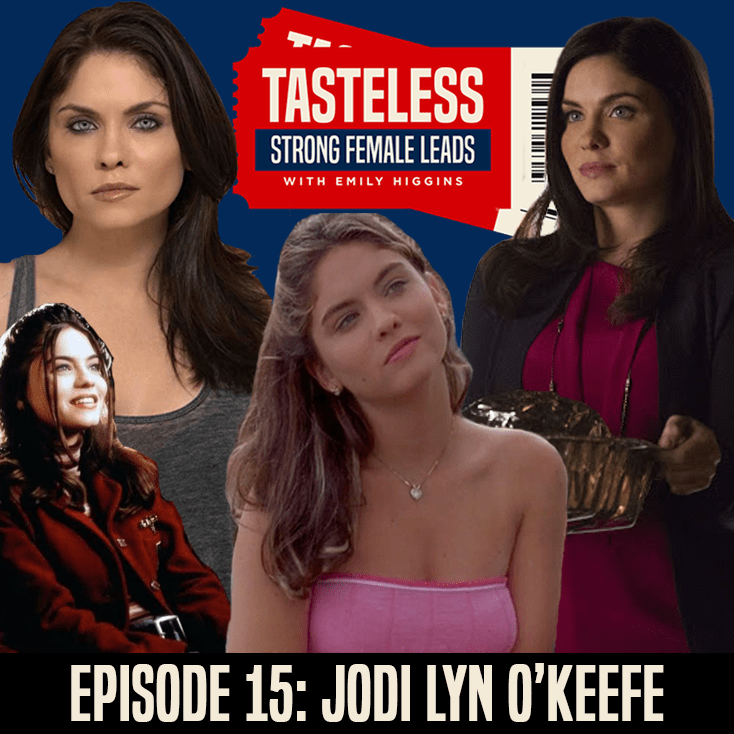
Jodi Lyn O'Keefe | Strong Female Leads
Jodi Lyn O'Keefe (She's All That, Prison Break, Hit the Floor) is a dream of a human being who lets me gush about my favorite roles of hers as I mathematically prove she has the best career — from being a comedy powerhouse to the perfect kind of villain — and she shares the romantic gesture to end all gestures, plus gives me even more reasons to adore Heretic Parfum. This show breaks down at points because I am laughing uncontrollably, what a joy!
Follow Jodi on Instagram | Follow Heretic Parfum on Instagram | Visit the Heretic site to fall as in love with their scents as I have
Heart's Desire: Black Swan vs Deadly Illusions
Two movies about a woman in a high pressure environment who is unsure of what is real and what is not, and must come to terms with her desires — it's Black Swan vs Deadly Illusions.
Glimmer of Hope: Children of Men vs Underworld: Blood Wars
Two movies where survival of a species comes down to one bloodline and hope is finally carved out amidst the despair — it's Children of Men vs Underworld: Blood Wars.
Read The Episode
Every episode of Tasteless, I take a critically acclaimed film and compare it to one that shares the same themes but didn't get the attention it deserves — and explain why that second movie is my pick. This week: two movies where survival of a species comes down to one bloodline and hope is finally carved out amidst the despair. It's Children of Men versus Underworld: Blood Wars.
Children Of Men
In 2027, in a chaotic world in which women have somehow become infertile, a former activist agrees to help transport a miraculously pregnant woman to a sanctuary at sea.
This came out in 2006, has a 92% on Rotten Tomatoes, directed by Alfonso Cuarón. It was nominated for three Oscars — Best Adapted Screenplay, Best Cinematography, and Best Film Editing.
This movie is about a very sad England where everything is falling apart. It's a post-apocalyptic gray sadness because babies stopped being born 18 years ago. And everyone is just like, okay, I guess F it then, we're going to go berserk, because babies aren't being born anymore. This is it. This is the end of our lineage.
Our protagonist Theo is played by Clive Owen. He's a regular office guy whose only real friend is Michael Caine doing a John Lennon impression. There's a scene at the beginning where Clive is at Michael Caine's house and he's just absentmindedly petting this cat. And then he starts petting it maybe a little too aggressively, unless the cat really likes him. I was so focused on this cat and trying to decide if he was petting him an appropriate amount that I noticed the different shots had the cat facing different ways. It was a continuity error.
This animal thing is a through line though. We find out that all animals love Clive Owen. Some dogs come up to him and someone's like, those dogs don't like anyone. And then this little kitten tries to climb up his pant leg, but he doesn't even reach down and pet it — which is the least believable part of this movie. If a little kitten came up to you and was tugging at your pant leg, you would just look down at it and be like, go about your business? Scoop that kitten up.
Clive Owen had a wife and a kid, but the kid died. So he's just kind of aimless. England seems to be one of the places left standing — there was a nuclear attack on New York. People truly went bananas when they realized no more children were being born. Michael Caine is the comic relief and does a pull-my-finger joke immediately in the film.
Spoiler: Michael Caine euthanizes his wife and his dog, which I get why he does, but come on, figure out a way to save the dog. But it's important to note that he dies farting. In this gritty exploration of humanity, Michael Caine dies farting, because he is surrounded by gunmen and he's like, pull my finger, and reaches a finger out and then gets shot. And I can only assume he died farting.
We're introduced to baby Diego, who was the last baby born, the youngest person on earth. I thought this was fascinating — seeing the news coverage of him. He dies, and the nation is in mourning. The world is in mourning. He was the last baby born and had this celebrity thrust on him that he did not want and just couldn't handle. We learn there are legal suicide kits called Quietus. There's a lot of little touches. I'm going to have to read the book because I liked all the little pieces of lore, the world that is existing.
Clive Owen gets kidnapped and brought to the hideout of the Fishes, this rebel group trying to help the refugees that England is railing against. The Fishes want equal rights for immigrants in Britain, which is great. Fishes is not a cool name for a movement, but it's a good cause. Julianne Moore plays Julian, Clive Owen's ex-wife, leader of the Fishes. She has a nose stud and I didn't know that was a look. IMDB trivia says Alfonso Cuarón wanted an actress who had the credibility of leadership, intelligence, and independence.
At one point they're in a car together, fleeing with the pregnant woman, and they play a game. Julianne Moore is like, no one's ever been able to do it like you, Clive. And he's like, I can't, not now, not in front of these people. And she's like, no, we're going to do it, and she spits a ping pong ball into his mouth and he spits it back into her mouth. And then Julianne Moore — spoiler — dies. And then I was like, yeah, I bet this is why I didn't like this movie. A dog dies and Julianne Moore dies. What are we doing here?
I do hope that Alfonso was like, Julianne Moore, you are such a credibly intelligent, independent woman. Could I get you to pretend to spit a ping pong ball into this man's mouth? And she was like, okay.
So she captures Clive because she needs him to get transport papers from his cousin Danny Huston, whose son is Ed Westwick — Chuck from Gossip Girl — playing with this weird hand robot. And I was like, what are you doing here? He gets the papers but has to travel with the person. Julianne Moore gets killed. And at the hideout with Chiwetel Ejiofor, who I also love, Clive Owen wanders around and finds Kee — who is the girl he's helping. Claire-Hope Ashitey is this actress, and she is the lynchpin. She is pregnant. She is the first pregnant woman in 18 years.
When Clive Owen finds her in the barn and she reveals she's pregnant, he is shocked. She plays this role — it's so interesting — later she talks about realizing she was pregnant, that she had never been taught about it. She's young enough that fertility had stopped before she got into school, so there was no reason to teach it. But she just knew. I would have loved more of this, of the journey Kee has taken.
I also love her friendship with the Fish that is looking out for her, played by Pam Ferris, aka Miss Trunchbull from Matilda, who has an eyebrow ring. Everybody in this movie has a questionable piercing. Pam Ferris is keeping Kee safe and is such an ally to her — her and Clive Owen are a great duo in protecting Kee.
Then we find out things aren't as they seem. Chiwetel has some secret stuff going on. Charlie Hunnam has some secret stuff going on. Chiwetel's guys killed Julianne Moore because they don't want the baby taken to the Human Project — they want to keep the baby for political gain. So Clive takes Kee and Pam Ferris and flees in the night. Later, Chiwetel sees the baby in a war zone and he's crying because it evokes something in him. It's really interesting. The baby is born and it evokes something in people.
A couple of questions. One: why are future movies so neutral slash brown-looking? It's so gray. Is that just because it's England? I'm not interested. Too gray. Two: we see the destruction society has faced. If we were all infertile for, let's say, 20 years, would that actually give the earth time to reset? In this movie it's been 18 and people are still there just being awful. What if we just stopped having babies for 20 years and let the earth chill? Cut down on global warming? Would society crumble? Would someone nuke New York City if we couldn't have babies? I think it's such a weird, interesting conclusion — that without a hope for people to come, without people carrying on your line, you would just totally go anarchist.
The movie is currently on Peacock for free, where there's an ad every five minutes, which really takes you out of a drama. But you get what you get.
Underworld: Blood Wars
Vampire death dealer Selene (Kate Beckinsale) fights to end the eternal war between the Lycan clan and the Vampire faction that betrayed her.
This movie came out in 2016. It has a 21% on Rotten Tomatoes.
I have covered a couple of Kate Beckinsale movies on this show. My love for her is well known. Love and Friendship is such a good movie. I'll watch anything she's in. Underworld is her big blockbuster franchise. She plays Selene, a vampire who has extra powers because she drank blood from the original immortal — so she can go in sunlight, she's extra strong. Before she got those powers, she was just a super cool death dealer. By the way, the original immortal got his powers because of a genetic mutation when a plague hit. So just like post-COVID, I would love some vampire powers. I want to be able to go outside. I want to jump real high, but I don't want to land hard. I don't want to land and break the concrete. I want agility. I want to be like a cat. So COVID Santa, if the genetic plague mutation could give me that, please.
We get to see Selene fight people and be cool and have fangs and blue eyes. I will say, some people look so cool with vampire teeth and some people don't. Kate looks very cool. But sometimes they have those little teeth and they're talking around them and you're like, boy, this wasn't meant for you. I worried that would be me. That if I had vampire teeth, I would talk dumb and no one would respect my vampire powers.
This movie further proves that an askance glance from Kate Beckinsale is one of the most important things committed to film. I hope we've sent a clip of one up in one of those space stations that have every seed in there so we can start a new society. Like they've got all the types of flowers — I hope there's just a clip of Kate Beckinsale in one of the Underworld movies doing an askance glance at someone.
I saw this movie in theaters. I was overjoyed when Kate Beckinsale comes into battle with the biggest, thickest coat. Yes, she has an iconic leather look, blah blah, but this is better. She comes sliding in, there's snow, her coat is so big. It's amazing. The action in this one is some of my favorite — I think because a lot of these movies, like Resident Evil, Blade, tend to be dark in color palette. I liked the contrast of this snowy tundra. The snow, the ice, that vibe. Very fun to see fight scenes in.
So this is movie five. Prior to this, Kate has gotten her cool powers, lived as a vampire for centuries, and then humans figured out there are vampires and werewolves and started purging them. They froze Kate in cryogenics. When she's unfrozen, turns out she had a kid with Scott Speedman. The kid was like 12. She finds out — this is prior to this film — and honestly, I know you're like, how can I watch this if I haven't seen the others? They do a little recap at the beginning. I had only seen the first one years prior when I went and saw this in theaters. You don't need to know everything. It's fine.
What you need to know: the kid is born, she doesn't even know because she's frozen. Right prior to this movie, the kid is like, I gotta go. You can't know where I am. You can't be my mom because everyone wants my really strong blood. If you know where I am, it endangers you and me. So that's where we're at. Kate's daughter Eve is in hiding because she has very pure blood — the father, Scott Speedman, is this relative down the line of the original immortal's family. She's very powerful.
A new Lycan leader, Marius, wants Eve's blood to get stronger. Semira, the vampire, wants Kate's blood to get stronger. And Kate is just trying to process not being in her daughter's life.
Semira, aka Lara Pulver, gets to play this over-the-top villain. She's still hurting over her mentor Victor being killed by Kate in the first movie. She's not as strong as Kate, so she wants to drink Kate's blood. She sets up this whole ambush to get Kate excommunicated, disgrace her amongst their people, and steal her blood. At one point she's drinking Kate's blood out of this big chalice and then throws the rest on the ground in triumph. Like, what a waste. You just threw all that blood on the ground. Who's going to clean that up, Semira?
Semira wants power, she wants respect, and she's trying to manipulate her way into the good graces of the council, the high elders. Meanwhile Marius and the Lycan clan are going berserk trying to get Kate and fighting vampires. Vampires and werewolves are enemies, obviously.
By the way — werewolves. They have never succeeded in making them super hot. Even in Twilight, Jacob is such a baby face. Obviously he's a good-looking guy, but he just looks so young. I think it's because vampires just pop their little teeth out but otherwise they're still gorgeous actors. Werewolves are big, hairy, gross animals. So we don't think they're hot. Which is good.
Theo James plays David, a vampire and Kate's only real ally. His dad is played by Charles Dance, who helps him and Kate after really screwing Kate over in a previous film. So it's nice that he joins Theo in saving her from the robot that is sucking her blood out courtesy of Semira.
My only complaint about this movie: a lot of people stand in water in pants and robes. They just get in water with full fabric coverage. Ooh, that's tough. They're going to get out of the water. Their calves are going to be wet. Pants clinging to them.
This is a fun series and they keep teasing that another one is coming. I do like the point this one left off — I think it's a satisfying and fitting end for Selene and for Eve, for her family. Selene battles those who want her blood, battles those who want Eve. She never breaks. They're trying to get Eve's location from her and she doesn't know it. It kills her that she doesn't know it, but it's also so good that she doesn't. She protects the people that are here. She's a good person. She's a good vampire, even when everything has been stripped from her.
Kate Beckinsale is one of our funniest actors on screen and off screen. Her Instagram videos with her cats and her dog — she'll just be holding a gorgeous sweet cat and saying the funniest things. I will watch eight more Underworlds if she chooses to make them. There's room for those movies. I love that kind of movie and I love a period comedy and I love a hard-hitting think piece. There's room for everything. Kate is so multi-talented.
Shared Themes
Children of Men and Underworld: Blood Wars both deal with the survival of a species, with individuals who have something the rest of society lacks.
In Children of Men, Kee is carrying the first baby in almost two decades. In a world where it was believed women were no longer fertile, no new babies have been born. Kee is pregnant. Not just pregnant — she gives birth. Successfully gives birth to a healthy baby girl. This baby is truly it. This baby is humanity's future. Whether we think it's because it means other people can possibly get pregnant too, that this won't last forever, or because this baby can perhaps be studied — this is the first proof that survival of the human race is even a possibility. Everyone wants a piece of Kee and her baby because of what this survival represents.
In Underworld: Blood Wars, amidst constant power struggles between vampires and Lycans and within their own ranks, Kate Beckinsale's blood and even more so her daughter's blood both represent an advantage that each side covets. Eve has hidden herself away to prevent others from using her, and those in her orbit understand the importance of her powers not falling into the wrong hands.
The blood that Eve has, that Kate shares, their bloodline — it allows vampires to step into the sun. It allows a certain level of freedom, domination, existence, survival. If these creatures didn't have to cower in the dark, they wouldn't be so much of a target. They could blend in. They wouldn't be caged by the whims of the sun. Whoever has this blood can rule, can pass it down, can create a new species — a stronger, more powerful, more balanced one. That is a legacy these creatures crave.
Children of Men and Underworld: Blood Wars are dealing with bleak spots, but both carry through a sense of hope even amidst despair. Clive and Kate have had everything taken from them, but they give themselves to a cause. And kindness comes from surprising places, further imbuing the films with a sense that goodness can be found and not everything is lost.
In Children of Men, not only is the world awful — with most countries gone besides England — but Clive's world is bleak. He and his wife separated after their child died in a flu epidemic. He used to be politically active with Julianne Moore, but he's been floating through life since his son died. His only friend is a weird old dude. But when he becomes embroiled in Julianne's plan to get Kee to safety, to the human project, it gives him a purpose. It gives him something to believe in, and in opening himself up to Kee, he is met with support in turn.
The older woman in the Bexhill refugee camp — he had been so annoyed by her. She just had this barking dog and kept getting in their space. But when they're forced to share with her that Kee has given birth, this woman comes to their aid. She dedicates herself to protecting them. We see what Michael Caine gives up for this baby — he poisons his wife and his dog and gets himself shot to buy them time. He sees their survival as more important. He doesn't feel he dies in vain. He knows what he's doing.
Kee being pregnant, giving birth, means something. It means life. It means hope. It means future. It means that there's still a chance that whatever wiped out fertility is not 100%, is not permanent. Kee's baby surviving is of utmost importance because that hope, if they even think it's a possibility, will take away the suicidal despair so many people have been feeling.
In Underworld: Blood Wars, Kate is listless, distressed over the daughter she lost that she never knew. The daughter who told her not to be a mother. After Charles Dance dies helping Theo and Kate escape, she says: it seems it's the curse of every parent to disappoint their child. Theo says: at least you fought for your child. Kate replies: yes, and lost.
She feels so helpless. But she's set on not betraying her daughter, on not chasing her — even though she wants to. She sees that Theo and Charles had a complicated history but came together to help her, to do what is right. Charles sacrifices himself saving her. He knows he messed up. And Kate knows that somewhere out there, her daughter is alive. That's the best she can hope for in a world of bloodshed.
She finds help from the vampires in the ice and responds to their support in kind, adding one of their leaders to the vampire high council when given the chance. These vampires share with Theo James that his lineage is much more noble than he believed. With a good man finally having rights to the throne, there is hope for the future — that it won't always be chaos and infighting. At the end of the film, we see a vision of Eve. Perhaps the greatest proof that this world is back on track to something decent — that fighting will be put behind them and Eve will be safe to walk around as part of the clan and not just a political tool fought over by the weak.
Clive and Kate are people who aren't into statements, into politics. They just want to live. They live as outcasts, disconnected from society, but they are sucked back into battle — into other people's battles — because of what they bring to the table.
Clive has been incredibly shut off since his child died. He doesn't care about baby Diego. When everyone mourns baby Diego, he's like, he was a wanker. He doesn't have ties. He doesn't take part in the politics he used to involve himself with when he was with Julianne Moore. But Julianne pulls him back in. He takes on her transit paper quest because she offers money — that's why — but also out of some small loyalty to her. It's not his fight. It only becomes personal when he realizes Kee is pregnant and determines he's going to protect her at any cost.
He reminisces about his days as a rebel, claiming he only joined in because he wanted to sleep with Julianne. But it's clear based on how quickly he comes to Kee's aid that he is a good man who will work to protect what he believes in. He just needed that fire stoked again within himself.
In Underworld, Kate says: I'm finished with this war. And she's told: well, it's not finished with you. Kate doesn't have anything to fight for with her daughter away. Nothing besides her own life. But she's lived so long. She's tired. She doesn't care who's in power. She only cares about the basics, about survival. The war is brought to her doorstep as people fight for her blood and her potential knowledge of where her daughter may be located.
Once she's involved, she will not let Charles Dance's death be in vain. She wants to end the terror while she can. She works to reinstate Theo James as the rightful leader. She is someone who is loyal — and though she was betrayed by her ruler of many years, she still believes there is justice.
Clive and Kate achieve redemption in a way, channeling their struggles into creating a better world for others. Nothing can bring back Clive's son Dylan, and nothing can give Kate back the time she lost with her daughter. But they still do what's right.
What Underworld: Blood Wars Did Better
Children of Men is not a refugee's story. It's not Julianne Moore's story. It's not Kee's story. It is somehow inexplicably Clive Owen's story. While in Underworld: Blood Wars, yes, it's Eve's blood that is the Holy Grail for these people after power, but we're exploring Kate's story — as a mother who has given up her child, as a person who is being hunted for who she is, for reasons beyond her control.
Now — this killed me about Children of Men. In the movie, the infertility crisis is the result of all women being infertile. In the original novel by P.D. James, it's the result of all men producing no sperm. Why'd it have to become the lady body's problem in the movie? I love in The Handmaid's Tale that it's so clear that all the dudes' sperm is jacked up, so the Handmaids have to go get impregnated by other people in secret to maintain this facade. Whatever, not important, great show.
As much as I love Kee in Children of Men, this story is Clive coming to terms with what he lost and trying to build a better future. It's not the story of the actual revolutionary Julianne Moore — she is killed so fast. We don't know Kee's past, who the father of her baby is, or what circumstances may have led to her pregnancy. We join the story when the white savior joins the story and we leave it when he does. And that is for sure an oversimplification. I like this movie and what it brings up and discusses. But if we're looking at things that are either impressive or tired — this is tired.
We've got this movie with this rich tapestry of people — the Fishes' guy who is willing to kill his own for political means, so many people with compelling narratives — and Clive Owen's is the most boring and that's who we're following.
I love the way Underworld: Blood Wars shares the story of a strong woman, a mother who struggles with her role in her daughter's life, who is seen as a threat as much as she's seen as a pawn to be used. People respect her and discard her in equal measure. She is unsure of her place in a world where she is accepted by no one. She was a death-dealing vampire but killed her leader, so vampires hate her. Humans hate her. Lycans hate her because of who she is. And yet, instead of going into the woods forever, she continues to take part in this world because she knows at the end of the day, she needs to fight for what's right.
The movie ends with Kate on the council, indicating a more positive future for the vampires. Kate's life is one of sacrifice. We join her at a point where she has truly hit her lowest, feels disconnected. We watch as she raises herself up, is brought back from the brink of death after her fight with Marius, and rejoins the war that has stripped her of everything. Kate lives between worlds, and it's her strength.
Despite not much dialogue from Kate, Selene is a compelling character — one whose story is layered and troubled and fascinating. There are great characters in Underworld, but I'm not watching it going, I wish we were learning about anyone else. The way I felt a little bit in Children of Men, where it's like — how did Kee and Pam Ferris meet? What's their deal?
Children of Men's infertile future is not a clichéd plot. It's fascinating. But all focus being on the protection of a baby, on the importance of a baby being born, of birth itself — it's a little well-worn. Underworld: Blood Wars explores the pain of choosing to let a child go for their own good, of the intensity of being away from them through your own choice, of never having a bond with that child.
In Underworld: Blood Wars, it's about a relationship that never happened, about the bonds that didn't have a chance to form. There's a longing Kate has, but there's also a certain level of detachment, an awareness of what she must give up to stay sane and to keep Eve safe.
It's a brave choice and interesting to look at — people who must give up their children for reasons beyond their control. Kate had to make this choice. It was the only option. It doesn't keep her from feeling alone and feeling that loss, but she's a pragmatist about it. She stays connected to her daughter the ways she can — carrying a lock of her hair, a little bit of mind reading, seeing out of her eyes. Vampire stuff. She never doubts the choice she made.
I love that they didn't fully reunite in this film. The kid didn't run up at the council meeting and go mommy. Instead, we're given a glimpse as a shrouded figure approaches Kate at the end. Because their reunion is less important than what both gave up for the sake of the other and for the sake of the world. It's a really interesting relationship to explore.
Children of Men is a great exploration of the impact children have, the way thoughts of lineage and passing something down determine whether people even behave as though they're in a society. But the actual story of motherhood is a little well-worn. We have this mother who will do anything for her child and keeps the child with her. Kee doesn't want the kid taken for purposes political or scientific, understandably. This birth, this biological process is so highly venerated because it has been impossible for years. Yes, it's completely new terrain in a lot of ways, but it's the same relationship we so often explore — a mother looking into her baby's eyes for the first time, that connection, that bond.
In Underworld: Blood Wars, Eve grew up without a mother. Kate gave birth in a cryogenic freeze. She wasn't even aware she had a daughter. She finds out from Eve herself. This film is about a relationship that never happened. About the bonds that didn't have a chance to form. And knowing Kate had to make this choice, that it was the only option — it doesn't keep her from feeling alone. But she's a pragmatist. She never doubts it.
Give Underworld: Blood Wars a shot. I guess watch all the other ones first — out of the other four, one is a prequel so you can maybe skip that one. But I'd say just watch all of them. Just go for it. You can watch Blood Wars right now on Tubi for free. I of course own it in 4K, because who do you think I am?
Hit me up at @tastelesspod on social media. We can talk about Kate Beckinsale's giant coat in Blood Wars and how much I love it, or we can talk about why some people don't look very good with fangs.
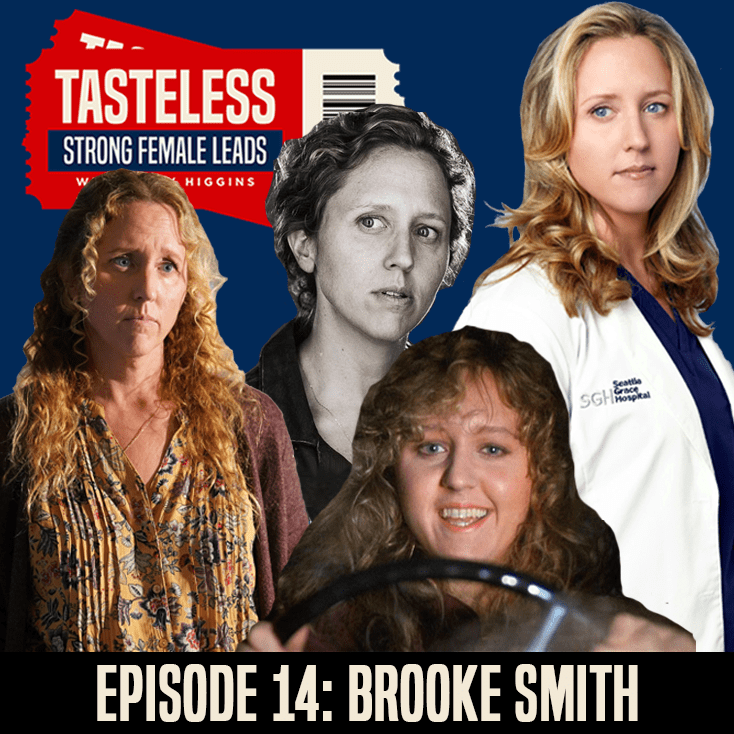
Brooke Smith | Strong Female Leads
Brooke Smith (Big Sky, The Silence of the Lambs, Grey's Anatomy) becomes my favorite character in every project she joins, and this episode felt like a breezy chat with a close friend. Brooke answered my questions about the satisfaction of bringing a character like Merilee to life on Big Sky, her relationship with Darla the dog aka Precious, and I called dibs on hiring her as a therapist should she ever change career paths.
Follow Brooke on Instagram and Twitter | Catch up on Big Sky on Hulu or ABC | Watch a trailer for Them coming to Amazon April 9th
Tunnel Vision: Goodfellas vs I, Tonya
Two movies about the pursuit of a specific lifestyle and feeling powerless — it's Goodfellas vs I, Tonya.
Read The Episode
Every episode of Tasteless, I take a critically acclaimed film and compare it to one that shares the same themes but didn't get the attention it deserves — and explain why that second movie is my pick. This week: two Oscar winners about the pursuit of a specific lifestyle and feeling powerless. It's Goodfellas versus I, Tonya. And yes, I was furious to discover the I, Tonya poster literally has the pull quote "the Goodfellas of figure skating." Someone thought of this comparison before me and put it on the poster.
Goodfellas
The story of Henry Hill and his life in the mafia, covering his relationship with his wife Karen and his mob partners Jimmy Conway and Tommy DeVito.
This movie came out in 1990, has a 96% on Rotten Tomatoes, and is number 17 on the IMDB Top 250. Joe Pesci won an Oscar for Best Supporting Actor for playing Tommy DeVito. It was also nominated for Best Picture, Best Supporting Actress for Lorraine Bracco, Best Director for Martin Scorsese, Best Adapted Screenplay, and Best Film Editing.
I like this movie, mostly because I love Lorraine Bracco. We're going to talk about her. But let's talk Ray Liotta first, who plays Henry Hill. Henry Hill is a real man on whom this book was based. Ray Liotta was so attractive. I knew him better from Chantix commercials and I hope he managed to stop smoking. In Goodfellas, he always looks like he has eyeliner on in a very attractive way. I also realized while watching that I know him maybe best from voicing Tommy Vercetti in Grand Theft Auto: Vice City, a game I used to play for hours on the original Xbox.
Ray Liotta is our protagonist, our guy, the one doing the narration. He's a little more even-keeled than the other guys because he's the most normal, the most human, the easiest to empathize with. A lot of the movie is just him listing foods. He loves talking about foods. Made me very hungry. There's a whole scene where they're in prison and he's talking about the foods that are being made. There's another scene where he's voicing over all the things he has to get done — the cops are following him, there's a wire, he has to drop stuff off, call this person, get someone's lucky hat — I gotta chop the veal, I gotta chop the tomatoes, I gotta get a nice sear on the things. He was cooking some full meat as an appetizer. It was a big to-do. This movie will make you very hungry. I actually, after watching it, ordered pizza from a fancy place and it sucked. It sucked so hard and I'm mad about it.
Robert De Niro — also a hunk in this movie, but I would say he's a hunk now, and that I was attracted to him in the film called Dirty Grandpa. This role unfortunately is kind of just a worse version of his role in The Godfather Part II. He's just supporting as Jimmy Conway. And apparently on set he was very obsessed with realism and authenticity — he wanted to use real money for a scene where Jimmy hands out money because he didn't like the way fake money felt in his hands. IMDB claims the prop master gave De Niro $5,000 of his own money. At the end of each take, no one was allowed to leave the set until all the money was returned and counted.
It got me thinking — if Robert De Niro said, I need $5,000, you'll get it back, would I get it for him? I think I would. If I had $5,000, if that was all my savings, I'd be like, okay, here, I just went to the bank. Is this good enough for you, Mr. De Niro? Also, he was always asking questions like, how would the real Jimmy do something? How would he apply his ketchup? And Henry Hill is just like, oh my God, because the real Henry Hill talked about this movie — he claims Robert De Niro was calling him multiple times a day. Robert De Niro sounds a little clingy.
Joe Pesci is Tommy DeVito. He is always screaming and shooting people. Henry Hill had a rude little factoid about him — Henry Hill said Joe Pesci's portrayal of Tommy DeSimone was 90 to 99% accurate with one notable exception: the real Tommy DeSimone was massively built. Very rude. Joe Pesci is a little wise guy. He's like, hey, you think I'm funny? Funny like a clown? I'm gonna shoot you. Pop pop. I don't like that unhinged chaotic energy.
What I do like is a little character named Karen, played by the original Karen, played by Lorraine Bracco — who I know you know as Angela Rizzoli, the Rizzoli matriarch in Rizzoli & Isles. Love her from that. That's why I watched Goodfellas: to watch Angela Rizzoli.
What I love about her character is Karen is very down for whatever's going on. She says — because we get to hear from her in the narration — look, other women would not have been into this. He asked me to hide the gun and it turned me on. All right, Karen, cool. She wears a lot of great sweaters.
The lens through which I look at these films is a lot of the time: why isn't there more women? It's a big problem I have with a lot of these gangster movies. What's most frustrating is they always have one really good woman. Lorraine Bracco in Goodfellas is such an interesting character. When we see her with the other mob wives, she doesn't quite gel there. She doesn't quite fit in, because I think in another life she could have been the Henry Hill. She could have been the mobster, because she likes a little bit of danger and there's this undercurrent with her where nothing is what you think it's going to be. I would say the same about Casino — Sharon Stone is so incredible in that film and it's like, why are we even looking at anyone else?
Lorraine Bracco, in talking about this movie, said she found the shoot emotionally difficult because it was such a male-dominated cast. She realized if she didn't make her work important, it would probably end up on the cutting room floor. What's fascinating about that is yes, they could have carved her out of this movie. Absolutely. And I think it wouldn't have been the hit that it was. She adds something perhaps intangible, something important, something human — seeing Ray Liotta through her eyes, seeing the way she views this world. He is stars in his eyes, wants to be a mobster, loves these guys. Lorraine Bracco is kind of like, I mean, it's fine. I don't know why we have to spend every weekend hanging out with them.
It's crazy to think this movie is number 17 on top movies of all time, nominated for multiple Oscars, and she could have just been cut out. You wonder how many of these movies had storylines like hers just removed.
There's a lot of yelling at Karen. She flushes his drugs and he's just yelling and she's like, the cops were here. Of course I flushed the drugs. She could have done better. Honestly, you know what would have been great? If she had started hooking up with Jimmy Conway, with Robert De Niro. Yes. That would have been a movie. Let's redo it. Cast Lorraine Bracco and Ray Liotta and Robert De Niro all at their current ages. Have De Niro and Lorraine Bracco make out. Cinema.
Paul Sorvino plays Paulie. He's kind of the quiet one, the big mob guy you never quite know what he's thinking. In IMDB trivia it says when Paulie confronts Henry after Henry's release from prison, Paul Sorvino improvised the slap to Ray Liotta's face, hence Liotta's reaction. Imagine a job where you can just slap someone and be like, it's fine, I was in character.
A couple really great supporting women in this movie — Illeana Douglas of To Die For, love her. Debi Mazar of the show Younger. Two important Italian women and I was so excited when both popped up. And Martin Scorsese's mother Catherine plays Tommy's mother in the infamous dinner scene. Scorsese's father Charles played Vinny the prisoner who put too many onions in the tomato sauce. I love nepotism when it helps old people. That's the kind of nepotism I can get behind. Cast your moms in stuff. Good. But only if they're over 70; otherwise I don't care.
Joe Pesci won the Oscar. Sixth shortest acceptance speech in Academy history: It's my privilege, thank you. He later admitted he didn't say very much because he genuinely felt he didn't have a chance of winning. The record is two words — Patty Duke in 1963 said thank you. Somebody needs to get up there and just go thanks and walk away. Imagine the power that would have. I will now be getting into acting so that I can win an Oscar and give the shortest acceptance speech. I'll keep you all abreast of how that goes.
I, Tonya
Competitive ice skater Tonya Harding rises amongst the ranks at the U.S. Figure Skating Championships, but her future in the activity is thrown into doubt when her ex-husband intervenes.
This movie came out in 2017, has a 90% on Rotten Tomatoes. It won a Supporting Actress Oscar for Allison Janney as Tonya Harding's mother. It was also nominated for Best Actress for Margot Robbie and Best Film Editing.
Clearly I've been on a Margot Robbie kick lately with Bombshell and Birds of Prey already covered this year. I don't think I quite realized what an incredible filmography she has. I saw I, Tonya at a screening, was so blown away — just frantically telling everyone they needed to see it ASAP. I was gratified to see it get awards recognition. I felt like finally the Oscars knew what was up.
The prep Margot Robbie put into this movie really paid off. She learned to ice skate, she met with Tonya Harding, and I felt like she didn't pull her punches in presenting an authentic portrayal, but she also did engender sympathy for a woman who faced hardship on an international level.
Let's face it, there's a harsh reality to what happened to Tonya Harding. I want to be cautious because I don't want to make light of what Nancy Kerrigan went through. She was assaulted. And as we watch this movie and feel such sadness at the thought of Tonya not being able to skate again professionally, it's important to note that was the reality Nancy Kerrigan faced. Nancy wound up recovering, was able to compete at the Olympics. But when all you do is skate and someone bashes your knee in, things aren't looking good. But this is Tonya's story, so let's talk about her angle.
There's a through line where she addresses the way the media portrayed her, how we reacted to Tonya Harding, the jokes, the punchline she was made. She says at one point, turning to camera: you're all my attackers too. You think about how we all knew who she was, we all knew the joke. There are a few national jokes — it's like that woman who cut her husband's penis off. There's a few where we just all know it.
The story as told in the film: her ex-husband Jeff Gillooly — they have a complicated, volatile relationship. Not even complicated: in the movie he beats her, he abuses her, he treats her like garbage and she thinks that's what love is. He gets involved with his weird friend Shawn Eckhardt, who wants to basically shake up Nancy Kerrigan because Nancy is Tonya's biggest threat. Tonya thinks they're going to send a letter, a scary threatening letter. She also gets Nancy's training schedule and tells Jeff — like, yeah, this is when she's here and this is when she's there. She's not on the up and up, but I doubt she was involved in knowing a physical attack would be carried out.
She says to camera: Nancy gets hit one time, everybody goes nuts. For me, it was an everyday occurrence. When we see her confiding in her mother that her husband hits her and her mom's like, well, you know, he needs to shut you up — it's disgusting the way she was treated. She was raised in such a hateful environment. The way the movie explores her is really nuanced and interesting. And it's also funny — very darkly comedic. At one point Jeff is telling his side of the story, saying she pulled a gun on him, and it shows Tonya chasing him around the house with a shotgun. And she turns to camera, pumps the shotgun, and says, this is BS. I never did this. And goes back to chasing him.
The only really bad thing about this movie is the CGI. And I say that only because it's so shocking amidst this incredible film. Do you remember those Elf Yourself dance videos? That's what it looks like. Margot trained extensively, but as producer Tom Ackerley stated, there have been only six women since Tonya Harding who have done a triple axel. Even if there was one doing it today, she'd be training for the Olympics and couldn't risk doing it for the film. So the jump was accomplished with visual effects and a lot of these skating scenes are Margot Robbie's head glued onto someone else's body. I would have rather had a stunt double whose hair was in their face, like old-school Buffy or Charmed.
Margot Robbie — incredible. Allison Janney as Tonya's mother is intense and awful and hateful, but is also the reason Tonya was able to train. Allison Janney herself had actually trained to become a figure skater as a child, but she walked into a sliding glass door at 17 and gravely injured her right leg. She shot for about eight days on this movie and won the Oscar. She has a little bird on her shoulder. At the Q&A, the writer talked about how they had to audition different birds to figure out which one to hire — they just wanted one that wasn't always yelling. They chose the most chill bird.
Sebastian Stan plays Jeff Gillooly. He is so charming at first, has his moments, but you see the anger in him — the way he hits Tonya when he doesn't get what he wants. Their relationship is so unhealthy, but they need each other because he takes care of all the business things so Tonya can focus on skating. Her mother raised her with no life skills, so Jeff basically takes on the role of her mother. Sebastian is currently best known as Bucky in the Avengers series, but I loved him on Once Upon a Time as the Mad Hatter, as Carter in Gossip Girl, as Nicole Kidman's criminal boyfriend in Destroyer. He has range. That is a talented actor who I think we will be seeing Oscar nominations for at some point.
Paul Walter Hauser plays Shawn, the dumb friend who is the one who basically makes all this happen. Jeff is the one who pays for it and thinks he's the boss, but it's Shawn just wanting to do stuff that makes it an issue. I hate this character so much. In the interview scenes, he's just talking with his eyes almost all the way closed, leaned back, like, I know counterterrorism. I'm an expert. And they're like, what? No you aren't. We looked. And he's like, yeah, yeah. The doubling down, the lying. I hate him so much. But Paul Walter Hauser himself, the actor — I've heard such lovely things about him.
Julianne Nicholson plays Diane, Tonya's trainer. She is there for Tonya in a way not many people are. She's frank with her and with her mother that the judges expect a certain level of presentation. She gets one of the best moments in the film — when she begins working with Tonya again and they're training for the Olympics. Some of the training is a little unorthodox. Tonya is running through the woods carrying a massive bag of dog food over her shoulders, and we hear in the narration: this is how Rocky trained when he had to fight the Russian, and it worked. Then the camera pans out past Diane, who turns directly to the lens and says, matter-of-factly: she actually did this.
Touches like this bring an extra interesting layer of humanity to the film — reminding us this is a real person who is alive today, who was such a part of our cultural conversation. And Bobby Cannavale appears as a tabloid producer, commenting on needing to fill the 24-hour news cycle. The timing of Tonya's story was such a big deal partially because the media made it a big deal because they needed to fill time.
Shared Themes
Our protagonists lose control over their lives and their selves. Their humanity takes a backseat to the pursuit of a certain lifestyle. Both Ray Liotta and Tonya are so laser-focused on one arena to the detriment of the rest of their lives.
Ray wants to be a wise guy. He sees value in getting respect and thinks joining the mobsters is how you get it. But to maintain his lifestyle, to keep his bosses happy while also getting respect from those he's shaking down, he gets embroiled in more and more criminal activities and runs himself ragged. He meets a nice woman, Lorraine Bracco, who he barely spends time with because he's always off running cons. He can never fully trust those around him — a wrong move can lead to being offed. He gets into the drugs he's selling and is always worried about the next big thing, where money is coming from, whether he's being followed, whether he'll get caught. For all his bravado, he lives life in fear 100% of the time. He is never secure. He never feels secure.
Tonya Harding wants to skate. That's all she wants to do. She's been pushed into it from a young age. She doesn't have other life skills. She says at one point when a judge tells her she can never skate professionally again after the Nancy Kerrigan incident: the people who actually ordered and paid for the attack got jail time. They got 18 months — I'll do that, your honor. I don't have an education. All I know is skating. I'm no one if I can't — I'm not this monster. I'm trying to do the best with what I know how to. It's like you're giving me a life sentence. You can't do that.
Not being able to skate is worse than prison. It is a life sentence. She has been skating since she was four years old. It's where she gets her confidence, her sense of self. In a world that has beaten her down in every other arena, no one can take from her the skill she has on the ice. No one can take from her that she can land a triple axel.
Ray and Tonya become involved with shady figures — the people who hang around their lines of business. The other mobsters, and then Jeff Gillooly, who was truly just lurking at the skate rink. Because they're only ever in this one space, they never have people in their lives they can really trust. Ray's best friend in Goodfellas is probably Robert De Niro, but by the end of the film De Niro is going to kill him. He can't trust anyone, not really. He's so by himself. Even in a house full of people, even in an organization he has helped build up.
Tonya has a mother who abused her and a father who abandoned her. She looks for love in the wrong places. Her mother hit her, so when Jeff Gillooly hits her, she takes it, accepting it as a piece of a normal loving relationship. She keeps trying to escape, but she goes back because Jeff knows her business and he knows her. When she's training long hours, where else is she going to meet someone? This is the world she is in.
Ray and Tonya get caught up in things that get fully out of control, their lives spiraling, with other people's actions creating more and more panic.
There's something so tragic about the circumstances of Ray and Tonya's birth not allowing them to ever fully be accepted into the professions they've dedicated their lives to.
Ray can never be a made man because he's part Irish, not full-blooded Italian. It's a point of contention for him and Robert De Niro, who's also half Irish, because being a made man is an incredible honor — it grants you a certain level of protection as well as greater respect. It's the acknowledgment: you're one of us, officially. But he can't change the fact that he's part Irish. Being truly part of this community is outside his reach, forever.
For Tonya, her supposed redneck upbringing has her in the judges' crosshairs from day one. She can't afford fur coats to wear on the ice. She doesn't have fancy schooling or parents of means. The upper crust of the figure skating world will never truly accept her. It doesn't matter what she does, what moves she can land — she's not considered one of them. They're like, yeah, Tonya Harding's out there, got a triple axel, which barely any other humans can do. Well, but look at her skirt. It's so absurd and she just can't change that perception. It's the perception the media cashed in on, exaggerated, dragged out, and turned into a punchline.
Power is something always just out of reach for Ray and Tonya. Something they crave if for no other reason than to finally be in charge of themselves, to not have to bow to the whims of others. They attempt to garner this power in small ways throughout their films, but Ray and Tonya are doomed from the start. The hand life has dealt them never allowed them to truly empower themselves. Their fate is left to others. At their lowest, they are powerless. Not in charge of what is happening or what will happen.
Ray spends a large chunk of Goodfellas serving others, doing as people say, trying to be a team player. As a kid, when he first dabs with the mob, he gets a warm reaction from Robert De Niro because when he's caught in a crime, he doesn't rat out his friends. That loyalty sticks with him. But when he's sent to jail, he develops his own drug connections and grows increasingly frustrated by Lorraine Bracco wanting to loop in Paulie. Paulie tells Ray straight up not to do the drug nonsense. But Ray finally has his own business going and doesn't want to turn down easy money. The problem is he's already too entrenched. They hang out at each other's houses. Their wives are friends, mistresses are friends. There's no escape. His illusion of power comes crashing down when the drug business makes him a paranoid wreck and the guys he's been with for decades stop trusting him.
Tonya is constantly slighted by the figure skating judges because they don't like her presentation. Doesn't matter if she's athletically the most gifted — she loses points for looks, for homemade outfits, for skating to heavy metal songs. It wears her down until finally she confronts the judges. She asks them: how am I supposed to get a fair shot if you're not actually judging me based on my skill?
It's an important moment for Tonya. The people around her don't appreciate her brashness, her questioning of this governing body. But it's one of the bravest things she does, because she says out loud: I am worth something. I know I have these skills. And this treatment is insane. And with the way Tonya has been treated her whole life, it's powerful to see her acknowledge her skills.
She eventually does have to bow to at least some whims of the figure skating ruling bodies. But it was a critical part of her own development and independence, leading to her finally extricating herself from Jeff Gillooly. The problem is it still isn't enough. You can't change how people see you to a certain extent. She stood up for herself, but she still is a joke to them. She still is glossed over by them. She doesn't get any satisfaction from yelling at them.
I do love that Tonya Harding, the real Tonya Harding, has said — when she first saw the film she particularly liked a certain line. She told Margot Robbie she wished she had actually said that. You don't get that in real life. So while it's wish fulfillment to watch her do it, you know it's not going to change anything. She's still powerless to these people and their whims.
What I, Tonya Did Better
Loyalty is something we all interpret a little differently, despite it being a concept you'd think would be pretty objective. For all Ray Liotta's talk of loyalty in Goodfellas, of having a crew — at the end of the day, they will whack you. At the end of the day, it's you or them. Whereas in I, Tonya, the dedication of Diane, Tonya's coach, is a through line that really touched me, as well as Tonya's loyalty to herself.
Loyalty is constantly rewarded for Ray in Goodfellas — he's praised when he doesn't rat people out, given more trust. And yet the same loyalty doesn't seem afforded to him. It seems crazy to take part in this system, talk up the loyalty, be excited about being a mobster, all with the knowledge you can never actually be a made man. It doesn't surprise Ray when at the end Robert De Niro definitely wants to kill him, even before he rats everyone out to the government. Ray cheats on his wife, not affording her the same loyalty he himself wants. It's all so false and hollow.
When we think of Goodfellas, we think loyalty. We think of these guys laughing in a darkened restaurant, having each other's backs, ready to bury a body for one another. But they also would totally bury each other. And that is rude. And that is not good friendship.
In I, Tonya, we see the ways people have let Tonya down. Everyone is looking out for themselves. The only constant in Tonya's life is skating, her love for it, even when it leads to her more difficult moments. Coach Diane coming back to find her at her waitressing job, bringing her out of retirement and giving her purpose again — it's so kind, so beautiful, so important. Diane wasn't taking on new clients when Allison Janney first busted into her ice rink, but she saw the passion a young Tonya had and has worked to help her channel that into skill for decades. Even knowing the reception Tonya gets, knowing how difficult it will be — Diane is there for her and wants her to do her best. That is loyalty.
And there's the loyalty Tonya has to herself when she involves herself in skating. She always gives it her full commitment. She gives her body her full commitment. She practices, she prepares. She never ever phones it in because this is what she's passionate about. And her passion is something Ray never has in Goodfellas.
Ray loves the life he's joined, the idea of it, but he never puts himself first. It's always trying to be bigger and better, but in the way that these other men want him to be. He never has a dream for himself. Tonya truly just wants to excel at this thing she loves. She wants to physically best those around her and find new heights of what she can achieve. That's compelling to watch.
Ray is not a full-fledged person in Goodfellas. He loses all aspects of himself conforming to the Goodfellas model. He's always trying to confirm that he's one of them. Whereas Tonya, despite the blows she takes, is herself to a fault. It's what makes her such a tragic figure and also why I don't have much connection to Ray Liotta. In Goodfellas, Ray is always trying to please other people. We see him as a kid wanting to be a gangster. We see him taking orders, constantly panicking, worried over how others will see him. He revels in their successes, but it's always a group affair, everyone together, no individuality.
One of the IMDB trivia facts says the film, told from Henry Hill's perspective, portrays him as a major player in the world of organized crime. Real-life gangsters of that era have said Hill was a minor figure and more of a hanger-on. So they already are taking liberties with Henry Hill — the story's about him, so of course he's going to do the most cool stuff. But he's still, even with the liberties, not cool. He has no sense of self. So why am I watching him? Show me anyone else in this movie, follow their story, because this guy has nothing.
In I, Tonya, Tonya Harding is so true to herself even as the world around her works to break her down. She is very clear about what she will or won't do in the sport. She wants to be authentic — not for some reason of looks, but because this is what she loves and what she knows, and she knows she's good. So to watch her find out what Jeff Gillooly has done, when she realizes what has happened to Nancy Kerrigan and her part in it — it's affecting. It's sad, because she could have won the right way. She had beat Nancy. She had come in first and Nancy second. She could have beat her. Jeff and Shawn took that chance from her.
When she breaks down in the courtroom over having skating taken from her, it's devastating. When we see Ray in the courtroom in Goodfellas, it's to rat out all his former friends and get himself a lighter sentence. Even his mantra of loyalty isn't carried out in that element of the film either.
There's something about Tonya. This movie definitely romanticizes the story a little bit — it shows us a woman you want to root for, and that's what this movie has been crafted to do. But think about the real-life woman who, when she performed the triple axel at the 1991 Nationals, choreographed her routine to Danny Elfman's theme for the 1989 Batman. She knew what she liked and she did it. And I love that.
I also think I, Tonya took the element of narration and upped the ante by having Tonya speak directly to the viewer while looking at us. Listening to Ray explain the world of Goodfellas is the backbone of the film. But when Tonya turned to the camera, gun in hand, pumping the shotgun and saying I never did this before chasing Jeff Gillooly — and when she said, turning about the news surrounding the attack on Nancy Kerrigan: it was like being abused all over again, only this time it was by you. All of you. You're all my attackers too — she turns and looks directly down the barrel of the camera. It struck me. It elevated the film. It helped me think more critically about the way we gather information, what the media feeds us, what we learn.
I hope you will give I, Tonya a chance. They don't need my help that much, but I do really adore it. It is currently streaming on Hulu.
Hit me up at @tastelesspod on social media. We can talk Margot Robbie, we can talk Ray Liotta's eyeliner, or we can talk about the fact that somebody needs to win an Oscar and just say "thanks" and walk away.
Out of Character: Face/Off vs Deadly Sibling Rivalry
Two movies about taking on someone else's identity in pursuit of revenge — it's Face/Off vs Deadly Sibling Rivalry.
Read Charisma Carpenter's THR piece, How To Be an Ally of Victims of Abuse
Read The Episode
Every episode of Tasteless, I take a critically acclaimed film and compare it to one that shares the same themes but didn't get the attention it deserves — and explain why that second movie is my pick. This week: two movies about taking on someone else's identity in pursuit of revenge. It's Face/Off versus Deadly Sibling Rivalry.
Face/Off
To foil a terrorist plot, an FBI agent assumes the identity of the criminal who murdered his son via facial transplant surgery, but the crook wakes up prematurely and vows revenge.
This movie came out in 1997, has a shocking 92% on Rotten Tomatoes with just under 100 reviews, and is just one of those action movies that people are talking about all the time. I watched it for the first time. Was shocked by everything that happened. It was nominated for an Oscar for Best Sound Effects Editing — it lost to Titanic.
The most insane part of this movie, though — where somebody's face gets swapped with somebody else's face — the most insane part is it opens on a carousel. John Travolta with his son, who he loves dearly. The son's probably about five years old. And Nicolas Cage is watching them because he's going to shoot John Travolta. And I guess to show his affection for his son, John Travolta takes his big old beefy hand and just runs it down the front of his son's face. You know, like in a movie when someone's dead and the other person runs their hand over their face to close their eyelids? That's what this looked like. It's so weird.
And then when he's trying to convince his wife that he's him later — when he's in Nick Cage's body — he touches her face, rubs his hand down her face, and she's like, it is my weird husband who rudely rubs his hand down my face. This must be him in someone else's body.
It's not a body swap, by the way. They're very specific about that. They're like, it's your body. We've shaved you and done plastic surgery and taken in your love handles. Somebody rudely says that to John Travolta — we've cut out your love handles so your body looks like Nick Cage's body. We have cut your hair and the only thing different is your face.
John Travolta is Sean Archer, an FBI agent who's been hunting this terrorist maniac Nick Cage. His son was killed by Nick Cage — by mistake. Nick Cage was trying to shoot John Travolta and the bullet went through his body into the body of his son. Not the best planning. This movie reminded me of how attracted I was to John Travolta in Look Who's Talking. Knock your — you thought I was going to say Grease? No. Look Who's Talking.
And then his enemy is Nick Cage playing Castor Troy, who is really, I feel like, not that good at crimes. He's really off the handle. When he's setting up the bomb at the beginning, every time he hits a button on this little portable computer, a little graphic of a flame pops up on the button after he hits it. Then we see him dance around in a priest's robes. I don't know why. He just dances around and grabs women's butts. He is truly a predator and disgusting.
Then he gets on a private jet with his brother, played by Alessandro Nivola — who you may know as the man in Disobedience, basically Italy's answer to Sam Rockwell. Nick Cage is hitting on this flight attendant and grabs her and makes her sit in his lap and goes, I can eat a peach for hours. But in kind of a weird valley accent, like, I can eat a peach for hours, man. And then he says that about 200 more times during the movie. That's the phrase John Travolta uses to get into his voice and his identity, because they give him this little voice box. He's just like, I can eat a peach for hours. I can eat a peach for hours. Peach, peach, I can eat a peach for hours. It's so upsetting and insane.
Poor Joan Allen in this movie has to kiss both John Travolta and Nick Cage. We also have CCH Pounder, who I love, John Carroll Lynch, who I love, Margaret Cho, who I love, and Gina Gershon, who we're going to get into in a second.
So they've swapped. They're like, John Travolta, Nick Cage is dead but we've got his brother and we need to find out where this bomb is. He won't talk to anyone besides his brother. So why don't you put on his brother's face and go talk to him? And John Travolta is like, great, sure. They give him Nick Cage's face. He goes to talk to Alessandro Nivola. Then while he's in there, Nick Cage wakes up from being dead, sees John Travolta's face floating in a jar, makes the surgeon give him John Travolta's face, kills everyone who knew that John Travolta was undercover — including CCH Pounder, which made me very sad — and goes on a rampage as John Travolta.
So we have Nick Cage with John Travolta's face, which is just the actor John Travolta pretending to be Castor Troy. And then we have John Travolta with Nick Cage's face, who is supposed to be undercover as Castor Troy. And immediately to one of the prisoners he's like, I busted you. You're in jail because of me. Oh wait, I mean — no. Sean Archer busted you. I'm Castor Troy. How are you an agent that you're this bad at going undercover?
Then he's looking around, like, the brother doesn't buy it's me. So I'm going to really pretend to be Castor Troy, and he does this insane person face that's like a meme online. And he just starts yelling, I'm Castor Troy! I'm Castor Troy! Great plan. If you want to pretend to be someone and you want other people to believe you, just scream that you are them as many times as you can.
Nick Cage, who is Sean Archer in Castor Troy's body, just keeps crying and touching his face. He finds out Tito is dead and he's like, Tito! He can't say the word "die." He keeps saying it and there's always — I watched with subtitles and that's the only reason I could tell he was saying a word and not just making a sound.
Later, Sean Archer in the Nick Cage body is trying to convince his wife, Joan Allen, that it's him. And he tells the most unhinged story: I took this girl on a date. I took her to surf and turf, but it turned out she was a vegetarian. And by the way, the story's about you. You broke your tooth on a rye seed, remember? You just ate a bunch of bread and you broke your tooth. What? This is what you picked to convince this woman that you're her husband?
As much as I hated all of Nick Cage's acting, I really enjoyed John Travolta getting to play Castor Troy, getting to be the bad guy. There's almost something a little feminine about it and something just very loosey-goosey that I enjoyed. He immediately was so creepy to Joan Allen. I feel like if my husband was suddenly a freak, I would at least be like, hey man, should you go to the doctor? Do you have a brain tumor?
Very funny trivia: one of his lines is I hate this ridiculous chin, which is Castor Troy in John Travolta's body talking about his chin. IMDB trivia says John Travolta asked the writers if they were making fun of him with the ridiculous chin line. They explained that Castor was such a narcissist that he would hate having anyone else's face. John Travolta is like, hey, is this joke about my chin? And they're like, no, no, no, it's the character. The character just hates everyone's chin. It's not you specifically.
Also in John Travolta trivia: before shooting emotional scenes, John Woo played soft, sad music to help the actors get into character. John Travolta said he didn't need it. He nailed the scene in one take, earning the nickname One Take John. Okay, that 100% did not happen and/or John Travolta submitted this piece of trivia himself.
They say "face off" about 18 times in this movie. Nick Cage is like, I want to take his face off. And his henchman is like, face off? Face off? You want to take his face off? I'm going to take his face off — for about 10 minutes. It's a real weird Who's on First thing. The studio wanted to take the slash out of the title. John Woo was like, no, I'm worried people will think it's a hockey movie if it doesn't have the slash.
Now, Gina Gershon. She is so cool in this movie. The best part is she's holding her son — probably five years old, turns out Castor is the father — and the FBI comes in to raid these bad guys. She kicks one of the bad guys in the crotch and turns to her kid and goes, I don't ever want to see you do that. IMDB trivia says Gina Gershon decided Sasha should kick a man in the groin. I thought that just encapsulated her whole personality. The whole killer mom. Yes!
She told John Woo she wanted to shave her head for the role and he said no. Then Nick Cassavetes, who played her brother, surprised John Woo by shaving his head for the role. John Woo said it was just the image he wanted. Double standard much?
A couple more bits of trivia because this movie is just a movie. The two main characters' blood types reflect their antagonistic nature. Sean Archer's blood type is O-negative, the universal donor, reflecting Archer's role as a police officer dedicated to serving the community. Castor Troy's is AB-positive, the universal recipient — someone who takes from society without giving anything back. I really hope there's never any IMDB trivia about my blood type and what it says about me.
And important trivia: a lot of people caught the flu while filming the prison scenes because of the dirty conditions there.
The grossest part of this movie is that at the end — spoiler alert — Gina Gershon dies, so John Travolta, now Sean Archer again, brings home Gina Gershon's son and is like, we're going to raise him now. He's the same age as our child that died. His daughter goes up to the little boy and just runs her hand right down his face. What is wrong with this family? Family's a bunch of sickos.
Deadly Sibling Rivalry
In trouble with the law, a woman assumes the identity of her twin sister, who is in a coma after a car accident. Her niece isn't so easily fooled, but proving it could have deadly consequences.
This movie came out in 2011. It does not have a score on Rotten Tomatoes, but it lacks me, and I'll change that.
I decided to crack into this comparison because of Charisma Carpenter's recent headlines. Now, Charisma is an incredible actress and human. I know and love her from Buffy, which led me to following her career in all arenas. She hosted a show called Surviving Evil, a documentary series about people fighting for their lives, and she shared her own story about being attacked. She's created her own virtual convention experience with MyCon.live. And recently she has been in the news because she has come out about her experiences with Joss Whedon, in support of Ray Fisher.
Ray Fisher played Cyborg in Justice League and came out against Joss and his abusive behavior. An official legal inquiry was opened. Charisma provided testimony to support Ray Fisher's claims and shared on social media what she had gone through — how she was psychologically abused during her tenure on Joss's shows. Her speaking out caused many more people from Joss Whedon's past works to come out to support her or share their own stories.
It's so hard to be the first one to do something, but it's so important. One person can make such a massive difference. Following that, Charisma wrote a piece for The Hollywood Reporter titled "How to Be an Ally of Victims of Abuse." In a time where an unprecedented number of people are coming forward sharing their stories, when people have access through social media to the people in their lives who care about them, to people who don't know them, to people who look up to them, and to people that are hateful little trolls — we don't always know how to react. Charisma's bravery is very appreciated and further cements my deep love of her, so I wanted to revisit one of my favorite movies of hers.
This movie — Deadly Sibling Rivalry — not only stars Charisma Carpenter, it stars two Charisma Carpenters. She is twins Janna and Callie. Not only is she a phenomenal actress, but she's so funny. And I love seeing doubles of my favorite actors. What a dream come true to have two Charismas on the screen.
These twins have a contentious history. As teens, they went rock climbing and their father falls to his death in front of them. Now, I will say this: maybe don't do an activity where you could die in front of your children. But it messes them up.
Fast forward to the present. Janna is a mom. She's careful, she's nice, she cares about her daughter more than anything. Instead of rock climbing and adventuring, she owns majority stake in a travel magazine where she writes about the adventures she wishes she could go on. Callie, her twin, is the so-called bad twin. She flits from place to place, no roots, is involved in some shady dealings, some prescription drug thievery, and whenever she comes to town, you know you're in for some trouble.
Janna's daughter is played by Krista Allen — who I know you know as young Jenna Rink in 13 Going on 30. She's in college now and has come back home to visit with her mom and is really excited that her Aunt Callie is visiting because Aunt Callie is fun and laid back, whereas her mother Janna is controlling. Like, yeah, that's what moms are for. Obviously your aunt is more fun. That's how it works.
This movie made the social media rounds again a few months ago because there's a scene — Callie's friend is played by Kyle Richards. Actress, Real Housewife of Beverly Hills, was an actress before that. She's Callie's shady friend involved in the drug dealings. Callie kills her, puts her in a freezer, and sits on top. It's an amazing, classic death scene — so ridiculous in the best way. In a movie where there are twins and there's an evil twin, obviously someone dies in a freezer. Every time that scene floats around Twitter because it has Kyle Richards, I have to go immediately watch Deadly Sibling Rivalry.
Janna and Callie, the twins, are in the car together and wind up in a car accident. Janna flags down help. Callie is in a coma. While Janna remains mostly unscathed, we see her rattled, shaken up, but relieved to be back with her daughter. Her daughter Fiona checks in on Callie, talks to her to help get her out of the coma because she heard that's good for coma patients. And Janna is just so happy to be alive that she says life is too short and starts being more "fun" with Fiona. But fun in the same way that Nick Cage in John Travolta's body is fun in Face/Off — where I'd be like, no, I don't want this much freedom.
She starts being more fun with her daughter, lets her drink wine, and her daughter's like, mom, you're cool now. And then her mom goes into the bathroom, closes the door, and — spoiler alert, as is revealed — it was Callie all along!
Callie has taken Janna's place and it is actually Janna who is in the coma. Callie is wearing Janna's scarf, but when she starts changing, we see the red lingerie that Callie had put on at the beginning of the film. It's such a good villain reveal. I truly gasped. She goes into the bathroom and you're like — her mom is going in to get changed or whatever. And she goes, I'm going to have to retrain that girl, and undoes her shirt. Boom! Callie's bra. Whoa.
Fiona starts to suspect something is wrong. She suspects her mother is actually the one in the coma. But no one believes her. This is just one of those movies where it's so fun from beginning to end. You're just like, oh my God, what? Oh my God, what?
There's a mother-daughter motorcycle ride. Very cool. One Charisma Carpenter shoots a shotgun at the other Charisma Carpenter. If that's not the description of your perfect movie, then we have nothing in common. I'm sorry. That's my perfect film.
Shared Themes
Our characters face a crisis when taking over someone else's identity, because a life that has been built on how they are perceived by others is suddenly shattered.
John Travolta in the body of Nick Cage — so Sean Archer, the nice FBI man, now wearing Nick Cage's crazy face and receding hairline — at first doesn't want to lean into Nick's identity, into Castor Troy. He aggressively does a bad job at being undercover, whether subconsciously or just because he's a dummy. He's like, hey, I arrested you — I mean, someone else did, I'm a bad guy. Up until he realizes Castor Troy is out in the world wearing his face, being him, taking over his life, and that everyone who knew he was undercover is now dead. No one's going to believe he isn't who he looks like.
He seems a lot less concerned with Castor Troy being out in the world, sleeping with his wife, being bad, having a bomb — and a lot more concerned with: no one is going to know who I am. The fact that Castor Troy has killed everyone who could vouch for Sean Archer's true identity really sends Archer into a tailspin.
And then we see how quickly people accept Castor Troy in Sean Archer's body — Castor Troy in the John Travolta body, slapping butts, having a nice time. Margaret Cho, one of his employees, is like, finally, you're fun and you'll drink with us. It's so weird to see how much they love him not being himself.
Castor Troy in the body of John Travolta never really attempts to take on John's identity. He tamps down his own craziness the teeniest bit so as not to fully give up the game, but he doesn't do a great job. He continually comments on missing his old face, his old body, his weird new John Travolta chin. He risks his freedom to get the Nick Cage face back. He needs his face back. He's obsessed with it. He really is loud and proud about loving himself. It's incredibly important to him that people see him as Nick Cage and not as Sean Archer.
Sean Archer in Nick Cage's body is so crushed to be thought of as evil. He just cries for most of the movie. He so quickly has to be reminded who he is — he gets Nick Cage's face put on him and his bosses are like, hey, hey, it's okay, you're Sean Archer wearing Nick Cage's face. It's fine, cool it.
In Deadly Sibling Rivalry, Callie is thrilled by the reception she gets as Janna. People trust her. They let her in. She's not thought of as a flake, as a criminal. She's always been jealous of Janna, envious of the life she lives, and now she gets to fully immerse herself in that life. She talks about herself in this third-person way, constantly complaining to other people about Callie, and she waits for other people to agree, expecting them to. It throws her off when Fiona doesn't — when Fiona sees the good in Callie.
She's frustrated by Fiona's constant support of Callie. Fiona's love for someone who flits in and out of her life. Callie doesn't understand how Fiona could keep loving her. It's clear that if Callie had had that sort of support throughout her life, things could have turned out differently. But she shakes that off, angry, and goes back to trashing the supposed Callie in the coma.
At this point, everyone thinks Callie is the one in the coma. The police want to interrogate her. She's in a coma. She can't talk. But then she wakes up. Janna wakes up and is told that she's Callie. And because she has amnesia, she goes along with it. She fully loses her identity. She doesn't quite jive with being Callie — who they say Callie is, someone who has committed crimes — but she doesn't know what else to believe. It's easier to accept what doctors tell her, what police tell her.
Fiona has to convince her who she is, of the incredible mother she is, to bring her back to herself. It's her love for her family, for her daughter, for her father, that brings back her memories and allows her to gather the strength to protect herself and her daughter from Callie's rage.
Face/Off and Deadly Sibling Rivalry are about identity and about how inhabiting the life of someone else causes our characters to further discover who they really are deep down — because there's this realization that at the end of the day, we can't escape ourselves, for better or for worse.
John Travolta, Sean Archer in the Nick Cage body, truly wigs out. He is distraught with how people look at him, what they expect him to be. He is so weirdly pumped when he finds out Castor is the father of Gina Gershon's son, because he gets to hug this little boy and play a fatherly role. Now, he does hug the little boy while screaming his dead son's name, and Gina Gershon is like, okay, please stop, you're scaring him. But Sean Archer's identity as a father is so important to him. He needs that affection. Getting to connect as a father again is what drives him — it's what brings him back to himself and laser-focuses what he needs to do to get his life back.
Nick Cage, Castor Troy in John Travolta's body, becomes so weird because he feels this need to prove himself. It's like he's constantly showing off. He wants all these FBI people to be kissing his butt so he can be like, ha ha, I got them. And it's like, well yeah, you work with them. And he's like, no, but I'm secretly a bad guy. Ha ha. He just needs that. He needs this fear of himself.
In Deadly Sibling Rivalry, we have two women who don't want to admit that there are things about themselves they would like to change. So they reject those things in others wholeheartedly. Janna and Callie are like oil and water, hating everything about the other person because they see what they themselves lack.
Janna clearly misses adventuring, is wistful over the people she features in her magazine who are living the lives she writes about. Everyone sees Janna as this uptight person without understanding how the death of her father led her to wanting to stay safe, to be cautious. When she believes that she is Callie, she doesn't feel quite right hearing the things Callie is accused of doing. She wonders how she could have gotten here. It's her love for her daughter that brings her back from the amnesia.
Everyone thinks of Janna as boring, as a stick in the mud, and there's a certain freedom to inhabiting the skin of carefree Callie. She's willing to bust out with her daughter because a little bit of pressure is lifted, a little bit of expectation. She warns her daughter though, when they're making their escape from the hospital, about being careful, about potentially getting in trouble. And her daughter Fiona laughs and is like, see, you are my mom. Callie doesn't care about getting in trouble. Janna, in this weird way, finds the best of both worlds in this post-amnesia state.
Callie is the more conflicted of the duo. She lives life carefree, globetrotting, but is resentful of the peace and harmony that Janna has with her daughter. Callie makes reckless decisions that lead to her getting in trouble with the law, but she sees a way out in the form of taking over Janna's life. As Janna, she realizes even further what she's been missing — the love of Janna's daughter, just the respect she gets, having a home to call her own. Instead of coming to terms with the things she doesn't have, she tries to destroy them.
The rivalries we witness are deeply personal because the people our characters love have gotten caught in the crossfire. Revenge is a powerful motivator, one that gives our characters some strange sense of control. In pursuit of revenge, they finally feel like they're working towards something.
Castor Troy has taken everything from Sean Archer — and by everything I mean his weird son whose face he rubs. He kills that son and Sean never recovers. So Sean is willing to have his face ripped off and replaced with another face to see through ending the criminal streak of Castor Troy. He gives up his wife and his daughter so quickly — yeah, of course I'll abandon them and wear a new face, great. He couldn't do anything to save his son Mike, so he thinks this is how he makes amends. But then when he's actually faced with the thought of losing who he is, that's when he's motivated. That's when he's like, okay, no, I have to get back to my life. A life he had been working to escape, a life he had been absent from. Joan Allen was like, oh my God, please just come home, you loser. But revenge keeps him going. It's only when he overcomes that revenge and is out to reunite with his family that he's able to save himself.
In Deadly Sibling Rivalry, Callie kills her own father when she's trying to kill her sister. She blames this on her sister. She never wanted her father to die, but it happened because of her jealousy. And so now she has to make that horrible mistake worth it. She has to get rid of the person she sees as the architect of her misery: Janna. She's given the opportunity to take Janna's life for herself and she does. When she realizes that doesn't change who she is at her core — that Kyle Richards can still sniff her out and say, I knew you were a rat, I see your hand on your hip like the uppity jerk you are — Callie can't escape herself. This revenge drives her insane. Because she can't put it aside, can't come to terms with Janna, she basically kills herself in this quest.'
What Deadly Sibling Rivalry Does Better
Despite being played by two different actors, the two main characters of Face/Off are not particularly distinct, whereas Charisma Carpenter creates two very different people in Deadly Sibling Rivalry.
According to IMDB trivia, in Face/Off, Nicolas Cage and John Travolta spent two weeks together before filming to learn how to play each other. They decided on specific gestures and vocal cadences for each character that could be mimicked. To that I say: you did a bad job. This is straight up just two Nick Cages almost immediately. Two Castor Troys. Castor in Sean's body doesn't try to blend in at all — he acts as though he's making fun of it the entire time. So John Travolta is basically doing a Nick Cage and Nick Cage is doing a Nick Cage.
Nick Cage just screams. He's supposed to be the FBI agent, the calm one. He should be the more walled-off Sean Archer. Instead he just goes bananas. Yes, okay, it's fun to see everyone acting wacky. But it's frustrating that Sean does not retain who he is when he's in this new body, except for his weird thing with touching little boys' faces. Oh my God — I can't get over the fact that he adopts Castor Troy's son and his daughter immediately is like, let me just put my entire hand on this boy's face. I would rather live with Nick Cage than with these freaks.
Nick Cage as Sean Archer acting like Nick Cage, John Travolta as Castor Troy acting like Nick Cage. Indistinct. Just immediately both full-blown crazy in a way that makes it hard to determine the real effects of the face swap.
In Deadly Sibling Rivalry, Charisma's two sisters are more distinct — and they're played by the same person. There is an art to this. One Charisma Carpenter has mastered, one people like Tatiana Maslany have mastered.
Even when we don't know yet that Charisma is playing Callie pretending to be Janna, there are subtleties to her performance that let you know something is off — things you can really pick up on on a second watch. They are two fully distinct women, women who wonder about the effects of nature versus nurture, women who have carved out separate lives despite having all the same advantages and opportunities. It's fascinating to wonder what it is that shapes us.
Callie ponders that something went awry in her nurturing since she and Janna are identical, and she constantly rips on Janna out of misplaced jealousy. I have empathy for both women. Yes, one of them murders Kyle Richards in a freezer, tried to murder her sibling, accidentally murdered her dad. But man, do I feel for that sibling rivalry.
And yes, I'm a twin. Sharing a birthday with someone, it's tough. You share all milestones. You go to the same schools, take the same tests, go to college at the same time. Everything is both of you and you want to differentiate. It's so hard not to nickel-and-dime your parents in terms of the time they spend with your sibling. Everything given to one sibling, you want as well. I feel for this woman who thinks she's gotten the short end of the stick, whose envy of the relationship between her sister and her dad leads to the biggest tragedy in her life.
Callie is clearly unwell and projects her hatred and anger onto Janna, who really just wants to do what's best for her daughter. I understand both of these women. That may come down to the fact that Face/Off feels very black and white, while Deadly Sibling Rivalry explores many facets of humanity.
The director of Face/Off, John Woo, is all about good versus evil in his works — it's a major theme. Nick Cage is given almost no redeemable characteristics. He's just evil. We don't even have the emotional payoff of Castor Troy finding out he has a son — we get Sean Archer in Nick Cage's body finding out about the relationship. Castor is just a bad guy through and through. Sean Archer is our supposed good guy. He just gets pass after pass. He's a terrible husband and father. He's just disengaged and grumpy. Somebody should have sent him home to take a nap. There are no shades of gray to these two characters.
What's so interesting about Deadly Sibling Rivalry is that I can see myself in both of these women. With Callie, even at her darkest, I understand it. I can feel for what she's been through, that she goes through life thinking she's less than. And Janna has sympathy for Callie, which is so important. Janna is upset with how things end. Fiona is surprised when Janna mourns her sister. But Janna points out — at the end of the day, no matter what, that's her family.
There's a humanity, a code, a backbone, a personality to these women that shines through and makes me want to support them and watch them and follow their story. Face/Off has some great action sequences, but are we invested in either of these men? Sean Archer is supposed to be our hero, but he spends a lot of the time crying and saying peach. We don't know them — not the way I feel I know Callie and Janna so clearly.
I hope you will give Deadly Sibling Rivalry a watch. It is on Tubi. It's very fun. Or rent it wherever you rent movies. Make sure you read Charisma Carpenter's Hollywood Reporter column — it is really important, really helpful, critical required reading for people with the access we have to people whose lives we don't know.
Hit me up at @tastelesspod on social media. We can talk about how incredible it is to watch two Charisma Carpenters in the same scene. We can talk about the fact that I'm a twin and I have yet to murder my father trying to murder my sibling, so I have that going for me.