Call of Duty: Ghostbusters vs Mercenaries

Ghostbusters vs Mercenaries

Two movies where people work together outside the bounds of polite society and their reluctant involvement turns into true heroism — it's Ghostbusters vs Mercenaries.

Watch Zoë Bell's #BossBitchFightChallenge: https://www.instagram.com/p/COV-Cc9DgWg/

Janet Varney | Strong Female Leads

Janet Varney Strong Female Leads

Janet Varney (The Legend of Korra, Country Comfort, Burning Love) is as kind as she is talented. Her conversational prowess is unrivaled, and she made me feel very supported in my secret wish to wear reflective aviators. In this episode, we dive into how wonderful it is to create something with your friends, the downsides of polyester pants in Georgia, and the satisfaction of a well-written sitcom.

Follow Janet on Instagram | Follow on Twitter | Listen to The JV Club Podcast | Watch Fortune Rookie

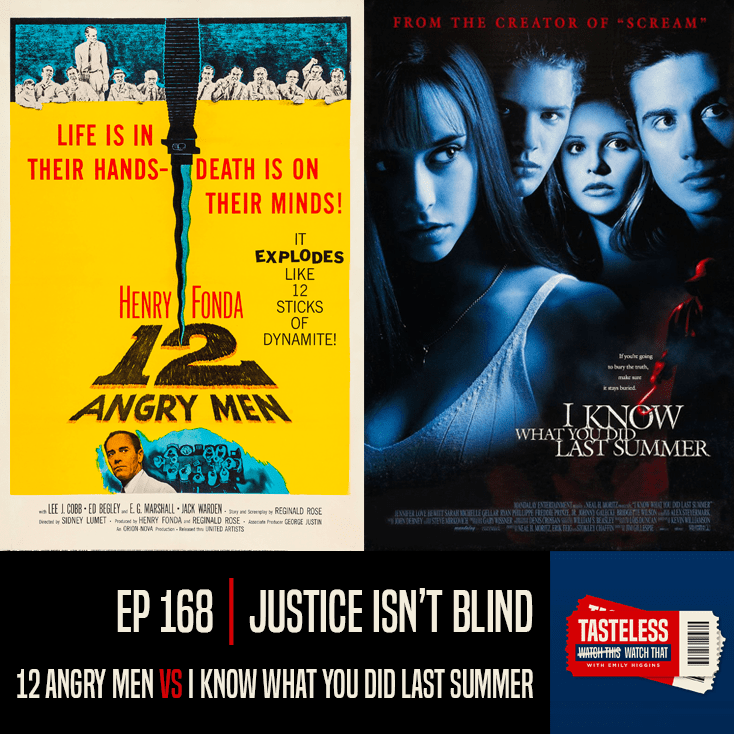
Justice Isn't Blind: 12 Angry Men vs I Know What You Did Last Summer

12 Angry Men vs I Know What You Did Last Summer

Two movies that explore the meaning of justice and how our preconceived notions affect that justice being served — it's 12 Angry Men vs I Know What You Did Last Summer.

Read The Episode

Every episode of Tasteless, I take a critically acclaimed film and compare it to one that shares the same themes but didn't get the attention it deserves — and explain why that second movie is my pick. This week: two movies that explore the meaning of justice and how our preconceived notions affect that justice being served. It's 12 Angry Men versus I Know What You Did Last Summer.

12 Angry Men

The jury in a New York City murder trial is frustrated by a single member whose skeptical caution forces them to more carefully consider the evidence before jumping to a hasty verdict.

This movie came out in 1957. It has a 100% on Rotten Tomatoes. On IMDB it is number five of the top-rated 250 movies — basically of all the movies on IMDB, this movie is number five. It was nominated for three Oscars — Best Picture, Best Director, and Best Adapted Screenplay. It lost all those nominations to The Bridge on the River Kwai.

As of 2020, this is the shortest movie in the IMDB Top 10, as well as the only one in the Top 10 to be under two hours. I love that this movie is 96 minutes. That's what I want. We need more movies that are 96 minutes. This movie is an affecting movie that has stuck with us and it doesn't need to be 30 hours long.

It feels like a play, which I enjoy. It's adapted from a teleplay, so it has that vibe of being on a stage. It's mostly taking place in one single room, and the filming was incredibly deliberate. At the beginning, the cameras are all positioned above eye level and mounted with wide-angle lenses to give the appearance of greater distance between the subjects. As the film progresses, the cameras slip down to eye level. And by the end, nearly all of it is shot below eye level, in close-up, and with telephoto lenses to increase the encroaching sense of claustrophobia. When the jurors leave the courthouse, they're filmed from a wide overhead angle, and director Sidney Lumet claimed that the final shot was filmed through the widest lens used in the movie to emphasize the sense of release.

I feel like the Rural Juror in 30 Rock having to say the word "juror" more than once.

Watching this movie — I had seen it ages ago in class and really didn't remember much. Upon a rewatch, I cannot tell these men apart. I had to take so many notes on where people were seated and what they said, cross-checking with IMDB and Googling pictures. This room is just 12 basically white guys in black and white, just sweating, wiping their brows. One guy has a cold and is blowing snot. I was like, no, this is going to be a nightmare. I was pleasantly surprised. It is a good film.

Let's go around the table clockwise. Juror #1 is the foreman — the man who gets to be like, here's the rules, we're deciding innocence or guilt. I wrote down "has a tie." Also, you can see his nipples more than you see in an episode of Friends. His shirt is so tight. No one respects him and he's mad about it. He's kind of hot in a Twilight Zone main character way.

Juror #2 looks like Bob Balaban but nerdier. Has a whiny voice. Juror #3, played by Lee J. Cobb — I say that because he looks familiar and I couldn't tell if it was because I just watched The Exorcist, which he was in, or because he looks like what I think Marlon Brando looks like if I had to draw a police sketch of Marlon Brando. So I call him Thick-Voiced Marlon Brando Guy.

This guy is our main antagonist. He's like, I used to call my father sir. Okay, cool brag. He's basically like, yeah, you should beat your kids, like I do. And I beat my kid so much and then my kid punched me and I haven't seen him in years. This guy sucks. He's really awful. But he gets his little cathartic moment at the end. He's the one who's like, let's send this kid to the electric chair because sons don't respect their fathers enough.

Juror #4 — paper reader stock guy. Has an attitude. Has glasses. He's like, I do stocks. I'm reading the paper. Juror #5 — this guy's like, I want to pass. He doesn't even want to vote. He's got a gray suit and looks really sad. Eventually when everyone's like, this kid from the slum is guilty because people from the slum suck, this guy's finally like, I'm from the slum. And later: has anyone seen a knife fight? I have.

He has the most upsetting piece of trivia. IMDB says: The death of Jack Klugman, Juror #5, on 12-24-2012 means none of the 12 jurors from the film are alive. So everyone in this movie has been dead for over a decade. Almost.

Juror #6 — I just called Squarehead Guy. He's fine. He's there. Juror #7 is Foom Baseball Tickets Hat Guy. He's like, Foom! Baseball! In the bathroom he says, I made 27 grand selling marmalade. That's not bad. IMDB trivia tells us that would be over $235,000 in 2015. So that's not bad. I don't know if this guy only sold marmalade or if he sold a bunch of different things and marmalade was especially lucrative. Wonder how this guy feels about Paddington.

I was very obsessed with the fact that Tony Danza played this role in the 1997 remake wearing a deep V. Baseball Tickets Guy is just like, I have tickets to a baseball game tonight, I don't want to be here. Let's go, I'll vote whatever. But then it starts raining and he's like, all right, I guess I'll focus on whether or not we send this kid to the electric chair since I can't go to my baseball game.

Juror #8 is our main protagonist. I said he's Window Looking Hot Guy. He's standing looking out the window at the beginning for a long time. Has a little widow's peak. This is Henry Fonda. He produced this movie. He's like, no, this kid is not guilty — slash, the prosecutor didn't meet their burden of proof. And everyone's like, ugh, now we have to stay here and talk about this.

Juror #9 is an old man who is in the bathroom at the beginning for a really long time. The secret ballot — everybody votes guilty except Henry Fonda, then later he's like, let's take a secret vote, I won't vote, and if anyone else votes not guilty we'll keep talking. They get one not-guilty vote in the most old man cursive handwriting ever. Like it is the oldest man handwriting and I immediately think, it's that old man. Later, this old man is bragging about having 20/20 vision. He's calling out the glasses stock reader guy — I have 20/20 vision myself, always have. Okay, cool.

Juror #10 is our other antagonist, a real turd played by Ed Begley. It shocked me to realize Ed Begley Jr. is Jr. for a reason. This old man is racist. He's like, anybody from the slums that's that color is definitely a criminal. And everyone's like, yeah, probably. But then as he gets more and more racist, there's this scene where he's going on this rant about we know how those people are, and one by one everyone gets up and turns around from him, stands to look out the window.

Juror #11 — I call Mustache Suspenders. Juror #12 — Rod Serling Guy. He will not stop talking about his job. He's like, I doodle. This is a doodle of Rice Pops. I sell Rice Pops. I do advertising. This guy is a wannabe standup comedian, so I hate his guts. At one point he's smoking in the background and blows little smoke rings. How? How do people do that? How are you controlling the elements?

I love when Henry Fonda pulls his own knife out in this jury room and compares it to the evidence knife. And then the other guy takes Henry Fonda's knife and stabs it into the table and I was like, that's city property, I don't think you can do that.

A really insane trivia piece: this film is commonly used in business schools and workshops to illustrate team dynamics and conflict resolution techniques. That's psychotic. Everyone in this movie is a maniac!

At the end, Henry Fonda and Marlon Brando Guy have this moment because Marlon Brando Guy is the lone holdout guilty by the end. He tears up this photo of his kid and is crying on the table. They vote and everybody walks out and our hero guy gives him his jacket in this very nice, touching gesture — helps him put his jacket on. And I was thinking how if this movie came out today there would be so many Twitter and Tumblr accounts that are like, Henry Fonda and Marlon Brando Guy should bone! Why aren't they making out? Look, I drew a picture of them making out.

Final trivia piece: there are no female characters in the film aside from extras in the courtroom prologue, although a woman's bathroom can be seen in the jury room. Cool. That's the same thing. There are no female characters, but there is a female bathroom. Great. Really great.

I Know What You Did Last Summer

Four young friends bound by a tragic accident are reunited when they find themselves being stalked by a hook-wielding maniac in their small seaside town.

Came out in 1997, has a 43% on Rotten Tomatoes. Kevin Williamson adapted the screenplay from a Lois Duncan novel and made it more deadly. He changed quite a bit from the book. I really love Lois Duncan — I loved her books growing up. I understand why she wasn't pleased with the violence added to the film. Her daughter was murdered in real life and she wrote a book about the experience. So I can see why she'd be sensitive to that. Kevin Williamson had just hit big with Scream, and I feel like this film tonally is a really perfect follow-up.

The cast of this movie is unbeatable, and probably the movie's greatest strength — the powerful 90s energy of everyone in this film.

Jennifer Love Hewitt is our hero, Julie James. I adore Jennifer Love Hewitt. She recently did an interview with Ilana Kaplan for Vulture about Heartbreakers and her career as a whole. She talks specifically about the treatment she got surrounding her body, the creepy comments made by the media. She said she wished she had known how inappropriate that was so she could have defended herself or just not answered those questions. She laughed it off a lot of the time and wishes maybe she hadn't.

Jennifer is someone who has been in the industry for ages and doesn't get the respect she deserves. She's had several successful shows — Party of Five, Ghost Whisperer, 9-1-1. She's a talented singer. She's very funny and dramatic. She was fantastic in one of the all-time best SVU episodes. She can truly do it all and her legacy should not be discounted.

In this movie she is the conscience of the group, the one we follow. Another set of iconic bangs in this film. Jennifer's in the car with three friends when they hit someone in the road. Instead of reporting it, they agree to dump the body and never speak of it again. This secret really weighs on her. When she comes back to town a year later, she receives the "I know what you did last summer" note.

There is a classic scene in this movie. She walks out in the middle of the street and spins around: what are you waiting for, huh? What are you waiting for? Great slasher moment. And the story behind it is insane — Jennifer Love Hewitt explains that this scene was directed by a kid who won a contest. That's already bananas. In the video, Jennifer's like, I don't know where that kid is now. Kid, show yourself. Message me, where are you, kid that directed this iconic scene?

Don't let kids direct your movies or win contests unless it's this kid. This is the only good contest outcome that has ever happened.

Jennifer's best friend is Helen Shivers, played by Sarah Michelle Gellar. I adore Sarah — Buffy, Cruel Intentions, Scooby-Doo, I loved Ringer. This movie has a special place in my heart because a specific question about her in one edition of the game Scene It! was my life's greatest triumph. The question was one of those scrambled pictures that slowly unscramble, and I immediately knew it was a photo of Sarah Michelle Gellar on stage at the beauty pageant in I Know What You Did Last Summer. Maybe none of it had been unscrambled. Maybe a very small portion. It was just a blob and I was like, yes, of course. I hold that victory very dear. Even though it was definitely over 15 years ago, I'm still very proud.

Sarah, like Jennifer, doesn't get credit for her range. When she's competing in the beauty pageant and answering a question: Well, Bob, at summer's end, I plan to move to New York City where I'll pursue a career as a serious actress. It's my goal to entertain the world through artistic expression. Through art, I shall serve my country. Very Denise Richards in Drop Dead Gorgeous — just dark and knowing and perfect. Then a year later, when she's the returning queen sitting on stage wearing the tiara while the new contestants share their skills and one woman is singing horribly, she just goes: Jesus. She's so good at dark comedy, at viciousness in this way that makes me laugh.

Sarah Michelle Gellar in this film in the Letterman jacket with her tiara still on after winning — before they hit someone with their car — is such a good look. I feel like I'm going to do it as my Halloween costume. Do you think someone is already selling Letterman jackets from I Know What You Did Last Summer or will I need to commission one?

Sarah's boyfriend is Barry Cox, played by Ryan Phillippe. Barry is not a Ryan Phillippe name. But okay. Ryan gets super drunk the night of the pageant. Then they all get in his car, but Freddie is driving because he's too drunk. Then they hit the guy. Ryan is the most insistent that they don't tell the police. He's the rich kid — ugh, consequences. Ryan is such a great awful guy that you're still attracted to — much like in Cruel Intentions. He's disgusting, but also he cries a little and I'm like, I could fix him.

I was really shocked every time he said the word "slicker" talking about a raincoat. He kept saying it — some guy in a slicker. Some guy in a slicker attacked me. Did you see the guy in the slicker? I don't like that. It must be a regional thing.

Also, this film has great examples of the female gaze — seeing Ryan Phillippe walk around in a towel and then also a tank top, and Freddie Prinze Jr. in a tank top. These great moments of these guys just looking so good.

Freddie Prinze Jr. is Jennifer Love Hewitt's boyfriend, Ray Bronson. In real life, Freddie and Sarah are a power couple married for ages. They met on the set of this film but didn't date until three years later. I love Freddie Prinze Jr. He has one of the most lovable faces. He's a bit of a red herring in this film — his actions are shrouded in mystery — but one thing that's clear is his love for Jennifer. She just can't look at him knowing what they did together, and that's heartbreaking. They had such love for each other, but she can't live with what they did and he's a constant reminder.

Freddie Prinze Jr. in this movie in his tank top on the docks, helping with fish, is my dream man.

Also in this film: Bridget Wilson-Sampras, who plays Sarah's older sister Elsa Shivers. Is this where they got the idea for Frozen? Elsa Shivers? We shiver in the cold? We need to find out. She calls Sarah Michelle Gellar Little Miss Kroger and that got me. While looking at her IMDB I learned there was a 2007 Mr. and Mrs. Smith TV show pilot with her and Jordana Brewster as Mrs. Smith. I am furious that show doesn't exist. I can't believe this. This is the worst thing Hollywood has ever done.

Anne Heche plays the sister of the man they believe they've killed. Johnny Galecki plays a guy in love with Jennifer Love Hewitt. This is another movie you should just watch. It's streaming on HBO Max.

Shared Themes

12 Angry Men and I Know What You Did Last Summer are about justice and how we perceive it. What equals justice to one person may not be seen as justice by another.

In 12 Angry Men, many of our prejudiced jurors think justice is the accused boy being put to death for killing his father. They're like, look, this kid did it, everyone thinks he did it, and someone needs to pay for this man's death. While our main dissenting juror, Henry Fonda, thinks justice is following the laws set out by the court — sending someone to their death only when there is no reasonable doubt.

For him, the boy actually killing his father is less important than the task before them. And it's not as important to the movie either. We never actually find out if the boy was guilty or not. But we do see that the court did not meet its burden of proof. There were too many circumstantial pieces of evidence, too many explanations for how the boy may not have done it. Some of our jurors have a really hard time with that — the idea that a man is dead and perhaps no one will pay for it. Someone being punished is more important to some of them than carrying out the instructions laid forth by the court.

It's interesting to see how seriously some jurors take their task versus others. Some just want to get this over with. But when they start to listen and realize things may not be as cut and dry — when it's pointed out that the woman who claims she saw the stabbing had little glasses marks on her nose and likely wasn't wearing her glasses when she saw whatever she thinks she saw — the juror arguing for that testimony is like, you're right, she did have little glasses marks, just like me. For some people, it needs to be relatable to them.

For Juror #3, Marlon Brando Guy — he's like, no, I don't care what evidence you have or don't have. Children are terrible, like mine who hates me, so definitely this kid should be punished. At one point he's arguing that the old man witness is infallible. Someone else is like, well, that old man also said such-and-such. And juror three goes, he's an old man. How could he be positive about anything? And you see on his face — he's saying very clearly that obviously this old man doesn't know what he's talking about, but he's also basing his belief of the crime on what the old man said. He brushes right past it. He wants his views to be correct.

In I Know What You Did Last Summer, the conceit is someone knowing the actions of our protagonists and wanting to make them pay — wanting to enact his own form of justice on these rowdy teens. The slasher of the film — spoilers — is Ben Willis, a man whose daughter Susie died in a car crash with her boyfriend David Egan. Ben Willis blames David for Susie's death and enacts his own justice by first killing David and making it look like a suicide. Then, as he's leaving that scene, that's when he's hit by our four teens on their joyride. They dump his body instead of calling for help, and when he comes to, he dedicates himself to going after them.

Our four teens hit this guy with their car and argue over what to do. Jennifer Love Hewitt wants to tell the police. Ryan Phillippe thinks the accident will get them in more trouble because he's super drunk — he spilled alcohol all over the car, it's his car, it'll look like he was driving. Freddie Prinze Jr. is a poor kid from the wrong side of the tracks — he worries about his future, thinks justice isn't served by having his life ruined when this guy ran out into the middle of the road. And to be honest, you're right — that doesn't feel like justice.

If I hit someone with my car, I would tell the police. I swear I would. But I see where these people are coming from — it looks worse than it is and all four could suffer massive consequences. They're about to head off to college. Their lives could be cut short. I get it. Of course, because of their guilt, their lives don't go the way they want anyway.

Jennifer keeps insisting it was an accident, police will understand. But you never really know how the police are going to respond to anything. A year later, when the four reunite, the argument over what is right, what is just — it continues. Jennifer considers what they did murder, because instead of getting the man help or telling anyone, they dumped the body. In her mind, that's when it went from accident to crime, to murder. So she broke up with her boyfriend and left.

When she's talking to Freddie about what they've experienced, he says he knows they couldn't stay together because she blames him for driving. She says the most heartbreaking line: I'm responsible for my own actions and I don't blame you, but I don't want to know you either.

Jennifer is disgusted by her own actions, has spent the last year sad and alone, cut off from these people who reminded her of what she did, as she punishes herself as some form of justice, thinking she doesn't deserve happiness after choosing to not tell anyone about what happened.

So much of our perception of justice comes from who we are and our own experiences. It's incredibly subjective. As much as we don't want it to be, as much as it shouldn't be, preconceived notions about the ways of the world are an important part of both of these stories, because they're something we can never really get rid of in our own lives.

Juror #3 hates the accused kid in 12 Angry Men because he has such conflicting feelings about his own kid. He hates his relationship with his son and recognizes in some way that they could have just as easily been on the stand for the same thing — that his son likely wanted to kill him at some point. The racist juror — his racism has him immediately pitted against the accused. His long rant about how people from slums act shows that he believes those different from him are guilty almost immediately. He doesn't need other evidence. And then the juror from the slums is like, whoa, I came from there and I'm not a criminal. Also, I know what a knife fight is and someone wouldn't stab from above. Let me show you how a stabbing would go. He has different information than the other guys — information that helps color his view of the case. He's coming from a different perspective.

In I Know What You Did Last Summer, Jennifer Love Hewitt has lived a relatively easy life. She has faith the police will do the right thing, clear them if they say there was an accident. Whereas Freddie, who has lived as a poor guy on the wrong side of the tracks, treated badly — he doesn't have faith that the system will work in his favor because it never has. He feels like he's on a set path for life, that he's not going to get a break. When he becomes a fisherman like his father, it's with a certain resignation.

Ryan has always gotten what he wanted, gotten away with everything because of his privilege. So he believes this instance should be no different. He doesn't need to take responsibility. He can simply sweep this under the rug and go back to his life without a care.

Sarah tells herself the guy was drunk or suicidal, that he wanted to die, that they didn't kill him. She says to Jennifer, it was an accident. Jennifer says, Helen, we killed a man and then ruined the lives of everyone he knew. Sarah says, I don't think we're that powerful, Julie. You're giving us way too much credit. She doesn't want to think about the ripple effect of their actions. She wants to contain it to that one night, that one man. Because she's also never had to face consequences — she wins the pageant, things go well for her, people like her, she's popular. She starts to not like herself. You see that in the way she gives up on her dream and moves back home.


What I Know What You Did Last Summer Did Better

12 Angry Men is the story of 12 angry men forced together to determine the fate of the accused. They had nothing to do with the crime and were brought in on random chance. In I Know What You Did Last Summer, our four characters are brought together by a pact they made, a choice to remain silent regarding the crime that took place.

In 12 Angry Men, by the end, the guys mostly understand their involvement in the justice system. They understand, at least in some small way, the weight in sending a man to die. The process of being on a jury is something any one of us could experience, but it's still theoretical — this threat of a wrongful death. There's an obligation to complete the task and move on. When they vote not guilty, they all leave the courthouse never to see one another again. The old man and the main dissenter exchange last names, but then they too go their separate ways.

Even if they had voted the man guilty, they were just fulfilling their end of the bargain of society. They were called in to serve via mail. They had no idea what sort of case they'd get. The stakes for these men aren't particularly high. They're in a room with people who don't know them. It's not like anyone will know, that guy voted guilty, that guy was a real jerk about it. They will never see these men again. It's a high-minded film of what's right and what's wrong. Like a logic problem, it's theoretical rather than real. It's the trolley problem with no actual trolley.

In I Know What You Did Last Summer, four people have their lives ripped from them because of the choices they made. We see how Jennifer Love Hewitt is affected — at college, she's dead-eyed and pallid, not enjoying life. She's cut off her old relationships, her love for Freddie not enough to overcome what they did. Her affection for Sarah also falling by the wayside in her guilt. She has no one anymore. She's not connected. She's untethered.

We see that Sarah's journey to New York didn't work out — she came back home to work in her father's store with her overbearing older sister. She's not an actress, but a shut-in, reflecting on her past glory, telling herself the man they killed wanted to die. Freddie is devastated to lose Jennifer — instead of heading off to college, he stays home and goes into the fishing life expected of him. Ryan is least affected as far as we can tell, but things aren't going great for him either.

When Jennifer comes back to town, she points out that their lives have been ruined and begs them to reconsider. She says, yeah, but this is insane now, Barry. Look at us. The secret's killing us. He says, I'm not going to the police and you're not either. She says, Barry, please, we could put an end to it and maybe salvage some small fraction of a life. He says, and how do we do that? Huh? There was no accident, Julie. It was murder. Your words, remember? Murder.

Ryan feels they're in too deep and wants to solve the problem of the person taunting them by himself. Jennifer is desperate to reclaim the life she lost. Freddie has continued thinking about what they did — we learn he visited Anne Heche in secret under an alias and had a brief relationship with her before the guilt became too much, because he believed he had killed this woman's brother. All our characters hang on to what happened in one way or another, unable to move past it, unable to live their lives, because they had a hand in it.

The brilliance of 12 Angry Men is that it exists in one space at one time. It's claustrophobic, intense, frenzied, a slice of humanity. But it's a slice that exists outside of a whole, separate from a whole. There's no before and no after. There's no telling how the hours spent in this courtroom will affect the jurors going forward.

Whether the kid committed the crime or not is left ambiguous because whether he did it doesn't affect these 12 men. There can't be consequences for jurors for what they do — otherwise no one would serve jury duty. It would take away the idea that people can weigh in honestly based on what's presented. These men debate about what's right, make their pick, go on their way. It doesn't affect them.

In I Know What You Did Last Summer, four people have to live with what they chose. They didn't report what happened. They didn't call the police with even an anonymous tip. They didn't drop the body outside a hospital. They chose to shove him into the water. They used their own hands to enact it.

Sarah tries to put that choice onto the man they hit, giving him agency to remove herself from the equation. She says, maybe he wanted to die. David Egan — his girlfriend was killed on that same road, July 4th, one year earlier. Maybe he blamed himself. Maybe he was sitting in the road waiting for us to hit him. Jennifer replies: yeah, if that'll help you sleep at night.

Jennifer knows it's a futile hope. Regardless of what anyone else chose to do, regardless of whether that man wanted to die, her choices are her own. And that is what weighs on all of them.

If you're thinking about watching something about justice — you need to show something to a class — maybe think about teaching I Know What You Did Last Summer. An equally thought-provoking film on the concepts of justice and preconceived notions. It's streaming on HBO Max.

Hit me up at @tastelesspod on social media and we can talk about how much I miss late ‘90s slashers, or how incredible it was to see these four people in one film. Perfection.

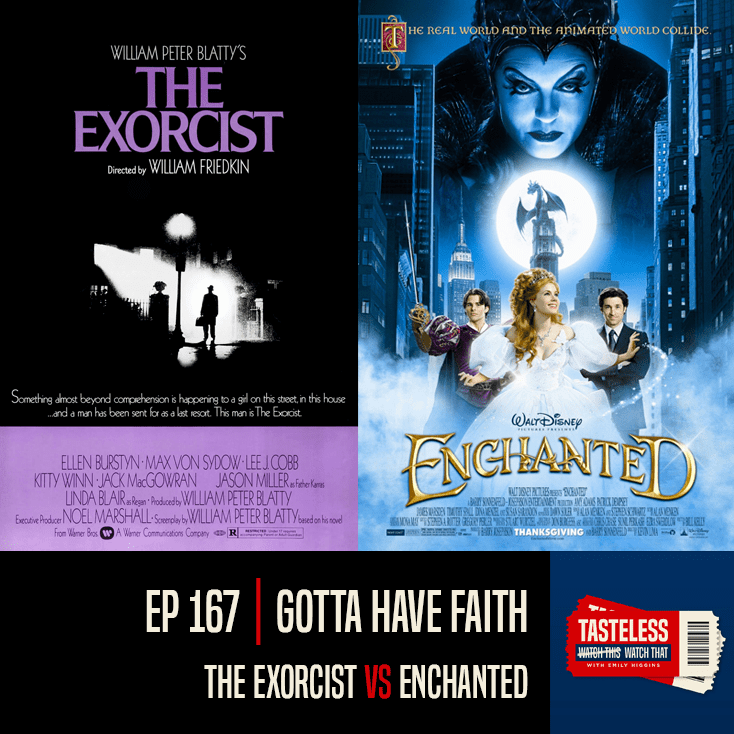
Gotta Have Faith: The Exorcist vs Enchanted

The Exorcist vs Enchanted

Two films that explore faith as well as representations of good and evil that endure through generations — it's The Exorcist vs Enchanted.

Read The Episode

Every episode of Tasteless, I take a critically acclaimed film and compare it to one that shares the same themes but didn't get the attention it deserves — and explain why that second movie is my pick. This week: two films that explore faith as well as the ultimate representations of good and evil. It's The Exorcist versus Enchanted.

The Exorcist

When a mysterious entity possesses a young girl, her mother seeks the help of two Catholic priests to save her life.

This movie came out in 1973 and has an 83% on Rotten Tomatoes. It won the Oscar for Best Adapted Screenplay for William Peter Blatty, who adapted the film from his own novel, and it also won for Best Sound. It was nominated for another eight Oscars — Best Picture, Best Lead Actress for Ellen Burstyn, Best Supporting Actor for Jason Miller, Best Supporting Actress for Linda Blair, Best Director for William Friedkin, Best Cinematography, Best Art Direction, Best Film Editing. That's crazy for a horror movie. A genre often maligned for supposed cheap scares and tricks — it's hard to get a horror movie the recognition it deserves.

The Exorcist was a success. It's famous for the reactions it elicited in audiences — people keeling over, passing out, barfing. Very upsetting. I'm glad I didn't see this in theaters in 1973. I knew the basics of this film, but I recently watched it for the first time. The sense of foreboding woven throughout is impressive.

It starts in this desert. This old guy, Max von Sydow — he's Father Merrin, a priest at an archaeological dig who finds a weird little statue of a demon. Maybe don't pick up dusty artifacts. We learned this in The Mummy. Don't pick stuff up out of the sand. Anything that's in the sand, it wants to be there. But then this guy is almost trampled by horses. He's just walking around looking dazed and scared. I felt like the desert was too hot for this old man. Clearly something bad is happening.

Then we meet Ellen Burstyn. Her character Chris McNeil is an actress, but we only see her being an actress for about four minutes at a fake protest scene. Is Ellen Burstyn ever not stressful? Are there movies where she just has a nice time? I haven't seen them. Poor Ellen Burstyn. Her kids are Jared Leto in Requiem for a Dream and the damn devil in this movie. And then Pieces of a Woman seems like a real bummer. And in SVU, she's Elliot Stabler's mom and bipolar and refuses to get help. Ellen Burstyn never gets to just chill.

In one scene, the lights flicker off and Ellen is just darting her eyes back and forth. Really good moment. She portrays this trembling inner fear so well she makes the viewer feel nervous, even though she has the same haircut as Danny in The Shining. Very upsetting.

Of course, this film's exorcism is centered on Ellen Burstyn's daughter Reagan, played by Linda Blair. Linda was in this great weird 80s horror movie called Hell Night. She also played an obnoxious reporter, uncredited, in Scream. I love when someone leans into their career. Linda raises money for the Linda Blair WorldHeart Foundation, an animal welfare organization, by selling autograph prints and memorabilia. She has used this thing she's so known for, for good, and I love that.

The role obviously skyrocketed her to fame. And it's upsetting how much was stacked against her. According to the Exorcist Wiki, the agency representing Linda Blair recommended 30 other clients for the part but not Linda, and Linda's mother brought her in herself. Then, due to death threats from religious zealots who believed the film glorified Satan, Warner Brothers had to hire bodyguards to protect her for six months after the film's release. People are insane.

Linda Blair received a Best Supporting Actress Oscar nomination. But William Friedkin really pushed that she was the only person who portrayed this role because he wanted realism. But Mercedes McCambridge provided the voice of the demon. When she wasn't credited, it caused controversy. They couldn't take back the nomination when that was found out, but it really killed her chances of winning.

Mercedes insisted on swallowing raw eggs and chain smoking to alter her vocalizations. She had problems with alcohol in the past and wanted to drink whiskey to mess up her voice and create the crazed state of mind. At William Friedkin's direction, McCambridge was also bound to a chair with pieces of a torn sheet at her neck, arms, wrists, legs, and feet to get a more realistic sound of the demon struggling against its restraints. Then Mercedes had to sue Warner Brothers for credit as the voice of the demon.

Basically, Linda Blair is this kid. The production of the movie has nothing to do with her. And the director is like, yeah, she did it. And she's just like, yeah, I did it. And then people are like, how dare you take credit? It just sucks.

She's possessed by a demon that claims to be the devil. The bed is shaking, she's screaming. At first I'm thinking, okay, get off the bed. But then I realized that when an earthquake happens, I just stay on the bed and assume I'm dying. I can't really judge.

Her mom takes her to doctors, to multiple doctors for different tests. One test is just blood shooting out of a throat hole. Very normal test. One of the first ones they do. They put a hole in your throat, have some blood shoot out, and go, okay, blood's coming out, that's good. Apparently it was a relatively accurate version of this test and William Friedkin claims students have used it to study the procedure, but it is a shocking scene.

Burstyn's like, okay, I guess we get a priest because I don't know what to do. The doctors are like, there's some alien intelligence, a spirit if you will. These scientists are ridiculous. Reagan is straight up purple and green and talking in this demon voice and scientists are like, uh, maybe something's weird with her brain? I don't know.

So Ellen Burstyn gets Father Karras, played by Jason Miller — a priest who has been doubting his own faith and whose mother is having a hard time and ultimately dies. He's kind of like, I don't know that exorcism is what we should be doing. And the scene where Reagan projectile vomits at Father Karras only required one take — the vomit was intended to hit Jason Miller in the chest, but the plastic tubing misfired, hitting him in the face. His reaction of shock and disgust is genuine, and he admitted he was very angered by this mistake. If a demon threw up on me, I would not be able to continue my life. It would be done.

Then we get back to Father Merrin from the beginning, Max von Sydow. He's called in because Karras is like, all right, maybe we do an exorcism. And the higher-ups are like, okay, we've got to get the big guns. This guy, Father Merrin, he'd done one before and almost died. Let's get him. And it's so sad because he's out in the woods hanging out and some other priest comes up and gives him this paper, which clearly says, hey, you've got to come do an exorcism. And he just looks at it and it's like: God, fine. I guess I'll go die doing another exorcism.

My final review: this movie has too many fluids coming out of too many holes. But it's definitely worth a watch.

Enchanted

A young maiden in a land called Andalasia, who is prepared to be wed, is sent away to New York City by an evil Queen, where she falls in love with a lawyer.

This movie came out in 2007, has a 93% on Rotten Tomatoes. Enchanted was nominated for three Oscars — three Best Song Oscars. They had a 60% chance of winning with "Happy Working Song," "So Close," and "That's How You Know." Lost to "Falling Slowly" from Once. Honestly, very unacceptable.

This movie is a mix of animation and live action. We start with the animation — animated Amy Adams running into animated James Marsden. They're both singing. They decide to get married the next day, but then she's sent by a witch, Susan Sarandon, to a place where there are no happily ever afters — aka modern-day New York. Amy is of course confused by this loud, bright new world. She lands in Times Square in her giant wedding dress. The imagery, the cinematography in this movie is so striking.

Amy Adams is incredible. To pull off this level of cartoonish bigness and not be annoying — she's so naive, so earnest. Yet I have no cynicism towards her. I'm rooting for her from moment one.

Let's talk Amy Adams roles for a second. Arrival should have gotten her an Oscar. At least a nomination. She has six Oscar nominations. Junebug was her first, one of her earlier roles. Doubt was her next — her and Philip Seymour Hoffman and Meryl Streep dealing with scandal in a church setting. The Fighter she was so good in. The Master she was so good in. American Hustle, Vice.

Other movies she should have been nominated for: this one — Enchanted. Big Eyes. Trouble with the Curve. The movie Her. The Muppets. Miss Pettigrew Lives for a Day. Sunshine Cleaning. Her episodes of The Office, her episode of Charmed, her episode of Buffy. Talladega Nights. Cruel Intentions 2. All of her scenes in Psycho Beach Party. Drop Dead Gorgeous. All things she should have been nominated for Oscars for. Am I just screaming her IMDB? Yes, I am. Amy Adams should have 200 Oscars.

Everything she does, she is a joy to watch. She's such a talented — workhorse feels like an offensive word, but whatever she is in, she is making it better. She was working for ages before hitting it big. She put just as much heart and humor and reality into the small roles as the big ones. I mean, Talladega Nights — she's the mousy assistant that winds up with Will Ferrell at the end. It's so good. She can do so broad, so specific. She gets dark humor. She gets drama. She can make you cry. And not only can she portray any role, she can sing like an angel.

"Happy Working Song." Brilliant. The pigeons and rats and roaches come and help her clean up because basically it's the classic Disney song — she calls all the forest creatures to come help her clean. But the forest creatures of New York are pigeons and rats and roaches and they help her clean and it's amazing.

When she steps out of the shower and the birds put the towel around her body, her wide-eyed grin — it could easily be insipid, but it's not. It's utterly charming. She makes a dress out of curtains. She nails every single layer of comedy and rings every funny moment out of a scene in a way that doesn't chew the scenery and that only enhances the work of her co-stars.

When Amy Adams lands in modern-day New York, she tries to find her way home and climbs up onto a billboard that looks like an enchanted castle. There, Patrick Dempsey and his young daughter find her and try to help. Patrick Dempsey is the stereotypical love interest grump. I hate fun. I have floppy hair but a rigid personality. He is perfect for this because Amy's head-in-the-clouds nature needs a little grounding to get used to New York. Who better than a single dad who helps couples get divorced and doesn't really live life for himself?

Although he does become the true villain of the movie when they're walking through the park and she's eating something — like a donut or a cinnamon bun — and she's like, this is so yummy, nibbling. And he goes, you all done? and takes it from her hand and throws it out. She wasn't done, there was still some left, Patrick Dempsey.

When they're walking in the park, we hear another of the Oscar-nominated songs, "That's How You Know." This is another fun movie moment where you're sucked in, everybody's singing and dancing. Patrick gets the classical musical moment of being like, wait, how does everyone know this song but me? I know I'm banging on him, but if I was with someone and they started singing in the park, I would be distraught. I'd be like, why do you all know this song? Why are you doing this to me?

Amy, with Patrick Dempsey, explores nuance — different emotions other than just excitement, happiness, true love. She gets to feel anger for the first time. That feeling disconnects her from her prince, James Marsden. James doesn't feel anger — he feels just dopey happiness at all times. When he and Amy are reunited, they don't click in the same way. James Marsden — perfect for this role. Handsome prince. Not fair that he can also sing. He comes to rescue her. He really does want what's best for her, but he doesn't grow or change. And she does.

She's obviously starting to fall for Patrick Dempsey. He has a girlfriend: Idina Menzel. Now, the one knock against this movie — it is a full Disney musical with Idina Menzel and Idina does not sing a note. Absolutely insane. Why? Why would you put her there and not let her sing?

Susan Sarandon comes to town — she's the witch, James Marsden's stepmother. She comes to get Amy Adams to eat a poison apple. She rises up in Times Square in a plume of green smoke from a sewer. She's so evil in the most cartoonish, amazing way. She sneaks Amy an apple. And that's another cinematography moment — Amy is looking at the apple and her face is reflected in it. She takes a bite. And of course she dies, or passes out and will die if she doesn't get revived by midnight.

James Marsden is like, I need to kiss her. True love's kiss. He kisses her. Nothing. And then he's like, hold on, Patrick Dempsey, you should kiss her. You're probably her true love. Patrick Dempsey is like, I'm kind of dating Idina Menzel. And Idina Menzel is like, just go ahead, Patrick. Just kiss her. Because even she is like, obviously you should be with Amy Adams. What a secure, wonderful woman.

Then we get the great moment of Amy saving Patrick from the evil dragon. Giselle — that's Amy's name in the movie — is like, is this a habit of yours, falling off of stuff? And Patrick says, only when you're around to catch me. I love that they turned it on its head.

Then James Marsden and Idina Menzel hop into a storm drain. I would hop into a storm drain with either of them to go live in the fairy tale land and have their own wedding. And the movie ends with a shoeless family dance, which I love just as much as I loved it in Matilda.

I haven't even talked about Nathaniel. Nathaniel is great — the henchman, played by Timothy Spall, who's a perfect henchman. IMDB's bio for him is: short, roly-poly, pudding-faced Timothy Leonard Spall was an award-winning classical character actor. Short, roly-poly, pudding-faced Timothy. That is so rude.

Shared Themes

Good versus evil is a big, broad concept — one that's at the core of most movies, of most stories. A good guy and a bad guy. The Exorcist and Enchanted are two representations rooted in a certain way of thinking: The Exorcist in religion and Enchanted in fairy tale and the world of Disney. These films tap into the types of stories we are told that are meant to shape how we perceive the world — whether that's religious lessons and doctrine or fairy tales with morals at the end. They're stories that endure in our lives across generations.

The Exorcist taps into our fears about the devil, demonic possession, an entity that is stopped only by holy water and the utterances of a priest. A pure evil, one that overtakes a child for no other reason than it can. Reagan has done nothing to deserve what happens to her. She hasn't brought it upon herself in any way. And that's an important part of the story — that she's an innocent and yet this is able to happen. The only people who can fix it, or attempt to, are those closest to God. The priests who speak from the Bible and fight off what has taken root in poor Reagan.

Ellen Burstyn is upset to find a crucifix in Reagan's room at one point, not wanting to admit that it may save her daughter — that something repelled by the presence of a crucifix could be inhabiting her child's body. People watching the film passed out, walked out, because of how intense the imagery was. Yeah, some of that was all the bodily fluids, but some of that was also tapping into this dark, primal fear we have within us.

What allows people to turn to religion in times of need is also what can be the downfall. We look back on exorcisms in olden times as barbaric and inhuman, but if we were unsure of how else to help someone we loved, I think many of us would at least give it a shot. In our bones and the stories passed down to us, we've been told that true evil can be fought by those who have been deemed worthy, blessed with the title of Father.

In modern times, religion is still a piece of who people are, still taught and learned and expressed. But we now also have the cult of media. The images we're presented every day in the art we consume, the stories we read, the bedtime stories our parents told us. Less often about demons and more often about princesses and princes, dragons and castles. These stories shape our morals and our expectations just as much as religion has. It's just a more in-touch, modern way of getting those lessons across.

Enchanted has its happy endings and its fun tropes, but it can be watched as a deconstruction of the Disney-fied idea of happily ever after that we've been fed by the media for decades.

These more modern depictions of good and evil show beautiful princesses who fall for a man who will take care of them. The princess marries him, lives as this bride. Evil are the older women jealous of the heroine's good looks, her youth. The messaging that lies under every rom-com, it's in Disney, it's in the muted fairy tales adapted from the more violent Grimm's stories — that a woman's value is in getting the attention of a man and supporting him, while a man must be the ultimate protector.

In Enchanted we explore these tropes, these extremes. We see Amy and James meet and decide to get married the next day. Then Amy meets Patrick Dempsey and realizes she has choices. But we see how she must fight that initial urge to do as she's told, do what she thinks she's been taught to do. Yeah, at the end of the day, the Evil Queen is evil. She poisons Amy. She's very rude to her little henchman guy. Susan Sarandon is awful to Nathaniel. There is still that black and white of evil and good. But in Enchanted's even more modern version of morality tales, we get to see choice — the henchman doing what is right, Amy exploring her own path, making choices for herself.

The Exorcist and Enchanted raise questions of faith — faith our characters must have in themselves and in their actions to defeat their foes.

In The Exorcist, faith is the central focus and exploration. Father Karras is a religious man but aligns much more with the scientists who repeatedly check Reagan for brain lesions, seizures, psychiatric problems. He questions his faith as he watches his mother suffer. He runs scientific tests on Reagan — flicking her with what he claims is holy water that she reacts to by screaming, and he later says it was only tap water. He also thinks to be possessed you need to speak in another language, and maybe she is, but then he finds out she's just speaking backwards and is like, she's a faker.

Father Karras's speaking backwards is kind of impressive and very scary, especially because she says the name of Merrin backwards — and it's like, how did she know he was coming? But Karras embraces what must be done with Father Merrin, and he completes the ultimate leap of faith when he demands the demon take his body instead of Reagan and then throws himself to his death.

There's something interesting to what bearing faith has on the physical. The psychiatrists Ellen Burstyn visits prior to linking up with Father Karras tell her to look into exorcism. Ellen says, you're telling me that I should take my daughter to a witch doctor? They don't think it's a demon, but they think Reagan believes that. So perhaps going through the ceremony will work through whatever inner turmoil is causing her to lash out. Basically the placebo effect.

This movie is scary if you believe in the possibility of demon possession, of exorcism. And it's scary if you don't — because someone does. On the mostly harmless side, you see people who believe in the Holy Ghost passing through them, flinging themselves around on the ground. On the scarier side, you see people who do awful things because they think some other entity is controlling them. Whether they claim a demon or Grand Theft Auto, they're ascribing their actions to something else. Their faith in that thing controlling them is what determines the outcome.

It comes down to what you believe. If you are not Catholic, you are less likely to believe you need an exorcism. People thinking they are possessed are most often Catholic or raised Catholic or associated with that faith more so than any other. There is something spiritual about this film, something that makes you question your own belief.

The film's production suffered its own events some call cursed. The set caught on fire. Ellen Burstyn had her spine injured being ripped on a wire — she said about William Friedkin that he's so dedicated to getting the shot right that some other considerations fall by the wayside. She was ripped back, landed on her coccyx, has a permanent injury. Actors Jack MacGowran and Vasiliki Maliaros both died while the film was in post-production — they also played characters that died in the film. Televangelist Billy Graham stated there is a power of evil in the film, in the fabric of the film itself.

At one show, a woman was so frightened she passed out and broke her jaw. She later sued, suggesting subliminal messages caused the accident. Warner Brothers settled. One subliminal message scholar believed such imagery to be authentic and not created by the filmmakers — therefore he deemed the film itself was possessed. But when he talked about it, the subliminal images he described were not actually in there. He imagined them. This movie sends people off the rails. It's what you are willing to let in. What you have faith in affects what's going to happen to you in a weird way.

In Enchanted, Patrick Dempsey keeps telling Amy she doesn't know what she's talking about. He tells his daughter that Amy is confused when she talks of this magical land of Andalasia. He thinks she's just a super weird non-fairy-tale human instead of a fairy tale woman plucked from her realm and unceremoniously dropped in Patrick's world.

But when Amy has been poisoned by the Evil Queen's apple, she only has until midnight to be revived. After James kisses her and nothing happens and the clock ticks forward, everyone turns to Patrick saying he can give true love's kiss and bring her back. He hesitates — no, no, I have a girlfriend. Even his girlfriend is like, just kiss her. And when he kisses her and she remains still for a moment, he is disappointed — because in that moment he believed it would work. He believed he would revive her. And then suddenly she is awake.

Whether the kiss was true love's kiss doesn't matter as much as having that faith. He needed to believe it was real because that's what gave him the magic to bring her back to life. He willed her back into existence with his love. He poured all of his love into her, hoping it would be enough.

He is so much happier when he lets these beliefs in. When Amy was just a crazy person, someone he wanted kept away from his daughter, someone who was a burden — he was like, this sucks, you're ruining my job. But when he believes she is who she says she is, it allows him to see the best parts of her. Her optimism and kindness are no longer naive but instead charming. It causes him to look at the world differently — approaching his job as a divorce lawyer not with cynicism but wanting what's best for the person in front of him.

Amy also puts her faith in true love — not in the way she thought. At first she's worried love has led her astray because when she's reunited with James Marsden, they're not having a good time. But she feels she owes him something because they're meant to be. She's bored of him, not challenged the way she is with Patrick. But she has faith things work out as they should. And when Patrick gives her true love's kiss and she reawakens, she's just as quick to put her faith in the love between herself and Patrick.

Although she's lived in a world where she's the damsel, she has faith she can protect this love. She rescues Patrick from the dragon and succeeds. She puts belief in herself as the hero in a way that changes who she is. And that's what makes her an incredible character and role model — this faith she has in herself and in the goodness of others to do the right thing.

What Enchanted Did Better

While The Exorcist played into the extremes of our beliefs, Enchanted purposefully brought its story into a world without magic to shatter those extremes, to ground them.

The Exorcist with its overabundance of fluids spraying around the screen, its subliminal imaging, its disgusting sexualized demon in the body of a young girl — it's all worst-case scenario, truly awful, meant to terrorize you. The demon takes on Father Karras's mother's voice to taunt him from beyond the grave. It flings people to their death. There's no subtlety and that's what's so frightening. The worst thing a mother could ever think of happening to her daughter is happening right in front of her. The movie's tension is ratcheted up and up and up. I understand why people keeled over — there's no respite, no time to take it in. You're hammered with aggressive imagery for over two hours.

It's effective. But I find it so intriguing on revisiting Enchanted that it takes these big ideas, these fairy tale characters, and mostly neuters them. The wisecracking chipmunk can only do little chipmunk peeps in the real world. Instead of gorgeous bluebirds, Amy is helped to clean by roaches and rats and pigeons — everyday animals. She fashions the apartment's curtains into a dress instead of wearing gorgeous fabrics made by a rabbit with some thread or whatever.

Enchanted evokes magic in the everyday, an intrigue in things closer to home. It takes the magical and makes it part of real life — instead of taking real life and making it extreme.

I think it's easier to evoke the emotion you want if you are just hammering the same note over and over, as The Exorcist does effectively. But I like the rises and falls of Enchanted.

The Exorcist leans into its stereotypes and religious mythos. Enchanted holds a mirror up to the romantic ideals, Disney-type stories that have been set forth in pop culture and turns them on their head. The Exorcist terrorizes viewers with its depiction of good and evil. It puts a real fear of God into people, fear of the devil. It came down on the side of the possession being real, giving the viewer every reason to believe Reagan's body had been taken over. The author took a real story about possession and adapted it.

Enchanted brings fairy tale archetypes we know to life, but then dismantles them, which is what makes the film so interesting. The Exorcist is about an exorcism — it's exactly what it says on the tin. Enchanted is about things not being enchanted at all, but how that's not what matters. It gives us a new lens through which we can view similar films, yet also captures the same joyful emotions that a more typical Disney film captures.

A kid can watch this movie and feel just as thrilled, have their imagination provoked in the same way as when they watch Cinderella or Sleeping Beauty. The fairy tale is the jumping-off point, but the movie fights against any expectations you set for it. It's what makes the film so charming and why it holds up now and will hold up in the future. It questions what we've been told by stories. The Exorcist enforces our deepest fears from stories. Both are valid approaches.

The Exorcist deserves a spot as one of the best all-time horror movies, as something that changed the landscape of horror. But Enchanted becomes something that can take on a life of its own across genres and can be taken at face value or looked at as something deeper. There are elements you see coming — you know she's going to end up with Patrick Dempsey. But that extra little twist of her saving him after he kisses her is what keeps me coming back.

I don't know that The Exorcist is something I need to revisit again. I think I got all I needed. So if you haven't seen either movie, I'd say watch them. Maybe don't watch them together like I did. Actually, you know what? Watch them together. Start with The Exorcist, then Enchanted, so you can go to bed less scared.

I'm going to go back to just repeatedly watching "Happy Working Song" on YouTube for the next 10 hours.

Hit me up at @tastelesspod. Tell me your favorite Amy Adams role. Or how we can get Ellen Burstyn on a nice vacation.

Shalita Grant | Strong Female Leads

Shalita Grant Strong Female Leads

Shalita Grant (Search Party, You) is truly America's sweetheart. I learned so much about not just acting, but about life and myself from Shalita, who is so insightful in her self-reflection in addition to being absurdly gifted comedically. Shalita talks about not judging the characters she plays, the importance of collaboration in comedy, and building her haircare brand Four Naturals.

I am sorry I brought up Dave & Buster's to a Tony nominee... but not really, because like with everything else Shalita speaks on, she not only made me laugh but also educated me (in this instance on getting what you want!)

Follow Shalita on Instagram | Follow on Twitter | Learn more about Four Naturals

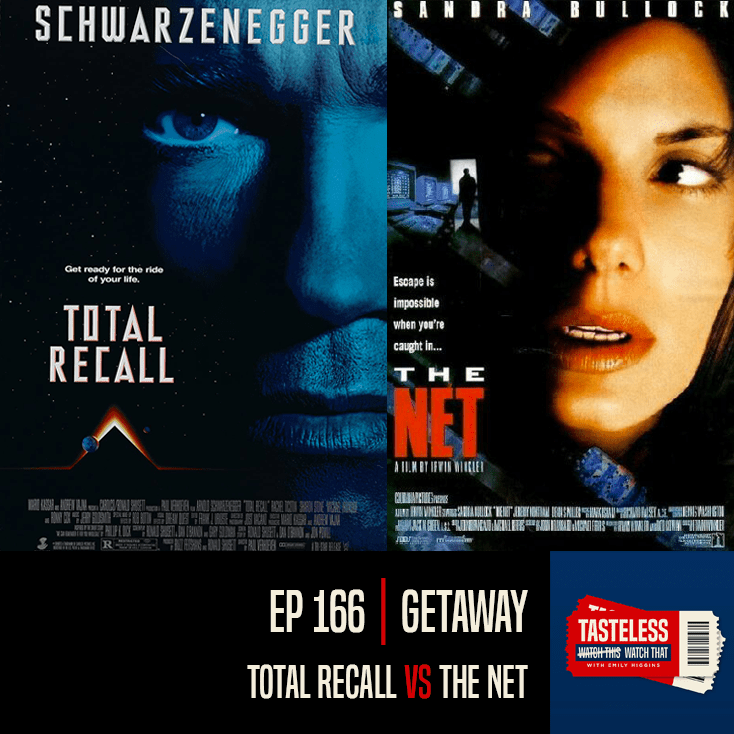
Getaway: Total Recall vs The Net

Total Recall vs The Net

Two people decide to take a little vacation that kicks off a fight for their lives as their identities are called into question — it’s Total Recall vs The Net.

Read The Episode

Every episode of Tasteless, I take a critically acclaimed film and compare it to one that shares the same themes but didn't get the attention it deserves — and explain why that second movie is my pick. This week: two people who decide to take a little vacation, but that vacation kicks off a fight for their lives as their identities are called into question. It's Total Recall versus The Net.

Total Recall

When a man goes in to have virtual vacation memories of the planet Mars implanted in his mind, an unexpected and harrowing series of events forces him to go to the planet for real - or is he?

This movie came out in 1990, has an 82% on Rotten Tomatoes, won the Oscar for Visual Effects. It was also nominated for Best Sound and Best Sound Effects Editing. Total Recall is based on the Philip K. Dick short story "We Can Remember It for You Wholesale."

This movie is cool. The plot is cool. It's interesting. I personally would not go to Mars if given the chance. I would say no thank you. And if they said, do you want some free memories of Mars? I would say no, I'm good. But Arnold Schwarzenegger goes on this virtual vacation — they implant memories so you feel like you've gone somewhere, indistinguishable from real vacation memories. And while he's under having these memories implanted, he starts flipping out. The vacation people at Rekall are like, his brain is already very full of false memories we didn't put there. Someone else put these in. It turns out he's not who he thought he was. His memories, his mind — they've been tampered with.

Paul Verhoeven directed this film and I have a real love-hate relationship with Paul. I love his films — Total Recall, Basic Instinct, Showgirls, Starship Troopers. He has a really interesting point of view and he picks stars like Sharon Stone that are just so perfect. But I'm always brought back to the Basic Instinct controversy with the leg-uncrossing scene and that he lied to Sharon about what could actually be seen on the film. That is such an uncool move. Even though he's made movies I love, that doesn't excuse cruddy creep behavior.

This movie did lead to Sharon Stone being in Basic Instinct because she played Lori in this, worked with Paul. He saw her being able to change from this timid, charming sweetheart — Arnold's wife Lori — to a diabolical person and back again at a moment's notice. That is what's so brilliant about her.

But we have to talk about Arnold. Arnold Schwarzenegger in this movie is named Doug Quaid. That's insane. Imagine Arnold Schwarzenegger in a t-shirt, guns out, arms out, tight t-shirt, short sleeves, just like: hi, I'm Doug. I'm Doug. My name is Doug.

I can't get a good read on Arnold. I think he might be a really wonderful guy, other than the cheating. But he's a little old school in the way he talks about people, especially women. If there was a Mount Rushmore of action stars, Arnold Schwarzenegger would be on it. He was the original Dwayne “the Rock” Johnson. Where is the Schwarzenegger tequila? I would buy that.

I went on Wikipedia to see if he owns any alcohol brands and no, he has various investments. Had a restaurant that I'm devastated I did not visit. Wrote an autobiography and called it “Total Recall,” which is genius. But the best part of his Wikipedia is that there is an entire section dedicated to a battle over what height Arnold Schwarzenegger is. It says his official height of 6’2” has been brought into question by several articles. In his bodybuilding days he was measured at 6’1.5”. In 1988 both the Daily Mail and Time Out mentioned he appeared noticeably shorter. Prior to running for governor, his height was questioned in the Chicago Reader. As governor, he engaged in a lighthearted exchange with assemblyman Herb Wesson over their heights. Wesson made an unsuccessful attempt to settle this once and for all with a tailor's tape measure. Schwarzenegger retaliated by placing a pillow stitched with the words "need a lift" on the five-foot-five-inch Wesson's chair. In 1999, Men's Health stated his height was five foot ten. And that's the end of the section. I don't know where we fall. Next person that sees Arnold Schwarzenegger, let me know how tall he is.

Arnold is great at what he is great at. And luckily Paul Verhoeven knew that. There was a falling out between writer Dan O'Bannon and Verhoeven when Verhoeven replaced the satirical humor with extreme violence. In the original screenplay, dark humor was much more prevalent. But when Arnold came aboard, Verhoeven recognized the necessity to tailor the script to Schwarzenegger's talents. This is not a knock on Arnold at all. He is great at certain things. You're not going to also give him dark humor. He does incredulous, he does angry, he does surprise. That's what he does and he does it well.

Now someone who can do everything is of course Sharon Stone as Lori — a breakout role that led to Basic Instinct. She plays Arnold's wife Lori, who as it turns out was never his wife and is actually just an agent there to keep an eye on him after his memories were replaced. Arnold believes they've been married for eight years. When he realizes she isn't who she says she is, she's like, yeah, okay, I'm not your wife, but do you want to bone for old time's sake? And he's like, oh, good try, clever girl — because obviously she was just stalling so the bad guys could come get him.

Sharon Stone can take all my memories if she wants to and live in my house with me. Go for it. I don't care. I would love a remake of this movie from Lori's point of view, where she has to go live with this guy undercover — this weird giant man who thinks he's a construction worker. And you're just keeping an eye on him and acting like everything's normal. There's something very creepy Truman Show fascinating about it that I love.

The tennis outfit she wears with the swoop bangs rivals Michelle Pfeiffer in Grease 2 for level of cool outfit that I desperately want to pull off. I was really mad that when she's shooting at Arnold and he doesn't know yet that she's against him, she misses him so many times. I was offended that they would make Sharon Stone such a bad shot.

I'm currently reading her new memoir, “The Beauty of Living Twice.” I'm trying to space it out and savor it and not just finish it all in one weekend, because this is a woman who has lived and she is so smart and interesting and funny. In her memoir, Sharon talks about the work she put into being believable as someone who could beat up Arnold Schwarzenegger. And it paid off. She physically fights him. She kicks him in his head — whether he's five-ten or six-two, that is insane. And I buy it fully. You buy her physicality. She was pumping iron. She put so much prep into this movie and it works. You see their fight and you don't think he could just flick her away like a fly. No — there is weight to her actions.

The big bad guy is Cohaagen, played by Ronnie Cox of RoboCop and Beverly Hills Cop. He's best friends with the Schwarzenegger from the past, Hauser. Hauser was an agent who worked for him, and Hauser came up with the plan to have his own memories wiped, have himself replaced with this mild-mannered construction worker Douglas Quaid, to enact their evil plans.

Cohaagen has an employee named Richter, played by Michael Ironside — and Sharon Stone is his girlfriend. He's so mad that Arnold is fake-married to her. He has such a vendetta. His boss is like, stop, I don't want Arnold Schwarzenegger dead. And Michael Ironside is basically just constantly saying, are you sure? Because I could kill him any moment if you want.

Michael Ironside did a Reddit AMA and said one of his favorite memories of Arnold at the studios in Mexico City was that while shooting, his sister back in Canada had a cancerous growth in her abdomen. She was in intensive care. He'd been calling her on a daily basis. Arnold noticed him calling every day at lunch. He said, who is it you're calling? And Michael told him about his sister. Arnold said, come on, let's go to my trailer. He had one of those conference phones set up and called Michael's sister and they talked for an hour. Arnold went through a whole diet thing with her, told her the healthiest diet for surgery recovery. He called her two or three more times to check on her. Michael said Arnold changed the course of his sister's recovery. She seemed lighter, had more sense of humor, felt less isolated. And she recovered. Isn't that so sweet?

We also have Benny — Mel Johnson Jr. — this lovable taxi driver who drives Arnold around on Mars. Then we discover he's a mutant and his arm is foldable and also bones. I felt so betrayed. Rachel Ticotin plays Melina, Arnold's ex-partner and girlfriend who has been wiped from his memory, but he has these dreams about her as Doug. In real life, Rachel was in Con Air. More importantly, most importantly, she was Carmen's mom in The Sisterhood of the Traveling Pants. The power of Melina is that you see her and you're just like, of course, she's the perfect match for Arnold. They work so well together. I love their chemistry.

But Arnold is very rude to her because when he reunites with her and doesn't have his memories, he says, Melina, Melina, I don't remember you. I don't remember us. I don't even remember me. Start with the last one, buddy. Don't start with "I don't remember you" because she doesn't know you've had your memories wiped. She just thinks you're mean. Start with like, hey, my memory has been wiped, I'm so sorry.

But the cool thing about Rachel and Lori is they have this fight scene. I wrote the following note verbatim while watching: Women fighting women with skill. This is not a cat fight. This is two people with abilities grappling. In the IMDB trivia, it says Paul Verhoeven asked second unit director Vic Armstrong to choreograph the fight not as a cat fight but more like a martial arts fight, to give the feel of two warriors fighting each other and not simply two women. Verhoeven remarks in the DVD commentary that this is probably the first time in a feature film where we see two women fighting each other normally. This fight scene is fantastic.

Spoilers — this movie is from 1990, it's older than me, not to brag. Arnold and Sharon are fighting, and Sharon has this great delivery. She's looking at Arnold: sweetheart, be reasonable. After all, we're married, as she's slowly reaching for the gun she thinks he doesn't know about. And then he shoots her in her forehead. She drops over dead and he goes, consider that a divorce. It's so cold-blooded. It's so rude.

The Net

When Angela Bennett, a computer programmer, stumbles upon government secrets, she finds herself on the run from an unknown enemy hell-bent on destroying her completely.

Came out in 1995, has a 40% on Rotten Tomatoes. Offensive. Rotten Tomatoes has done Sandy B so dirty. It's rude. It's unacceptable.

I own The Net on DVD. I popped it in. There's a great DVD menu recreating her computer. God, it's so fun to pop in a movie and it has a clever menu or a cute montage or a great song over the DVD menu. We lose that with streaming services.

Sandra Bullock — very clearly an all-time favorite actress of mine. I love her movies. Yes, I love The Net. Rewatching it, I bumped it up a few slots on my ranked list of Sandra Bullock movies, because this is a good one. I love a dumb computer movie, even if all the computer stuff could be totally wrong. Who cares? Stop asking questions. It's computers and they do things. What does it matter to you? Are you the computer police? No. I didn't think so. So shut up. That's not how a virus works. I'm sorry, I didn't know you were Steve Wozniak.

One Mr. Roger Ebert in his review of The Net said: this stuff is so concocted. I had no business caring about it, but I did because of Bullock. How does she do that? She's very low key. She's so natural. She seems to be remembering a scene rather than playing it. She has a warm smile. She never overacts. She creates a sensation that although a scene may seem absurd to us, it seems perfectly real to her and we buy it. I think me and Roger would have had a good time. We could have hung out.

So she is a computer person. We see her at a computer, wearing flannel, ordering an online pizza, talking to some guy named CyberBob. It's my dream life. She is a homebody to the extreme. She fixes computer viruses — well, she isolates them and figures out what's wrong. At one point in this movie she has poofed bangs to rival While You Were Sleeping. And she's just so good.

She goes on vacation to Mexico and can't help but bring her laptop and her work with her, including this virus she's been working on, this floppy disk. While there she is attacked. Her things are stolen, thrown on the ground. Her identity is taken. She has no ID, no wallet. Her social security number is associated with a woman named Ruth Marx who has her exact picture. She is given the identity of Ruth Marx against her will. She's at the embassy trying to figure out how to get back home from Mexico, and the woman working there is just screaming her social security number out to her, which is so inappropriate.

To get back into America she has to agree that she's Ruth Marx and not Angela Bennett. Angela Bennett is now on the run. She goes back home, goes to her apartment — all her stuff has been sold. They're like, yeah, Angela Bennett sold this place, she moved out a week ago. And Sandra Bullock's like, what are you talking about? I'm Angela Bennett. And everyone's like, well, no one can vouch for you because you're always in here ordering online pizzas, so none of us know what you look like. You could be a crazy lady.

So much of this movie is Sandra Bullock running up to a computer, doing something on it, then running away. It's perfect. It's fantastic. She runs somewhere, whoever she runs with dies. She runs off again, puts a floppy disk into a thing. It is fantastic.

Here's how it happens to her. She's on the beach and a nice good-looking man starts talking to her — Jack Devlin, played by Jeremy Northam from Gosford Park, Emma, The Crown, being British. He's a real jerk who works for the Praetorians, the entities in charge of the Gatekeeper conspiracy. Basically, cyber terrorists enacted attacks on various facets of infrastructure and government and then sold the people who got attacked protective software called the Gatekeeper program. The secretary of defense is like, no, we shouldn't use this weird software. So these bad guys give him a fake HIV diagnosis via computer hacking and he's very homophobic and kills himself. Then they're like, okay, so do you guys want to buy our Gatekeeper program?

Sandra uncovers this by mistake. She's been sent a floppy disk from a friend who's like, check out this weird virus. It's a backdoor into what the Praetorians are doing. And they trick her in the meanest way. She's in her little chat room eating her pizza. CyberBob is like, so what do you want in a man? And Sandy says, butch, beautiful, brilliant. Captain America meets Albert Schweitzer. And CyberBob says, settle for a guy who puts the seat down.

Jack Devlin pretends to be all those things. And he is so cruel — he turns those words on her when she realizes something's wrong. She's like, why do you have a gun on this boat? It's very weird. And he's like, oh, I use it for shooting sharks. And she's like, why do you have a silencer on it, you freak? And he's like, oh, you — I got you. You wanted someone butch, beautiful, brilliant, Captain America meets Albert Schweitzer, dummy. And she's like, oh my God, you're so mean.

Dennis Miller is Sandra's ex-boyfriend who she turns to when trying to regain her identity. Dennis Miller was in a very weird array of movies. This and Disclosure are such a one-two punch of my favorite things that don't need Dennis Miller in them. He is not one of her better movie companions. The honors for best of course go to Keanu and Hugh Grant, or even Benjamin Bratt joining the two-time Sandra Bullock co-star club alongside Keanu — Speed and The Lake House — with Miss Congeniality and Demolition Man.

Should I just do a separate podcast about Sandra Bullock's co-stars?

Dennis Miller is clearly still very indecisive. She just needs someone who knows who she is so she doesn't go fully crazy. And he's like, yeah, yeah, yeah, let's get into the vodka in the mini fridge at this hotel, huh? She's like, I am kind of on the run, I don't know if that's a great idea.

Her mother is played by Diane Baker, aka Senator Ruth Martin from The Silence of the Lambs. The relationship between Sandra Bullock and her mom who has Alzheimer's is such a core of this film and it's so heartbreaking. When no one knows who she is, when documents, computers, the government all say she is someone else, she calls her mother and it's like, it's Angela, Mom. And her mom doesn't know who that is. And she's like, I just need you to tell these people at the police station that I'm me. And her mom can't do it because her mom doesn't know who she is.

It is so upsetting. I cried a lot while I watched this. I cried like I was watching an episode of This Is Us, the government-created television show meant to suck the tears from our bodies.

Her mother doesn't know her. Sandra is going through it and she needs to keep her mom safe and she needs to keep herself safe. And that's hard to do when her mom doesn't even know what's going on. The Net is something you just have to watch because it unfolds. It's fun action, it's thriller-y, it's cool. She's funny. She's charming. There is some real heart to it.

Shared Themes

Both movies share the distinction of being non-Jurassic Park films where someone says "clever girl." More importantly in Total Recall and The Net, our heroes book a little holiday getaway to escape their humdrum lives, to relax. But in a turn of events, each discovers they have had a new identity created for them against their will, and they must make the best of it.

In Total Recall, Arnold finds out the life he thinks he has built was created only in his mind. His memories of an eight-year marriage to Sharon Stone, a boring life as a construction worker with giant, giant arms — these things are a lie. His beloved wife only came into his life six weeks ago and in fact is in love with a different man. Arnold discovers the dreams he has of a brunette woman on Mars may be the most real thing in his brain, pulled from his past life. When he meets that woman, Melina, he starts to realize what has been missing.

It's like if someone told me my cat Gracie was in my head and my life wasn't real — I don't know that I'd dive into a new life. I think I'd just go to sleep for a few days. Instead, Arnold follows the path laid out for him by his past self because he wants answers. He wants to see where this thing leads. Once he's in it, he's not going to take the easy way out. He wants to regain what he had — his relationship with Melina and some sort of control over his life and his choices.

Sandra Bullock has her identity brutally ripped away from her in The Net. On the internet, scrubbed from existence and replaced with a woman she doesn't know. We exist legally in computers, in the cloud. Imagine right now that you lost your driver's license, your passport, your credit cards. And when you go to the DMV to tell them your name, they say, no, that's not who you are. Here you are, here's a picture of you with a different name.

Think about how tough it is to prove who you are even when you do have all the pieces you need. Logging into your bank needs a password and a code sent to your phone. You better have access to both. To check your email, you need to get onto your computer or your phone with face ID. When the power goes out or a computer crashes, you're lost, bereft.

Sandra has no access to her past and no way to build a future. But she refuses to accept the life of Ruth Marx, the identity assigned to her when Angela Bennett is ripped away. She sets out to figure out what has happened and why, knowing it has something to do with the disk Devlin tried to take from her. The friend who sent the disk dies, by the way. I feel like sending someone a floppy disk in the mail is never going to turn out great. If I were to get a floppy disk in the mail, I'd know my days were numbered, like the Ring tape.

The core of these two films is finding out what you're capable of. Arnold discovers he is capable of goodness and Sandra of making tough decisions and of intrigue.

I love Douglas Quaid. I love the man Arnold becomes after having his mind wiped. They implant memories of this ordinary life with a cool wife, and past mean Arnold — Hauser — scoffs at Doug. Cohaagen is so mad to lose Hauser, his friend and confidant. Doug is an embarrassment to these men. But Arnold embraces being Doug. He likes who he is — that he's trusted by Melina, that he's helping the mutants. Doug cares about people. He cares about the greater good. He thinks air should be free. And although it turns out he was set up to go on the journey he did, even when he knows the truth, he still works to beat Cohaagen. He doesn't embrace the man he was before.

He's very cool with killing his ex-wife, but otherwise Doug is a kinder man. You see this version of Arnold that could have existed without the greed. Knowing that he has that capacity — he doesn't have to be who he was. He doesn't have to go back to being Cohaagen's lapdog. He makes the choice to be a good man and to work for others.

In The Net, Sandra has been a homebody. She's asked to meet up with people and she's like, nah, I have a standing Friday night arrangement — which we discover is ordering pizza online and joining a chat room with weird dudes. She brushes off going out into the real world with people. She's been incredibly stuck in her routines. The craziest thing she's decided to do is go on this vacation, and even then she brings her computer. She only lets Devlin hijack her plans after a lot of hesitation and him knowing exactly what to say.

Once she gets back home and realizes her home is no longer hers and nobody knows who Angela Bennett is, she focuses on regaining her life. She has always been a problem solver, but of other people's problems, in a way that is removed from herself. This time it affects her and it affects the rest of the world. She steps up in a way that the FBI couldn't. She's commended at the end of the day by the news for what she does.

She also has been in this weird spot with her mom where she doesn't know how to interact with her. You see that change over the course of this movie. You see how she becomes more confident with her mother, accepting what her mother knows and doesn't know, while also making herself part of her mother's life. Instead of sitting around feeling upset about what has happened to her mother, she realizes she needs to take advantage of any time they have left.

Arnold and Sandra both don't know who to trust, but they find companionship and help in the form of rediscovering a loved one.

Arnold had been dreaming about the brunette that we learn is Melina. When he sees her for the first time as Doug, he finally feels like things are falling into place. He doesn't remember her, but there's a connection. When she realizes he isn't out to get her, she's excited to see him. I can only imagine how maddening it must have been as Melina to have this history with Arnold that he doesn't remember. But it also means they can start fresh somewhat, without the lies and deceit that Arnold as Hauser was enacting. They're a team and treated as such. They finish the movie with a kiss, glad to be together in any reality, unconcerned with the truth of the situation so much as they are just happy to be reunited.

In tough times, Sandra calls up the one person she's been close to besides her mother — her ex-boyfriend Dennis Miller. While he doesn't necessarily believe or understand what's happening to her, he wants to be there for her. But more importantly, after what has clearly been a long experience with her mother's Alzheimer's, feeling abandoned by her, unable to connect with her, Sandra is imbued with a new vigor for their relationship and works to escape her predicament to reunite with her mom, who has been hidden in a sanitarium by the now-dead Dennis Miller.

It's her mother that keeps her going. Her mother is her tether to reality, to who she is and who she wants to be, even if her mother doesn't know that.

What The Net Does Better

Total Recall is an incredible sci-fi movie with innovative visual effects, fantastic action sequences, a cool plot. But there isn't humanity — not in the way The Net explores the true impact of finding out your life is disposable.

In Total Recall, Arnold is never really emotionally distressed. Imagine discovering your wife isn't your wife. You're not who you think you are. What a spiral that would send you into. But instead Arnold is just like, okay cool, well, I'm Doug, what's up? Even the shooting of Sharon is like — consider that a divorce. In your mind you were together eight years. That has no weight? He's not at all conflicted by her death.

I think the best sci-fi makes us consider humanity as much as it makes us marvel at what could be possible in our future or in an alternate world. It also makes us take a deeper look at ourselves. Doug could have really had a crisis over the fact that he used to be a man like Hauser — the man we see via computer screens wearing his face. But instead the two are painted as completely different people with no relation to one another. Arnold is angry with other Arnold instead of horrified that he has this capacity for evil within himself.

In The Net, the relationship Sandra tries to maintain with her mother is such an important and heartbreaking thread. Her only living relative, a mother she adores, doesn't know who she is. Sandra visits her bringing her favorite candy, playing the piano, and her mother has no concept of their relationship. Her mother looks her in the eye and sees a stranger. So it's all the more frightening when the rest of the world stops seeing her as well. Her mother can't even vouch for her, can't support her, can't tell the police that Sandra is her daughter.

To have this access to her mother, to be so close yet so far, because her mother doesn't understand the world in the same way — it really is upsetting. It gives weight to Sandra's quest to regain her identity. She was easily targeted to be wiped off the face of the earth because she had no other living family and existed in relative isolation. The Praetorians believed her to be disposable. To overcome that, to prove she matters to people, that her mother has a connection with her — it's incredibly important for Sandra's development and for herself.

When she's with her mother at the end, there's an easiness in their relationship that wasn't there before. Sandra has embraced that her mother may not know her exactly, but does know who she is in some sense — that she's someone who can be trusted, someone she wants to spend time with. They are planting flowers together at the end.

My big problem with these movies and sci-fi movies where things that couldn't happen happen: I don't pick a movie apart unless I hate it. I told you to ignore any computer inaccuracies in The Net and I stand by that. But man, does it make me frustrated when a movie's like, this shouldn't have worked, it was such a tenuous plan. That's what they do in Total Recall. Among all the craziness, instead of leaning into it, they have the characters question it while also brushing it under the rug.

In the world of The Net, we see Sandra as Angela Bennett doing her computer things and she's confident in them. So the viewer is confident as well. It's not called into question in the world we're existing in. She speaks with such confidence on the subject that I don't question it. I'm along for the ride. She's the expert. She clicks the little pie symbol in the corner. She knows — that's a nasty one. I buy it because the movie is trusting me to buy it. The movie's like, here, you're here for 90 minutes to enjoy this with us? Enjoy.

As opposed to Total Recall being like, we know all this was crazy, so our characters are going to say it was crazy. That makes me mad. It's a cop-out. If you go into The Net knowing what you're doing, you're going to have a great time.

Please watch The Net. I love Sandra Bullock. I love Total Recall. Watch both. Total Recall is on Netflix. The Net is rentable, very cheap.

Hit me up at @tastelesspod on social media. We can talk about Sandra Bullock on the beach with a little portable computer in 1995. We can talk about Sharon Stone as Lori and her tennis outfit that honestly everyone should be wearing now in modern day. And why Quato is such a gross little freak.

Pipe Dream: Call Me By Your Name vs James and the Giant Peach

Call Me By Your Name vs James and the Giant Peach

Two movies about sad boys with an affinity for peaches who find self-acceptance through a dreamlike adventure — it's Call Me By Your Name vs James and the Giant Peach.

Read The Episode

Every episode of Tasteless, I take a critically acclaimed film and compare it to one that shares the same themes but didn't get the attention it deserves — and explain why that second movie is my pick. This week: two movies about sad boys with an affinity for peaches who find self-acceptance through a dreamlike adventure. It's Call Me By Your Name versus James and the Giant Peach. This is not just because of the peach, okay? I swear to God it's not. But I was watching James and the Giant Peach and had a real lightbulb moment. This episode makes sense. I swear to God. Just let's get into it.

Call Me By Your Name

In the summer of 1983, 17-year-old Elio is spending the days with his family at their villa in Lombardy, Italy. He soon meets 24-year-old Oliver, an intern working for Elio's father. They discover the heady beauty of awakening desire.

Came out in 2017, has a 94% on Rotten Tomatoes. It won the Oscar for Best Adapted Screenplay for James Ivory. It was nominated for Best Lead Actor for Timothée Chalamet, Best Motion Picture, and Best Original Song for Sufjan Stevens.

I am coming at this movie in the year 2021 as not a gay man, not a man, and it is a post-Armie-Hammer-is-a-cannibal world. So you can take this review with a grain of salt. I watched it for the first time and I think it really suffered from the non-movie-theater experience. If I had watched this in a theater in the dark with a big Coke and some buttered popcorn, I would have been more easily sucked into the fantasy than watching it at home at 8 a.m. with my neighbors making as much noise as possible.

I understand completely how this movie could mean something to someone, how you could see yourself in it. But I'm going to approach it from my angle of not liking a single person in this movie.

Timothée — actually, Timotay is how you're supposed to say it — is a teen who is with his parents at their really gorgeous house for the summer. Because this is set in the 80s, it seems totally normal to everyone that they just give Timothée's room to Armie. So Elio — let's call him Elio — gets shuffled off into this weird side room through the bathroom. He has to come out of the bathroom to leave the room. That sucks. Imagine if every single summer your parents were like, go sleep in the closet, I'm giving some other dude your room. Why don't they put him in the closet room? I mean, he is ten times the size of Elio, so maybe that's why he couldn't fit. But I would be so mad.

Immediately Elio is rubbed the wrong way by this hunky American. Every time Oliver is leaving, he's like, later. Elio is like, don't you think he's impolite when he says later? Don't you think he's arrogant? And everyone's like, Elio, who cares? He's not trying to be rude. That's just how he says goodbye. It's fine. Why are you so mad about it? You should be much more mad that your weird dad invites someone to sleep in your room every single year.

There are so many bugs in this movie. Mostly all over him. There's a scene where he's about to start touching himself and there's this fly on his crotch. When they're outside at one point, Oliver is laying in the grass and Elio is playing guitar and bugs are everywhere.

When Oliver first gets there, he's tired, he's traveled from America to Italy, he conks out. Some bell rings and Elio is like, that's the bell. The bell means it's time for dinner. Oliver doesn't wake up. So he goes in and takes a book and slams it onto the ground. The bell! It's time for dinner! Oliver's like, hey, I'm going to keep sleeping. Could you make an excuse for me, buddy? Thanks. I'm a grown man. I'll eat dinner. Leave me alone.

I was really disgusted by Elio telling his dad he almost had sex with a girl. He's like, yeah, I almost had sex with this girl the other night, Dad. All I had to do was find the courage to reach out and touch and she would have said yes. And his dad's like, ooh. And Oliver's like, then why didn't you? Why are you telling this story? I hate him. I hate Elio. I get he's a kid. I get it. Teen boys have a lot of things to deal with. I did not like him. Timothée Chalamet, perfectly talented. This is not his fault. I wanted to punch Elio in the face.

Armie Hammer as Oliver — he talks like an alien trying to be a human. All his words are very purposeful. I think that's why he was so great in The Man from U.N.C.L.E., because he was playing a Russian agent so he had to be very specific with his words. He gets to this town and he's like, hey guys, I'm here. Is there a bank in town? I'd love to start an account while I'm here. The professor's like, ooh, none of my students have ever wanted to start a bank account while here. Why would you start a new bank account in this town?

Armie straight up eats a raw egg. He keeps eating eggs that I guess are supposed to be poached or cooked or something. They just look raw. He's shoveling down raw eggs. And he drinks his juice so fast. I don't know if it's supposed to be attractive. And then they talk about apricot juice for a really long time and the professor is giving the most boring lecture and Armie goes, actually, I'm sorry, but I need to talk about the etymology of apricots because actually it's from this and not what you're saying. And then the whole family is like, ha ha, you passed the apricot test. I was like, God, I hate these people so much. This is the worst family I've ever seen.

Armie, in real life, has been accused by multiple women of lewd messages and inappropriate acts. He's been taken off every project he was involved in. And it's unfortunate because this was a mainstream movie about two men in love — and how often do we get that? Very rarely, especially to have it win the awards it did, get the consideration it did. So it sucks. It sucks that Armie Hammer was creeping around.

I was not not into it when he was doing his dance in shorts and sneakers and very long socks. He's said in interviews the most uncomfortable he felt during filming wasn't the sex scenes but the dance scenes. That's because only someone with a chiseled face like that and a head of hair like that can dance so goofy.

A trivia fact that really delighted me: during the party scene where the Psychedelic Furs' "Love My Way" begins, the opening lyrics are there's an army on the dance floor — and there is literally an Armie on the dance floor. I will never get over someone naming their kid Armie Hammer, who's an heir to the Arm & Hammer fortune. It's sick. It's like if my name was In-N-Out and my parents created In-N-Out. That's not right.

Regarding the peach scene — obviously we have to talk about the peach because it is technically what made me think about this film. Director Luca Guadagnino went to Timothée Chalamet and told him that he had tried masturbating with a peach himself and found it was indeed possible. Therefore he thought they should do the scene. Chalamet responded that he had also tried it and agreed. Very American Pie vibes.

Also, whenever he's eating a peach shirtless in his bed, he throws his peach pits just onto the ground in the corner of this room. The same gross dusty room where he brought that girl to have sex with her on the dirtiest mattress of all time, this poor girl. And then later he's in that room just flinging peach pits into the corner. This kid's an animal.

Elio's final conversation with his father shows how things have changed. His father for the first time connects with Elio as a fellow human instead of his child. He talks to him about love, about how he had something special with Oliver and how Elio must realize how rare that is. And then weirdly is like, I almost had that, but I didn't. Do you not like Mom? Apparently in the next book they get divorced. So I guess he doesn't like Mom. But maybe don't tell your kid you have never felt love before.

James And The Giant Peach

An orphan who lives with his two cruel aunts befriends anthropomorphic bugs who live inside a giant peach, and they embark on a journey to New York City.

This movie came out in 1996, has a 91% on Rotten Tomatoes. It was nominated for an Oscar for Best Music, Original Musical or Comedy Score for Randy Newman — lost to Emma by Rachel Portman. I don't remember Emma having a song that explains its plot, so I'm not sure how that happened.

This will be my third Roald Dahl book-to-movie adaptation that I'm vouching for on this podcast. I hadn't actually realized how much I loved his body of work until this. Combine it with producer Tim Burton, the darker side of Disney — the director Henry Selick also directed The Nightmare Before Christmas and Coraline. I found this movie most similar to Coraline in terms of its darkness and unique visuals. It's a really creative movie. It's a PG movie that is frightening, that has intense scenes, that has a moral. It is just stellar.

Paul Terry plays James and this is the only film he ever acted in. We first meet James with his parents — he's a little kid, they're hanging out on the beach, looking at clouds, talking about this trip they're going to take to the Empire State Building. They're in England but they're going to go to New York. Then tragedy strikes: his parents are eaten by an escaped rhinoceros from the zoo. You know how that can happen.

He is sent to live with his two aunts, Aunt Spiker and Aunt Sponge, who are super mean, basically have him working all the time, wake him up early to do chores. They are played by Joanna Lumley and Miriam Margolyes. Joanna Lumley as Aunt Spiker is an all-time scary villain. There is a scene where she has this wet mascara running that haunts me. Rewatching it brought back such strong scared emotions from childhood. This further confirms my thesis that funny people can be the absolute scariest, because this character is miles away from Ab Fab and yet has a similar edge to it.

Aunt Sponge is played by Miriam Margolyes. She also voices the Glowworm. She has been in every British thing ever.

These two aunts have him working all the time. Then a strange man, played by Pete Postlethwaite — who you know from being tall and in everything — is like, hey buddy, I got these magical crocodile tongues, here you go. James takes them and drops them all over the ground next to his aunts' old peach tree that hasn't grown anything in years. And of course a magical gigantic peach grows. His mean aunts use it to make money — as you would, you charge people to see the giant peach. If I found a real big fruit, I would get out my calculator and a little lockbox for the change.

James winds up going inside the giant peach in secret, transforms into a stop-motion boy, meets some magical human-sized bugs, and they go on an adventure. Very normal stuff.

But here is the thing. In this film, a little boy sings a song and yet I still love it. A little boy messily eats a peach, chomping away, and yet I still love it. He says "whino" instead of "rhino." The scary whino ate my parents. Yet I still love this movie. It overcomes these things. There is something so eye-catching, something so memorable — such beautiful moments, stunning visuals, haunting villains.

Rewatching it brought back so many memories. As things were happening, I had such strong déjà vu of — oh my God, I watched this a million times. I knew what was going to happen despite not seeing it for decades.

I'm pretty sure the spider in this movie is why I like spiders. There's this big bulbous black spider that James sees when he's still a flesh-and-blood person. When he goes inside the peach, he meets her and her name is Miss Spider and she is French and she is played by Susan Sarandon. Of course she's French, why not? The Times of London reported that James and the Giant Peach was once banned in a Wisconsin town because a reference to Spider licking her lips could potentially be taken in two ways, including sexual. They were like, this spider is too sexy. Which is what you get when you get a French Susan Sarandon spider. Sorry, you knew what you were doing.

Richard Dreyfuss is Mr. Centipede. He has a newsboy hat. He is the worst of the bugs. He's like, I can navigate this peach — because guess what? The peach is flying. It's flying across the world. He's like, I got this, I'll point the peach in the right direction. Then he falls asleep and they get lost in some scary ice world and have to go underwater to get a compass and rescue the centipede. Do your job, Mr. Centipede. You had enough time to put on that hat. Get it together.

Jane Leeves is the Ladybug and I love her. She of course, Daphne from Frasier, star of Hot in Cleveland. I want this ladybug to adopt me so bad. She's the nice one, the little old ladybug that's just like, let me just hold on, I'm coming along with you guys.

David Thewlis is the Earthworm — he has little sunglasses on his little face and they move because it's this incredible stop motion. You see him make little facial expressions and his little sunglasses make faces. You know, he's Remus Lupin in Harry Potter. I know him from Basic Instinct 2. Simon Callow is Mr. Grasshopper. He plays grasshopper songs.

Sometimes I can break down the plot, but sometimes you just have to see it because it's all a feeling. You have to watch it. I love the stop motion — it's something that is never not impressive. And then there's this scene with a sort of 2D paper effect that's really cool.

I'm sure it's on Disney+. It is. None of you have any excuses. All of you have access to someone's Disney Plus account. If you haven't seen it or if you haven't seen it in a while, watch James and the Giant Peach. I think you're going to be surprised by how many little elements have stuck with you.

Shared Themes

Elio and James are young. They're treated as children, treated as disposable — or if not disposable, at least pliable. Like their thoughts don't matter. Like what they want doesn't matter. Elio's room is taken from him each year for the visiting grad student. He's shuffled off into that weird side room. James is ignored by his aunts, other than getting labor out of him. But in these films, their lives are changed because each boy is treated like he matters, like what he wants has consequence.

Each year, as a new student comes and hangs out with his dad, Elio wanders his family's gorgeous compound, making eyes at one girl while another makes eyes at him. His parents force him to wear a shirt he doesn't want to, ask him to play piano for their guests like a trained monkey. Normal things, but when you're a kid, it feels so much bigger — like they're exerting control just because they can. He doesn't feel like he's in charge of his space or himself.

When he meets Oliver, he's immediately struck by him. Oliver is so self-possessed. He's not worried about what people think when he says "later" instead of goodbye. No one's going to chide him. He is a grown man. Elio is jealous of this, calling out the behavior, trying to turn his family against a person he believes to be arrogant. But his tune changes when Oliver starts to pay attention to him. He writes in his diary that he hadn't liked Oliver because he thought Oliver didn't like him, that he had the wrong impression. Oliver sees him, talks to him, asks his opinion, tells him about his paper, massages his tight shoulders. Okay, that last one is where things change a little bit.

Elio is trusted with his own choices with Oliver. Oliver basically says, hey, if this is what you want, meet me at midnight. If not, no hard feelings. And when Elio says, this is what I want, I'm an adult, I can handle this, Oliver takes him at his word. That takes away a little bit of the tragedy for me. It's of course sad at the end when he's crying over his first big love. But he was given this gift in having someone who truly saw him, and it ended on good terms.

Elio's final conversation with his father shows how things have changed. His father for the first time connects with Elio as a fellow human instead of his child. He gives weight to what Elio felt. He's not like, it was a fling, whatever. He really does treat it as serious. He validates it. We see the parents decide to let Elio have alone time on the phone with Oliver, getting off their receiver and giving each other knowing looks after Oliver shares the news he is engaged. They let Elio make his own mistakes and give him time to grieve. There's a respect there. A shift into Elio feeling like an adult.

In James and the Giant Peach, after James' parents die, he is sent to live with his hateful aunts. They see him as a nuisance. A stupid child not worthy of their time or energy. He's never spoken to about his feelings, simply told to shut up, put to work. His opinion isn't wanted, his feelings don't matter. Then he journeys away with the bugs that reside in the peach, and they treat him as a full-fledged person. They look to him for answers. He helps decide the course of their travel and solves problems like when the scary metal shark is coming after them.

He's always been shoved aside by his evil caretakers, but with the support of his new friends, he overcomes that. At the end of the film, when the aunts come to take him away, he confronts them. He stands up for himself. He says, I matter. This dream he has of going to the Empire State Building — this fantasy, this one thing he's holding onto — it happens. He gets there. He tells the aunts, I made it. I'm not nothing. You are.

The bugs told him he mattered. They asked his opinion. They trusted his judgment. When he decided to go with the spider into the icy ocean to save Mr. Centipede, they're like, do you really want to do that? It's super dangerous. But when he says, yeah, I'm not leaving anyone behind, they respect that. They want to hear from him in a way he hasn't experienced since his parents died.

Call Me By Your Name and James and the Giant Peach are both fantasies. They have a dreamy quality, and much like dreams, the events of the films allow our main characters to work through how they feel. What you believe is as important as what is real.

Call Me By Your Name has such an ambiance — a feeling of summer, of longing, a reverie of eating directly from a tree, paddling around in a river, having no obligations, and the sole attention of a hunky dude. It's in this space that Elio gets to explore himself. He doesn't have school, he just whiles away the days figuring out what he likes, who he likes, who he is. He's in this isolated capsule away from the real world so he can express things more freely and see where his complicated emotions surrounding Oliver lead.

Oliver is charming with everyone, has an easy way about himself. At first Elio isn't sure if he wants to be Oliver or be with him. Although Oliver claims he made his intentions clear with the shoulder massage, it is Elio who first admits his feelings — super vaguely, but he tells him something's going on. The whole "call me by your name" aspect — to call each other by their own names, to say their own names reverently with love and experience life as the other even for a moment — shows Elio a different side of himself, a side he loves. It shows him he matters.

Oliver leaving is heartbreaking but doesn't take away from how important this time was. Elio never really wanted to be with that girl he was sleeping with — he kept blowing her off and neither was quite sure why. When he falls into this affair with Oliver, he has sex with her to gain some sort of control. And when things end with Oliver, she's understanding because she realizes he didn't know himself well enough to know he would hurt her. This was something brewing for a long time. His inability to get close to these women — to finally have an answer to why that might be is a relief for him as much as it is for her. He had to be isolated to this special, strange space where anything could happen for him to work through how he actually feels.

James and the Giant Peach presents fantasy as reality, showing a giant peach and floating bugs in New York City surrounded by human children at the end. But whether it happened isn't what's important. James, when no one believes him, says to everyone for the world to hear: I flew the giant peach across the ocean. He believes in the adventure he has had and it empowers him. He no longer cowers at the sight of his aunts, though they have never looked scarier. He speaks up to them.

There's really such a feeling to this movie. The crackling of the paper when James lights his paper lantern. The texture of the peach chunks when they're singing their Eat the Peach song. It puts you into the mindset of anything being possible and allows you to be taken away by the magic of it all.

Whether it happened or not, not important. It only matters that James has had this meaningful, life-changing experience. He speaks his mind, he stands up for his friends, he immediately is letting all the little street kids eat off his dirty peach. I mean, maybe these kids have homes. I would not bite into that peach that has just rolled its way down a building onto the concrete. To each their own. He has lived this fantastical life and it shows him what's important — sharing, kindness.

There's also an undercurrent of darkness to both films. Something just out of reach because you know things will go wrong. Elio and Oliver can't be together forever. You worry about someone finding out. They're in a little bubble. Same for James — he's floating around up there, it's fun and there's dancing and peach eating, but he's going to have to come back to earth at some point. And that eventuality looms. But by the end, our characters realize real life isn't so bad.

What James And The Giant Peach Does Better

Both films take place in dreamlike locales where the unexpected can happen. But there is a hollowness that Call Me By Your Name possesses, while James and the Giant Peach is much more fantastical but has an emotional core that has kept me thinking about it for decades.

There's a crackle of something — of perhaps longing, if not quite chemistry — in Call Me By Your Name. Whenever Elio and Armie aren't talking but simply sharing knowing glances, you feel it. But then they talk and it's like, is this what we were waiting for? The way they talk to each other is so stilted and weird. There's this whole exchange when Elio is playing something on the guitar — I'll show it to you on the piano. Did you change it? I changed it a little bit. Why? I just played it the way Liszt would have played it if he'd altered Bach's version. Play that again. Play what again? The thing you played outside. Oh, you want me to play the thing I played outside? Please.

It's all so weird and aggressive. Just play the song, man. Why you gotta be so difficult? This Who's on First forced teasing — it's like false intimacy. They're trying to make us think there's a connection when there really isn't one. What on earth does Oliver see in Elio? I don't buy it. The parents are too chill with it. The girlfriend too calm. It all feels like things fall into place in a way that — I don't need realism, but something about this rings false.

I love the longing Elio has for their relationship, but the moments when they are actually together, there's a lack of emotion. I think Elio really could have gained many of the same lessons from experiencing that longing and intrigue without ever becoming physical with Oliver, because it's really Oliver's approval that makes such a big difference. Oliver admitting he likes to spend time with Elio, that he was looking at him when they were playing volleyball — that's what is important.

But the casualness with which Oliver has sex with his professor's underage kid and then is like, okay, well, this was fun, gonna go get married — there just isn't a real connection. I don't feel the humanity. It's very manic pixie dream girl — he flits in, is like, I like you too, bye bye.

In James and the Giant Peach, James is hanging out with talking bugs — obviously insane — but Spider, whom he saved before he knew she could talk, looks out for him in such a kind way despite her slightly hardened edges. The bugs coddle him just as much as they turn to him for his thoughts. There's a give and take, a push and pull. We see who James truly is — going out of his way to save the centipede even though the centipede screwed them all over. He's a good kid and he wants to help people, and the bugs sense that about him.

When they first meet, Spider vouches for him — look, he put his neck out there with Aunt Spiker in coming to my aid. There's a connection here that is real, that is true. They all eat their little peach lumps together, they sing a song, and I feel like I'm at home. I feel part of things as the viewer. I feel the memories James has of his parents and how the new ones he's making with these bugs help alleviate some of his sadness.

Something about this fantasy allows the viewer to fully connect, to really get into the mindset and feel what James is experiencing — having people who love him again, how important that is. Mr. Centipede is probably the closest to Oliver in this film — he's just like, whatever, I'll navigate, I got a cool little hat and 40 hands, what's up? He's a jerk, he messes up, but he has remorse. He tries to fix it. There's never that moment with Oliver. Oliver is such a hollow, false, Greek-god-of-a-man with no actual substance. There's no vulnerability.

There's a very sweet scene where the Earthworm is stressed about what just happened when they were trying to escape the metal shark. James says, when I had a problem, my mom and dad would tell me to look at it another way. Earthworm says, how? First I was bird bait, then I was shark bait. James says, I suppose. But you could say you gave us wings to fly and defeated a giant shark single-handedly. Earthworm says, no-handedly. James says, you're a hero. Earthworm says, I am? I'm a wonder worm. James replies, you are.

I get more humanity out of a centipede than I do out of Oliver. And that's too bad. Although I still would be so attracted to Oliver in real life.

Being older doesn't mean you know more. Doesn't mean you know better. Growth is possible for people at any age. And yet Oliver seems unchanged by his relationship with Elio, whereas James and his anthropomorphic bug friends learn from one another. Equally.

In Call Me By Your Name, one of the most interesting elements was Elio's father coming to him as a man. When he talks to Elio about how rare that kind of love is, there's real emotion there. But I hated that Oliver truly seems unaffected. There's just no conflict for him. He had a fling with Elio and moves on completely, still the exact same guy. That's what makes the relationship strangest and brings me back to — why? What are you getting out of this?

Elio really lets himself be free. He's totally honest with Oliver in a way he isn't with other people. He's goofy instead of trying too hard to look cool. He realizes it's okay to open yourself up, even if it doesn't end how you hope. He grows.

In James and the Giant Peach, these bugs have been living their weird bug lives for ages. They've been in a rut. Then James plops into their home and suddenly they're on an adventure. Suddenly they're honest with each other. Centipede admits fault. They share about their pasts, their goals for the future. There's learning and growing. All of them gain new knowledge from their time together, new appreciation for the ways of the world.

Every relationship doesn't have to teach you something. But it certainly feels more equitable, more meaningful, to have our hero influencing the life of someone else the way James influences these bugs. These bugs that have been hiding, have been almost stepped on — they're now front and center and proud, ready to web up the mean aunts that people have been terrorizing when they were too small to fight back.

Give James and the Giant Peach a shot. It's very fun. It's like 80 minutes. It's short, it's cool, it's beautifully done. It's on Disney+.

And if I'm missing something in Call Me By Your Name, feel free to tell me. Hit me up at @tastelesspod on social media where we can talk about which bug was your favorite, or about Joanna Lumley as Aunt Spiker being one of the scariest villains of all time.

Jodi Lyn O'Keefe | Strong Female Leads

Jodi Lyn OKeefe Strong Female Leads

Jodi Lyn O'Keefe (She's All That, Prison Break, Hit the Floor) is a dream of a human being who lets me gush about my favorite roles of hers as I mathematically prove she has the best career — from being a comedy powerhouse to the perfect kind of villain — and she shares the romantic gesture to end all gestures, plus gives me even more reasons to adore Heretic Parfum. This show breaks down at points because I am laughing uncontrollably, what a joy!

Follow Jodi on Instagram | Follow Heretic Parfum on Instagram | Visit the Heretic site to fall as in love with their scents as I have

Heart's Desire: Black Swan vs Deadly Illusions

Black Swan vs Deadly Illusions

Two movies about a woman in a high pressure environment who is unsure of what is real and what is not, and must come to terms with her desires — it's Black Swan vs Deadly Illusions.

Read The Episode

Every episode of Tasteless, I take a critically acclaimed film and compare it to one that shares the same themes but didn't get the attention it deserves — and explain why that second movie is my pick. This week: two women in high-pressure environments who are unsure of what is real and what is not and must come to terms with their desires. It's Black Swan versus Deadly Illusions.

Black Swan

Nina is a talented but unstable ballerina on the verge of stardom. Pushed to the breaking point by her artistic director and a seductive rival, Nina's grip on reality slips, plunging her into a waking nightmare.

This movie came out in 2010, has an 85% on Rotten Tomatoes. Natalie Portman won the Oscar for Best Actress. The film was also nominated for Best Picture, Best Directing, Best Cinematography, and Best Film Editing.

These were the Oscars where everyone turned on Anne Hathaway as she tried to save the sinking ship that was getting anything useful out of James Franco. How dare we turn on her. The Social Network beat Black Swan for Film Editing. Are you kidding me? Inception got Cinematography — fine, whatever, because buildings are caving in, but Black Swan was better. Directing and Picture were given to The King's Speech, which I didn't see, but I bet it was about a turd. I will not be looking further into it. Please do not inform me.

Black Swan deserves all the awards and recognition for being a truly compelling look at a woman forced to both repress and expose herself in equal turn for the acceptance of those around her. Natalie Portman does an amazing job. I love this movie. I saw it in theaters, I think twice, and it's stuck with me. I am offended that it only has an 85% on Rotten Tomatoes.

Natalie trained for a year as a dancer to prepare for the role, paid for the training out of her own pocket until the film found investors. Darren Aronofsky attributed the film getting made at all to Portman's dedication and enthusiasm. I think you can tell when an actor has a true passion for a role, and that carries through here. Out of all the awards nominations the film received, Natalie Portman won every single Best Actress category — Oscars, Golden Globes, every single one she was nominated for, she won.

Her performance is one of the most incredible I've seen — the way she goes within herself, the vulnerability, the sadness. To contrast that with the woman who sang one of my favorite songs, the Natalie Rap. She has range. She's brilliant.

Natalie as Nina is desperate for the approval of Tomah — as she says, Tomah, spelled Thomas — played by Vincent Cassel. He heads up the ballet troupe and assigns the roles. While Natalie is a talented dancer, he believes she doesn't have the darkness or sensuality to play the Black Swan and therefore cannot play the multifaceted Swan Queen in their upcoming Swan Lake. She struggles to open herself up and be less regimented, and this isn't helped by Tomah's sexually aggressive nature. She has complicated feelings for him — a schoolgirl crush she refuses to acknowledge when pressed about it by Mila Kunis.

Mila Kunis is perfection in this film as well. There is an easiness to Mila as Lily that is something I absolutely covet. She was so perfect for this role. To get the viewer into the space Natalie inhabits — the envy, the interest. Mila is the kind of person where you just want to be in her orbit.

Although it is fully psycho when she goes into the bathroom Natalie is in, goes to pee, takes off her underwear and hands it to Natalie to hold. I would be distraught if that happened to me. But then when Mila goes to Natalie's house later to apologize — because she had really pushed Natalie's boundaries, talked to Tomah about her — I loved that. She recognizes that even though Natalie is really intense and not nice to her, she still hurt her and tries to make up for it.

She goes to her apartment, invites her out. Natalie takes her up on it. While they're out at a bar, Mila offers her drugs. And I too would take a strange pill for Mila Kunis. I think any one of us would. This is the only fun girls' night out Natalie has had maybe ever. So in her mind it becomes more than it is. She has the hallucination of going home and having sex with Mila Kunis.

Even the response when she finds out it was not real — she goes to Mila and is like, okay, last night can never happen again. And Mila's like, what happened last night? I went home with a dude. Oh my God, did you have a dream about me? And she's not even really mean about it. She's just kind of like, was I good? There's such an acceptance with her — she's not judgmental, she's just open. And it's this ease that Natalie can never achieve.

A lot of that is due to the way she was raised. Barbara Hershey plays Natalie's overbearing mom, and she's so frightening. Perhaps the scariest part of the film, besides the skin strip Natalie peels off her finger, which I still cannot look at no matter how many times I see the movie. There's a theory that the mother was possibly molesting her, and even if we don't take that as fact, the control her mother exerts is sickening. It's very Carrie — this perverted, twisted idea of love being used as a weapon to keep Natalie in line.

Although she wants her daughter to be a success, she encourages and allows for this odd regression. Constantly calling the receptionist at the theater to find out Natalie's whereabouts. And when Natalie gets the Swan Queen role, she says to her mom, he picked me, mommy, and it just makes my skin crawl. Then her mom gets this full sheet cake and Natalie's like, I'm trying to be ballerina-body, I can't eat a sheet cake. And Barbara Hershey goes to throw it away. And then it's like, no, I'm sorry, I didn't — I'm just so proud. It's this constant push of control.

This relationship is so stressful, so tense. Uncut Gems who? This is tension. You see why Natalie is living so much of her life internally and why her view of the world becomes distorted when this is how she was raised — to never feel safe, to always wonder when the other shoe was going to drop.

I was also thrilled to see Winona Ryder as a ballerina at the company who has passed the age where people want to see her perform. She's put out to pasture and accuses Natalie of sleeping with Tomah to take her job. Ksenia Solo, aka Kenzi from Lost Girl, appears as another ballerina. Sebastian Stan is one of the guys Natalie and Mila meet at the bar. I had totally forgotten that.

Here's one problem with this movie: Darren Aronofsky. I am not denying he's a genius in some of the ways we consider people geniuses. But a little piece of trivia from IMDB: Natalie Portman revealed that Aronofsky would subtly try to pit her and Mila Kunis against each other during filming, in an attempt to increase the on-screen tension. This included keeping the two actresses separated and sending each of them intimidating text messages about each other's performance that day. However, according to Kunis, this backfired because they were good friends before filming. Whenever they got wind the other was doing really well, they would respond in congratulatory support, not rivalry.

It's a job, Darren Aronofsky. Don't play mind games. These are excellent actors who can do the job without some nonsense you're trying to put in their head.

Also, IMDB has director trademarks. One for this movie was the film Perfect Blue — an overhead shot of Nina in the bathtub is an exact replica of a shot in the Japanese anime thriller. Years before, when making Requiem for a Dream, Aronofsky bought the remake rights to Perfect Blue just to use that one sequence. Black Swan itself contains numerous similarities to Perfect Blue, though Aronofsky has denied it was an influence. You already bought this movie to use in something else and now you're like, no, that movie has nothing to do with my work. Come on, dude.

Although the film was never marketed as such, Aronofsky has always maintained it was meant to be a psychological horror film. I would say yes — this is the kind of thriller that made me appreciate the genre and realize it can be layered and meaningful and truly frightening. Black Swan is one of my all-time favorite films.

Deadly Illusions

After a bestselling novelist suffering from writer's block hires a new nanny for her children, the line between fiction and reality starts to blur.

This came out in 2021, has a 13% on Rotten Tomatoes — but only eight official critics have reviewed it, so I don't think that's quite fair.

This is one of the timelier episodes of Tasteless. Deadly Illusions dropped last weekend as of this recording and Sam Hurley of Movie Reviews in 20Qs told me it existed and that it looked up my alley. I immediately pulled it up on IMDB and said, yes, it is. And yes, it was. What a film.

I have spoken before about this genre of thriller. Saying "erotic thriller" does always make me feel like a serial killer, but I don't know what else to call it. I would argue Black Swan could fall into the category as well. This was a type of thriller more prevalent in the eighties and nineties that peaked with Basic Instinct and had a late-nineties resurgence with ones aimed at a younger crowd — Cruel Intentions, Wild Things. It's this type of twisty thriller where there's a mystery and the best ones have women using their sexuality to get what they want — instead of it being something they're subjected to, they turn it on the oppressors.

Netflix has been circling this, wanting to bring back the fun twisty surprising psychological thriller with a little sex thrown in, and this is a perfect example.

As our star we have Kristin Davis. Charlotte was always my favorite on Sex and the City. Kristin Davis has shown again and again what a delight she is — between her very funny and supportive engagement with the Every Outfit on Sex and the City Instagram, which has this meme called Woke Charlotte where they correct problematic quotes from the show. Also, Kristin Davis is a big supporter of animals. She has dedicated herself to helping elephants through the Sheldrick Wildlife Trust. I just love her.

In this movie she is my favorite kind of character: an author who wrote a bestselling series of sexy thriller novels, but has basically retired from that to be with her family because she feels writing those books have been some of the unhappiest times of her life. Unfortunately her husband Dermot Mulroney does some bad business, so she has to take an offer to write another book in the series to get them some money. And she switches to full writer mode. The cigars, the robes, the cozy sweaters.

Kristin Davis's whole vibe in this movie is so cool. At one point she has her boots up on her writing desk smoking her giant cigar and I could just watch that for eight hours like a video of a Yule log. I have a Reddit thread bookmarked right now to find out where one of her sweaters is from — someone on a knitting subreddit was like, does anyone have the pattern for the sweater? Someone replied, I have this exact sweater. Three people have replied asking where they bought it. This person has not replied. It's been seven days. Please come back, Reddit user, and tell us where you bought the sweater.

Let's talk Dermot Mulroney. Hunk from My Best Friend's Wedding gets his full butt out in this movie. I like parity in my actor nudity — I want a lady butt, I want a man butt. Have it all in there. His relationship with Kristin is overall very refreshing. She says to him, what do you think about women who get plastic surgery? He goes, like fake boobs? And he kind of looks like, no, I don't want you to get fake boobs. She goes, maybe something else? He says, like a fake butt? And he mulls it over. They're kind of laughing. And he says, the hottest thing about you is you're brilliant and you're a wonderful mom to our kids.

Other than Dermot's betrayal with finances, this couple clearly likes each other and is into each other. They are going at it for half the movie. He is so attracted to her. They have such love for each other, such chemistry. It's not the usual — the wife is so busy, she doesn't pay enough attention, or the husband is stepping out with his secretary. No, they're equal partners.

In comes the nanny, with one big braid and different-colored bows and a beach cruiser bike and a lot of white-sock, white-sneaker combos. It is Greer Grammer. She seems like the perfect nanny — she loves reading and kids, is trying to make money for college, immediately has palpable sexual tension with Kristin Davis. All things that are great in an employee.

Greer spoon-feeds Kristin about 18 different foods and I love every moment of it. Honey, chili — yes, there's some sexy chili spoon-feeding. Who doesn't want that? And Greer plays Grace and she just feels so at home with this family. Kristin Davis is a great employer — she buys her bras, she hangs out with her. It seems like a really nice time at that house.

There's something about her that intrigues Kristin. We see Kristin talking to her friend, played by Shanola Hampton of Shameless — who is also a producer on this movie, which I have a lot of questions about. The only flaw in this movie is that there was not more of her. Kristin plays the role of slightly lascivious employer with such gusto. She straight up tells Shanola what's up. She doesn't hide it. She's like, I am very into my nanny. There isn't any shame surrounding it. Shanola asks, are you even into girls? Kristin goes, no, I just like that she'll do whatever I want. And Shanola is like, okay, well, keep working on your book.

So many of these types of thrillers rely on the husband and wife hating each other and lying to each other. That's not what happens here. Obviously Kristin doesn't tell her husband she's very attracted to the nanny, but she's also not secretive. I mean, yeah, they stop making out when the kids come in, but that's just being polite.

There are about 18 twists in this movie, some of which we will get into. But really you just need to watch it — it's on Netflix. And all you nitpickers who are like, what's the timeline of this movie? — shut your faces! If you want a timeline so bad, watch Memento, you turds.

This movie has one of the best visual gags I've seen in ages. There's an incident I'm not going to spoil, but you see Kristin look at the cover of what is very clearly a People magazine — same font and everything — but instead of People it says Persons, in the People font. I was really delighted by that.

Shared Themes

These films explore reality and our perception of it — how fantasy and nightmare can become more tangible and sometimes more desirable than the real world. Natalie and Kristin feel they can't trust their own memory of what has happened, because the world around them has a different view of it altogether.

Natalie in Black Swan is so overwhelmed by her drive to be the best. She is already an anxious person, so to be in a field where that's the crux of it, where there is such competition and it's so cutthroat — it's not good for her. It's not a supportive environment; it's one of pain and pushing yourself to the limit. Natalie's greatest enemy and roadblock is herself. She puts so much pressure on herself that every comment from someone else is a shot to her heart.

She sees her face plastered onto people passing her. She fights a vision of herself. She stabs herself with some glass. She's in a constant war with who she is, but projects it onto her battle with Mila Kunis — thinking this other dancer is her enemy instead of her own insecurities. Natalie is so fragile that each vision of betrayal, of being wronged, of death and destruction, pushes her closer to the edge. She doesn't know what is real and is constantly frightened, unsure of other people's motives. She sees feathers growing in on her back and tries desperately to pluck them out. She sees entire strips of her skin being torn away.

In Deadly Illusions, Kristin becomes lost in the world of her book. She writes tantalizing stories with twists and seduction and killers, and she finds herself living inside one when her nanny is a little too eager to please. She has visions of her husband and the nanny having sex on the kitchen counter, but then both deny it and Kristin is made to feel insane. She even accuses Shanola of having an eye on her husband. Shanola's like, we will talk later, you're being ridiculous because I danced with your weird husband.

Fantasy can be a place of escape and comfort as much as it can be intrusive and frightening. Natalie and Kristin experience both sides. Natalie finally finds release when she fantasizes about bringing Mila home — Mila represents a form of freedom and easiness that Natalie covets but can never quite achieve. Through Kristin's fantasies, she can take the weight of the world off her shoulders. She's adored and doted on by the young nanny who takes care of her as well as the children.

Black Swan and Deadly Illusions explore desire and sexuality in a way that is female-focused without centering their experience on gaining a man's approval. There's freedom and escape within these sexual relationships for each woman.

In Black Swan, Natalie is very closed off — in a state of arrested development, still living with her mom, focusing only on work and being the best. There's no easiness to her. It's why Tomah doesn't believe she can embody the Black Swan, but only the more virginal White Swan. It's clear Tomah has no problem wielding sexuality as a weapon — aggressively kissing Natalie, being thrilled by her biting him. He tells Natalie to go home and touch herself and she takes this assignment seriously, even though it's very inappropriate from her employer. But because she continues to be so afraid of being out of control, she can't turn off her brain. And when she finally does, her mom is there, just sleeping in the corner of her room. She doesn't have a lock on her door — she has a wooden dowel to keep her mom out.

It's not until her night out with Mila — drinking and doing drugs and having fun and not worrying about her career — that within her fantasy of sex with Mila, she's able to let go. She fights her mom, stands up for herself, takes what she wants.

There's an IMDB trivia fact I want to talk about here. An online rumor broke out shortly after the film's release claiming Natalie Portman and Mila Kunis took shots of tequila before shooting their sex scene and were drunk on screen. Kunis denied this, saying, I don't think we could have done that scene if we were intoxicated. There's something interesting and immensely frustrating here because we hear it a lot. When women have to kiss or have sex scenes, some rumor always comes out that they got drunk. We don't think that about man-on-woman sex scenes. There's something we see as other when it's two people of the same sex versus a heterosexual love scene.

Natalie wants the approval of Tomah, yes, but she wants to be Mila. She wants to feel that freedom. And that's the kind of person she can open herself up to.

In Deadly Illusions, Kristin Davis and Dermot Mulroney have so much chemistry. So Kristin can't figure out why she is so drawn to her nanny. But she comments a couple different times how intoxicating it is that she feels the nanny would clearly do anything for her.

In a life where she's so out of control in some ways — where her husband has lost their savings without her knowledge, where her book publishers constantly push for her to write what they want instead of what she feels is correct — in this relationship with the nanny, she has control. She's in charge. That power is potent and hard to ignore. With her husband, Kristin is taking care of him. With the nanny, she is being taken care of.

The nanny at one point — Kristin's in the bath — brings in rose petals and pours milk in the bath. Which I guess is okay? It seems bad. Maybe it's cream. Is that better or worse than milk? Are those the same thing? Either way, the dynamic is not something she has experienced as this high-profile author, as a mother to twins, as someone constantly holding things together. She hasn't just had someone dote on her like this.

Dermot has encouraged her to get help, to hire a nanny. He doesn't think any less of her for wanting that help as she focuses on work. But there is something so different and so important for Kristin in the nanny saying to her, let me make you happy. All I want to do is make you happy. There's no obligation there. Nothing is expected of her. Kristin and Dermot are such equal partners in so many ways, but a lot of the labor of fixing things falls on Kristin. So there's such a different type of freedom with the nanny.

Later in the kitchen when Kristin is trying to talk about her tenth anniversary with Dermot, the nanny is all up on her trying to get a piece of her — you deserve this. Kristin can just take and take without giving anything back. There's no emotional labor. She took her bra shopping and just got one little grope in and the nanny just went about business as usual. This nanny has made it so easy, has just offered herself up to Kristin. Whereas in her relationship with Dermot, Kristin feels like she has to pick up the pieces when he crashes and burns their life — and this is not the first time he has done this.

Neither relationship in both films is necessarily a measure of attraction. Yes, obviously Mila Kunis and Greer Grammer are good-looking. But it's more what they represent. In Black Swan, Mila is easy, carefree, confident, without guile. She doesn't play the same games. She takes what she wants. In Deadly Illusions, Greer is simple, innocent, pliable, and she looks at Kristin with such adoration.

We also see the other side — we see Greer with Dermot where she is aggressive, she bosses him around, because he doesn't get that from Kristin. She brings whatever the other person needs. One of the most strangely intimate moments is when Kristin takes off her bathing suit to hop in the pool and then gestures for the nanny to put it on. Which she does. The nanny puts on someone else's wet bathing suit, which — okay. But Kristin sees herself in the nanny. You see this when she picks out the bras and talks about youth being wasted on the young, wishing she had more confidence in her body when she was Greer's age. And in Black Swan, Natalie Portman sees her own face on Mila Kunis while they're having sex. They are both working through their relationship to themselves in a way that would not be possible with a man.

What Deadly Illusions Does Better

Natalie in Black Swan is a very specific character — someone so stilted in so many ways that despite her immense talents, it's as though all her regular social and emotional IQ have been converted to regimented physicality, not even general comfort in her body. Whereas Kristin in Deadly Illusions is more balanced — an adult struggling with the weight placed on her shoulders as a mother, a wife, the breadwinner. Natalie never truly grows into a full-fledged person, while Kristin has no choice but to explore who she can be in relation to what has happened to her.

In Black Swan, Natalie is not living a regular life. She's raised by an overbearing mother who infantilizes her even as she berates her, making Natalie unable to take care of herself and yet mocking her for that same inability. Each time Natalie starts to break out of the shell — going out with Mila, drinking, staying up late — this step forward is met with two steps back. She's apologetic the next morning, distraught over what she believes has happened.

There's a catharsis in Natalie's death at the end — the acknowledgment that the person she stabbed is in fact herself. She dies in this truly perfect moment. But there's no moving forward for Natalie. There's no true experienced growth. She isn't able to integrate the two sides of herself. Instead, as she starts to achieve that integration, that is how she dies. She cannot live with both sides of herself.

In Deadly Illusions, Kristin makes her choices and stands by them. She's not regretful, simply confused over the turn things take when she discovers Greer's true face. I appreciate that she stays in the nanny's life at the end — because obviously things go down with the nanny. It's called Deadly Illusions. In the promo pictures, the nanny is seductively whispering in her ear. Obviously bad stuff goes down. But despite what the nanny does to her family, she feels a connection and a fondness for this girl who has been treated with such cruelty by her own parental figures.

Kristin doesn't feel shame. She simply adjusts her perspective when presented with the rest of the facts about who this woman is. She doesn't begrudge Dermot for being seduced by the nanny as well — she was too. And despite the ambiguous ending, I do believe Kristin has achieved some sort of happiness and growth. We see she has finished her book, a woman at the office is reading it intently, and Kristin has channeled what has happened to her into that work of art for others to enjoy. Instead of penning the last pages and falling to her swan-like death, she sets to work supporting the people in her life and providing forgiveness to the young girl whose actions were not quite her own.

Forgiveness is something Natalie never is able to give herself. She acknowledges the two sides of who she is, but I don't think she ever fully loves and accepts the pieces of herself that have kept her safe amidst her mental turmoil. Kristin's forgiveness of Greer — as well as of herself — was a really interesting element that allowed the characters to not be black and white.

Natalie ends Black Swan proud of her accomplishment — performing the Black Swan serves as a culmination of her work. All the time she put into this, the way she ruined her body and her mind. There's this continued thing in movies where people can't have balance. Liz Lemon's whole bit on 30 Rock about wanting women to be able to have it all, but they can't. I get that it takes 10,000 hours to become a master of something, and it's admirable to have such dedication. But it's also inhuman. We see Natalie as this otherworldly waif — this ballerina lacking humanity in a lot of ways, all the most timid, scared pieces. Every aspect of her life is so controlled that I don't ever feel I know who she is. Is she anyone? Is she just this combination of skill and fear?

In Deadly Illusions, Kristin becomes involved in writing again because of necessity. She has to support her family, they need money. She's an incredible writer whose books have done very well and clearly gotten her this nice house with a lot of very nice outdoor spaces. But I like seeing someone whose interest isn't at the expense of everything else. You can be passionate about something, skilled at something, while balancing other things. Yeah, she's writing her book by hand with a fountain pen onto various sheets of paper, and someone's going to have to type that up later. But she's not worried about it. She's going to write some pages and then go lay by the pool topless. She's got a life to lead.

So many movies about being the best are just — this is it, this is all you can do. Black Swan, Whiplash, I, Tonya. These people have no life skills and are weirdos because all they can do is this one thing. I like the way Kristin's skill — this way she's able to tap into a book — is also her downfall in that she dives too deep, becomes too involved, and it changes how she reacts to things as she gets sucked into the book. But she can turn that off. She chooses to dive back into this darkness for the good of her family. There's something about that choice I find really satisfying — especially because she lives with the results and doesn't shame herself for what has happened.

I hope you will watch Deadly Illusions on Netflix so we can talk about it. Hit me up at @tastelesspod. Tell me which of Kristin Davis's sweater-plus-cigar combos was your favorite. If you know where any of those sweaters are from and can tell me before the people on Reddit, please do.

Glimmer of Hope: Children of Men vs Underworld: Blood Wars

Children of Men vs Underworld Blood Wars

Two movies where survival of a species comes down to one bloodline and hope is finally carved out amidst the despair — it's Children of Men vs Underworld: Blood Wars.

Read The Episode

Every episode of Tasteless, I take a critically acclaimed film and compare it to one that shares the same themes but didn't get the attention it deserves — and explain why that second movie is my pick. This week: two movies where survival of a species comes down to one bloodline and hope is finally carved out amidst the despair. It's Children of Men versus Underworld: Blood Wars.

Children Of Men

In 2027, in a chaotic world in which women have somehow become infertile, a former activist agrees to help transport a miraculously pregnant woman to a sanctuary at sea.

This came out in 2006, has a 92% on Rotten Tomatoes, directed by Alfonso Cuarón. It was nominated for three Oscars — Best Adapted Screenplay, Best Cinematography, and Best Film Editing.

This movie is about a very sad England where everything is falling apart. It's a post-apocalyptic gray sadness because babies stopped being born 18 years ago. And everyone is just like, okay, I guess F it then, we're going to go berserk, because babies aren't being born anymore. This is it. This is the end of our lineage.

Our protagonist Theo is played by Clive Owen. He's a regular office guy whose only real friend is Michael Caine doing a John Lennon impression. There's a scene at the beginning where Clive is at Michael Caine's house and he's just absentmindedly petting this cat. And then he starts petting it maybe a little too aggressively, unless the cat really likes him. I was so focused on this cat and trying to decide if he was petting him an appropriate amount that I noticed the different shots had the cat facing different ways. It was a continuity error.

This animal thing is a through line though. We find out that all animals love Clive Owen. Some dogs come up to him and someone's like, those dogs don't like anyone. And then this little kitten tries to climb up his pant leg, but he doesn't even reach down and pet it — which is the least believable part of this movie. If a little kitten came up to you and was tugging at your pant leg, you would just look down at it and be like, go about your business? Scoop that kitten up.

Clive Owen had a wife and a kid, but the kid died. So he's just kind of aimless. England seems to be one of the places left standing — there was a nuclear attack on New York. People truly went bananas when they realized no more children were being born. Michael Caine is the comic relief and does a pull-my-finger joke immediately in the film.

Spoiler: Michael Caine euthanizes his wife and his dog, which I get why he does, but come on, figure out a way to save the dog. But it's important to note that he dies farting. In this gritty exploration of humanity, Michael Caine dies farting, because he is surrounded by gunmen and he's like, pull my finger, and reaches a finger out and then gets shot. And I can only assume he died farting.

We're introduced to baby Diego, who was the last baby born, the youngest person on earth. I thought this was fascinating — seeing the news coverage of him. He dies, and the nation is in mourning. The world is in mourning. He was the last baby born and had this celebrity thrust on him that he did not want and just couldn't handle. We learn there are legal suicide kits called Quietus. There's a lot of little touches. I'm going to have to read the book because I liked all the little pieces of lore, the world that is existing.

Clive Owen gets kidnapped and brought to the hideout of the Fishes, this rebel group trying to help the refugees that England is railing against. The Fishes want equal rights for immigrants in Britain, which is great. Fishes is not a cool name for a movement, but it's a good cause. Julianne Moore plays Julian, Clive Owen's ex-wife, leader of the Fishes. She has a nose stud and I didn't know that was a look. IMDB trivia says Alfonso Cuarón wanted an actress who had the credibility of leadership, intelligence, and independence.

At one point they're in a car together, fleeing with the pregnant woman, and they play a game. Julianne Moore is like, no one's ever been able to do it like you, Clive. And he's like, I can't, not now, not in front of these people. And she's like, no, we're going to do it, and she spits a ping pong ball into his mouth and he spits it back into her mouth. And then Julianne Moore — spoiler — dies. And then I was like, yeah, I bet this is why I didn't like this movie. A dog dies and Julianne Moore dies. What are we doing here?

I do hope that Alfonso was like, Julianne Moore, you are such a credibly intelligent, independent woman. Could I get you to pretend to spit a ping pong ball into this man's mouth? And she was like, okay.

So she captures Clive because she needs him to get transport papers from his cousin Danny Huston, whose son is Ed Westwick — Chuck from Gossip Girl — playing with this weird hand robot. And I was like, what are you doing here? He gets the papers but has to travel with the person. Julianne Moore gets killed. And at the hideout with Chiwetel Ejiofor, who I also love, Clive Owen wanders around and finds Kee — who is the girl he's helping. Claire-Hope Ashitey is this actress, and she is the lynchpin. She is pregnant. She is the first pregnant woman in 18 years.

When Clive Owen finds her in the barn and she reveals she's pregnant, he is shocked. She plays this role — it's so interesting — later she talks about realizing she was pregnant, that she had never been taught about it. She's young enough that fertility had stopped before she got into school, so there was no reason to teach it. But she just knew. I would have loved more of this, of the journey Kee has taken.

I also love her friendship with the Fish that is looking out for her, played by Pam Ferris, aka Miss Trunchbull from Matilda, who has an eyebrow ring. Everybody in this movie has a questionable piercing. Pam Ferris is keeping Kee safe and is such an ally to her — her and Clive Owen are a great duo in protecting Kee.

Then we find out things aren't as they seem. Chiwetel has some secret stuff going on. Charlie Hunnam has some secret stuff going on. Chiwetel's guys killed Julianne Moore because they don't want the baby taken to the Human Project — they want to keep the baby for political gain. So Clive takes Kee and Pam Ferris and flees in the night. Later, Chiwetel sees the baby in a war zone and he's crying because it evokes something in him. It's really interesting. The baby is born and it evokes something in people.

A couple of questions. One: why are future movies so neutral slash brown-looking? It's so gray. Is that just because it's England? I'm not interested. Too gray. Two: we see the destruction society has faced. If we were all infertile for, let's say, 20 years, would that actually give the earth time to reset? In this movie it's been 18 and people are still there just being awful. What if we just stopped having babies for 20 years and let the earth chill? Cut down on global warming? Would society crumble? Would someone nuke New York City if we couldn't have babies? I think it's such a weird, interesting conclusion — that without a hope for people to come, without people carrying on your line, you would just totally go anarchist.

The movie is currently on Peacock for free, where there's an ad every five minutes, which really takes you out of a drama. But you get what you get.

Underworld: Blood Wars

Vampire death dealer Selene (Kate Beckinsale) fights to end the eternal war between the Lycan clan and the Vampire faction that betrayed her.

This movie came out in 2016. It has a 21% on Rotten Tomatoes.

I have covered a couple of Kate Beckinsale movies on this show. My love for her is well known. Love and Friendship is such a good movie. I'll watch anything she's in. Underworld is her big blockbuster franchise. She plays Selene, a vampire who has extra powers because she drank blood from the original immortal — so she can go in sunlight, she's extra strong. Before she got those powers, she was just a super cool death dealer. By the way, the original immortal got his powers because of a genetic mutation when a plague hit. So just like post-COVID, I would love some vampire powers. I want to be able to go outside. I want to jump real high, but I don't want to land hard. I don't want to land and break the concrete. I want agility. I want to be like a cat. So COVID Santa, if the genetic plague mutation could give me that, please.

We get to see Selene fight people and be cool and have fangs and blue eyes. I will say, some people look so cool with vampire teeth and some people don't. Kate looks very cool. But sometimes they have those little teeth and they're talking around them and you're like, boy, this wasn't meant for you. I worried that would be me. That if I had vampire teeth, I would talk dumb and no one would respect my vampire powers.

This movie further proves that an askance glance from Kate Beckinsale is one of the most important things committed to film. I hope we've sent a clip of one up in one of those space stations that have every seed in there so we can start a new society. Like they've got all the types of flowers — I hope there's just a clip of Kate Beckinsale in one of the Underworld movies doing an askance glance at someone.

I saw this movie in theaters. I was overjoyed when Kate Beckinsale comes into battle with the biggest, thickest coat. Yes, she has an iconic leather look, blah blah, but this is better. She comes sliding in, there's snow, her coat is so big. It's amazing. The action in this one is some of my favorite — I think because a lot of these movies, like Resident Evil, Blade, tend to be dark in color palette. I liked the contrast of this snowy tundra. The snow, the ice, that vibe. Very fun to see fight scenes in.

So this is movie five. Prior to this, Kate has gotten her cool powers, lived as a vampire for centuries, and then humans figured out there are vampires and werewolves and started purging them. They froze Kate in cryogenics. When she's unfrozen, turns out she had a kid with Scott Speedman. The kid was like 12. She finds out — this is prior to this film — and honestly, I know you're like, how can I watch this if I haven't seen the others? They do a little recap at the beginning. I had only seen the first one years prior when I went and saw this in theaters. You don't need to know everything. It's fine.

What you need to know: the kid is born, she doesn't even know because she's frozen. Right prior to this movie, the kid is like, I gotta go. You can't know where I am. You can't be my mom because everyone wants my really strong blood. If you know where I am, it endangers you and me. So that's where we're at. Kate's daughter Eve is in hiding because she has very pure blood — the father, Scott Speedman, is this relative down the line of the original immortal's family. She's very powerful.

A new Lycan leader, Marius, wants Eve's blood to get stronger. Semira, the vampire, wants Kate's blood to get stronger. And Kate is just trying to process not being in her daughter's life.

Semira, aka Lara Pulver, gets to play this over-the-top villain. She's still hurting over her mentor Victor being killed by Kate in the first movie. She's not as strong as Kate, so she wants to drink Kate's blood. She sets up this whole ambush to get Kate excommunicated, disgrace her amongst their people, and steal her blood. At one point she's drinking Kate's blood out of this big chalice and then throws the rest on the ground in triumph. Like, what a waste. You just threw all that blood on the ground. Who's going to clean that up, Semira?

Semira wants power, she wants respect, and she's trying to manipulate her way into the good graces of the council, the high elders. Meanwhile Marius and the Lycan clan are going berserk trying to get Kate and fighting vampires. Vampires and werewolves are enemies, obviously.

By the way — werewolves. They have never succeeded in making them super hot. Even in Twilight, Jacob is such a baby face. Obviously he's a good-looking guy, but he just looks so young. I think it's because vampires just pop their little teeth out but otherwise they're still gorgeous actors. Werewolves are big, hairy, gross animals. So we don't think they're hot. Which is good.

Theo James plays David, a vampire and Kate's only real ally. His dad is played by Charles Dance, who helps him and Kate after really screwing Kate over in a previous film. So it's nice that he joins Theo in saving her from the robot that is sucking her blood out courtesy of Semira.

My only complaint about this movie: a lot of people stand in water in pants and robes. They just get in water with full fabric coverage. Ooh, that's tough. They're going to get out of the water. Their calves are going to be wet. Pants clinging to them.

This is a fun series and they keep teasing that another one is coming. I do like the point this one left off — I think it's a satisfying and fitting end for Selene and for Eve, for her family. Selene battles those who want her blood, battles those who want Eve. She never breaks. They're trying to get Eve's location from her and she doesn't know it. It kills her that she doesn't know it, but it's also so good that she doesn't. She protects the people that are here. She's a good person. She's a good vampire, even when everything has been stripped from her.

Kate Beckinsale is one of our funniest actors on screen and off screen. Her Instagram videos with her cats and her dog — she'll just be holding a gorgeous sweet cat and saying the funniest things. I will watch eight more Underworlds if she chooses to make them. There's room for those movies. I love that kind of movie and I love a period comedy and I love a hard-hitting think piece. There's room for everything. Kate is so multi-talented.

Shared Themes

Children of Men and Underworld: Blood Wars both deal with the survival of a species, with individuals who have something the rest of society lacks.

In Children of Men, Kee is carrying the first baby in almost two decades. In a world where it was believed women were no longer fertile, no new babies have been born. Kee is pregnant. Not just pregnant — she gives birth. Successfully gives birth to a healthy baby girl. This baby is truly it. This baby is humanity's future. Whether we think it's because it means other people can possibly get pregnant too, that this won't last forever, or because this baby can perhaps be studied — this is the first proof that survival of the human race is even a possibility. Everyone wants a piece of Kee and her baby because of what this survival represents.

In Underworld: Blood Wars, amidst constant power struggles between vampires and Lycans and within their own ranks, Kate Beckinsale's blood and even more so her daughter's blood both represent an advantage that each side covets. Eve has hidden herself away to prevent others from using her, and those in her orbit understand the importance of her powers not falling into the wrong hands.

The blood that Eve has, that Kate shares, their bloodline — it allows vampires to step into the sun. It allows a certain level of freedom, domination, existence, survival. If these creatures didn't have to cower in the dark, they wouldn't be so much of a target. They could blend in. They wouldn't be caged by the whims of the sun. Whoever has this blood can rule, can pass it down, can create a new species — a stronger, more powerful, more balanced one. That is a legacy these creatures crave.

Children of Men and Underworld: Blood Wars are dealing with bleak spots, but both carry through a sense of hope even amidst despair. Clive and Kate have had everything taken from them, but they give themselves to a cause. And kindness comes from surprising places, further imbuing the films with a sense that goodness can be found and not everything is lost.

In Children of Men, not only is the world awful — with most countries gone besides England — but Clive's world is bleak. He and his wife separated after their child died in a flu epidemic. He used to be politically active with Julianne Moore, but he's been floating through life since his son died. His only friend is a weird old dude. But when he becomes embroiled in Julianne's plan to get Kee to safety, to the human project, it gives him a purpose. It gives him something to believe in, and in opening himself up to Kee, he is met with support in turn.

The older woman in the Bexhill refugee camp — he had been so annoyed by her. She just had this barking dog and kept getting in their space. But when they're forced to share with her that Kee has given birth, this woman comes to their aid. She dedicates herself to protecting them. We see what Michael Caine gives up for this baby — he poisons his wife and his dog and gets himself shot to buy them time. He sees their survival as more important. He doesn't feel he dies in vain. He knows what he's doing.

Kee being pregnant, giving birth, means something. It means life. It means hope. It means future. It means that there's still a chance that whatever wiped out fertility is not 100%, is not permanent. Kee's baby surviving is of utmost importance because that hope, if they even think it's a possibility, will take away the suicidal despair so many people have been feeling.

In Underworld: Blood Wars, Kate is listless, distressed over the daughter she lost that she never knew. The daughter who told her not to be a mother. After Charles Dance dies helping Theo and Kate escape, she says: it seems it's the curse of every parent to disappoint their child. Theo says: at least you fought for your child. Kate replies: yes, and lost.

She feels so helpless. But she's set on not betraying her daughter, on not chasing her — even though she wants to. She sees that Theo and Charles had a complicated history but came together to help her, to do what is right. Charles sacrifices himself saving her. He knows he messed up. And Kate knows that somewhere out there, her daughter is alive. That's the best she can hope for in a world of bloodshed.

She finds help from the vampires in the ice and responds to their support in kind, adding one of their leaders to the vampire high council when given the chance. These vampires share with Theo James that his lineage is much more noble than he believed. With a good man finally having rights to the throne, there is hope for the future — that it won't always be chaos and infighting. At the end of the film, we see a vision of Eve. Perhaps the greatest proof that this world is back on track to something decent — that fighting will be put behind them and Eve will be safe to walk around as part of the clan and not just a political tool fought over by the weak.

Clive and Kate are people who aren't into statements, into politics. They just want to live. They live as outcasts, disconnected from society, but they are sucked back into battle — into other people's battles — because of what they bring to the table.

Clive has been incredibly shut off since his child died. He doesn't care about baby Diego. When everyone mourns baby Diego, he's like, he was a wanker. He doesn't have ties. He doesn't take part in the politics he used to involve himself with when he was with Julianne Moore. But Julianne pulls him back in. He takes on her transit paper quest because she offers money — that's why — but also out of some small loyalty to her. It's not his fight. It only becomes personal when he realizes Kee is pregnant and determines he's going to protect her at any cost.

He reminisces about his days as a rebel, claiming he only joined in because he wanted to sleep with Julianne. But it's clear based on how quickly he comes to Kee's aid that he is a good man who will work to protect what he believes in. He just needed that fire stoked again within himself.

In Underworld, Kate says: I'm finished with this war. And she's told: well, it's not finished with you. Kate doesn't have anything to fight for with her daughter away. Nothing besides her own life. But she's lived so long. She's tired. She doesn't care who's in power. She only cares about the basics, about survival. The war is brought to her doorstep as people fight for her blood and her potential knowledge of where her daughter may be located.

Once she's involved, she will not let Charles Dance's death be in vain. She wants to end the terror while she can. She works to reinstate Theo James as the rightful leader. She is someone who is loyal — and though she was betrayed by her ruler of many years, she still believes there is justice.

Clive and Kate achieve redemption in a way, channeling their struggles into creating a better world for others. Nothing can bring back Clive's son Dylan, and nothing can give Kate back the time she lost with her daughter. But they still do what's right.

What Underworld: Blood Wars Did Better

Children of Men is not a refugee's story. It's not Julianne Moore's story. It's not Kee's story. It is somehow inexplicably Clive Owen's story. While in Underworld: Blood Wars, yes, it's Eve's blood that is the Holy Grail for these people after power, but we're exploring Kate's story — as a mother who has given up her child, as a person who is being hunted for who she is, for reasons beyond her control.

Now — this killed me about Children of Men. In the movie, the infertility crisis is the result of all women being infertile. In the original novel by P.D. James, it's the result of all men producing no sperm. Why'd it have to become the lady body's problem in the movie? I love in The Handmaid's Tale that it's so clear that all the dudes' sperm is jacked up, so the Handmaids have to go get impregnated by other people in secret to maintain this facade. Whatever, not important, great show.

As much as I love Kee in Children of Men, this story is Clive coming to terms with what he lost and trying to build a better future. It's not the story of the actual revolutionary Julianne Moore — she is killed so fast. We don't know Kee's past, who the father of her baby is, or what circumstances may have led to her pregnancy. We join the story when the white savior joins the story and we leave it when he does. And that is for sure an oversimplification. I like this movie and what it brings up and discusses. But if we're looking at things that are either impressive or tired — this is tired.

We've got this movie with this rich tapestry of people — the Fishes' guy who is willing to kill his own for political means, so many people with compelling narratives — and Clive Owen's is the most boring and that's who we're following.

I love the way Underworld: Blood Wars shares the story of a strong woman, a mother who struggles with her role in her daughter's life, who is seen as a threat as much as she's seen as a pawn to be used. People respect her and discard her in equal measure. She is unsure of her place in a world where she is accepted by no one. She was a death-dealing vampire but killed her leader, so vampires hate her. Humans hate her. Lycans hate her because of who she is. And yet, instead of going into the woods forever, she continues to take part in this world because she knows at the end of the day, she needs to fight for what's right.

The movie ends with Kate on the council, indicating a more positive future for the vampires. Kate's life is one of sacrifice. We join her at a point where she has truly hit her lowest, feels disconnected. We watch as she raises herself up, is brought back from the brink of death after her fight with Marius, and rejoins the war that has stripped her of everything. Kate lives between worlds, and it's her strength.

Despite not much dialogue from Kate, Selene is a compelling character — one whose story is layered and troubled and fascinating. There are great characters in Underworld, but I'm not watching it going, I wish we were learning about anyone else. The way I felt a little bit in Children of Men, where it's like — how did Kee and Pam Ferris meet? What's their deal?

Children of Men's infertile future is not a clichéd plot. It's fascinating. But all focus being on the protection of a baby, on the importance of a baby being born, of birth itself — it's a little well-worn. Underworld: Blood Wars explores the pain of choosing to let a child go for their own good, of the intensity of being away from them through your own choice, of never having a bond with that child.

In Underworld: Blood Wars, it's about a relationship that never happened, about the bonds that didn't have a chance to form. There's a longing Kate has, but there's also a certain level of detachment, an awareness of what she must give up to stay sane and to keep Eve safe.

It's a brave choice and interesting to look at — people who must give up their children for reasons beyond their control. Kate had to make this choice. It was the only option. It doesn't keep her from feeling alone and feeling that loss, but she's a pragmatist about it. She stays connected to her daughter the ways she can — carrying a lock of her hair, a little bit of mind reading, seeing out of her eyes. Vampire stuff. She never doubts the choice she made.

I love that they didn't fully reunite in this film. The kid didn't run up at the council meeting and go mommy. Instead, we're given a glimpse as a shrouded figure approaches Kate at the end. Because their reunion is less important than what both gave up for the sake of the other and for the sake of the world. It's a really interesting relationship to explore.

Children of Men is a great exploration of the impact children have, the way thoughts of lineage and passing something down determine whether people even behave as though they're in a society. But the actual story of motherhood is a little well-worn. We have this mother who will do anything for her child and keeps the child with her. Kee doesn't want the kid taken for purposes political or scientific, understandably. This birth, this biological process is so highly venerated because it has been impossible for years. Yes, it's completely new terrain in a lot of ways, but it's the same relationship we so often explore — a mother looking into her baby's eyes for the first time, that connection, that bond.

In Underworld: Blood Wars, Eve grew up without a mother. Kate gave birth in a cryogenic freeze. She wasn't even aware she had a daughter. She finds out from Eve herself. This film is about a relationship that never happened. About the bonds that didn't have a chance to form. And knowing Kate had to make this choice, that it was the only option — it doesn't keep her from feeling alone. But she's a pragmatist. She never doubts it.

Give Underworld: Blood Wars a shot. I guess watch all the other ones first — out of the other four, one is a prequel so you can maybe skip that one. But I'd say just watch all of them. Just go for it. You can watch Blood Wars right now on Tubi for free. I of course own it in 4K, because who do you think I am?

Hit me up at @tastelesspod on social media. We can talk about Kate Beckinsale's giant coat in Blood Wars and how much I love it, or we can talk about why some people don't look very good with fangs.